The Doneraile Reindeer Question30396 BCE
Around 30,396 BCE Ireland lay within the Late Pleistocene, approaching glaciation but not necessarily wholly ice-covered. Evidence from Derryvree sediments indicates cold treeless wetlands with tundra vegetation and freshwater habitats. Castlepook Cave preserves remains of a Marine Isotope Stage 3 fauna including reindeer mammoth giant deer and predators. A marked reindeer femur may record stone-tool use and intermittent human presence but requires confirmation. Cave deposits and radiocarbon dates cannot establish occupation at a specific year or prove settlement. No secure evidence exists for villages political societies or enduring Palaeolithic communities. Climatic instability and ice expansion shaped landscapes and erased evidence.
Dateline
Modern calendar-year precision is not available for Ireland in 30,396 BCE. No written record, settlement sequence or datable event can be assigned to that particular year, and the conversion of remote radiocarbon results into BCE dates produces broad calibrated ranges rather than anniversaries. The most responsible view places this notional date within the Late Pleistocene, broadly Marine Isotope Stage 3, several millennia before the Last Glacial Maximum. Ireland was a changing cold-world landscape, connected to a wider north-west European environment by lowered seas and exposed continental shelves, not the familiar island of later history.
The evidence is necessarily fragmentary. It comes chiefly from animal bones in caves, buried wetland sediments, pollen and plant macrofossils, glacial landforms, and radiocarbon measurements. Such material can reveal habitats, animals and climatic shifts; it cannot supply kings, tribes, laws, campaigns or diplomatic agreements. The central historical question is therefore not what happened in one numbered year, but what sort of country Ireland was becoming as climate deteriorated and ice sheets expanded.
A Date Within a Range
“30,396 BCE” is a modern chronological label, roughly 32,345 calendar years before AD 1950, the conventional reference point for radiocarbon dating. It must not be confused with a radiocarbon age of 32,345 BP. Atmospheric carbon-14 levels have varied substantially through time, especially in the Late Pleistocene, so uncalibrated radiocarbon ages require calibration against curves such as IntCal20. At this depth of time, both measurement error and the shape of the calibration curve can create ranges of centuries or millennia.
One important Irish comparison comes from Derryvree near Maguiresbridge, County Fermanagh. There, roadworks exposed organic freshwater silts and fine sands sealed between two glacial tills. A sample known as BIRM-166 produced a determination of 30,500 ± 1,100 radiocarbon years BP. That measurement does not date a single day, season or human community, and it cannot securely be converted into the exact calendar year in this article’s heading. It does, however, show that before the later advance of ice across the locality, freshwater and wetland conditions existed there during the middle part of the last glacial cycle.
At the scale of north-west Europe, the climate did not follow a smooth descent into maximum glaciation. Greenland ice cores record repeated abrupt shifts between colder stadials and relatively milder interstadials. These oscillations affected Atlantic weather, vegetation and ice margins in and around Ireland. Assigning an Irish deposit neatly to a named Greenland event remains an interpretation rather than a direct observation: local deposits have their own dating uncertainties, gaps and reworking. The secure conclusion is simpler. Around this broad period, Irish environments could change markedly over comparatively short geological intervals.
Wet Ground Before the Ice
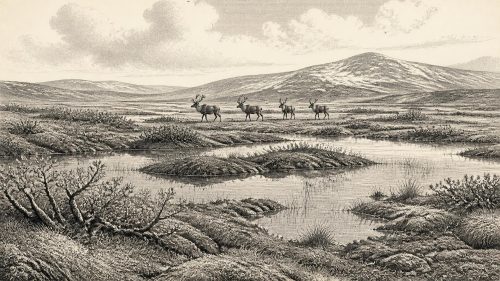
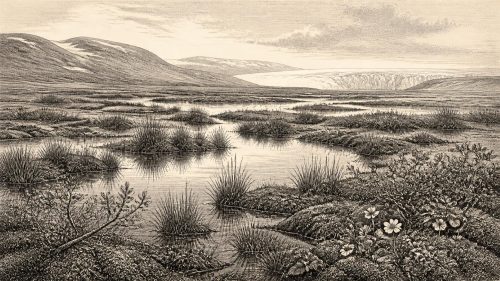
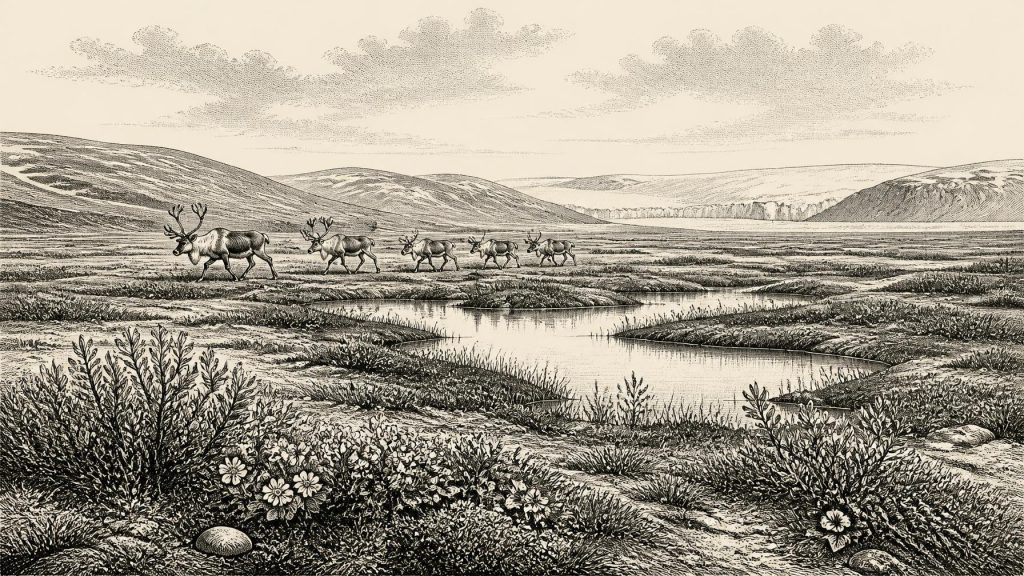
The Derryvree deposit gives an unusually vivid, if local, glimpse of this world. Plant remains and pollen indicate a treeless, cold-climate freshwater and muskeg landscape rather than forest. Sedges, mosses and aquatic plants occupied shallow water and wet margins; dwarf willow, mountain-avens and other arctic-alpine or tundra elements point to exposed ground beyond the pools. Bogbean and water-milfoil are especially useful reminders that cold does not mean lifeless. Where meltwater, springs or shallow basins persisted during the growing season, vegetation could be varied and productive on a small scale.
This was not a green Ireland of oak woods and enclosed fields. Trees were absent or extremely scarce in the documented Fermanagh setting, and the ground would have been vulnerable to frost action, seasonal waterlogging and wind. Yet neither should it be imagined as an unbroken white desert. Open herb-rich tundra, damp sedge ground, mossy pools, bare mineral surfaces and low scrub could form a mosaic. The precise distribution of those habitats across the island in 30,396 BCE is unknown. Derryvree is a site archive, not a map of every Irish valley, but it demonstrates that parts of the country supported freshwater ecosystems before being overridden and sealed by later ice.
Glacial geology adds the longer environmental frame. The most extensive phase of the last British–Irish Ice Sheet came later, with major advances and maximum configurations broadly falling between about 30,000 and 20,000 calibrated years BP, varying by sector. Around the article’s notional date, Ireland was approaching that severe phase, not necessarily uniformly ice-covered. Ice growth, glacier movement, permafrost and changing sea level reshaped routes through the region and repeatedly erased or buried older surfaces. This destructive history helps explain why evidence for both animals and people is so sparse.
Castlepook and the Faunal Record
The richest directly relevant animal archive is Castlepook Cave, also called Mammoth Cave, near Doneraile in north County Cork. Antiquarian excavations there recovered a remarkable collection of Pleistocene bones, later supplemented by modern re-examination and limited excavation. Re-dating has shown that some older measurements underestimated the true age of the material because of earlier radiocarbon methods and pretreatment. The cave therefore matters not merely as a fossil store, but as a warning that the chronology of Ireland’s deep past is continually being refined.
Research on the Castlepook assemblage has established that Ireland supported a substantially richer mammal fauna during Marine Isotope Stage 3 than during later historical times. The wider record includes reindeer, woolly mammoth, giant deer, brown bear, wolf, hare, fox, lemmings and spotted hyaena. These remains do not prove that all species lived together at the same moment, or that each belonged precisely to 30,396 BCE. Cave bone collections commonly combine material accumulated over long periods through carnivore activity, natural death, water movement and excavation disturbance. Nonetheless, they demonstrate that Ireland lay within a wider cold-stage ecosystem whose animals could cross the then-lower seascape or move through connected land corridors.
Spotted hyaena is particularly revealing. Its presence at Castlepook indicates not an African-style savannah but a capable large scavenger and predator operating in a Pleistocene food web. Hyaenas may have carried bones into caves; bears, wolves and other carnivores also altered carcasses. Consequently, the cave cannot automatically be treated as a hunting camp or a record of ordinary human meals. Reindeer, meanwhile, were well suited to cold, open terrain and are among the clearest signs of the broader northern environment in which this Irish fauna existed.
The Marked Reindeer Bone
Castlepook has gained exceptional importance through a reindeer femur bearing a deep linear incision, publicly presented as a possible stone-tool cut mark made while the bone was fresh. The bone has been reported as about 33,000 years old in radiocarbon terms and has been popularly expressed as approximately 31,000 BC. If the modification is confirmed as anthropogenic and securely associated with the bone’s age, it would be remarkable evidence that a person handled and perhaps butchered a reindeer in Ireland long before the better-attested terminal Pleistocene evidence.
That conditional wording matters. A radiocarbon result dates the animal’s death, not necessarily the moment a surface mark was made. Identifying a mark as a stone-tool cut also requires specialist microscopic and taphonomic analysis, because trampling, carnivore damage, sediment abrasion and excavation can leave misleading traces. Nor can one modified bone establish a settlement, a named population, a permanent colony, or even a successful hunt. It may represent a short visit, the processing of a scavenged carcass, or an episode whose wider context is lost.
For these reasons, the reindeer femur should be treated as important proposed evidence rather than licence to populate Ireland with an imagined Palaeolithic society. The National Museum of Ireland’s general account has continued to stress the absence of unequivocal evidence for Palaeolithic human presence on the island. The tension is productive rather than contradictory: Castlepook poses a serious research question, while the wider archaeological record remains too thin to answer it conclusively.
People, Society and the Limits of History
If people did reach Ireland in this broad period, they were almost certainly highly mobile hunter-gatherers moving through a larger European world, not inhabitants of villages, farms or states. No houses, hearths, burials, worked-stone assemblages or repeated occupation surfaces securely attributable to around 30,396 BCE have been recovered in Ireland. There is therefore no evidence for local political authority, formal warfare, diplomacy, territorial boundaries, trade institutions, organised religion or a distinct Irish cultural tradition at this date.
That absence is evidence in itself. It means that claims about clans, language, ethnicity, ritual or social rank would be invention. A temporary group could have used hides, wood, bone, plant fibre and perishable equipment that have not survived, but archaeology cannot responsibly turn that possibility into fact. Similarly, the exposed shelf and lower sea level made movement more feasible than in later millennia, yet no documented route, crossing or exchange network can be identified for this particular time.
Everyday life, should an occasional human presence be confirmed, would have been constrained by seasonal light, cold, animal movement and access to sheltered terrain, fuel and fresh water. Reindeer and other large mammals offered meat, fat, hides, sinew and bone, but their presence also attracted formidable competitors and scavengers. In that sense, ecology was the closest thing to politics: survival depended upon mobility, knowledge of terrain and the shifting availability of animals and plants.
An Island Not Yet Made
The enduring development around 30,396 BCE was environmental instability. Ireland had not yet acquired the permanent island geography, settled human history or cultural landscapes with which it is usually associated. Its caves and buried sediments preserve brief, uneven glimpses of wetlands, tundra vegetation and large mammals in a landscape increasingly vulnerable to glaciation. Later ice would both transform that terrain and destroy much of the evidence needed to narrate it.
For this reason, the year is best understood through a careful distinction between evidence and interpretation. Evidence shows a cold, treeless Irish environment in some localities, a diverse Pleistocene fauna, lower seas, and climatic movement towards the major glaciation to come. Interpretation suggests that intermittent human visits may be represented by the Castlepook reindeer femur. What cannot be recovered is a year-specific event. The historical value of this remote date lies instead in recognising how much of Ireland’s earliest story survives not in chronicles, but in a wetland silt beneath a drumlin and a single marked bone from a Cork cave.
Primary Sources
- A reconsideration of the radiocarbon dating of the Marine Isotope Stage 3 fauna from southern Ireland
- A Middle Midlandian Freshwater Series at Derryvree, Maguiresbridge, County Fermanagh, Northern Ireland
- The Irish Quaternary Fauna Project
- Growth and retreat of the last British–Irish Ice Sheet, 31 000 to 15 000 years ago: the BRITICE-CHRONO reconstruction
- Pattern and timing of retreat of the last British-Irish Ice Sheet
- Deglacial rates and controls for the western margin of the British-Irish Ice Sheet
- Character of advance and retreat of the southwest sector of the British-Irish Ice Sheet
- Trimlines, blockfields and the vertical extent of the last ice sheet in southern Ireland
- The IntCal20 Northern Hemisphere Radiocarbon Age Calibration Curve (0–55 cal kBP)
- The Greenland Ice Core Chronology 2005, 15–42 ka. Part 1: constructing the time scale
- A 60 000 year Greenland stratigraphic ice core chronology
- A stratigraphic framework for abrupt climatic changes during the Last Glacial period based on three synchronized Greenland ice-core records
- Prehistoric Details: Stone Age Collections
- Heritage Artefacts of County Cork 2021
- Castlepook Cave, County Cork, 2022 excavation report
- New insights on the fauna of Ireland's Younger Dryas and Early Holocene from Alice & Gwendoline Cave
- First evidence of a Late Upper Palaeolithic human presence in Ireland
- Irish Quaternary Association Field Guide 16: Fermanagh
- The subdivision of the Quaternary Period in Ireland
- A critical review and re-investigation of the Pleistocene deposits of the Irish Midlands
- The colonization of Ireland: A human ecology perspective
- Filling in the spaces in Irish prehistory