BIRM-166 Organic Mud30388 BCE
30,388 BCE is an approximate modern label for a climatically unstable Marine Isotope Stage 3 interval, not a datable Irish event. At Derryvree, County Fermanagh, organic mud between glacial tills records an ice-free freshwater wetland, later overridden by ice. Its plants and insects indicate treeless, cold, varied habitats shaped by severe periglacial conditions. Growing British–Irish ice remained regionally dynamic, while later glaciation destroyed much evidence. Castlepook Cave’s mixed fauna demonstrates ecological connectivity, and a possibly cut-marked reindeer bone suggests, but cannot prove, fleeting human presence. No settlement or society is established. The record reveals environmental change, cold-adapted animals, and uncertainty.
Dateline
30,388 BCE is a modern calendar label, not a date that can be matched to an event in prehistoric Ireland. No written record, indigenous calendar, settlement sequence or radiocarbon result can resolve conditions on the island to that individual year. In archaeological terms, it falls roughly 32,338 calibrated years before AD 1950, in the later part of the Pleistocene and broadly within Marine Isotope Stage 3: a long, climatically unstable phase before the Last Glacial Maximum. The responsible history of Ireland at this point is therefore one of deposits, animal remains, changing ice and cautious probability rather than rulers, wars or named communities.
A Date Within Ranges
Calendar conversion should not create a false impression of precision. A radiocarbon age is measured in radiocarbon years before present, where “present” conventionally means AD 1950; it must then be calibrated against changing levels of atmospheric carbon-14. For a date as remote as this one, calibration produces broad ranges rather than a single calendar year. The exact relationship between 30,388 BCE and any Irish deposit is consequently approximate.
The closest important environmental record is Derryvree, near Maguiresbridge in County Fermanagh. Roadworks there exposed freshwater sands, silts and organic mud between two layers of glacial till: the unsorted debris deposited by glacier ice. Organic material from the intervening bed, laboratory sample BIRM-166, returned a conventional age of 30,500 radiocarbon years BP, with an uncertainty of more than a thousand years. Recent syntheses treat the old measurement cautiously, yet it remains significant. Its broad calibrated age range encompasses part of the later Middle Midlandian period and overlaps the general time represented by 30,388 BCE.
The order of the layers is firmer than an exact date. Ice had previously crossed the Derryvree locality and laid down the lower till. Afterwards, freshwater and wetland sediments accumulated in an ice-free hollow. Later glacial activity covered the deposit with another till. This is direct evidence for environmental change at one locality, not a picture of the entire island in one season. It does, however, rule out a simple notion that Ireland was continuously and uniformly buried beneath ice throughout the whole earlier part of the last glacial cycle.
Fermanagh’s Treeless Wetland
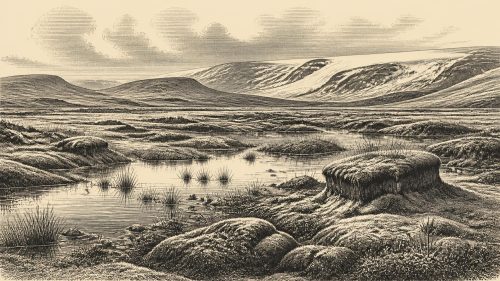
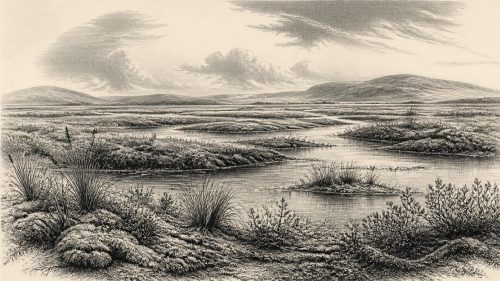
The Derryvree organic beds contain a distinctive cold-climate assemblage. Plant macrofossils and pollen have been interpreted as evidence for an open, treeless landscape, with wet ground, shallow freshwater and moss-rich vegetation. Records include sedges, bogbean or buckbean, water-milfoil, dwarf willow, mountain-avens and other plants now associated with northern, alpine or arctic-alpine settings. Insects and plant remains indicate that even harsh Pleistocene landscapes could contain varied microhabitats: pools, saturated margins, exposed mineral ground and patches of low vegetation.
That evidence should not be turned into a painted panorama of every Irish county. The plants grew at Derryvree during the accumulation of a local deposit, and their ecological requirements illuminate a particular catchment. Nevertheless, the assemblage strongly supports an interpretation of cold, largely unwooded country rather than forest. Summers may have permitted a short but productive growing season around water; winters and longer climatic downturns were severe. Periglacial processes such as frost action, seasonal thaw, unstable ground and sparse cover probably shaped much exposed terrain.
Ireland’s position at the north-western edge of Europe made it sensitive to abrupt North Atlantic climatic shifts. Greenland ice-core records show that this was not one unchanging “Ice Age”. The date lies close to a period conventionally termed Greenland Interstadial 5.1, a brief warmer oscillation within a larger sequence of cold stadials and milder interstadials. Such correlations provide a regional climatic framework, but they do not prove that a temperature change registered in Greenland occurred in exactly the same form, year or decade at Derryvree. Local ice, topography, water and vegetation all affected how climate was expressed in Ireland.
Growing Ice, Changing Ground
The great British–Irish Ice Sheet had not yet reached the maximum extent for which it is best known. Its fullest late-glacial development was still thousands of years away, with maximum ice volume reconstructed at about 23,000 years ago and with different sectors advancing and retreating at different times. Yet the ice sheet was growing and its margins were dynamic. Upland ice centres, coastal glaciers and marine outlets did not necessarily behave together. One region could preserve an open-water or wetland interval while another experienced glacier advance, and later ice often scoured away the deposits that might have clarified the sequence.
This destruction is central to the difficulty of writing Ireland’s history at 30,388 BCE. Later glaciation reworked sediments, remodelled valleys and plains, and sealed or removed many older land surfaces. The survival of Derryvree beneath till is therefore exceptional. Its value lies not in delivering an annual chronicle, but in preserving a stratified environmental interval that would otherwise have vanished. At this time, coastlines also differed greatly from those of modern Ireland because so much water was locked in global ice sheets. Lower sea level altered the extent of the Irish Sea basin and the distances between lands, although the precise availability of particular crossing routes at any moment remains unsettled.
Castlepook and the Reindeer Question
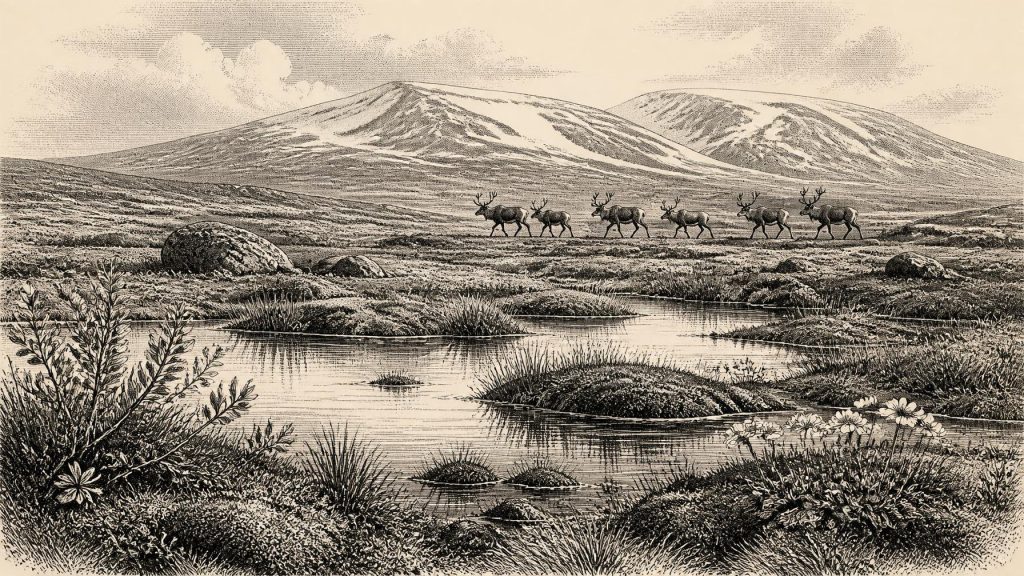
Farther south, Castlepook Cave near Doneraile in County Cork—historically called Mammoth Cave—offers the most provocative evidence relevant to human activity. Excavations begun by Richard J. Ussher in the early twentieth century produced a rich collection of Pleistocene animal bones. The assemblage includes animals appropriate to varying phases of the Ice Age, including reindeer, woolly mammoth, spotted hyaena, brown bear, fox, hare and lemming. It demonstrates that Ireland was not biologically empty during broad intervals before the Last Glacial Maximum.
A reindeer femur from the Castlepook collection has particular importance. Zooarchaeologist Ruth Carden identified a deep linear mark interpreted as damage made by a sharp stone tool during the processing of a carcass. Public heritage material has associated the bone broadly with about 31,000 BC, while the wider scientific question concerns a Late Pleistocene age of roughly 33,000 years ago. If the mark is correctly identified as a cut mark, and if it belongs to the same broad phase as the bone, it would constitute remarkable evidence that a person handled a reindeer in Ireland long before the better-established terminal-Pleistocene evidence.
But the limits of that claim matter as much as its excitement. Castlepook’s older collections were obtained before modern excavation standards, and cave bones can be moved, reworked or affected by carnivores, sediment and excavation. The date records the animal’s death, not necessarily the instant of the mark. One modified bone does not demonstrate a permanent settlement, a named Upper Palaeolithic culture, a camp, a hearth, a boat crossing, a family group or continuous occupation. Nor has a securely dated stone-tool assemblage, dwelling, burial or occupation floor of this age been established in Ireland.
Recent research and test excavation at Castlepook have sought undisturbed deposits and improved chronological control. This work is important precisely because new methods have revised earlier radiocarbon results: re-dating of southern Irish fauna using improved pretreatment produced some ages thousands of radiocarbon years older than previous determinations. The lesson is methodological as well as historical. Ireland’s Ice Age record is real and increasingly informative, but old collections and legacy dates must be tested rather than simply repeated.
People Without a Proven Society
There is no responsible basis for describing political affairs, diplomacy, organised warfare, religion, formal learning or a settled economy in Ireland at this date. There were no Irish states, kingdoms, towns, farming communities, written traditions or monuments known from this period. If people were present, the Castlepook evidence suggests at most a fleeting encounter with an animal carcass, not an identifiable society. Any visitors would have belonged to highly mobile hunter-gatherer worlds known elsewhere in Upper Palaeolithic Europe, where knowledge of seasonal animal movement, stone-working and survival in severe climates was vital. Applying that wider comparison to Ireland remains interpretation, not direct Irish proof.
Nor can trade be demonstrated. Animals and perhaps people reached Ireland during parts of the Pleistocene, but their routes are unresolved. Lower sea levels may have narrowed sea crossings or exposed land in the Irish Sea region; seasonal sea ice, watercraft or combinations of routes have also been considered in broader discussions of animal dispersal. The faunal record proves arrival, not the exact mechanism. Reindeer and other cold-adapted animals may have ranged through suitable open landscapes, while carnivores and scavengers accumulated bones in caves. Mammoth and hyaena remains speak to ecological connectivity with wider north-west European faunas, not to a permanent human population.
An Island in Evidence, Not Myth
The most important development around 30,388 BCE was environmental instability. Ireland contained, at least in some regions and intervals, ice-free ground capable of supporting freshwater wetlands and cold-adapted plants and animals. At the same time, glacier expansion was transforming the island and would later erase much of the evidence. Derryvree preserves the local sequence of ice, wetland and renewed ice; Castlepook preserves a long, mixed faunal archive and a tantalising possible trace of human butchery.
That is a more compelling history than an invented annual event. It shows an Ireland at the threshold of major glacial growth: treeless in places, ecologically patchy, inhabited by animals adapted to cold and potentially visited by people whose presence remains difficult to prove. The surviving record is fragmentary, but it is sufficiently rich to establish both the dynamism of the Pleistocene landscape and the need for restraint when turning deep time into history.
Primary Sources
- A reconsideration of the radiocarbon dating of the Marine Isotope Stage 3 fauna from southern Ireland
- Growth and retreat of the last British–Irish Ice Sheet, 31 000 to 15 000 years ago: the BRITICE-CHRONO reconstruction
- A stratigraphic framework for abrupt climatic changes during the Last Glacial period based on three synchronized Greenland ice-core records: refining and extending the INTIMATE event stratigraphy
- The Irish Quaternary Fauna Project
- The Irish Quaternary Fauna Project
- New insights on the fauna of Ireland's Younger Dryas and Early Holocene from Alice & Gwendoline Cave
- Phylogeographic, ancient DNA, fossil and morphometric analyses reveal ancient and modern introductions of a large mammal: the complex case of red deer (Cervus elaphus) in Ireland
- Heritage Artefacts of County Cork
- 2022:564 – Castlepook Cave, Castlepook South, Cork
- Ireland's Palaeolithic Archaeology – Fleeting Footprints in a Frozen Land
- Pleistocene glaciations in Ireland
- Figure 6—The subdivision of the Quaternary Period in Ireland
- Exploring controls of the early and stepped deglaciation on the western margin of the British-Irish Ice Sheet
- Britain and Ireland: glacial landforms from the Last Glacial Maximum
- Character of advance and retreat of the southwest sector of the British-Irish Ice Sheet during the last glaciation
- Pattern and timing of retreat of the last British-Irish Ice Sheet
- Pattern, style and timing of British–Irish Ice Sheet advance and retreat over the last 45 000 years: evidence from NW Scotland and the adjacent continental shelf
- Trimlines, blockfields and the vertical extent of the last ice sheet in southern Ireland
- Ireland Under the Ice
- The Mesolithic in Ireland: when was it?