Membership is completely free, giving members unlimited access to all available resources, services, features, and benefits without any restrictions or fees.
Welcome back. Sign in to continue enjoying unlimited access to all available resources, services, features, and member benefits at no cost.
The most important campaigning of the year centred on Limerick and the rival powers of Munster. An Anglo-Norman force led by Raymond le Gros had captured the city in 1175. This was a daring advance far beyond the more securely occupied districts of Leinster and the south-eastern ports. Limerick commanded a crossing of the Shannon and access to the rich lands and waterways of Thomond. Its possession threatened Domnall Mór Ua Briain, king of Thomond, and offered the invaders a base from which to intervene throughout Munster.
Ruaidrí Ua Conchobair remained king of Connacht and Ireland’s leading Gaelic overking. Henry II nevertheless claimed an overriding authority that Ruaidrí had neither accepted in a lasting settlement nor decisively defeated. The political map therefore contained overlapping claims. Irish kings continued to expect tribute, hostages and military service from lesser rulers, while Henry’s followers divided territories into lordships supposedly held from the English crown. Local communities might encounter both systems, each backed by armed force but neither uniformly effective.
Ruaidrí began the year in a strong position across the western half of the island. The Annals of the Four Masters record that he took hostages from Toirdelbach Ua Briain of Thomond. Hostages were normally important relatives or dependants of a ruler, delivered as guarantees of obedience. Taking them demonstrated political superiority, although that superiority lasted only while it could be enforced.
The most consequential firmly dated development was the assassination of Donnchad Ua Máel Sechlainn, king of Meath. The Annals of Ulster and Annals of Tigernach describe his death as treacherous, naming Murchad Ua Finnalláin, ruler of Delbna Mór, and his son as the killers. The later Annals of the Four Masters adds that old grievances and Donnchad’s own actions lay behind the attack. This judgement reflects his deeply troubled recent career. In 1157 he had violated a guarantee upheld by leading churchmen and kings, after which an ecclesiastical assembly excommunicated him and removed him from power. Mac Lochlainn nevertheless restored him, making Donnchad dependent upon northern support.
The principal annals do not arrange every episode in exactly the same way. The Annals of Tigernach place the partition of Munster and the first expulsion of Toirdelbach Ua Briain under 1152, while the Annals of the Four Masters group these developments with the campaigning of 1153. Mac Carthaigh’s Book also assigns the alliance against Ua Briain to 1153. The great northern intervention and the defeat of Ruaidrí Ua Conchobair at Fordruim are firmly recorded under 1153 by both Tigernach and the Four Masters, but no precise day can responsibly be supplied.
Tairdelbach Ua Conchobair, king of Connacht, remained the leading claimant to the high-kingship. Medieval sources and modern historians properly qualify his position as king of Ireland “with opposition”. He exercised formidable influence across Connacht and the midlands, but did not command an undisputed national monarchy. Authority depended on expeditions, alliances, hostages and the recognition of lesser kings, all of which could change rapidly.
Tairdelbach Ua Conchobair remained king of Connacht and the leading claimant to the high-kingship, which Irish sources qualified as kingship “with opposition”. His authority rested upon military organisation, alliances, fortifications and sustained intervention in neighbouring kingdoms. Yet by 1147 his supremacy faced a newly dangerous challenge. Muirchertach Mac Lochlainn, king of Cenél nEógain, had secured his position in the north and was beginning the expansion that would eventually make him Ua Conchobair’s principal rival.
Tairdelbach Ua Conchobair had made Connacht a power of island-wide importance. He maintained fleets, fortified strategic sites and placed members of his family in contested kingdoms. Nevertheless, the title sometimes accorded him by the annalists—king of Ireland—should not be mistaken for undisputed government of the whole island. His was a high-kingship with opposition, exercised through military pressure and personal agreements rather than a permanent central administration.
Tairdelbach Ua Conchobair, king of Connacht and the leading claimant to the high-kingship of Ireland, remained the island’s most powerful ruler. His authority, however, was not that of a centralised monarch. It depended upon alliances, hostages, military expeditions and the management of subordinate kings. In 1136 the greatest immediate threats to his position came from within his own extended family.
The precise sequence of the campaigns against Connacht is difficult to reconstruct because the surviving annals do not always assign related events to the same year. The Annals of the Four Masters place one great southern invasion under 1133, while Mac Carthaigh’s Book and modern biographical scholarship connect a major phase of the offensive with 1134. What is clear is that Cormac Mac Carthaig, king of Desmond and an aspirant to wider authority in Munster, had become the central figure in resistance to Tairdelbach Ua Conchobair.
The dominant political figure was Tairdelbach Ua Conchobair, king of Connacht and the strongest claimant to the high-kingship. The death of Domnall Ua Lochlainn in 1121 had removed his most formidable northern rival, but Ireland was not a centralised kingdom. Tairdelbach’s authority depended on repeated demonstrations of force, negotiated submissions, hostages and alliances with regional rulers. When annalists called him king of Ireland, they expressed a claim to supremacy, not undisputed administrative control over the island.
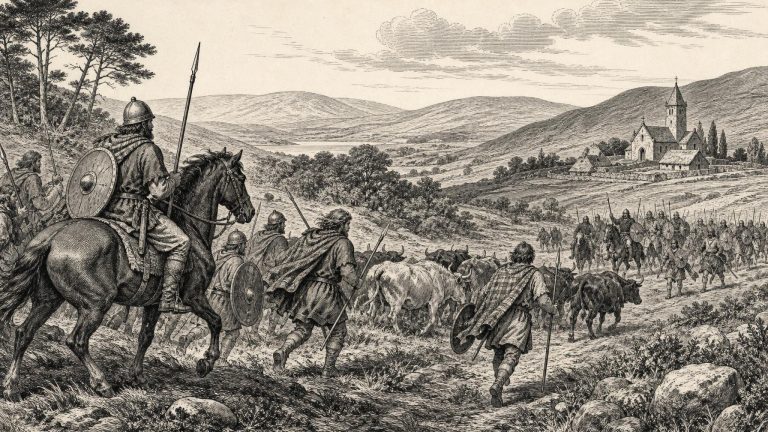
The most substantial campaign recorded for 1117 began with an incursion by Diarmait Ua Briain and the Munstermen into Connacht. The Annals of Tigernach name Tír Fhiachrach and Tír Briain among the districts ravaged. Such an expedition was intended not simply to destroy. Armies seized cattle, provisions and captives, damaged a rival’s standing and demonstrated that its ruler could not protect dependent communities. It continued the war between Connacht and Munster that had intensified as Muirchertach Ua Briain’s authority declined.
No single ruler governed Ireland as a unified state. Muirchertach Ua Briain, great-grandson of Brian Bóruma, possessed extensive influence in Munster and over several southern and central kingdoms. Domnall Ua Lochlainn, king of Ailech and leader of Cenél nÉogain, dominated much of the north. Each could assemble coalitions, demand hostages and claim a standing approaching the kingship of Ireland, but neither could compel permanent obedience throughout the island. The language of high-kingship therefore requires care: contemporary authority depended less upon a fixed national office than upon military reach, alliances, tribute and recognition by lesser rulers.
The immediate background was Muirchertach’s spectacular northern campaign of 1101. He had led forces drawn from much of southern and central Ireland into Inishowen, demolished the royal stronghold of Aileach and carried its stones away in symbolic retaliation for an earlier attack on the Ua Briain centre at Kincora. Yet this display had not destroyed Domnall Ua Lochlainn’s power. Indeed, the northern king remained firmly established among the Cenél nÉogain, with alliances and dependants extending into Ulaid, Airgialla and the midlands.
No king exercised undisputed authority over the whole island. Muirchertach Ua Briain, king of Munster and the most ambitious southern ruler, possessed influence in Leinster, Dublin and parts of the midlands. His principal rival was Domnall Ua Lochlainn, king of Ailech and leader of Cenél nEógain. Both could claim a wider standing through military strength, alliances, hostages and church patronage, but neither could reliably command the other.
In 1069 the most formidable ruler in southern and eastern Ireland was Diarmait mac Maíl na mBó. From his Uí Chennselaig base in south-eastern Leinster, Diarmait had accumulated an extensive overkingship embracing Leinster, Dublin and influence far beyond either. He was not an uncontested king of a unified Ireland. Power remained distributed among provincial kings, local dynasties, ecclesiastical families and Hiberno-Norse towns. Nevertheless, his ability to deploy both Leinster warriors and troops from Dublin made him one of the island’s dominant figures.
The events are preserved principally in the Irish annals, including the Annals of Ulster, Annals of Tigernach, Annals of Inisfallen and the later Annals of the Four Masters. They agree on the broad sequence but differ in names, emphasis and detail. The Annals of Inisfallen, written from a Munster perspective, present the campaign as a devastating assault on Connacht from several directions. The Annals of Tigernach provide the fullest description of the opposing armies and lavish praise upon the fallen Connacht king. Such language preserves political memory rather than neutral reporting. Exact days are not supplied, and places such as Turloch Adhnach and Turloch Sampaite cannot be identified with complete confidence. What can responsibly be said is that the campaign and Áed’s death were placed in 1067 by independent annalistic traditions.
No ruler exercised uncontested authority throughout Ireland. Donnchad mac Briain, son of Brian Bórama, remained king of Munster, but his position was deteriorating. Diarmait mac Maíl na mBó dominated Leinster and Dublin, while Áed Ua Conchobair, known as Áed in Gai Bernaig, ruled Connacht. Tairdelbach Ua Briain, Donnchad’s ambitious nephew and Diarmait’s protégé, offered an alternative focus for Dál Cais allegiance.
Donnchad mac Briain, son of Brian Bóruma and king of Munster, entered the year in a weakened position. His long authority had been battered in 1058, when Diarmait mac Maíl na mBó of Leinster and Donnchad’s rebellious nephew, Toirdelbach Ua Briain, invaded Munster. Limerick was burned and Donnchad was defeated at Sliab Crot. This recent disaster is essential context for understanding the political development recorded in 1060.
The change of ruler at Dublin marked the end of an era. The Annals of Tigernach state that Sitriuc son of Amlaíb went overseas from his kingship and that Echmarcach entered it. Sitriuc, better known as Sitriuc Silkbeard, had ruled Dublin through much of the turbulent period surrounding the Battle of Clontarf. He had survived repeated defeats, temporary expulsions and shifting relationships with the kings of Leinster, Tara and Munster. By the time of his departure he was elderly by the standards of medieval rulers and had occupied an important place in Irish Sea politics for several decades.
The Irish chronicles open 1025 with their usual calendrical precision: the Kalends of January fell on a Friday. That technical note matters because annalists were not writing modern narrative history. They arranged brief notices under years, sometimes preserving exact days, more often recording deaths, battles and ecclesiastical successions without fuller explanation. For 1025 the principal witnesses—the Annals of Ulster, Tigernach, Inisfallen, Loch Cé, the Four Masters and Chronicon Scotorum—agree on the broad outline, though not always on wording or emphasis.
The year opened with close calendrical attention. The Annals of Ulster place the Kalends of January on the third feria and note two eclipses in the same lunar month: a lunar eclipse on 10 January and a solar eclipse on 24 January. Chronicon Scotorum compresses the matter into a vivid report of an eclipse of the sun at midday and an eclipse of the moon in the same month, while the Annals of Inisfallen remember the solar event as “the spring of the black cloud”. Such notices should not be treated as omens automatically believed by everyone in Ireland, but they do show the observational and chronological habits of monastic record-keepers. Eclipses helped annalists anchor time, and their inclusion reminds us that Irish monasteries were intellectual communities as well as religious and economic institutions.
The political background to the year was the partial restoration of Máel Sechnaill. Brian Bórama’s rise had interrupted the older Uí Néill claim to overarching authority, and Brian’s death at Clontarf did not create a united kingdom. Instead, it reopened competition. Máel Sechnaill’s own power rested most firmly in Mide, but the annals still treat his campaigns and officers as matters of national importance. The killing in 1018 of Cais Mide, described in the Annals of Ulster as Máel Sechnaill’s steward, is therefore more than a local casualty. It shows the practical machinery of kingship: rulers depended on lawmen, stewards, raiding parties and client kings, not merely on titles.
The most active named king in the year’s record is Máel Sechnaill mac Domnaill, king of Mide and claimant to the kingship of Ireland. In 1017 the annals credit him with inflicting a slaughter on the “foreigners” and the Laigin at or near Odhba. “Foreigners” in these entries normally means the Hiberno-Scandinavian population and forces of towns such as Dublin, while the Laigin were the men of Leinster. The notice is short, but politically suggestive: Máel Sechnaill was still campaigning against the Dublin-Leinster alignment that had been central to the struggle culminating at Clontarf.
The most unstable region in the record for 1007 is Ulaid, roughly north-eastern Ireland. The annals name a grim succession of deaths. Máel Ruanaid son of Ardgar, styled king of Ulaid in Chronicon Scotorum and killed by Matudán son of Domnall, appears first. Matudán himself was then killed by a figure called “the Torc” in the middle of Dún dá Lethglas, modern Downpatrick, in Brigit’s church. The annalists stress the sacred setting and, in one version, say that this happened despite the protection of the saints of Ireland. Later notices add that the Torc, also called king of Ulaid, was killed by Muiredach son of Matudán in revenge for his father, and that Domnall son of Dub Tuinne, another king of Ulaid, was killed by Muiredach son of Matudán and Uargaeth of Sliab Fuait.
The most important political fact was Brian’s relationship with Máel Sechnaill. The former high-king did not disappear from public life; he remained king of Mide and was still a necessary partner in campaigns beyond Munster. The Annals of the Four Masters place in this year a joint expedition by Brian and Máel Sechnaill into north Connacht, as far as Tráig Eothail, with an apparent intention of making a circuit of Ireland. The same notice says that the Northern Uí Néill prevented their advance. Whether every detail belongs to the calendar year exactly as later compiled, the notice captures the unfinished nature of Brian’s overlordship. Connacht, Mide, Leinster and Dublin could be compelled or negotiated into submission, but Ailech and the northern dynasties were not yet simply at Brian’s command.
Ireland entered 1000 in the aftermath of a major military upheaval. The Annals of Ulster explicitly recognised the year as the thousandth since the Incarnation and the 568th since the traditional coming of St Patrick. The Annals of Inisfallen identified it as a leap year and placed the Kalends of January on a Monday. Such notices show scholarly interest in computus—the calculation of calendars, feast days and historical eras—but provide no evidence that Irish communities greeted the millennium with widespread fear or expectation of the world's end.