
Fire and Retribution1069 CE
Annals for 1069 record fires, deaths and warfare, while offering only a partial view of Irish society. Diarmait mac Maíl na mBó dominated Leinster and Dublin, where his son Murchad commanded combined forces. Murchad invaded Mide, burning Granard, Fore and Ardbraccan, but suffered severe losses interpreted as saintly vengeance; he died in Dublin in 1070. Fires also damaged Downpatrick, Ardstraw, Lusk and Swords. Clerical and regional rulers died or were killed. Accounts of broken oaths stressed sacred sanctions. Behind annalistic moral judgement lay competing dynasties, vulnerable wealthy churches, rural economies, and Hiberno-Norse Dublin’s commercial, maritime and political power in Ireland.
Dateline
The surviving record of 1069 is unusually vivid but uneven. Irish annalists noted deaths among clergy and regional rulers, destructive fires at four important ecclesiastical settlements, and a Leinster–Dublin offensive into Mide that became remembered as an act of sacrilege followed by supernatural punishment. These entries offer genuine evidence for the year, yet they do not amount to a complete national chronicle. Much of ordinary political negotiation, farming, trade and family life went unrecorded because annalists concentrated on rulers, churches and events regarded as morally significant.
A Powerful Leinster–Dublin Realm
In 1069 the most formidable ruler in southern and eastern Ireland was Diarmait mac Maíl na mBó. From his Uí Chennselaig base in south-eastern Leinster, Diarmait had accumulated an extensive overkingship embracing Leinster, Dublin and influence far beyond either. He was not an uncontested king of a unified Ireland. Power remained distributed among provincial kings, local dynasties, ecclesiastical families and Hiberno-Norse towns. Nevertheless, his ability to deploy both Leinster warriors and troops from Dublin made him one of the island’s dominant figures.
Diarmait’s son Murchad was central to this political system. By the later 1050s he was governing Dublin under his father and was described as lord or king of its inhabitants, whom Gaelic annalists continued to call the Gaill, or foreigners. The term did not mean that Dublin remained a detached Scandinavian colony. By the eleventh century it was a Hiberno-Norse town whose population, material culture and ruling elite were deeply involved in Irish politics. Murchad acted as both a dynastic lieutenant and a ruler in his own right, commanding combined Dublin and Leinster forces.
The principal obstacle immediately west of Leinster was Mide, ruled by Conchobar Ua Máelshechlainn. Control of its plains and routes mattered because Mide lay between Dublin, the Shannon and the northern half of Ireland. Its rulers also inherited the prestige of the Southern Uí Néill and of earlier kings associated with Tara. Raiding Mide could therefore obtain cattle, hostages and submission while weakening a politically important rival.
The Hosting into Mide
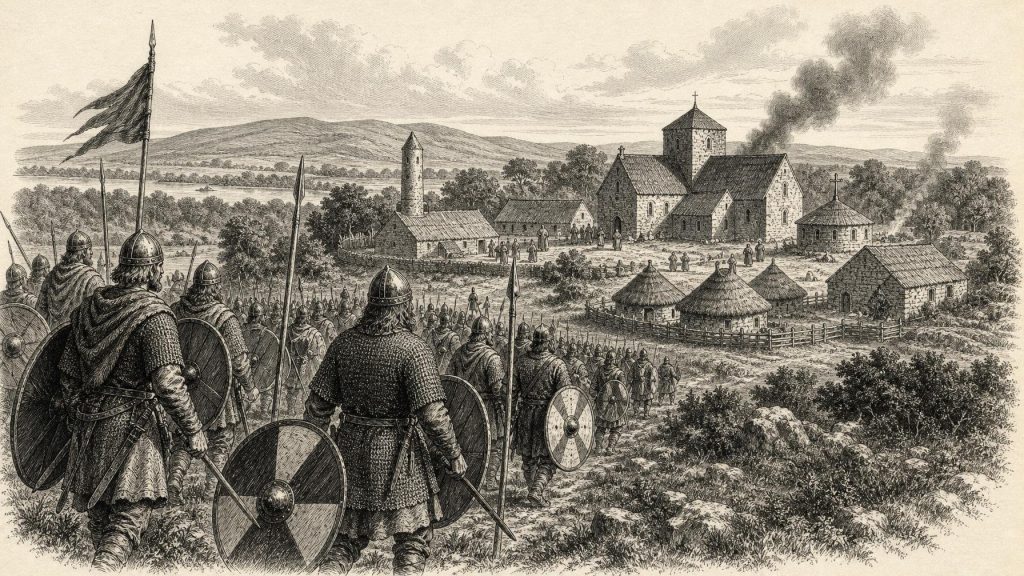
The year’s major military event was a hosting led by Murchad into Mide. The Annals of Tigernach, Chronicon Scotorum and the later Annals of the Four Masters place the expedition under 1069. They agree that his army burned Granard, Fore and Ardbraccan. These were not merely isolated farmsteads. Granard was an important centre in the north Midlands, while Fore was a celebrated foundation associated with St Fechín. Ardbraccan was likewise an established ecclesiastical site.
The attackers included Leinstermen and Dubliners. Their presence illustrates how a Gaelic overking could use the manpower and maritime wealth of a Hiberno-Norse town within a wider Irish war. It also warns against imagining a simple division between “Irish” and “Vikings”. Dublin’s soldiers served a Leinster dynasty, marched inland and participated in conflicts whose causes lay within the competitive politics of Irish kingship.
No surviving account gives a precise day, the size of the army or a dependable tactical narrative. Nor do the sources explain whether the churches were deliberately selected, whether troops sought stores and valuables there, or whether they were burned as part of a broader devastation of hostile territory. Ecclesiastical settlements could possess cattle, grain, precious metalwork, relics and dependent lands. They were also bound to ruling families and were consequently exposed to political violence despite the protection theoretically offered by sanctuary.
The expedition ended disastrously. Annalists wrote that Fechín killed Murchad “face to face” and that there was a slaughter of the foreigners and Leinstermen. The Four Masters instead refer to great destruction among them through various illnesses. These statements should not be read as evidence that the long-dead saint literally appeared as a warrior. They express the annalists’ conviction that violation of Fechín’s church brought divine or saintly vengeance. Disease may have spread through the returning force, and Murchad apparently survived for a time: several annals register his death at Dublin in 1070, not 1069. The firmly dated event is therefore the campaign and its attributed calamity; Murchad’s death belongs to the following annalistic year.
Churches in Flames
Separate annalistic traditions record that Downpatrick, Ardstraw, Lusk and Swords were destroyed or severely damaged by fire in 1069. These sites were spread across eastern and northern Ireland, so the entry does not establish a single connected disaster. The causes are not stated. Warfare, accidental fire and the close construction of timber buildings were all possible hazards, but assigning any particular cause would go beyond the evidence.
The list nevertheless shows the continuing importance and vulnerability of ecclesiastical settlements. Downpatrick was associated with Patrick and other major saints; Swords belonged to the Columban tradition; Lusk was an old religious centre north of Dublin; and Ardstraw served a significant community in the north-west. Such places were centres of worship and burial, but could also contain workshops, guest houses, schools, storehouses and the residences of clergy and dependants. A major fire consequently disrupted economic and social life as well as religious observance.
Several clerical deaths were also remembered. Cobthach, priest of Kildare, “rested in Christ”. The Four Masters praise him as a leading source of Leinster’s dignity, suggesting that his reputation reached beyond routine pastoral duties. Áed son of Dubgall, prior of Cluain Fiachna, died, as did Flannacán son of Áed, a deputy airchinnech or senior administrator at Armagh. The notices reveal a church governed through numerous offices rather than by monks alone. Priests, superiors, learned clergy and administrators managed extensive communities, properties and relationships with secular dynasties.
Regional Deaths and Violence
Political change continued below the level of the great overkings. Ua hÁeda, king of Uí Fhiachrach of Ardstraw, died during the year. His death may have required a local succession, although the annals do not describe its outcome. In the Midlands, Diarmait, a descendant of Gadhra Ua Dúnadaig and king of Síl Anmchada, was killed by Ua Madadáin according to the Annals of Tigernach. Chronicon Scotorum gives the less specific statement that he died, demonstrating why individual annalistic accounts must be compared rather than treated as perfectly identical records.
The Four Masters add several notices absent from the shorter contemporary-looking records. Mac Iairn son of Dubthach, lord of the Comanns, died, as did Gilla Mo Lua Ua Brúaideadha, lord of Ráth Tamhnaige. Fáelán the Blind Ua Mórda died at Aghaboe, an important ecclesiastical centre in Osraige. These obituaries map a landscape of many small kingdoms and lordships. Ireland’s politics operated through layered authority: a local king might acknowledge a stronger neighbour while retaining control over his own kindred, clients and territory.
Oaths, Relics and Justice
A particularly striking story appears in the seventeenth-century compilation of the Four Masters and should be treated more cautiously than entries shared by several earlier annals. It says that Gilla Máire son of Dub, chief of Uí Chremthannáin, and Mac Raith Ua Mórda swore a mutual oath upon a sacred object called the Caimmín. Despite this guarantee, Mac Raith killed Gilla Máire at the doorway of the oratory of Tech Mochua. Mac Raith was subsequently killed near Aghaboe while carrying the Caimmín, an outcome presented as vengeance by the saints Fintan, Mochua and Colmán.
Whether every detail can be assigned securely to 1069 is uncertain, but the account reflects authentic medieval assumptions about agreements and sanctuary. Relics, books or shrines could witness oaths, making the saints themselves guarantors of peace. Breaking such an oath was not simply dishonest; it endangered the moral order and invited divine punishment. The story resembles the interpretation of Murchad’s misfortune after the burning of Fore. In both cases, annalistic history turned political violence into a lesson about the power of sacred places.
Work, Wealth and Exchange
No annal records a harvest, market or craft innovation specifically for 1069. Broader archaeological evidence must therefore be clearly separated from the year’s dated events. Most people lived in dispersed farmsteads, often enclosed by ringforts, and worked within an economy dominated by cattle, dairying and mixed agriculture. Cows represented food, status and transferable wealth, which helps explain why cattle-raiding and territorial devastation were standard instruments of war. Grain, pigs, sheep, woodland products and fishing also supported households and religious communities.
Dublin offered a markedly urban environment of timber houses, property boundaries, workshops and busy waterfront activity. Craftspeople worked wood, leather, bone, antler and metals. Silver circulated through coins, ornaments and bullion, while imported pottery, soapstone and luxury objects testify to connections with Britain, Scandinavia and continental Europe. Ships carried merchants and goods, but also warriors and enslaved people. Murchad’s ability to lead Dublin troops into Mide rested partly upon this commercial and maritime base.
The artistic culture of the period similarly joined Irish and Scandinavian traditions. Eleventh-century metalwork adopted Ringerike and Urnes-style animal ornament while serving Christian purposes in shrines, croziers and reliquaries. Monastic communities preserved Latin and Irish learning, maintained genealogies and recorded deaths and disasters. The annals themselves are products of that literate world, though their terse entries preserve what churchmen considered memorable rather than a balanced survey of society.
A Year Remembered Morally
The surviving picture of 1069 is dominated by fire, death and violated sanctuaries. Its central political event was Murchad’s attack on Mide, an assertion of Leinster–Dublin power that brought devastation to Granard, Fore and Ardbraccan but also severe losses to the invaders. Alongside it, fires at four major churches and the deaths of clerical and regional leaders emphasised the fragility of institutions upon which communities depended.
For the annalists, these were not random misfortunes. Saints defended their foundations, oaths carried sacred force and rulers who attacked churches risked punishment. Behind that moral interpretation lies a recognisable historical landscape: competing dynasties, wealthy religious settlements, an internationally connected Dublin and a rural population sustaining both kings and churches through its labour.
Primary Sources
- The Annals of Ulster: Year U1069
- The Annals of Tigernach: Annal T1069
- Chronicon Scotorum: Annal CS1069
- Annals of the Four Masters: Annal M1069
- Annals of Inisfallen: Annal AI1069
- Annals of Loch Cé: Annal LC1069
- Diarmait (Diarmait mac Maíl na Mbó)
- Ua Máelshechlainn, Conchobar
- Ua Briain, Tairdelbach
- Donnchad Máel Na Mbó
- Cellach (Celsus)
- The Economy of Early Medieval Ireland
- Early Medieval Ireland, AD 400–1100: The Evidence from Archaeological Excavations
- Early Medieval Ireland: Archaeological Excavations, 1930–2009
- Viking Collections
- Early Medieval Collections
- Nine Unmissable Objects from Clontarf 1014
- Wooden Plank with Viking Ship and Weathervane Graffiti
- Fore Abbey
- Baile Fhobhair/Fore
- Ard Breacáin/Ardbraccan
- Ardagh Ringfort
- The Irish Church, 800–c.1050
- Monastic Identity in Early Medieval Ireland
- The Chronology and Sources of the Early Irish Annals
- Chronological Synchronisation of the Irish Annals