
A Year of Upheaval1061 CE
In 1061, Ireland lacked a supreme king and regional rivalries intensified. Connacht’s Áed Ua Conchobair raided Munster, destroying Kincora and damaging Killaloe, thereby exposing Donnchad mac Briain’s weakening authority. Áed was briefly displaced by the Ua Flaithbertaig of western Connacht, but defeated them and killed Ruaidrí. Elsewhere, battles, killings and deaths reshaped northern and eastern lordships, while Diarmait mac Maíl na mBó pressed Munster and projected power towards Man. Severe epidemic disease afflicted Leinster, and Glendalough was burned. Deaths of churchmen highlighted ecclesiastical institutions’ importance. Differing annal dates complicate chronology, but collectively portray fragile power, violence, hardship and political change.
Dateline
The surviving record of 1061 presents Ireland as a landscape of competing dynasties, vulnerable settlements and powerful churches. Its annalists concentrated on rulers, clerics, warfare, epidemic disease and destructive fires, leaving ordinary lives largely unrecorded. Their evidence is nevertheless unusually rich for this year. It reveals a major Connacht incursion into Munster, a dangerous rebellion within Connacht, deaths and killings among northern and eastern rulers, severe sickness in Leinster and the burning of Glendalough.
The annals were compiled and copied at different centres, and they do not always place events under the same year. Ruaidrí Ua Flaithbertaig’s death, for example, appears under 1061 in the Annals of Tigernach, Chronicon Scotorum and the later Annals of the Four Masters, but under 1062 in the Annals of Ulster. Murchad mac Diarmata’s expedition to Man is similarly assigned to 1061 by Tigernach and to 1060 by the Four Masters. Such differences warn against treating every annalistic heading as an exact modern calendar date.
Power Without a High King
No ruler exercised uncontested authority throughout Ireland. Donnchad mac Briain, son of Brian Bórama, remained king of Munster, but his position was deteriorating. Diarmait mac Maíl na mBó dominated Leinster and Dublin, while Áed Ua Conchobair, known as Áed in Gai Bernaig, ruled Connacht. Tairdelbach Ua Briain, Donnchad’s ambitious nephew and Diarmait’s protégé, offered an alternative focus for Dál Cais allegiance.
Donnchad had previously submitted to Áed, but he subsequently sought support from Diarmait. The changing alignment illustrates the practical character of eleventh-century diplomacy. Submission, tribute, fosterage, marriage connections and the exchange of hostages could establish relationships, but none necessarily produced permanent loyalty. Kings built authority through personal followings and negotiated alliances; when these failed, armies tested claims directly.
The Assault on Kincora
The year’s most striking campaign was Áed Ua Conchobair’s march into Munster. His forces reached Cell Dá Lua, modern Killaloe, and the nearby royal centre of Cenn Corad, or Kincora. This was the heartland of Dál Cais power beside the Shannon, closely associated with Brian Bórama and still central to the authority of Brian’s son Donnchad.
The sources differ in detail but agree on the scale and symbolism of the destruction. The Annals of Ulster say that Áed razed the fortress and stopped its well. Chronicon Scotorum adds that he burned Killaloe and that his men ate two salmon kept in the well before blocking it. The Annals of Tigernach refer to the destruction of a weir as well as the famous fish. These variants may reflect uncertainty about the structures at Cenn Corad, whose name means the “head of the weir”, but the basic message is clear: Áed deliberately attacked both a royal stronghold and its resources.
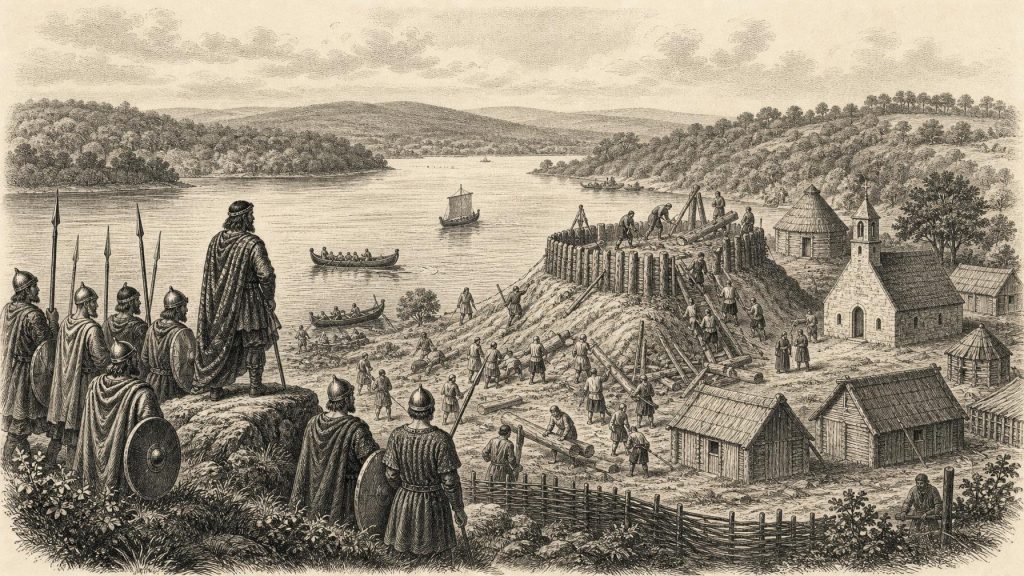
Kincora was not a stone castle of the later medieval kind. It was a fortified royal residence within a landscape of timber buildings, enclosures, roads, fields and river crossings. Killaloe combined this secular centre with an important church settlement associated with St Flannán. Burning the church buildings, dismantling the fortification and interfering with the water or fish supply publicly demonstrated Donnchad’s inability to protect the dynastic centre inherited from Brian.
The campaign also exploited geography. Killaloe stood where movement along the Shannon met an important crossing near the southern end of Lough Derg. Control there mattered for armies, tribute, livestock and communication between Connacht and Munster. Áed’s raid was therefore both a political humiliation and a blow against a strategic regional centre.
Rebellion in Connacht
Áed’s success abroad did not mean security at home. The Muintir Murchada, the kindred represented by the Ua Flaithbertaig rulers of western Connacht, advanced around Loch Oirbsen, now Lough Corrib, and temporarily deposed him. Ruaidrí Ua Flaithbertaig then assumed authority in the west. The revolt shows how a provincial king’s position depended upon controlling powerful subordinate dynasties rather than governing a unified territorial state.
Áed recovered quickly. According to the fuller account preserved by the Four Masters, he defeated the western Connacht forces at Gleann Pátraic. Ruaidrí was killed, and his severed head was taken to Cruachain, the ancient royal centre in present-day County Roscommon. Although the precise calendar placement is complicated by the Annals of Ulster’s later dating, the counter-attack is securely connected with the crisis of 1061. Displaying the fallen ruler’s head at Cruachain transformed battlefield victory into a declaration that Áed had regained the kingship.
Violence Across the Provinces
Political instability was not confined to Munster and Connacht. In the north-west, Domnall Ua Maíl Doraid was killed in battle by Ruaidrí Ua Canannáin. Both belonged to lineages competing for leadership among Cenél Conaill, and the terse notice preserves one moment in a prolonged regional rivalry. Niall son of Máel Sechnaill, king of Ailech and a leading figure among Cenél nEógain, also died during the year. His death opened the way for a new phase in the northern kingship.
Brega, extending across parts of modern Meath and north County Dublin, experienced its own succession losses. Gairbeith Ua Cathasaigh, styled king of Brega, died, while Flann Ua Cellaig, described as an heir to its lordship, was killed by the Saithni. Cú Ulad son of Congalach, ruler of Uachtar Tíre, likewise died, reportedly after a good or penitential life. These entries demonstrate how death, assassination and battle continually altered the balance among neighbouring kindreds.
Late in the year, the Four Masters alone preserve another major Munster attack. Around All Saints’ tide, Diarmait mac Maíl na mBó entered the province, defeated Munstermen at Cnám Choill and burned houses and standing or stored corn across the plain. The report should be treated cautiously because it is not equally preserved across the annal traditions, but it fits the sustained pressure being applied to Donnchad’s kingdom. Destroying grain weakened households and dependants long after an army had departed.
An expedition across the Irish Sea also belongs near this chronological boundary. The Annals of Tigernach place in 1061 a campaign by Diarmait’s son Murchad against Man, where he exacted tribute and defeated a son of Ragnall; the Four Masters put it in 1060. Whichever heading is preferred, it demonstrates that Leinster and Dublin power extended into the Hiberno-Norse maritime world.
Sickness in Leinster
The annals report severe disease throughout Leinster. Chronicon Scotorum names bolgach and tregait; conventional translations render these as smallpox and colic. The Annals of Tigernach describe widespread mortality, while the Four Masters record that Máel Brigte Mac an Gobann died of a plague or pestilence. Medieval disease names cannot always be matched confidently with modern diagnoses, so the notice is safest understood as evidence for at least one serious eruptive illness accompanied by acute intestinal sickness.
No figures survive, and the annalists’ phrase “destruction of people” cannot be converted into a mortality rate. Even so, an epidemic would have affected more than health. Sick households struggled to tend cattle, sow or harvest grain and fulfil obligations to rulers and churches. Travel along roads and waterways, attendance at assemblies and the movement of armies could all assist contagion, although the sources do not explain how this outbreak began or spread.
Churches, Scholars and Fire
A notable group of churchmen died in 1061. They included Muiredach Ua Maíl Choluim, superior or erenagh of Derry; Máel Coluim Ua Loingsig, a learned priest of Clonmacnoise; Ciarán, lector of Kells and an eminent scholar; Ócán Ua Cormacáin, superior of Inis Cuscraidh; Conaing, a deputy erenagh at Armagh; and Tigernach Bairrchech, successor of Finnian and celebrated as a leading confessor and anchorite. Their appearance in the annals reflects both personal reputation and the institutional importance of their churches.
Titles such as lector, coarb and erenagh belonged to a church organised around major sacred foundations, their lands and the remembered authority of founding saints. A lector supervised teaching and learned activity. A coarb was regarded as a saint’s successor, while an erenagh managed ecclesiastical property and dependants. These offices could carry political and economic authority as well as religious responsibilities.
Glendalough suffered a complete burning, described in one source as consuming both churches and houses. No cause is given. Fire was an ever-present danger in settlements containing timber dwellings, workshops, stores and wooden-roofed buildings, whether it began accidentally or during violence. The loss would have affected clergy, craftspeople, tenants, pilgrims and students, not merely the church hierarchy. It should not, however, be assumed that every structure visible at Glendalough today already existed in 1061.
Life Beyond the Annals
Most people experienced these political struggles through demands for cattle, food, labour and military service. Ireland remained overwhelmingly rural, with farming households living in dispersed settlements and enclosed homesteads. Cattle were measures of wealth and frequent objectives of warfare, while grain provided essential food and was vulnerable to deliberate burning. Rivers and lakes supplied fish, supported transport and linked inland communities with regional markets.
Dublin, Waterford, Wexford, Cork and Limerick formed part of a Hiberno-Norse trading network connecting Ireland with Britain, Man and continental Europe. Dublin had produced silver coinage since the late tenth century, although exchange elsewhere still relied heavily upon livestock, goods and weighed silver. Monastic settlements also served as centres of craft production, hospitality, learning and trade. No particular artefact or manuscript can be assigned to 1061 without evidence, but scribes, metalworkers, carpenters and merchants formed part of the society behind the annalists’ brief notices.
Viewed as a whole, 1061 exposed the fragility of power. Áed Ua Conchobair could destroy Kincora yet face deposition in his own province. Donnchad mac Briain remained king of Munster, but attacks on Killaloe and the Munster plain advertised his decline. Regional rulers died in battle or without secure succession, while epidemic disease and fire damaged communities beyond the battlefield. The year did not produce a single decisive transformation, but it accelerated changes that would soon bring Donnchad’s rule to an end and elevate new contenders for supremacy.
Primary Sources
- The Annals of Ulster: Year U1061
- The Annals of Tigernach: Annal T1061
- Annals of Inisfallen: Annal AI1061
- Chronicon Scotorum: Annal CS1061
- Annals of the Four Masters: Annal M1061
- CELT Project: The Annals of Ulster
- CELT Project: Annals of the Four Masters
- CELT Project: Chronicon Scotorum
- Diarmait (Diarmait mac Maíl (Máel) na Mbó)
- Donnchad
- Ua Briain, Tairdelbach
- Ua Conchobair, Ruaidrí na Saide Buide
- County Clare Urban Archaeology Survey: Killaloe
- Clonmacnoise Visitor Guide
- Glendalough Monastic Site and Visitor Centre Highlights
- Life in Glendalough
- Kells Monastic Site
- Irish School of Illumination, c. 650–1100
- High Crosses
- St Patrick
- Viking Collections
- 950–1450: Vikings, Normans and Medieval Mints
- Early Medieval Collections
- The Identification of Some Pestilences Recorded in the Irish Annals
- From Blefed to Scamach: Pestilence in Early Medieval Ireland
- The Irish Sea and the Atlantic Trade in the Viking Age
- Sanctity and Secularity in the Early Irish Church
- Early Medieval Ireland: Archaeological Excavations, 1930–2009
- The Erenagh in the Monastic Irish Church