
Donnchad Submits to Diarmait1060 CE
In 1060, Donnchad mac Briain, weakened by earlier defeats, apparently submitted to Diarmait mac Maíl na mBó of Leinster, transferring treasure and acknowledging his supremacy, though Ireland remained politically fragmented. Diarmait’s family projected power through Dublin and the Irish Sea. Ecclesiastical centres were contested and vulnerable: Armagh’s abbacy provoked armed conflict, Kells and Leighlin burned, and Clonmacnoise suffered a raid. Regional rulers died or were killed, while religious figures, notably Conn na mBocht, were remembered for charity and administration. A plentiful mast crop supported pig husbandry within a rural economy where cattle, churches and trading towns underpinned wealth and authority.
Dateline
The surviving record for 1060 is not a continuous national narrative. Irish annalists selected deaths, burnings, raids, changes of office and acts thought worthy of spiritual remembrance. Their chronology can also differ by a year. Even so, the entries assigned to 1060 reveal an Ireland in which provincial kings competed for supremacy, major churches were political institutions, and cattle, treasure and control of strategic settlements remained foundations of power.
A Kingdom Under Pressure
Donnchad mac Briain, son of Brian Bóruma and king of Munster, entered the year in a weakened position. His long authority had been battered in 1058, when Diarmait mac Maíl na mBó of Leinster and Donnchad’s rebellious nephew, Toirdelbach Ua Briain, invaded Munster. Limerick was burned and Donnchad was defeated at Sliab Crot. This recent disaster is essential context for understanding the political development recorded in 1060.
The Annals of Tigernach state that “the son of Brian” entered the house of “the son of Máel na mBó” and gave him abundant treasures and valuables. In annalistic language, going into another ruler’s house commonly signified submission. The entry therefore appears to record Donnchad formally acknowledging Diarmait’s superiority. Treasure was not merely a private gift: its transfer publicly expressed rank, obligation and political dependence.
This did not create a unified kingdom of Ireland. Diarmait was the strongest ruler in the east and controlled Leinster while exercising authority over Hiberno-Norse Dublin through his son Murchad. Donnchad remained king in Munster, and Áed Ua Conchobair remained formidable in Connacht. Toirdelbach, supported by Diarmait, continued to threaten his uncle from within the Uí Briain dynasty. Ireland’s greatest kings operated through alliances, hostages, tribute, fosterage and temporary submissions rather than a permanent national administration.
The Annals of the Four Masters place Murchad’s expedition to the Isle of Man in 1060, saying that he extracted tribute and defeated a son of Ragnall. The Annals of Tigernach assign it to the following annal, however, so it cannot be treated as securely dated to this calendar year. It nevertheless belongs to the immediate setting: Diarmait’s family was using Dublin’s ships and warriors to project Leinster power across the Irish Sea.
Strife at Armagh
A major ecclesiastical dispute erupted at Armagh. The Annals of Ulster describe a “great war” between Cummascach Ua hErudáin and Dub dá Leithe, successor of Patrick, over the abbacy. The Annals of Inisfallen add that Dub dá Leithe was expelled and Ua hErudáin took his place.
The language is striking. Armagh was not simply a secluded community of prayer. As the principal centre of Patrick’s cult, it possessed estates, dependants, relics, revenues and exceptional prestige. Its head could influence kings and communities far beyond the settlement itself. Competition for the succession was consequently both religious and political, and could draw armed supporters into conflict.
The episode should not be projected backwards as a dispute between later-style archbishops. The Irish Church of 1060 was still organised largely around powerful ecclesiastical settlements, saintly traditions and networks of dependent churches. The title “successor of Patrick” expressed custody of Patrick’s institutional and spiritual inheritance. Control of that inheritance was worth fighting for.
Fire at Kells and Leighlin
Two important churches suffered destructive fires. Kells, or Cenannas, was completely burned, including its stone church. Old Leighlin, Leithglenn, was also extensively burned, although its oratory survived. No surviving account securely states whether these fires resulted from warfare, accident or deliberate destruction, and it would be unsafe to choose among those possibilities.
The losses were serious regardless of cause. A stone church still contained timber roofing, doors, screens, furnishings, books and reliquaries vulnerable to flame. Around it stood wooden houses, workshops, kitchens, barns and accommodation for clergy, students, craftspeople, visitors and dependants. The burning of a major ecclesiastical settlement could therefore destroy stored food, tools and residences as well as places of worship.
Kells had long been associated with the Columban federation and with relics transferred from Iona. Its famous Gospel book was already regarded as an extraordinary treasure, though the annalists do not say that it was harmed in 1060. Leighlin was an influential religious centre in south Leinster. The survival of its oratory was sufficiently notable to be preserved in the record, perhaps because it suggested providential protection or offered a focus for rebuilding.
Violence at Clonmacnoise
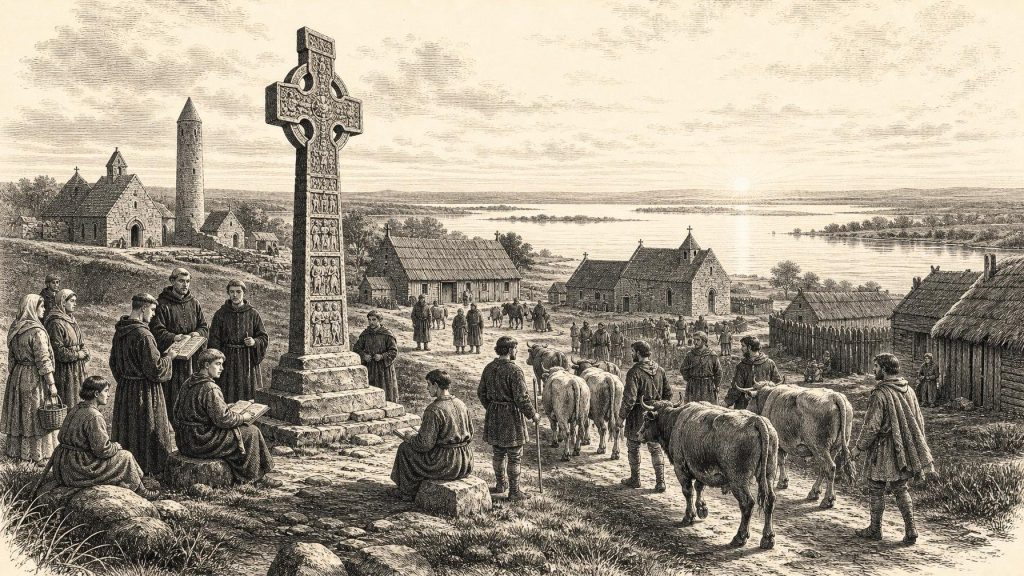
Clonmacnoise also endured violence. Several chronicles record a raid by the Éile and the Uí Fhócarta. The fuller tradition says that raiders seized captives near the Cross of the Scriptures and killed two people, one a student and the other a layman. The Delbna pursued them, defeated part of their force and recovered the prisoners or spoil.
The annalists presented the reversal as a miracle of St Ciarán. In one version, the stolen cattle returned to Clonmacnoise at sunrise. Such language belongs to the devotional interpretation of events and cannot be separated from the community’s effort to proclaim its patron saint’s continuing protection. Beneath it lies a credible account of raiding, killing, captive-taking and armed pursuit at one of Ireland’s richest ecclesiastical settlements.
The reference to a student is particularly revealing. Clonmacnoise remained a centre of teaching, writing and learned families, as well as a place of worship and pilgrimage. Its position beside the Shannon and major east–west routes encouraged trade and travel but also exposed it to competing armies. A large lay population lived around its churches, making the settlement resemble a small town more than an isolated monastery.
Deaths and Regional Change
The year brought the disappearance of several regional leaders. The Annals of Inisfallen report that Anad Ua Lochlainn, king of Corcu Modruad in what is now County Clare, was slain, although Tigernach says only that he died. Inisfallen also records the killing of Anad Ua Flainn, king of Eóganacht Locha Léin in the Killarney region. These deaths occurred within a Munster already destabilised by the contest between Donnchad and Toirdelbach.
In the east, the Annals of Ulster record a victory by the men of Brega under Gairbíth Ua Cathasaigh over forces from Gailenga and Cairbre. The same source notes the death of Flannacán Ua Cellaigh, king of Brega, while on pilgrimage. It also records the death of Muirchertach son of Gilla Fulartaigh, an heir-designate of the Déisi. These brief notices show how royal succession could change through battle, natural death or withdrawal into pilgrimage, with consequences now mostly lost to us.
Charity and Religious Memory
Among the most significant deaths was Conn na mBocht, “Conn of the Poor”, remembered at Clonmacnoise as an almoner, hospitaller and leader associated with the Céli Dé. He had endowed provision for poor people with cattle, linking charity to the productive resources of the agricultural economy. His descendants continued to hold ecclesiastical office; his grandson Máel Muire later became a principal scribe of Lebor na hUidre, the Book of the Dun Cow.
The Annals of Ulster and Inisfallen place Conn’s death in 1060, while the later Four Masters place it under 1059. A similar chronological variation surrounds Domnall Déisech, praised as a leading spiritual adviser and as a man of exceptional piety and charity. Inisfallen says that he died at Tech Munnu, modern Taghmon, and celebrates his pilgrimage in language comparing his travels with those of Christ.
Other ecclesiastics commemorated in 1060 include Máel Ciaráin Ua Robocáin, superior of Swords, and Mac Geláin, erenagh of Cloyne. An erenagh managed church lands and obligations, often within an established local family. Such notices remind us that religious settlements depended upon administrators, teachers, confessors, hospitallers and hereditary learned kindreds as well as monks and priests.
Work, Wealth and Settlement
Chronicon Scotorum records a great mast crop throughout Ireland. This meant an abundance of acorns, nuts and other woodland produce, especially valuable for feeding pigs. It does not prove universal prosperity, but it suggests favourable conditions for an important part of the food economy.
Most people lived in dispersed rural farmsteads, including raths, cashels and crannógs, rather than in towns. Daily labour centred on herding cattle, sheep and pigs; milking and making butter or cheese; ploughing; sowing barley and oats; harvesting; grinding grain; spinning; weaving; and maintaining houses, enclosures and field boundaries. Cattle were food-producing animals, stores of wealth and instruments of tribute. Their prominence in accounts of raids reflects economic reality rather than an annalist’s obsession with livestock.
Alongside this overwhelmingly rural world stood the Hiberno-Norse ports of Dublin, Waterford, Wexford, Cork and Limerick. Their craftsmen worked wood, leather, bone and metal, while merchants connected Ireland with Britain, Scandinavia and continental markets. Kings valued these towns for revenue, ships, manufactured goods and military manpower. In 1060, Diarmait’s authority over Dublin helped make his submission of Donnchad mac Briain politically meaningful far beyond Leinster.
The year therefore combined no single decisive battle or coronation, but several developments of lasting importance. Donnchad’s submission marked the decline of Brian Bóruma’s son and the ascent of Diarmait mac Maíl na mBó. Conflict at Armagh exposed the political weight of ecclesiastical office. Raids and fires demonstrated the vulnerability of prosperous churches, while the remembrance of Conn na mBocht preserved a different ideal of authority: wealth converted into hospitality, learning and care for the poor.
Primary Sources
- The Annals of Ulster: Year U1060
- The Annals of Inisfallen
- The Annals of Tigernach: Annal T1060
- Chronicon Scotorum: Annal CS1060
- Annals of the Four Masters: Volume 3, Annal M1060
- Conn na mBocht
- Donnchad
- Diarmait (Diarmait mac Maíl (Máel) na mBó)
- Máel-Muire
- Ua Máelshechlainn, Conchobar
- Kells Monastic Site
- St Columb’s House/Cell
- Clonmacnoise Monastic Site
- Clonmacnoise Visitor Guide
- Irish School of Illumination, c. 650–1100
- High Crosses
- St Patrick and Medieval Armagh
- The Viking Age in Ireland
- The Archaeology of Livestock and Cereal Production in Early Medieval Ireland, AD 400–1100
- Early Medieval Ireland: Archaeological Excavations, 1930–2009
- Early Medieval Archaeology Project Report
- Kingship, Society, and Sacrality: Rank, Power, and Ideology in Early Medieval Ireland
- The Zooarchaeology of Medieval Ireland
- Stories of Ireland’s Past: Knowledge Gained from NRA Roads Archaeology
- See Rome and Die: The Burial-Place of Donnchad mac Briain
- Ireland in the Middle Ages