Committee Room Fifteen1890 CE
In 1890, Charles Stewart Parnell emerged largely vindicated from the Special Commission, but his leadership of the Irish Parliamentary Party collapsed after Captain O’Shea’s divorce case exposed his relationship with Katharine O’Shea. Gladstone warned that retaining Parnell endangered Liberal support for Home Rule, while Catholic bishops opposed him. In Committee Room 15, forty-five MPs abandoned Parnell, leaving twenty-eight supporters and dividing nationalism for the decade. Meanwhile, land, labour and food insecurity persisted, despite Davitt’s activism. Belfast’s market, Derry’s Guildhall and Dublin’s museum signalled civic development, whereas removal of Inishbofin remains exposed exploitative Victorian anthropology and unequal institutional power over bodies.
Dateline
In 1890 Ireland’s constitutional nationalist movement appeared, at first, to stand stronger than it had for years. Charles Stewart Parnell, chairman of the Irish Parliamentary Party, had emerged from the long Special Commission inquiry with his reputation for direct involvement in murder and violent conspiracy substantially cleared. His party remained the indispensable Irish ally of William Ewart Gladstone’s Liberal campaign for Home Rule. Yet by the closing days of the year, the political structure Parnell had disciplined so carefully was breaking apart. The cause of an Irish parliament had become entangled with a divorce case, the calculations of British Liberalism, the authority of Catholic bishops and priests, and bitter disagreements among Irish nationalists themselves.
A Vindication With Limits
February brought the report of the Special Commission appointed after The Times had published allegations linking Parnell and other Irish nationalist MPs to crime, including forged letters supposedly written by Parnell. Richard Pigott’s exposure as the forger had already destroyed the newspaper’s most dramatic accusation. The commission’s findings did not present Parnell as the author of the forged material, and parliamentary debate in February treated that conclusion as a major vindication. It restored much of the political standing that the attacks had threatened to take away.
The result was nevertheless not a simple triumph. The commission found that some nationalist MPs had associated with organisations that used intimidation and had, at points, failed sufficiently to condemn violent acts. Unionists continued to deploy those findings against Home Rule. Parnell’s achievement lay in preserving the central political fact: he remained leader of an exceptionally cohesive parliamentary party, able to make Irish votes count at Westminster. That authority was especially valuable because neither of the great British parties could safely disregard the Irish question.
The O’Shea Case
The crisis that undid Parnell in 1890 arose from Captain William Henry O’Shea’s divorce petition against his wife, Katharine O’Shea. The petition had been filed in December 1889, naming Parnell as co-respondent, but the hearing took place in London on 15 and 17 November 1890. Parnell did not contest the allegation. A decree nisi was granted to Captain O’Shea, who also secured custody of the children. The legal result exposed Parnell’s long relationship with Katharine O’Shea to the public at the very moment when his capacity to lead a national movement depended on broad moral as well as political confidence.
It is important not to treat the affair as merely private gossip. Divorce law and public respectability were political matters in Victorian Britain and Ireland. Parnell was a Protestant landlord leading a party whose electorate was predominantly Catholic, rural and socially conservative. His supporters could argue that the personal conduct of a political leader did not settle Ireland’s constitutional claims. Opponents, however, saw an immediate danger: English Liberal and Nonconformist opinion might withdraw from the alliance on which Home Rule depended, while Catholic clerical support in Ireland could rapidly weaken.
Gladstone’s Intervention
On 25 November, apparently before the full implications of Gladstone’s view had become known to all those present, Parnell was re-elected chairman of the Irish Parliamentary Party. The apparent recovery lasted scarcely a day. Gladstone’s letter to John Morley, written on 24 November and then made public, stated in effect that Parnell’s retention would make Liberal victory and the advancement of Home Rule far more difficult. Gladstone’s own leadership, he warned, would be rendered nearly useless.
This was an extraordinary intervention. It made clear that the leader of the British Liberal Party claimed no formal right to choose the Irish party’s chairman, but it also made the practical dependence of Irish parliamentary nationalism unmistakable. Parnell treated the letter as an unacceptable Liberal veto over an Irish decision. In his manifesto, To the People of Ireland, issued on 28 November and published the following morning, he appealed over the heads of wavering MPs to the Irish public. He insisted that the party’s independence was its safeguard and suggested that Liberal concessions on Home Rule had been inadequate.
His argument struck a genuine nationalist nerve. A party created to compel Westminster to address Irish demands was now being told that its leader had to be sacrificed to preserve an English alliance. Yet many MPs reached the opposite conclusion. They did not necessarily deny Parnell’s past service or his right to resent Gladstone’s pressure; they judged that a leader rejected by Liberal voters and by much of the Catholic hierarchy could no longer carry a Home Rule bill.
The Break in Committee Room 15
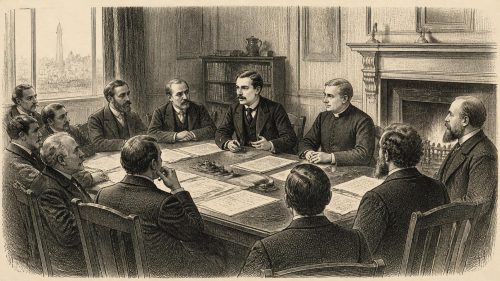
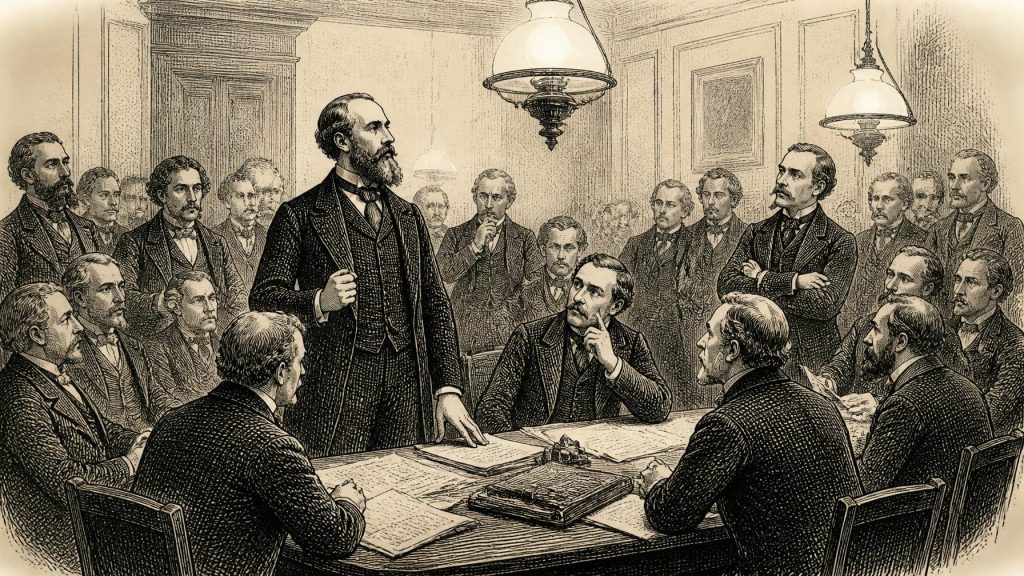
The decisive meetings unfolded at Westminster in Committee Room 15. From 1 to 6 December, Irish MPs argued over Parnell’s position in prolonged and increasingly acrimonious sessions. The dispute was about more than character. It set two political calculations against one another: Parnell’s belief that surrender would reduce Ireland to dependence, and the anti-Parnellites’ belief that retaining him would postpone self-government altogether.
On 3 December the standing committee of Irish Catholic bishops issued an address against Parnell’s continued leadership. Clerical opposition mattered greatly, though it should not be mistaken for the sole cause of the split. Politicians such as Justin McCarthy, John Dillon, Timothy Healy, Michael Davitt and William O’Brien made their own, often sharply differing, assessments of strategy and party discipline. Davitt, whose radical land and labour priorities had long sat uneasily beside Parnell’s leadership, became a particularly forceful critic. The bishops’ intervention, however, gave moral and organisational weight to the anti-Parnellite case in many localities.
On 6 December, forty-five MPs withdrew from Parnell’s leadership, leaving him with a minority of twenty-eight. The division was not yet the settled party geography of later years, and the Irish National Federation would be formally organised afterwards. But the break was real and immediate. Ireland entered the 1890s with a Home Rule movement divided between Parnellites and anti-Parnellites, each claiming to represent the authentic national cause. A political machine that had once united farmers, urban voters, clergy, labourers and constitutional nationalists now became a field of rival newspapers, conventions and public meetings.
Land, Labour and Hardship
The split came at a poor moment for people whose concerns did not fit neatly into the leadership struggle. The land question had changed since the peak years of the Land War, but it had not disappeared. Tenants still sought security, lower rents and, increasingly, ownership. Rural labourers remained among the most precarious people in the countryside: often dependent on seasonal employment, living in overcrowded cabins and lacking the political influence enjoyed by many tenant farmers.
Michael Davitt’s Irish Democratic Trade and Labour Federation, founded in January 1890, represented an attempt to give labour questions a more organised national expression. Davitt also used his newspaper, Labour World, to publicise social injustice and connect Irish workers with wider radical politics. Such initiatives reveal a country in which nationalism did not erase class interests. The later destruction or weakening of labour organisations in the quarrels of the Parnell split was not inevitable, but the year’s political warfare made sustained attention to wages, housing and rural employment harder.
Conditions in poorer western districts also remained fragile. Historians identify 1890–91 as a period of renewed localised food distress, a reminder that the Great Famine had not ended dependence on the potato or removed the risks facing smallholders. This was not a return to the catastrophe of the 1840s, but it demonstrated the persistence of subsistence vulnerability in parts of Ireland. The contrast with the national drama at Westminster was stark: while leaders debated parliamentary independence, many households remained exposed to bad harvests, weak employment and insecure access to food.
Markets, Museums and Municipal Ambition
Political crisis did not halt urban building or commercial change. In Belfast, work on the Victorian structure now known as St George’s Market began in 1890 and continued in phases through the decade. The project reflected Belfast’s dense urban economy, in which the trade in foodstuffs required covered space, regularised stalls and municipal investment. Markets connected country producers, dealers, shopkeepers and working-class consumers; they were practical institutions at the centre of daily provisioning.
In Derry, the new Guildhall opened in July as the administrative centre of Londonderry Corporation. Financed by the Honourable The Irish Society and built on reclaimed ground beside the Foyle, it expressed the civic confidence and distinctive political inheritance of the north-western city. Its location and funding also recalled the enduring relationship between Derry and the London companies. In Dublin, the Museum of Science and Art opened at Kildare Street in 1890. Its collections in art, industry, natural history and antiquities embodied a Victorian faith in public instruction, improvement and the classification of knowledge.
Science, Possession and Respect
That faith had a troubling counterpart. In July, Alfred Cort Haddon and Andrew Francis Dixon removed the partial remains of thirteen people from St Colman’s monastery on Inishbofin, County Galway, without the community’s knowledge or permission. The remains were taken for craniometric and anthropological study and entered the orbit of Trinity College Dublin. The episode belongs firmly to 1890, but its meaning extends beyond that moment: it shows how learned institutions could treat the dead of an Irish island community as material for racial measurement rather than as people owed care and respect.
The contrast with the new Dublin museum is instructive. 1890 witnessed institutions that preserved and displayed objects in the name of education, yet it also witnessed the removal of human remains without consent. Modern reassessment and the eventual return of the Inishbofin remains make clear why this was not a neutral scholarly act. The year therefore illuminates both the expansion of public culture and the unequal power embedded in some Victorian forms of collecting.
An Unsettled Ending
By December, Ireland had not lost its demand for Home Rule, its parliamentary representatives or its capacity for political mobilisation. It had lost the unity that had made Parnell’s party so formidable. The opening of civic buildings, markets and a national museum suggested material confidence and institutional growth; labour activism and renewed rural hardship exposed persistent inequality; the Inishbofin episode revealed the intrusive assumptions of contemporary science. Above all, the meetings in Committee Room 15 turned a personal scandal into a national rupture whose consequences would shape Irish politics for the rest of the decade.
Primary Sources
- Parnell, Charles Stewart | Dictionary of Irish Biography
- Healy, Timothy Michael | Dictionary of Irish Biography
- Croke, Thomas William | Dictionary of Irish Biography
- Chapter 13: Parnell Divorce Court Proceedings – The Material for Victory: The Memoirs of Andrew J. Kettle
- Parnell and the Clergy
- The Times Newspaper and Mr. Parnell. (Hansard, 11 February 1890)
- The Manifesto of 1890
- Letter Regarding Parnell and Ireland
- The Parnell Split
- Michael Davitt, After the Land League 1882–1906
- Labour World
- Politics and the Irish Working Class, 1830–1945
- Hunger and Poverty After the Famine
- Irish Statute Book: Public Acts, 1890
- The Science and Art Museum, Dublin
- Welcome to the National Museum of Ireland at Kildare Street
- Guildhall History
- Derry, Shipquay Place, Guildhall | Dictionary of Irish Architects
- St George's Market Historic Building Details
- Preliminary Note on the Bacteria of Poisonous Mussels
- The Haddon-Dixon Collection: Inishbofin Crania
- Working Paper on Human Remains from Inishbofin Held in the Haddon-Dixon Collection at TCD
- Osteoarchaeological Report on Human Crania from Inishbofin, Co. Galway