Membership is completely free, giving members unlimited access to all available resources, services, features, and benefits without any restrictions or fees.
Welcome back. Sign in to continue enjoying unlimited access to all available resources, services, features, and member benefits at no cost.
The clearest assertion of external independence came in September. On 17 September 1930 the Irish Free State began a three-year term on the Council of the League of Nations. This was more than ceremonial advancement. The League’s Council was a small body at the centre of interwar diplomacy, and the Free State’s presence there offered an international stage to a country that had entered the League only seven years earlier.
The defining event came on 22 July, when W. T. Cosgrave, President of the Executive Council, formally opened the Shannon Scheme at Parteen, near Limerick. Water was admitted from the intake works into the headrace canal leading to the generating station at Ardnacrusha. The scheme had been built for the Free State by the German firm Siemens-Schuckertwerke and involved a dam, diversion works, canal, turbines, transmission lines and a new organisation of national electricity supply. It was an immense undertaking for a state still only six years old, and it advertised a determination to use public infrastructure to overcome the disadvantages of a small, overwhelmingly agricultural economy.
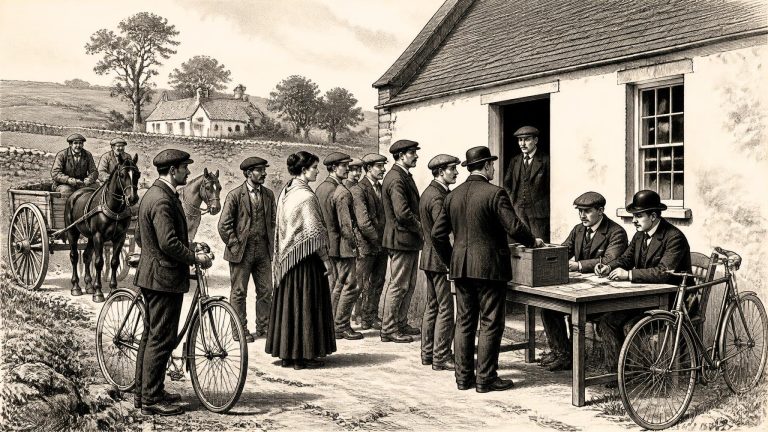
The most comprehensive event of the year was the Census of Population, taken on the night of Sunday 18 April. It was the first census conducted by the government of the Irish Free State. The machinery of the new state reached into private houses, farms, lodging houses, religious institutions, barracks, hospitals, prisons and vessels in Irish waters. Household heads were asked to record each person present at midnight; returns could be made in Irish or English. The census order also required information on dwellings and buildings, as well as the population’s age, sex, marital condition, birthplace, occupation, religion and Irish-language knowledge. Members of the Garda Síochána collected the forms, a significant everyday demonstration of the authority of a police force created in the aftermath of revolution.
The Civil War did not end through a negotiated settlement, formal surrender or single peace treaty. Its closing phase was instead a sequence of military reverses, political decisions and orders issued by the anti-Treaty leadership. Liam Lynch, chief of staff of the anti-Treaty IRA and a determined opponent of ending the campaign, was fatally wounded by Free State troops on 10 April while fleeing on the Knockmealdown Mountains in County Tipperary. He died that evening in Clonmel. His death removed the leading military advocate of continued resistance at precisely the moment when the republican movement was exhausted, increasingly fragmented and under severe pressure.