The Census and La Scala1926 CE
In 1926, the Irish Free State consolidated its institutions amid demographic decline, political division and economic change. The first Free State census counted 2,971,992 people, confirming rural depopulation, emigration, agricultural dependence, Catholic predominance and limited Irish-language knowledge. Legislation addressed allotments, school attendance and shop hours while accommodating farm labour. Construction of the Shannon hydro-electric scheme at Ardnacrusha demonstrated technological ambition, though reliant on foreign expertise. Éamon de Valera’s break with Sinn Féin produced Fianna Fáil, establishing a new republican organisation. Partition endured, while Cosgrave’s government asserted greater Commonwealth equality at the Imperial Conference. Women participated in political and peace activism.
Dateline
In 1926 the Irish Free State was still a young and deliberately practical state. Four years had passed since its formal establishment and three since the Civil War’s effective end. W. T. Cosgrave’s Cumann na nGaedheal administration governed from Dublin, seeking orderly institutions, balanced finance and recognition abroad, while its opponents disputed the Treaty settlement and the oath required of Dáil deputies. The year did not bring a single dramatic national rupture. Rather, it made visible several forces that would shape the following decade: a new republican party, a nationwide count of the population, an immense hydro-electric undertaking on the Shannon, and continued demographic loss from much of the countryside.
Counting the Free State
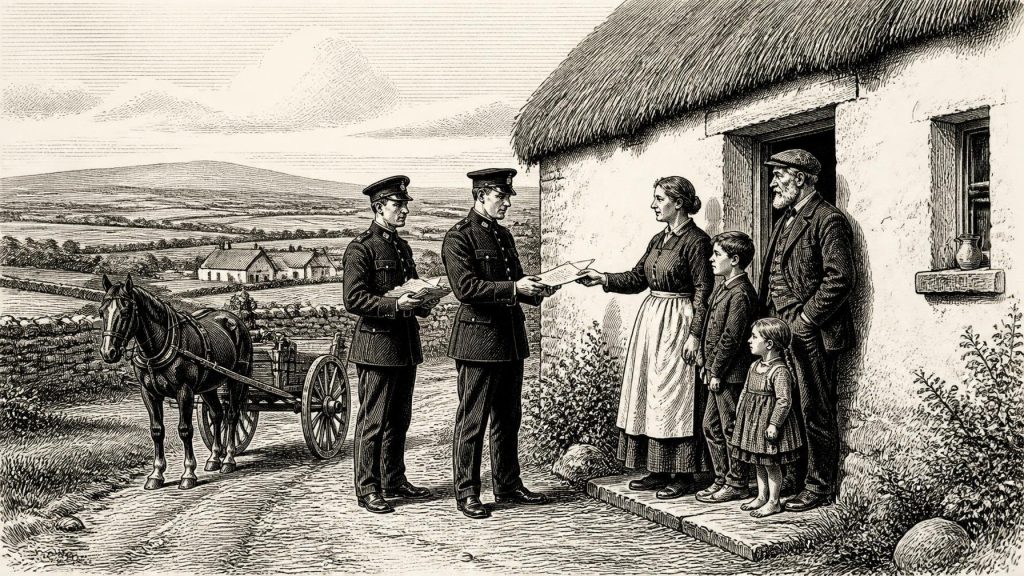
The most comprehensive event of the year was the Census of Population, taken on the night of Sunday 18 April. It was the first census conducted by the government of the Irish Free State. The machinery of the new state reached into private houses, farms, lodging houses, religious institutions, barracks, hospitals, prisons and vessels in Irish waters. Household heads were asked to record each person present at midnight; returns could be made in Irish or English. The census order also required information on dwellings and buildings, as well as the population’s age, sex, marital condition, birthplace, occupation, religion and Irish-language knowledge. Members of the Garda Síochána collected the forms, a significant everyday demonstration of the authority of a police force created in the aftermath of revolution.
The preliminary result, published in August, recorded 2,971,992 people in the twenty-six counties, a fall of more than five per cent since the corresponding area had been counted in 1911. This was not a simple measure of post-independence failure. The interval had encompassed the First World War, the revolutionary years, the Civil War, partition and the departure of British military, police and civil personnel after 1922. Yet the figures also confirmed a longer-running problem: outside Dublin, every county had lost population since 1911. Emigration and the movement from rural districts towards towns continued to define family calculations about work, marriage and the future.
The census captured a society still strongly rural, Catholic and young. Agriculture accounted for 51 per cent of those at work, and family labour was central to that economy: more than 206,000 sons and daughters were classified as assisting on farms. Roman Catholics comprised 93 per cent of the Free State population. Irish-language ability was recorded by 18 per cent, with Galway standing out as the county with the highest proportion. These figures should not be mistaken for a complete description of lived identity, but they show the conditions within which the government’s nation-building programme operated: a predominantly agricultural society, marked by regional inequality and sustained attachment to both parish life and the Irish language.
Farm, School and Household
Legislation in 1926 addressed the texture of daily life as much as high politics. The Acquisition of Land (Allotments) Act empowered local authorities to provide land for allotments, whether acquired by agreement or, subject to safeguards, compulsorily. Its scope was modest beside the great land reforms of the preceding generation, but it recognised the value placed on small plots for household food and recreation in towns and villages. The state also continued to fund the Land Commission and agricultural credit societies, while the annual estimates supported forestry and the Department of Agriculture. Such measures belonged to a wider official effort to stabilise small farming, improve production and retain people on the land.
The School Attendance Act of 1926 made parents responsible for ensuring that children attended a national or other suitable school, with enforcement ultimately through the District Court. The Act nevertheless preserved the demands of the farm household. Until 1936, a child aged twelve or over could be absent for up to ten days in spring and another ten in late summer and early autumn for light work on a parent’s land. Accessibility was also defined realistically: for younger children a school normally had to be within two miles, and for older children within three, unless suitable transport was available. The statute therefore tightened attendance while admitting that schooling competed with distance, seasonal labour and the needs of family agriculture.
Urban employment and consumption also entered the Oireachtas. The Shop Hours (Drapery Trades, Dublin and Districts) Act dealt with closing arrangements in the drapery and related trades, following contentious evidence about long working days, late shopping and the heavy Saturday rush in working-class districts. It was a narrow law, but a useful reminder that the Free State was not composed solely of farms and civil servants. Shop assistants, clerks, transport workers, domestic servants and skilled tradespeople inhabited a commercial Dublin whose rhythms were being negotiated through legislation as well as custom.
Ardnacrusha’s Rising Works
At the other end of the scale stood the Shannon hydro-electric scheme. The State had authorised the use of the Shannon’s hydraulic power in 1925; in January 1926 it passed a temporary Electricity Supply (Special Powers) Act to help existing undertakings co-operate and supply electricity more economically while power from the Shannon works was being made available. In June the electrical and mechanical engineering contract was signed with the Siemens-led enterprise responsible for the project. Construction at Ardnacrusha and along the altered river system was therefore a present reality in 1926, not merely a promise of future modernity.
The scheme brought engineers, imported machinery, specialised knowledge and a large labour force into the Shannon corridor. Its immediate benefit was employment and construction activity; its anticipated significance was far greater. A state able to harness a major river for electricity could claim technical competence as well as political independence. The project also exposed limitations in the domestic economy: foreign contractors and expertise were essential, and the scale of the works required elaborate contracts, transport links and administrative capacity. Limerick’s harbour legislation of the same year, including provision for quayside reclamation and embanking, belonged to this broader setting of adaptation around the Shannon estuary.
A Republican Reorganisation
The year’s most consequential political development came from the anti-Treaty side. On 9 March, Éamon de Valera failed to win Sinn Féin acceptance of his argument that entry into the Dáil, if the oath were removed, should be a matter of policy rather than principle. He resigned as the party’s president. During the following weeks he and his supporters organised a new movement, Fianna Fáil – the Republican Party. Its founding meeting at Dublin’s La Scala Theatre took place in May, and Countess Markievicz was among the leading figures associated with its launch.
Fianna Fáil did not immediately resolve the practical obstacle that had split republican politics: its members still rejected taking the oath and thus did not enter the Dáil in 1926. But the party created a new electoral vehicle rather than preserving abstentionist Sinn Féin as the sole republican alternative. Its programme connected national objectives to social and economic ones: political independence and a united republic, the restoration of Irish, redistribution of land, equal opportunity, and greater economic self-sufficiency. Organisation spread through local cumainn, often drawing on parish networks and veterans of earlier nationalist bodies. At its first Ard Fheis in November, hundreds of delegates signalled that the party had acquired a national structure.
Women were visible in this political work, although formal representation remained severely limited. Markievicz, Margaret Pearse, Dorothy Macardle, Hanna Sheehy-Skeffington, Kathleen Clarke and Linda Kearns were among the women linked with the party’s early organisation and executive. Dublin also hosted the fifth congress of the Women’s International League for Peace and Freedom, attended by 150 delegates from twenty countries. It was the first meeting of an international organisation held in the Free State, placing Irish women’s political and peace activism within an international setting at a time when the state’s external presence was still being defined.
Partition and External Status
Partition remained a settled fact but not an accepted national conclusion. The December 1925 agreement between the Free State, Northern Ireland and Britain had left the border substantially unchanged, and its political disappointment continued to frame southern debate in 1926. Northern Ireland, governed from Belfast by Lord Craigavon’s Unionist administration, conducted its own census on 18 April. Its published reports recorded the distinct population and housing patterns of the six-county jurisdiction, underlining that the island was now administered through two governments and two statistical systems.
Cosgrave’s government also pursued room for manoeuvre within the Commonwealth. At the Imperial Conference in London, held from 19 October to 23 November, the Irish Free State was represented among the dominions. Preparatory memoranda show Irish officials resisting any tendency towards constitutional or military uniformity, preferring close but independent co-operation. The conference’s declaration that the dominions were autonomous communities, equal in status and not subordinate to one another did not make Ireland a republic or end the Treaty connection. It did, however, strengthen the constitutional language through which the Free State could assert equality with Britain in future negotiations.
Thus 1926 was a year of enumeration, organisation and construction. The census supplied the young state with a detailed picture of a diminishing but resilient population; the Shannon works embodied an ambitious technological future; and Fianna Fáil gave anti-Treaty republicanism a durable new form. Ireland remained divided, agrarian and heavily shaped by migration, but its institutions were becoming more capable, more visible and more contested.
Primary Sources
- The Statistics (Census of Population) Order, 1926
- Census 1926
- Census 1926 Reports
- Key Findings: Then and Now: Life in Ireland in 1926 and 2022
- Population, Emigration and the 1926 Census
- Enumerators: An Garda Síochána and the 1926 Census
- School Attendance Act, 1926
- School Attendance Act, 1926, Section 4
- Acquisition of Land (Allotments) Act, 1926
- Electricity Supply (Special Powers) Act, 1926
- Shannon Electricity Act, 1925
- The Shannon Scheme
- Limerick Harbour Act, 1926
- Shop Hours (Drapery Trades, Dublin and Districts) Act, 1926
- Interim Report and Final Report: Shop Hours (Drapery Trades, Dublin and Districts) (Amendment) Bill, 1925
- University Education (Agriculture and Dairy Science) Act, 1926
- Appropriation Act, 1926
- Finance Act, 1926
- Timeline of Events, 1919–69
- Memorandum on the 1926 Imperial Conference for a Meeting of the Executive Council
- Existing Anomalies in the British Commonwealth of Nations
- Balfour Declaration 1926 (Imperial Conference)
- De Valera, Éamon (‘Dev’)
- Eamon de Valera Papers: Descriptive Catalogue
- Seán MacEntee Papers: Descriptive Catalogue
- 1920–29
- 1926 Census Reports
- Political Economy of Secession: Lessons from the Early Years of the Irish Free State