Ardnacrusha’s First Current1929 CE
In 1929, the Irish Free State opened the Shannon hydroelectric scheme at Ardnacrusha, demonstrating ambition, engineering capacity and national electricity supply, although rural electrification remained distant. The project transformed landscapes, including Friar’s Island’s medieval oratory. Agriculture, dependence on British markets, emigration, tuberculosis and limited medical certification exposed continuing economic and social fragility. Cumann na nGaedheal governed while Fianna Fáil developed as a parliamentary opposition; Seán Mac Eoin moved from army leadership into politics. The Censorship of Publications Act established lasting controls on print and contraception. In Northern Ireland, electoral reform ended proportional representation for most Stormont seats, strengthening institutional division.
Dateline
In 1929, the Irish Free State made its most dramatic material statement since independence not in the debating chamber but beside the Shannon. The completion and opening of the hydro-electric works at Ardnacrusha in County Clare gave the young state a conspicuous emblem of technical capacity, public ambition and administrative confidence. Yet the year was not simply a tale of modernisation. Most people still lived with the pressures of a predominantly rural economy, emigration, uneven health provision and limited cash incomes. Across the border, changes to the electoral system reshaped Northern Ireland’s political life. In Dublin, meanwhile, a censorship law set durable limits upon print culture and the public discussion of sexuality.
The Shannon Scheme Opens
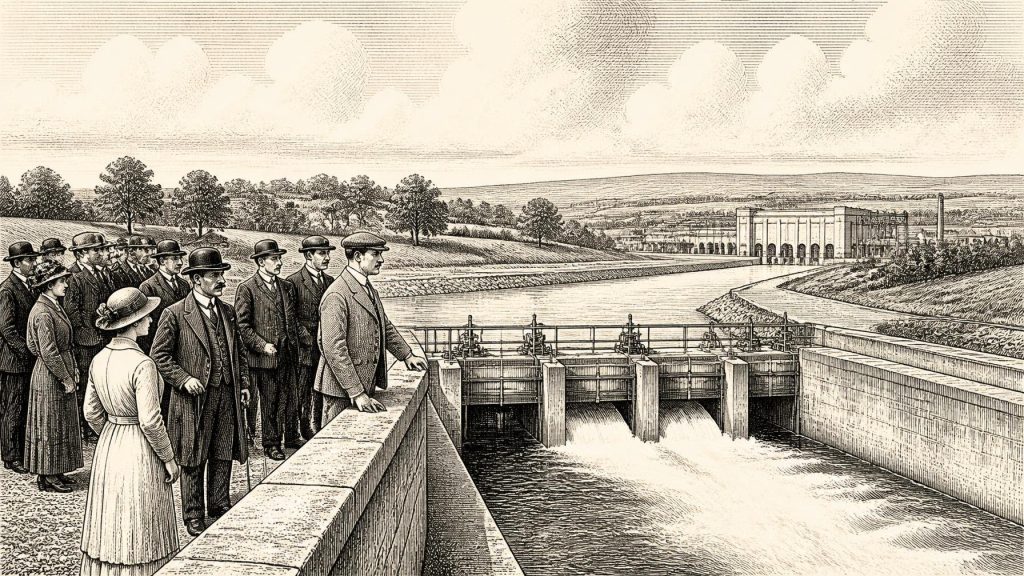
The defining event came on 22 July, when W. T. Cosgrave, President of the Executive Council, formally opened the Shannon Scheme at Parteen, near Limerick. Water was admitted from the intake works into the headrace canal leading to the generating station at Ardnacrusha. The scheme had been built for the Free State by the German firm Siemens-Schuckertwerke and involved a dam, diversion works, canal, turbines, transmission lines and a new organisation of national electricity supply. It was an immense undertaking for a state still only six years old, and it advertised a determination to use public infrastructure to overcome the disadvantages of a small, overwhelmingly agricultural economy.
The ceremonial opening should not be confused with instant transformation in every home. Ardnacrusha and the new national grid entered operation in August, but electricity remained a novelty or an aspiration for much of rural Ireland. The Electricity Supply Board had already begun promoting electric lighting, cooking and heating through advertising, demonstrations and showrooms. Its task was as much social as technical: power had to be generated, transmitted, sold and made useful in homes, shops and workplaces. The long rural electrification campaigns of later decades still lay ahead. Nonetheless, 1929 marked the moment when a national system, rather than a patchwork of local and private undertakings, became a practical reality.
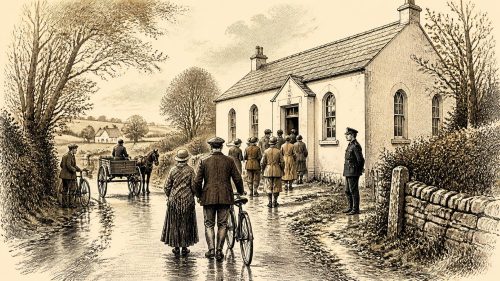
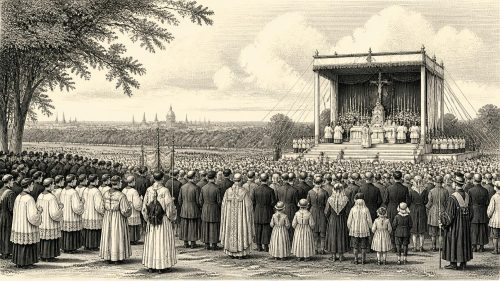
The project also altered a historic river landscape. Water management and inundation affected old routes, fisheries, islands and religious sites. On Friar’s Island, close to the scheme, the last Mass before removal of the threatened medieval oratory was celebrated on 21 July. The structure was then dismantled and transferred stone by stone. This episode captured a central tension of the Shannon works: the Free State’s largest engineering venture could be presented as national progress, but it also required decisions about what landscapes and inheritances would be changed, moved or lost.
Work, Trade and Household Pressures
Ardnacrusha did not make Ireland industrial overnight. Farming and the export of livestock and foodstuffs remained fundamental to Free State livelihoods, while the British market remained indispensable. Later official analysis recorded that exports and re-exports in 1929 were valued at £47.87 million, of which 92 per cent went to Great Britain and Northern Ireland. That figure reveals both the practical importance of the nearby market and a serious vulnerability. The Wall Street crash of October 1929 did not immediately produce the full depression in Ireland that later years would bring, but the country entered the new economic climate unusually exposed to a downturn in Britain.
Industry was more varied than the familiar image of an economy of stout and biscuits suggests. Research using 1929 industrial data identifies nine manufacturing factories employing at least 500 people and twenty-two firms with workforces of roughly 400 or more. Food processing, milling, fertilisers, brewing and newer foreign-owned enterprises all mattered. Their presence did not remove the structural problem of limited employment opportunities, particularly for young people outside the main towns, but it qualifies the idea that the Free State possessed no industrial base at all.
The everyday demographic record shows why grand projects could coexist with insecurity. In the Free State, 58,280 live births and 42,991 deaths were registered in 1929. The mid-year population was estimated at 2.946 million, 3,000 lower than in 1928. Official returns counted 20,882 emigrants to destinations outside Europe, most of them bound for the United States; that figure did not include the continuing importance of movement to Britain. Public health remained uneven. Tuberculosis caused 3,875 recorded deaths, while nearly a third of deaths in rural areas were not medically certified. At the same time, 200 deaths were attributed to vehicles, including 124 involving motor-driven vehicles: a grim indication that motor traffic was becoming more consequential on Irish roads.
Statistical publication was itself part of state-building. The 1926 census, the first conducted by the Free State, continued to appear in detailed volumes; the volume on religion and birthplaces was published in 1929. Its categories and tables gave administrators an increasingly systematic picture of a society shaped by a Catholic majority, Protestant minorities, migration and marked regional differences. Such data did not solve social problems, but it gave the new administration tools with which to describe the population it governed.
Government, Opposition and the Army
Cosgrave’s Cumann na nGaedheal government remained in office throughout the year, still committed to financial caution, orderly administration and the consolidation of institutions created after revolution and civil war. Fianna Fáil, having entered the Dáil in 1927, was now a constitutional opposition within Free State politics, even while it rejected the settlement’s limits and continued to seek a more fully independent republic. The difference between government and opposition was therefore substantial, but it was being fought increasingly through parliamentary organisation rather than armed conflict.
A revealing personnel change occurred on 20 February, when Major-General Seán Mac Eoin became Chief of Staff of the Army. Mac Eoin, renowned during the War of Independence as the “Blacksmith of Ballinalee”, represented the revolutionary generation now serving the state it had helped create. His tenure was brief. He resigned from the Army after receiving the Cumann na nGaedheal nomination for the Sligo–Leitrim by-election and was elected to the Dáil on 7 June. The transition from senior soldier to elected politician was not unusual in the aftermath of revolution, but it also underlined the subordination of military office to civilian political life.
A Statute for Moral Control
On 16 July, the Censorship of Publications Act became law. It provided for a Censorship of Publications Board, empowered prohibition orders against books and periodicals judged indecent or obscene, and imposed restrictions on reporting certain judicial proceedings. Crucially, it also prohibited the sale and distribution of publications advocating contraception, as well as those advocating abortion or miscarriage. The legislation emerged from an atmosphere in which Catholic moral teaching had powerful influence in public life, but it should be understood as an act of the Oireachtas and the state, not as a simple instruction issued by the Church.
The immediate importance of the Act lay in the machinery it established: printed material could now be formally examined, banned, seized and kept from circulation through customs and postal controls. Its larger historical importance is clearer in retrospect. The Act became a foundation stone of the censorship regime associated with twentieth-century Ireland, shaping publishers, booksellers, readers and writers for decades. In 1929, however, the key development was the passage of the law itself, following extended debate in both Dáil and Seanad, rather than any claim that all later censorship practices had already taken their final form.
Stormont’s New Electoral Map
Political change north of the border was equally consequential. The Parliament of Northern Ireland passed the House of Commons (Method of Voting and Redistribution of Seats) Act in April 1929. It replaced proportional representation by the single transferable vote for most Stormont seats with first-past-the-post contests in newly drawn single-member constituencies. Queen’s University Belfast retained its separate multi-member university representation under proportional representation, but the territorial basis of parliamentary politics had been fundamentally changed.
The Northern Ireland general election of 22 May was the first held under that new system. James Craig’s Ulster Unionist Party won 37 of the 52 seats; three independent Unionists, eleven Nationalists and one Northern Ireland Labour Party member made up the remainder. Twenty-two seats were uncontested, a striking sign of how restricted electoral competition could be. The result did not eliminate nationalist representation, and historians differ over whether the constituency map was designed chiefly to weaken nationalists or to contain labour and independent unionism as well. What is beyond dispute is that the move away from proportional representation reduced political plurality and established the electoral framework under which Stormont would operate for the following four decades.
Thus 1929 joined two contrasting developments in Irish history. At Ardnacrusha, a state mobilised engineering, foreign expertise and public authority to redirect a river and generate power. At Stormont, another administration used electoral law to redirect political representation. In the Free State, the Censorship of Publications Act set moral boundaries around what could be read and said. Together, these firmly dated developments show an island whose two jurisdictions were becoming more institutionally settled, but also more clearly divided in their political arrangements, economic prospects and public cultures.
Primary Sources
- Censorship of Publications Act, 1929
- Censorship of Publications Act, 1929 – No. 21 of 1929 – Houses of the Oireachtas
- Electricity Supply in Ireland
- ESB Archives History Timeline
- The Story of Ardnacrusha’s ‘Quiet Revolution’
- The Shannon Scheme
- Seán MacEoin Papers, P151: Descriptive Catalogue
- Annual Report of the Registrar-General of Marriages, Births, and Deaths in Ireland, 1929
- Census 1926 Reports
- Key Findings Then and Now: Life in Ireland in 1926 and 2022
- Extracts from a Memorandum by the Department of External Affairs on the Effects of the Economic Depression on the Irish Free State
- The Leading Manufacturing Firms in the Irish Free State in 1929
- The Irish Economy During the Century After Partition
- Northern Ireland House of Commons, 1921–1972
- 1929 Westminster Elections in Northern Ireland
- Electoral Systems and Political Manipulation: A Case Study of Northern Ireland in the 1920s
- Introduction to the Electoral System in Northern Ireland
- Northern Ireland – Current Political Developments
- Currency Act, 1927
- Bankers (Northern Ireland) Act 1928
- Currency and Bank Notes Act 1928
- Oireachtas Library and Research Service Display Case: Censorship