

Related Archive: Edward Poynings

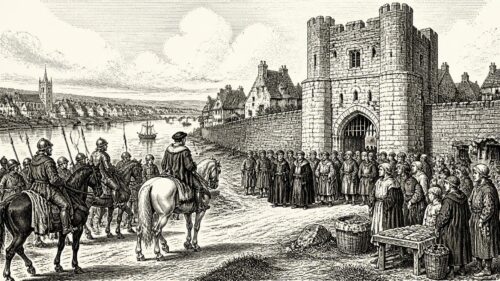
Waterford’s Eleven-Day Defence

Waterford’s Eleven-Day Defence

Archived: 19 October 2026

Abstract

In 1495, Sir Edward Poynings sought to strengthen Henry VII’s authority in Ireland through the Drogheda parliament, whose measures restricted Irish legislative initiative, while arresting the eighth earl of Kildare; his attainder was reversed later that year. Perkin Warbeck, backed by Desmond and Cork interests, failed after Waterford’s eleven-day land-and-sea defence, preserving a loyal harbour. Elsewhere, Aodh Ruadh Ó Domhnaill’s Scottish alliance and warfare around Sligo, conflicts in Breifne, and lordly rivalries demonstrated fragmented power. Church councils, monasteries, guesthouses, learned families and physicians reveal institutions supporting society. The year exposed Tudor ambitions but confirmed fragmented Irish power across the island.
Read Article

Poynings at Drogheda

Poynings at Drogheda

Archived: 19 October 2026

Abstract

In 1494 Henry VII sent Sir Edward Poynings to Ireland to strengthen Tudor control, counter Yorkist support and reduce reliance on Gerald FitzGerald, earl of Kildare. Landing in October, Poynings led an Ulster expedition, securing submissions from O’Hanlon and Magennis, but relations with Kildare deteriorated. His Drogheda parliament, opened in December and continuing into 1495, began legislation, including the measure later called Poynings’ Law, restricting Irish parliamentary initiative. Elsewhere, regional lordships remained autonomous: dynastic killings, sieges around Sligo, conflicts in Fermanagh and Cavan, raiding and hostage-taking continued. Church, trade and daily life were shaped by warfare, contested authority and insecurity.

Read Article