Membership is completely free, giving members unlimited access to all available resources, services, features, and benefits without any restrictions or fees.
Welcome back. Sign in to continue enjoying unlimited access to all available resources, services, features, and member benefits at no cost.
On 23 January, Dáil Éireann nominated Micheál Martin of Fianna Fáil as Taoiseach, and President Michael D. Higgins appointed him accordingly. Martin returned to an office he had previously held from 2020 to 2022. The new administration brought Fianna Fáil and Fine Gael together again, supported by the Regional Independent Group; Simon Harris of Fine Gael became Tánaiste. Its formation represented continuity as much as alteration. The two large parties of the centre-right retained control of government after the 2024 general election, but the inclusion of independents underlined the importance of local and regional priorities in an increasingly fragmented parliamentary landscape.
The general election of 8 February produced no commanding winner. Sinn Féin won the largest share of first-preference votes, while Fianna Fáil emerged with the largest number of Dáil seats, narrowly ahead of Fine Gael. The result reflected deep dissatisfaction with housing costs, homelessness and pressures on health services, as well as a striking appetite for political change. It also demonstrated the limits of a campaign: Sinn Féin’s unexpectedly strong vote came despite standing too few candidates to convert all its support into seats.
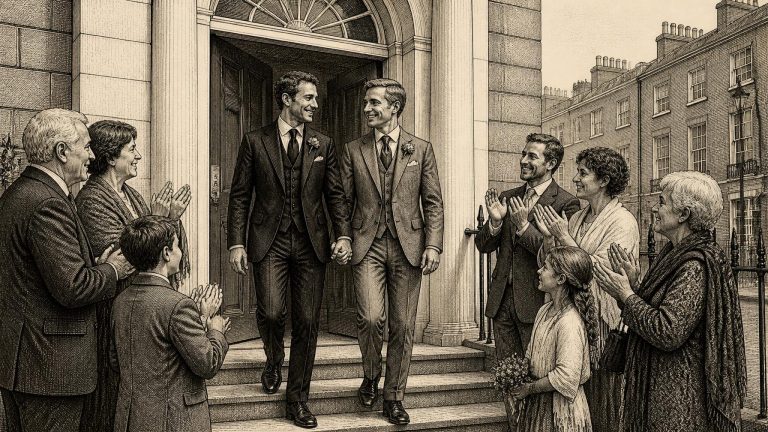
Enda Kenny resigned as Taoiseach on 13 June. The following day Dáil Éireann nominated Leo Varadkar, Fine Gael’s new leader, for appointment by President Michael D. Higgins. The nomination passed by 57 votes to 43, with 35 abstentions: a reminder that Varadkar led a minority administration dependent on the confidence-and-supply arrangement with Fianna Fáil. At thirty-eight, he was Ireland’s youngest Taoiseach to date and its first openly gay head of government. His appointment had a symbolic importance in a republic whose public culture had changed rapidly in the preceding decade.
The general election of 26 February returned a highly fragmented Thirty-second Dáil. Fine Gael remained the largest party, with 50 seats, but its previous coalition partner, Labour, suffered a severe reverse and retained only seven. Fianna Fáil recovered substantially to 44 seats; Sinn Féin won 23; and Independents and smaller parties occupied an unusually important place in the new chamber. No plausible two-party majority emerged. The result expressed both continuing approval for economic recovery after the financial crisis and widespread impatience with austerity’s social legacy, most visibly the controversy over domestic water charges, insecure housing and strained public services.
Ireland in 2015 was a country emerging unevenly from the financial crash while approaching a general election expected in the following year. Enda Kenny’s Fine Gael–Labour coalition could point to renewed employment, improving tax receipts and an end to the formal EU-IMF bailout programme achieved in late 2013. Yet the political atmosphere was not one of uncomplicated recovery. Years of spending restraint, changes to public services and continued emigration had left a deep mark. The introduction of domestic water charges on 1 January became an especially potent symbol of grievance. Demonstrations continued through the year, including a major Dublin march in April, while local campaigns against meters, bills and Irish Water brought national policy into estates and town streets.
The general election of 25 February delivered a decisive rejection of Fianna Fáil, which had governed through the property boom, banking collapse and the State’s entry into the EU–IMF assistance programme late in 2010. Fine Gael emerged as the largest party with 76 seats in the 166-seat Dáil; Labour won 37, while Fianna Fáil fell to 20. The result remade the party balance of the State, although no party commanded a majority alone.
The year began with the end of Garret FitzGerald’s Fine Gael–Labour coalition. On 27 January, the Government lost its Budget vote by 82 votes to 81. The immediate controversy concerned a proposed extension of VAT to children’s shoes, but the defeat exposed a more fundamental problem: the coalition did not command a secure majority in the Dáil. President Patrick Hillery dissolved the Twenty-second Dáil that day, and the electorate returned to the polls on 18 February.