Mountjoy and the Pike1954 CE
Ireland in 1954 experienced political change, economic pressure, religious mass devotion and cultural innovation. Fine Gael’s John A. Costello led a minority inter-party government after Fianna Fáil’s electoral losses, amid concerns over employment, emigration, farming and housing. New legislation addressed development, land, housing and health, while Tayto and the Evening Press began trading. Marian Year pilgrimages made Knock a major national destination. The Gough Barracks arms raid signalled renewed republican militancy. Michael Manning’s execution at Mountjoy became the state’s last. Brendan Behan’s The Quare Fellow, Christy Brown’s My Left Foot and the first modern Bloomsday reflected increasingly challenging cultural voices.
Dateline
In Ireland, 1954 was a year in which starkly different public worlds met. An election changed the government in Dublin; a prison execution revealed the continuing force of the criminal law; pilgrimage trains carried unprecedented numbers towards Knock; and, in a tiny Dublin theatre, Brendan Behan put a condemned but unseen prisoner at the centre of a new play. These were not parts of a single story, and they should not be forced into one. Yet together they show a country negotiating economic uncertainty, deep religious observance, unresolved partition and a culture beginning to find challenging new voices.
A Change at Leinster House
The firmly dated political turning point came with the general election of 18 May. Fianna Fáil, led by Éamon de Valera, remained the largest party but lost ground and could not retain office. When the Fifteenth Dáil assembled on 2 June, John A. Costello of Fine Gael was nominated Taoiseach. It was Costello’s second term in the office: he had previously headed the first inter-party government from 1948 to 1951.
The incoming administration joined Fine Gael, Labour and Clann na Talmhan, the small farmers’ party. It was an inter-party government, but not one with an overall Dáil majority. Its dependence on support beyond its three constituent parties was an immediate reminder that the electoral defeat of Fianna Fáil had not produced a decisive realignment. William Norton, Labour leader and Tánaiste, was central to the arrangement; the elderly de Valera moved to the opposition benches, though he remained leader of Fianna Fáil.
The campaign had been fought principally over matters that bore directly on household security: taxation, prices, farming incomes, employment and emigration. Fine Gael’s own election archive identifies agriculture and emigration among its principal themes. The concerns were real. Ireland’s protected, agriculture-heavy economy was struggling to generate enough secure work, while migration to Britain and further abroad remained an established fact of family life. It is important, however, not to treat every difficulty of the 1950s as an event of 1954. The election made the problem politically explicit; it did not solve it in a single season.
The new government nevertheless gave 1954 a substantial legislative record. The statute book includes a National Development Fund Act, a Land Act, a Housing (Amendment) Act and the Health Act 1954, among many other measures. The Health Act came into force on 1 August. Such enactments show a state using the tools of administration, finance and public provision during a difficult period. Their presence should not be mistaken for instant transformation: housing shortages, tuberculosis, uneven medical provision and the outward movement of younger workers remained major pressures upon Irish society.
Work, Travel and Devotion
Everyday life contained both constraint and novelty. In May, Joe ‘Spud’ Murphy established Tayto in premises off Moore Street in Dublin. The enterprise initially packed crisps by hand in waxed paper and delivered them to shops in tins. Its later fame makes the small-scale beginning easy to overlook, but it belongs to the economic texture of 1954: a local manufacturer finding a consumer market in a country where imported goods, limited purchasing power and small businesses still mattered greatly.
Dublin’s media landscape also changed. The Evening Press, a sister paper of de Valera’s Irish Press, first appeared on 1 September. An evening newspaper was a commercial undertaking, but it also enlarged the flow of news, sport, advertising and urban conversation at a time before television broadcasting in the Republic. Its launch underlines that electoral defeat did not remove Fianna Fáil’s wider cultural and institutional presence.
On 5 September, the international connections represented by Shannon Airport were darkened by the crash of KLM Flight 633 shortly after take-off. The aircraft came down in the Shannon estuary; twenty-eight of the fifty-six people aboard died. The tragedy was felt well beyond the west of Ireland. Shannon was a major transatlantic stopping point, and the accident demonstrated both Ireland’s place on post-war air routes and the dangers still attached to long-distance civil aviation.
Religion was even more visibly woven into movement through the country. Pope Pius XII had designated 1954 a Marian Year, and Irish Catholic devotion assumed a particularly large public form. The Knock Shrine Society travelled to Rome, where the Pope blessed its banner and presented a commemorative medal. At Knock itself, the Marian Year coincided with the seventy-fifth anniversary of the 1879 apparition. The shrine later recorded that annual pilgrim numbers exceeded one million for the first time by the end of the year.
Railway evidence gives the scale a practical dimension. Córas Iompair Éireann recorded operating 235 trains for Knock pilgrimages during 1954, compared with 103 in the preceding year. Father Patrick Peyton’s Family Rosary Crusade also held rallies across Ireland in the spring, drawing very large congregations. For many people, these were not abstract demonstrations of institutional power but collective acts of prayer, family discipline, travel and sociability. At the same time, their scale illustrates the exceptionally prominent place that Catholic practice held in public life.
Partition, Arms and External Affairs
Partition remained the defining constitutional limitation on the Irish state’s national claims. On 12 June, an IRA unit raided Gough Barracks in Armagh, a British Army installation in Northern Ireland, and removed arms. Contemporary British parliamentary discussion confirmed both the date and the seriousness with which the breach was regarded. The raid did not itself begin the IRA Border Campaign, which would start in December 1956. It can responsibly be seen instead as an important sign that militant republican organisation had revived after a quieter period, and as a development that later assumed added significance.
The border was also an economic boundary. A confidential Irish diplomatic report of November described mounting concern about unemployment in Northern Ireland, where agriculture, linen and shipbuilding were particularly exposed to post-war change. This was not merely an abstract issue for officials: economic insecurity on both sides of the border affected migration, local communities and political argument. Yet the political systems remained separate, with Stormont governing Northern Ireland and Dublin unable to determine policy there.
In foreign affairs, Ireland was still outside the United Nations, its application having been blocked by the Soviet Union. It also remained outside NATO, with partition a fundamental obstacle to participation in an alliance that included Britain. The year’s diplomatic papers nevertheless reveal a more complicated position than simple isolation. In January, the Department of External Affairs considered a cautious relaxation of restrictions affecting trade with Communist countries, especially in non-strategic goods. Economic necessity could therefore prompt limited practical engagement even while anti-communism, Catholic solidarity and the absence of normal Soviet-Irish diplomatic relations shaped official attitudes.
Execution and New Voices
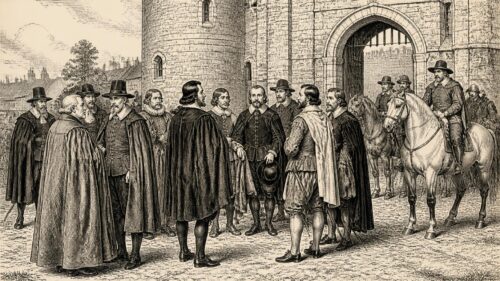
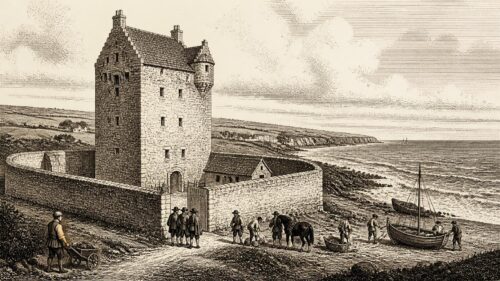
On 20 April, Michael Manning was hanged in Mountjoy Prison for the murder of Catherine Cooper, a nurse in Limerick. He was twenty-five. Albert Pierrepoint, the English executioner, carried out the sentence. Manning’s death was the twenty-ninth execution by the Irish state since 1923 and proved to be its last. Capital punishment was still lawful in 1954; that later outcome must not obscure how immediate and final the event was for Cooper’s family, Manning’s family and the prison staff involved.
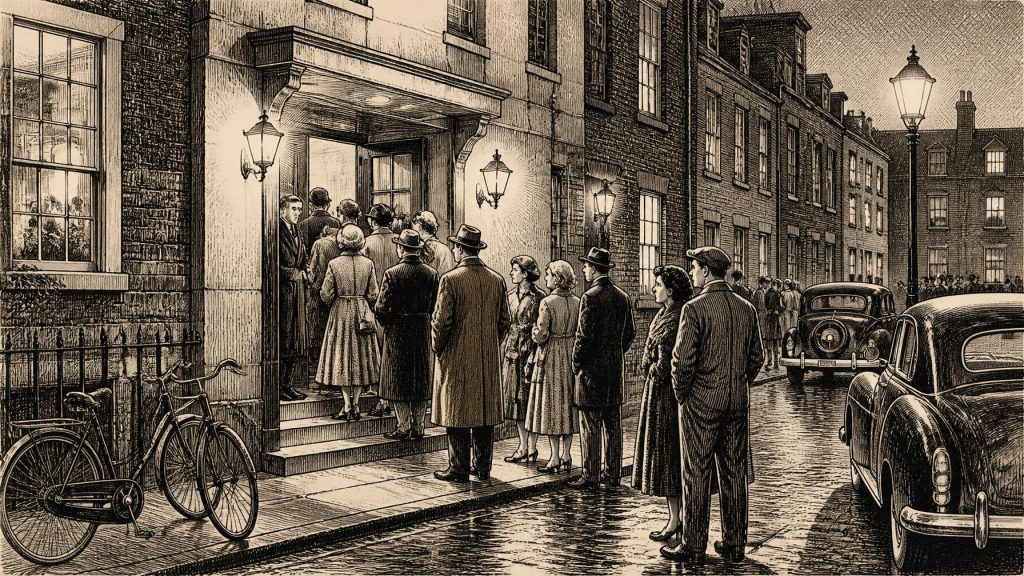
The year’s cultural record made capital punishment newly difficult to regard as a remote legal formality. On 19 November, Brendan Behan’s first professionally produced play, The Quare Fellow, opened at the Pike Theatre in Dublin. Set in a prison during the hours before an execution, it did not show its condemned title character on stage. Instead, prisoners, warders and officials spoke around an absence, exposing institutional routine, fear, humour and helplessness. The Pike was a small, independent venue; its decision to stage a work rejected by the Abbey Theatre gave Dublin audiences a sharper and less deferential kind of drama.
Other cultural moments broadened the year’s picture. On 16 June, John Ryan, Brian O’Nolan (Flann O’Brien), Patrick Kavanagh, Anthony Cronin and companions set out from Sandycove to retrace the route of Joyce’s Ulysses. The unfinished, horse-drawn excursion is now recognised as the first modern Irish Bloomsday celebration. In Cork, the first International Choral and Folk Dance Festival opened a new annual space for music and visiting performers. Christy Brown’s My Left Foot was published, bringing the experiences of a Dublin writer and painter with cerebral palsy into print with unusual directness.
Thus 1954 cannot be reduced to a change of government or to a list of famous beginnings. It was a year in which the old pressures of emigration, religious authority, partition and economic restraint remained powerful. But the election, the pilgrimage trains, the new businesses and newspapers, and the work of Behan, Brown and Joyce’s celebrants also disclosed an Ireland in motion: politically unsettled, culturally inventive and increasingly conscious of the human costs concealed by public institutions.
Primary Sources
- Chronological Table of the Statutes (1954)
- Health Act 1954
- Dissolution of Dáil—Motion, 11 March 1954
- Fine Gael General Election Archives
- John A. Costello Papers: Descriptive Catalogue
- The Irish Economy During the Century After Partition
- Ireland, Emigration and the New International Division of Labour
- Volume 10: Documents on Irish Foreign Policy, 1951–1957
- Memorandum for Government by the Department of External Affairs: Trade with Communist Countries, 28 January 1954
- Confidential Report, Boland to Nunan: Dinner with Soviet Chargé d’Affaires and Discussion on Irish-Soviet Relations, 25 January 1954
- Gough Barracks, Armagh (Theft of Arms), House of Commons Debate, 22 June 1954
- Confidential Report, Boland to Nunan: The British Government and Six-County Unemployment, 29 November 1954
- Michael Manning Executed in 1954
- A Family Affair? English Hangmen and a Dublin Jail, 1923–54
- Behan, Brendan Francis
- Writer Brendan Behan
- The Story of The Old Triangle
- Holdings: Anthony Cronin Assisting Flann O’Brien into Carriage, Bloomsday, Sandycove, 1954
- What Is Bloomsday?
- Cork International Choral Festival
- Cork Choral and Dance Festival
- Brown, Christopher (‘Christy’)
- Tayto History
- Dublin City Library and Archive Newspapers
- History of Knock Shrine
- Córas Iompair Éireann Fifth Annual Report, 1955
- ‘Scrupulous and Timid Conformism’: Ireland and the Reception of the Liturgical Changes of Vatican II
- ICAO Circular 50-AN/45: KLM Flight 633 Accident Investigation Report