Farming Department(c.1890s)
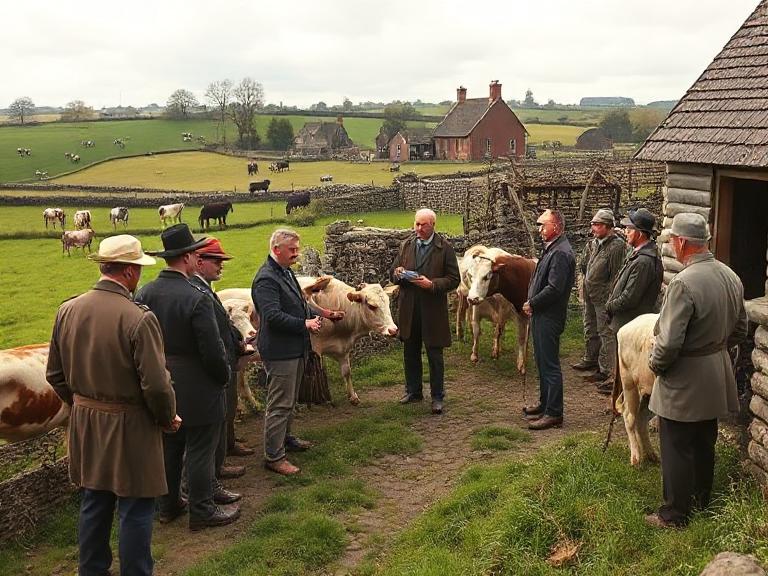
The newly established Department of Agriculture and Technical Instruction for Ireland has begun assuming responsibility for agricultural development, scientific instruction and several services previously divided among different public bodies. Created by legislation passed in 1899, the Department is intended to bring greater organisation to farming, fisheries, rural industries and technical education. Its emergence is being closely watched in County Limerick, where farmers, labourers, teachers and local representatives hope that practical instruction and improved scientific knowledge will strengthen agricultural production and create opportunities beyond traditional methods inherited within families.
The new authority has inherited responsibility for collecting agricultural statistics, supervising measures against destructive insects and regulating fertilisers and feeding stuffs. It will also assume functions connected with fisheries and important agricultural institutions, including the Munster Institute. These powers give the Department an unusually broad influence over rural development. Rather than dealing solely with crops and livestock, it is expected to encourage technical knowledge, local industries and better methods of production. Supporters believe that Irish farming can become more efficient when practical experience is reinforced by scientific testing, organised instruction and reliable information about markets and agricultural conditions.
County and local committees are expected to play an important role in shaping programmes suited to their districts. In Limerick, where dairying, cattle raising, tillage and agricultural labour remain central to economic life, instruction may include improved breeding, butter production, poultry keeping, horticulture and the treatment of plant or animal disease. Travelling instructors and demonstration schemes could bring new methods directly to farmers who cannot attend distant colleges. Technical classes may also benefit young people seeking employment in trades or rural industries, although much will depend upon funding, local participation and the availability of qualified teachers.
The Department’s creation reflects years of concern that Ireland lacked a coordinated system for developing its agricultural and industrial resources. Reformers associated with the Recess Committee studied systems operating abroad and argued that education must be connected directly with the realities of Irish economic life. Horace Plunkett, appointed vice-president of the new Department, has long promoted agricultural cooperation and practical self-help. His involvement has encouraged hopes that creameries, farming organisations and educational bodies will work together, although political opponents remain suspicious of any institution administered under British authority.
For ordinary Limerick families, the Department will be judged by visible results rather than administrative promise. Farmers require healthier livestock, dependable seed and better access to technical advice. Labourers need secure employment, improved housing and opportunities to acquire useful skills. Young men and women need instruction capable of opening livelihoods at home rather than preparing them only for emigration. The Department now possesses powers extending across agriculture, fisheries, statistics and technical education. Whether those powers can improve incomes and daily conditions throughout rural Ireland will become clearer as its programmes move from legislation into farms, classrooms, creameries and local communities.
- Agriculture and Technical Instruction (Ireland) Act, 1899, 62 & 63 Vict., c. 50, granted Royal Assent on 9 August 1899. The Act established the Department and transferred to it functions concerning agriculture, statistics, fisheries, technical instruction and agricultural institutions.
- Department of Agriculture and Technical Instruction for Ireland, Agricultural Statistics of Ireland with Detailed Report for the Year 1900, Dublin: His Majesty’s Stationery Office, 1901. Exact table and page should be confirmed before formal citation.
- Department of Agriculture and Technical Instruction for Ireland, Journal, Volume I, Dublin: His Majesty’s Stationery Office, 1900–1901. Exact issue, article and page should be confirmed before formal citation.
- Report from the Recess Committee on the Establishment of a Department of Agriculture and Industries for Ireland, Dublin, 1896. Exact edition and page should be confirmed before formal citation.
- Limerick Chronicle, 1900, reports concerning agricultural instruction, local technical-education schemes, farming organisations and the new Department’s activities. Exact issue, page and column should be confirmed before formal citation.