Munster

Shannon Retreat

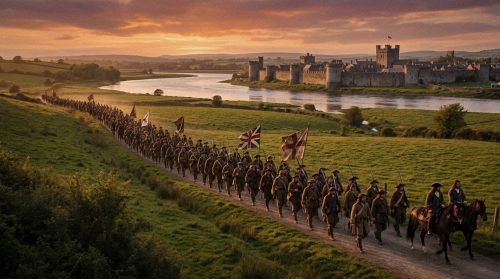
Limerick became one of the principal centres of Jacobite resistance after William III’s victory at the Boyne on 1 July 1690 forced the Irish army to abandon the eastern approaches to Dublin. James II departed for France, but most of his surviving soldiers remained under arms and withdrew westwards towards the River Shannon. Some gathered around Athlone, which guarded an important crossing into Connacht, while the larger concentration developed around Limerick. The city’s walls, river position and access to the western counties offered the Jacobites a defensible base from which the war might continue despite the loss of Dublin.

Drogheda Muster

Limerick entered the military calculations of the Jacobite leadership during the first half of September 1689, as Marshal Schomberg’s Williamite army advanced southwards through Ulster. French commander Conrad de Rosen regarded Dublin and Drogheda as dangerously exposed and favoured concentrating the Irish forces behind the Shannon, with Athlone and Limerick forming the principal defensive centres. The proposal revealed how rapidly Limerick had become important to the survival of James II’s cause. Richard Talbot, Duke of Tyrconnell, opposed an immediate abandonment of the eastern approaches and supported assembling the available Jacobite regiments around Drogheda to confront the advancing enemy.

Harvest Journeys

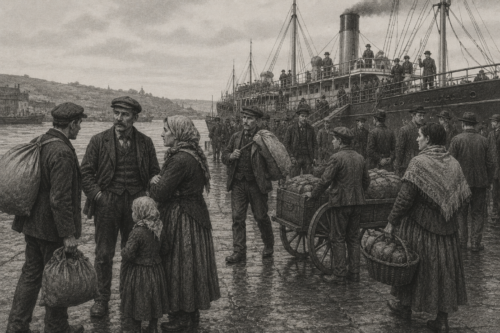
Seasonal migration remains essential to many small farming and labouring households across western Ireland and the poorer districts of Munster. Each year, men and women leave holdings incapable of supporting a family and travel towards districts offering temporary employment during sowing, haymaking or harvest. Others cross the Irish Sea to work on farms in Britain before returning home with wages needed to pay rent, settle shop debts, purchase seed and maintain relatives through the winter. What appears to be an individual search for work has become an established part of rural survival.

Western Hardship

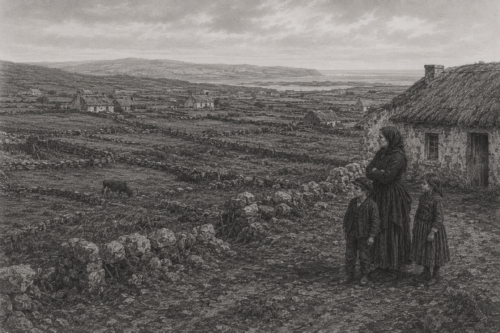
Congestion, fragmented holdings and poor soil continue to govern the lives of thousands of families throughout western Ireland. In large districts of Galway, Mayo, Roscommon, Donegal, Kerry and western Cork, households depend upon small and scattered plots that cannot reliably support those working them. A family may cultivate several separate strips divided by neighbours’ land, bog or rocky ground, making improvement difficult and wasting valuable time. Similar hardship is familiar in poorer coastal and upland parts of Munster, where limited employment and uncertain harvests leave communities dependent upon fishing, seasonal labour, credit and remittances from relatives abroad.

Rural Unrest

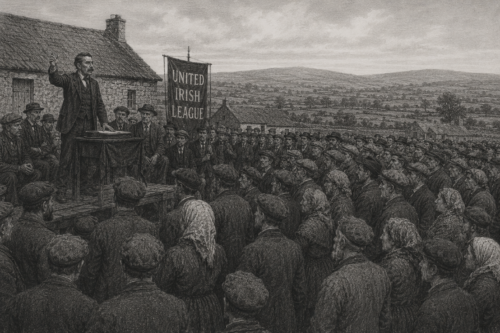
Agrarian agitation has become especially influential across Connacht and parts of Munster, where tenant farmers, smallholders and agricultural labourers continue to demand a fairer distribution of Irish land. County Limerick has not escaped the dispute. Rural families living on cramped or uneconomic holdings have watched substantial grazing farms occupy fertile ground while labourers struggle to secure cottages, gardens and dependable employment. Meetings connected with the United Irish League have provided an organised outlet for grievances concerning rents, evicted tenants, disputed farms and the slow progress of land purchase under legislation already introduced by Westminster.