Rural Unrest(c.1890s)
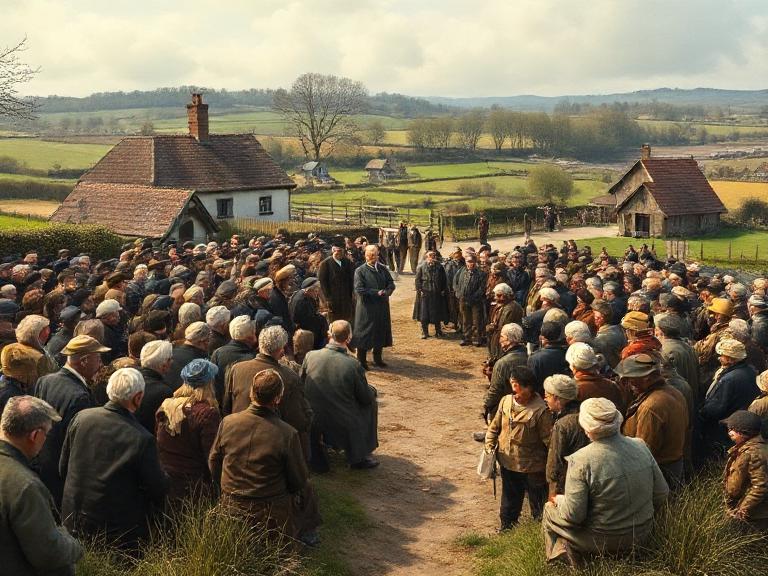
Agrarian agitation has become especially influential across Connacht and parts of Munster, where tenant farmers, smallholders and agricultural labourers continue to demand a fairer distribution of Irish land. County Limerick has not escaped the dispute. Rural families living on cramped or uneconomic holdings have watched substantial grazing farms occupy fertile ground while labourers struggle to secure cottages, gardens and dependable employment. Meetings connected with the United Irish League have provided an organised outlet for grievances concerning rents, evicted tenants, disputed farms and the slow progress of land purchase under legislation already introduced by Westminster.
The agitation is strongest where poverty and unequal landholding exist beside extensive cattle-grazing properties. In Connacht, the United Irish League has drawn support from communities seeking the enlargement of small farms through the redistribution of grazing land. Similar arguments carry considerable force in Munster, including County Limerick, where farming conditions vary sharply between prosperous districts and families dependent upon small plots or seasonal labour. Supporters maintain that the land should sustain resident families rather than remain concentrated in large holdings producing cattle for sale. Opponents warn that public pressure may intimidate lawful occupiers and disturb rural order.
William O’Brien’s United Irish League, founded in County Mayo in 1898, has rapidly expanded beyond its western base and linked the land question with the wider reunion of constitutional nationalism. Its branches encourage local organisation, public meetings and collective pressure against those accused of occupying evicted or disputed farms. The movement’s language of land redistribution has attracted tenants and poorer farmers, although agricultural labourers sometimes fear that their own demands will be subordinated to those of established tenant farmers. In County Limerick, labour organisers have insisted that cottages, wages and access to land must remain central to any meaningful rural reform.
The campaign has also revived bitter memories of eviction and the earlier Land War. Families dispossessed during previous decades remain powerful symbols at nationalist gatherings, while men described as land grabbers may face boycotting or social isolation. Such methods divide opinion even among people sympathetic to land reform. Clergy, shopkeepers, farmers and political organisers must decide how far agitation may proceed without becoming coercion. Royal Irish Constabulary officers continue to observe meetings and investigate complaints, while landlords and graziers demand protection for property and contracts. The countryside therefore remains outwardly quiet but politically charged, with old grievances moving into newly organised channels.
For Limerick’s rural communities, the controversy reaches beyond parliamentary speeches and nationalist unity. It concerns whether young families can obtain viable farms, whether labourers can secure decent homes, whether evicted tenants may be restored and whether ownership can replace insecure tenancy. The unequal distribution of land has made agrarian reform inseparable from poverty, emigration and local power. Connacht remains the agitation’s principal centre, but its spread through Munster demonstrates that the dispute is national in scale. Unless the government accelerates land purchase and addresses untenanted grazing estates, rural organisation and confrontation are likely to remain defining features of Irish public life.
- House of Commons Debates, “Irish Land Question,” 23 January 1902, vol. 101. The debate reviews the origins, organisation and methods of the United Irish League from 1898 onward.
- Inspector-General of the Royal Irish Constabulary, monthly reports for 1900 concerning agrarian organisation, United Irish League activity and public order. Exact report, archive reference, page and folio should be confirmed before formal citation.
- Limerick Chronicle, 1900, reports concerning tenant meetings, grazing disputes, evicted tenants, rural labour and United Irish League organisation in County Limerick. Exact issue, page and column should be confirmed before formal citation.
- Freeman’s Journal, 1900, reports concerning the United Irish League, agrarian meetings and the land campaign in Connacht and Munster. Exact issue, page and column should be confirmed before formal citation.
- The Irish People, 1900, reports and political commentary supporting the United Irish League and its programme of agrarian reform. Exact issue, page and column should be confirmed before formal citation.