Shannon Retreat
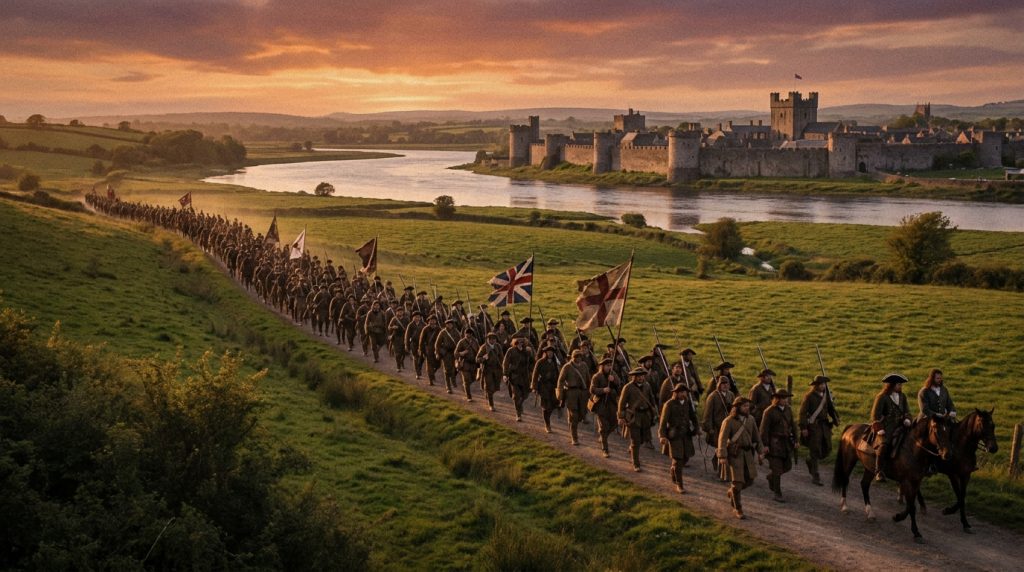
Limerick became one of the principal centres of Jacobite resistance after William III’s victory at the Boyne on 1 July 1690 forced the Irish army to abandon the eastern approaches to Dublin. James II departed for France, but most of his surviving soldiers remained under arms and withdrew westwards towards the River Shannon. Some gathered around Athlone, which guarded an important crossing into Connacht, while the larger concentration developed around Limerick. The city’s walls, river position and access to the western counties offered the Jacobites a defensible base from which the war might continue despite the loss of Dublin.
William did not allow the retreating army to reorganise without pursuit. He divided his forces, sending Lieutenant-General James Douglas towards Athlone while leading the principal Williamite army along the southern approach towards Limerick. Later narratives differ over the exact number of regiments detached with Douglas, but the force included substantial bodies of cavalry and infantry. The division reflected William’s intention to threaten both major Shannon strongholds at once. Athlone controlled the central crossing, while Limerick commanded the lower Shannon and remained capable of receiving troops, provisions and assistance from the Jacobite-held counties of western Ireland.
Douglas appeared before Athlone on 17 July and demanded its surrender. Colonel Richard Grace, the veteran Jacobite governor, had abandoned the less defensible eastern portion of the town and destroyed part of the bridge connecting it with the fortified western bank. Douglas opened a bombardment and attempted to overcome the Shannon defences, but his artillery and supplies were insufficient for a prolonged operation. The Jacobite garrison resisted firmly, while reports that cavalry might be approaching from the direction of Limerick increased the danger of remaining before the town. Douglas withdrew on 24 July without capturing the western fortress.
The resistance at Athlone gave the Jacobites valuable time to strengthen Limerick and gather the remnants of their field army. Within the city, military officers, French advisers, civic inhabitants and displaced supporters of James confronted difficult questions of command, defence and negotiation. Some senior figures doubted whether continued resistance could succeed, while others believed the Shannon line offered the only honourable and practical alternative to surrender. Limerick consequently became more than a refuge. Its possession determined whether the Jacobites could preserve an organised army, maintain authority across much of Connacht and Munster, and prevent William from claiming complete control of Ireland.
Douglas eventually moved south to rejoin William, whose main force reached the neighbourhood of Limerick in early August. The failure at Athlone demonstrated that the Shannon could not be crossed merely by appearing before its fortified towns, while the concentration at Limerick prepared the ground for the first great siege of the city. William expected that the retreat from the Boyne had broken Jacobite resistance, but the western army had not dissolved. Its withdrawal brought the war directly to Limerick, where soldiers and civilians would soon face bombardment, assault, hunger and the prospect that the city’s survival might determine the future of the Jacobite cause.
- George Warter Story, An Impartial History of the Wars of Ireland, with a Continuation Thereof, London: Richard Chiswell, 1693.
- John Stevens, The Journal of John Stevens, Containing a Brief Account of the War in Ireland, 1689–1691, edited by Robert H. Murray, Oxford: Clarendon Press, 1912.
- John Childs, The Williamite Wars in Ireland, 1688–1691, London: Hambledon Continuum, 2007, Chapter 14, “From Dublin to Limerick.”
- J. G. Simms, Jacobite Ireland, 1685–1691, London: Routledge and Kegan Paul, 1969.
- Pádraig Lenihan, “The Marquis de Boisseleau and the ‘Battle of the Breach’ at the First Siege of Limerick, 1690,” History Ireland, vol. 21, no. 4, July–August 2013.