Archived: 3 October 2026
Abstract
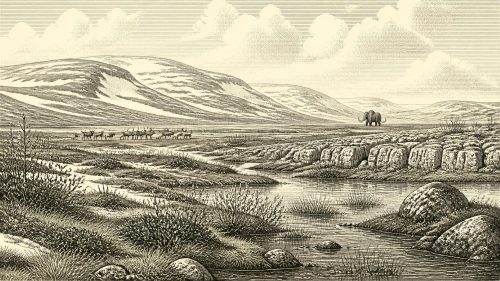
The modern label 30,324 BCE denotes no identifiable event in Ireland’s unwritten deep past. Evidence belongs broadly to Marine Isotope Stage 3, a climatically unstable pre-maximum glacial period. Castlepook Cave in County Cork preserves bones of mammoth, reindeer and other cold-stage animals, though deposits were disturbed and specimens differ greatly in age. A reindeer femur bears a possible fresh-bone stone-tool butchery mark, potentially Ireland’s earliest human trace, but not proof of settlement. Open tundra-like habitats, wetlands and shifting ice margins formed regional mosaics; lowered seas altered access without certainly creating a land bridge. The bone suggests mobile Upper Palaeolithic visitors.
Read Article
Archived: 3 October 2026
Abstract
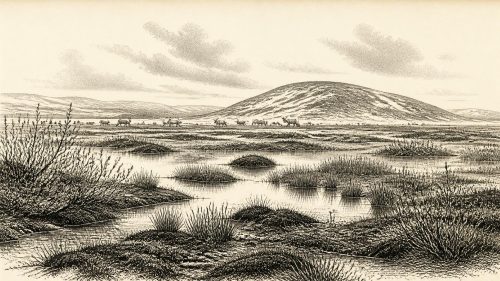
Thirty thousand three hundred and thirty-two BCE is a modern chronological label within a broad, uncertain Late Pleistocene interval, not a recoverable Irish year. Derryvree, County Fermanagh, records a cold, treeless freshwater wetland between glacial advances, demonstrating locally open, wet tundra conditions. Cave deposits, especially at Castlepook, County Cork, contain reindeer, mammoth, hyaena and other fauna, although dates and contexts remain imperfect. A reindeer femur with a linear mark, interpreted by Ruth Carden as stone-tool butchery, may be Ireland’s earliest human evidence. It cannot prove settlement. Together, environmental and faunal archives show a climatically variable landscape, ice and human presence.
Read Article

Archived: 30 September 2026
Abstract
Around 30,456 BCE, Ireland cannot be described through exact events or populations, but through uncertain environmental evidence. Organic silts at Derryvree, County Fermanagh, dated broadly to Marine Isotope Stage 3, record a cold, treeless freshwater landscape of mosses, sedges and tundra plants between glacial advances. Castlepook Cave, County Cork, yielded reindeer, giant deer, mammoth and hyaena remains, demonstrating Ice Age fauna before the Last Glacial Maximum. A cut-marked reindeer femur may indicate Upper Palaeolithic butchery and a brief human visit, not permanent settlement. Later ice expansion reshaped and destroyed evidence, leaving fragmentary records of habitats, animal movements and possible visits.
Read Article

Archived: 9 September 2026
Abstract
31,934 BCE is a modern label for Late Pleistocene Ireland, not a date for a documented event. During unstable MIS 3 conditions, Ireland was probably partly ice-free, with cold open habitats, altered coastlines and increasingly severe glaciation approaching. Castlepook Cave in County Cork preserves fauna, including reindeer, mammoth, bear, wolf and hyaena, accumulated across long periods. A reindeer femur reportedly bears a stone-tool butchery mark dated about 33,000 BCE, offering tentative evidence of a human visit. Disturbed deposits and lacking associated artefacts prevent claims of settlement. No direct evidence supports Irish society, culture or occupation; dating and excavation are required.
Read Article

Archived: 8 September 2026
Abstract
31,954 BCE is a notional date within MIS 3, not a recorded Irish year. Ireland then comprised volatile Late Pleistocene environments supporting cold-adapted fauna, including reindeer, mammoth, giant deer and carnivores, before the Last Glacial Maximum. Castlepook Cave, County Cork, provides a possible earliest human trace: a reindeer femur with a mark plausibly made by a stone tool during butchery. Poorly recorded early excavations, disturbed cave deposits and uncertain dating prevent stronger conclusions about settlement, hunting or access routes. No evidence supports communities, culture or politics. Later glaciation obscured evidence; secure sustained settlement begins only in the Mesolithic millennia later.
Read Article