Ruth Carden’s Cut Mark31934 BCE
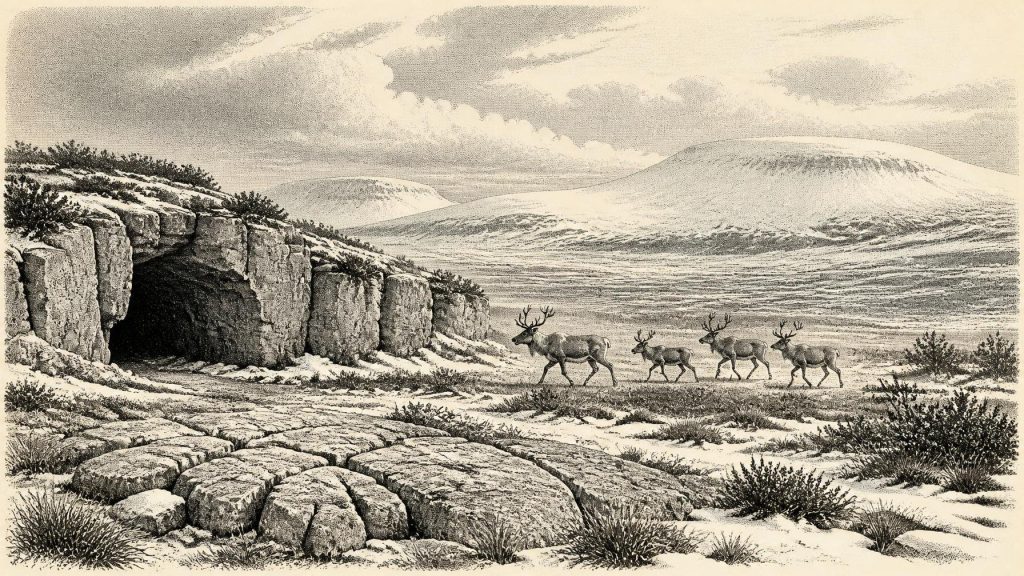
31,934 BCE is a modern label for Late Pleistocene Ireland, not a date for a documented event. During unstable MIS 3 conditions, Ireland was probably partly ice-free, with cold open habitats, altered coastlines and increasingly severe glaciation approaching. Castlepook Cave in County Cork preserves fauna, including reindeer, mammoth, bear, wolf and hyaena, accumulated across long periods. A reindeer femur reportedly bears a stone-tool butchery mark dated about 33,000 BCE, offering tentative evidence of a human visit. Disturbed deposits and lacking associated artefacts prevent claims of settlement. No direct evidence supports Irish society, culture or occupation; dating and excavation are required.
Dateline
A Calendar Label, Not an Event
“31,934 BCE” is a modern way of naming a point far beyond the reach of any Irish calendar, written record or year-by-year archaeological sequence. It must not be treated as the date of a known event. In the conventional archaeological system of years before present, where “present” means 1950, it corresponds broadly to about 33,884 years ago. That places Ireland in the Late Pleistocene, within Marine Isotope Stage 3 (MIS 3), a climatically unstable interval of the last Ice Age.
Modern calendar-year precision is not available for Ireland at this depth of time. Radiocarbon determinations are measurements with statistical uncertainty, not dates in an ancient calendar; they also require calibration against changing atmospheric radiocarbon levels. Where evidence is securely dated, archaeologists therefore use calibrated ranges, normally expressed as cal BP. The responsible question is not what happened in Ireland in one notional year, but what the surviving geological, animal and archaeological evidence can illuminate about the island around the thirty-fourth millennium before present.
The answer is necessarily cautious. Ireland was not the green, wooded island familiar today, and it had no recorded inhabitants, named peoples, rulers, settlements or monuments. Yet it was not simply a blank on the map. Cave deposits, animal bones, glacial landforms and regional reconstructions show that the island lay within a changing north-west European Ice Age world. The closest possible clue to human activity is a reindeer bone from Castlepook Cave in north County Cork, reported as about 33,000 BCE and bearing a mark interpreted as stone-tool butchery. Its importance is considerable, but its limitations are equally important.
Ireland Before Full Glaciation
At this approximate date, Ireland was entering the severe phase that culminated in the Last Glacial Maximum, but the maximum lay in the future. The British–Irish Ice Sheet did not grow as one uniform mass at a single moment. Recent reconstructions describe rapid expansion after about 31,000 cal BP, while evidence from uplands in central and northern Ireland indicates that some ground remained ice-free until at least roughly 34,000 years ago. Other research summarises Ireland as largely ice-free until around 32,000 cal BP before later full glaciation. Such conclusions are reconstructions with regional uncertainty, not a weather report for a particular day in 31,934 BCE.
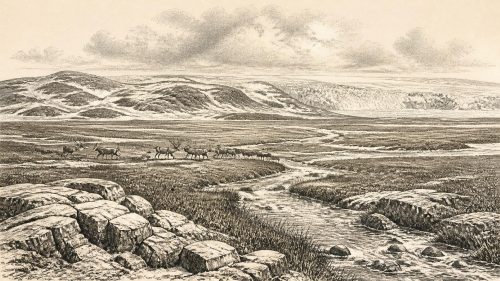
The crucial implication is that the island should not automatically be pictured as entirely buried beneath ice at this earlier point. Some uplands may already have held glaciers or perennial snowfields, while exposed lowlands and coastal areas could have supported cold-climate vegetation and mobile animal populations. Ice margins, meltwater, windblown sediment and freeze-thaw processes changed landscapes repeatedly. The later advance of ice would erode, rework or bury much earlier ground surface, helping to explain why the Irish record of this period is so meagre.
Sea level was substantially lower than today because much of the world’s water was locked in northern ice sheets. The outlines of the Irish Sea basin, shorelines and possible routes between Ireland, Britain and continental Europe were therefore different. It is safest not to call this a simple land bridge. Whether a particular route was dry ground, ice, water, estuary, coastal plain or a difficult combination of these depended on time and locality. Any visitors reaching Ireland would have crossed a demanding, changeable northern landscape rather than travelled through a stable, familiar country.
The Animal Evidence
The strongest direct evidence for Ireland around this broad period is palaeontological. Castlepook Cave, near Doneraile, is especially important because its excavations produced one of the island’s richest collections of Pleistocene vertebrate remains. The collection includes animals associated with cold, open environments and with the great ecological fluctuations of MIS 3: reindeer, giant deer, brown bear, wolf, Arctic fox, lemmings, woolly mammoth and spotted hyaena are among the species identified from the cave assemblage.
That list must not be turned into a single tableau. Cave deposits accumulated over long periods; bones may have been brought in by carnivores, moved by water, disturbed by sediment collapse or collected during early twentieth-century excavations whose recording standards cannot answer every modern question. Re-dating work has shown that some older Irish cave determinations were significantly inaccurate because of earlier laboratory methods and bone-treatment procedures. The fauna proves that these animals reached Ireland at different points in the Late Pleistocene; it does not prove that every species grazed or hunted together in northern Cork in 31,934 BCE.
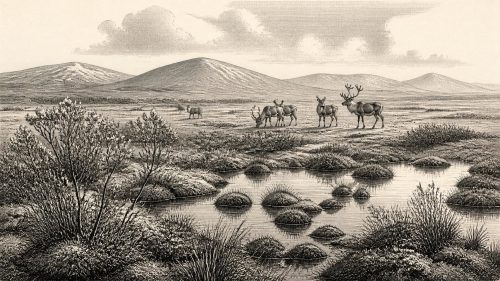
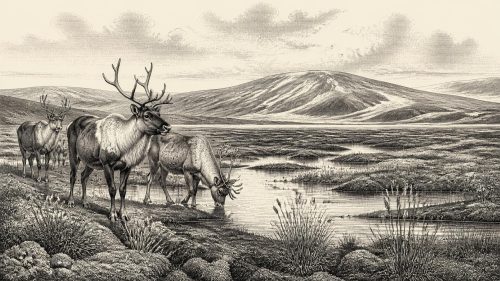
Nevertheless, reindeer provide a historically supportable focus. Their presence points towards open, cold-country habitats rather than broad forest. Such landscapes could include grasses, herbs, sedges, dwarf shrubs and sparse patches of woody vegetation, varying sharply with moisture, altitude and short-term climatic shifts. Large herbivores would have been valuable prey for human groups elsewhere in north-west Europe, while wolves and hyaenas were competitors and scavengers. The Irish evidence indicates a landscape capable, at intervals, of sustaining substantial mammals, but it does not demonstrate a settled human economy.
The Castlepook Question
A reindeer femur from Castlepook has been reported by researcher Ruth Carden and by Cork heritage publications as carrying a cut mark made with a sharp stone tool when the animal was butchered. It has been presented as dating to approximately 33,000 BCE. If that interpretation is confirmed, it would be the closest evidence presently known for human activity in Ireland around the date considered here: not a village or a population census, but an episode in which people processed a reindeer carcass.
The distinction is fundamental. No securely associated stone-tool assemblage, hearth, dwelling surface, burial, artwork or human skeleton of this age has been published from Ireland. Nor has a stratified settlement demonstrated enduring occupation in the thirty-second millennium BCE. Castlepook’s deposits have a complicated history, and the original large-scale excavations took place between 1904 and 1913. Much of the collection lacks the tightly controlled context that a modern excavation would provide. The cut-mark interpretation is therefore best described as important, promising evidence for a possible Upper Palaeolithic visit or short-lived activity, rather than proof of permanent colonisation.
The contrast with the better-established evidence from Alice and Gwendoline Cave in County Clare is instructive. There, a brown-bear patella with clear lithic-tool cut marks was independently radiocarbon dated to calibrated ranges of 12,810–12,590 and 12,810–12,685 cal BP. That much later find is peer-reviewed evidence of human presence in terminal Pleistocene Ireland. It cannot be projected backwards to 31,934 BCE. Instead, it shows why careful examination, direct dating, taphonomic study and scepticism about disturbed cave deposits are essential to the story of Ireland’s earliest people.
People, Society and Everyday Life
If people did reach Ireland around this time, they were mobile hunter-gatherers in the broad Upper Palaeolithic world of north-west Europe. A reindeer carcass could have supplied meat, fat, marrow, hide, sinew and bone. But this is a reasonable interpretation of the economic value of an animal, not a demonstration of precisely how Castlepook’s reindeer was used. The surviving evidence cannot identify the number of people involved, their season of arrival, their route, their language, their tool kit or whether they returned.
There is no basis for speaking of Irish tribes, Gaelic ancestry, chieftains, political alliances, diplomacy, formal warfare or territorial states. Nor is there Irish evidence at this date for farming, herding, fields, houses, pottery, metalworking, monuments, graves or a trade system. Stone tools and ornaments from contemporary communities elsewhere in Europe provide useful context for the technological abilities of Homo sapiens, but they cannot be assigned to Ireland without Irish finds. It would be equally unwarranted to import the cave art, ritual customs or social arrangements of France, Iberia or central Europe into a Cork cave.
Conflict is similarly invisible. People and predators may have competed for carcasses and shelter, but no weapon assemblage, injury pattern or fortified place allows historians to describe organised violence on the island. Diplomacy, in any recognisable political sense, belongs to societies for which no evidence exists here. The decisive forces shaping life were environmental: cold, seasonality, scarce shelter, animal movement and the approaching expansion of ice.
Religion, Culture and Knowledge
No religious site, artistic image, musical instrument, personal ornament or burial can responsibly be dated to Ireland around 31,934 BCE. It follows that there is no direct Irish evidence for ceremony, belief, teaching or symbolic culture at this time. This silence should not be mistaken for proof that visitors, if present, had no beliefs or knowledge. Upper Palaeolithic peoples elsewhere possessed sophisticated skills in hunting, toolmaking, material working and environmental observation. They may have brought such capacities to Ireland, but the island’s record has not preserved evidence that permits specific claims.
The real cultural achievement visible today is modern scientific recovery. Researchers combine zooarchaeology, microscopic analysis of bone surfaces, accelerator mass spectrometry, calibrated radiocarbon chronologies, sediment study and glacial geomorphology to extract evidence from very fragmentary remains. The history of Castlepook also demonstrates the value of museum collections: bones excavated generations ago can yield new questions and new results when examined with methods unavailable to their first collectors.
An Island in Transition
For Ireland, this was an era of possibility rather than continuity. Animal populations reached the island during milder phases, while the land was becoming increasingly exposed to the climatic deterioration that would produce the great ice-sheet expansion. Any human presence was, on present evidence, intermittent at most. The archaeological record does not allow a year-specific narrative, but it does reveal Ireland as part of the shifting ecological frontier of Ice Age Europe.
Thus 31,934 BCE should be remembered not for a named Irish event, but for the deep prehistory it represents: an Ireland of cold open ground, cave-dwelling carnivores and large herbivores; an island whose landscapes were about to be drastically reshaped by ice; and a period in which one disputed yet significant reindeer bone may preserve the faintest trace of human activity. Further secure excavation and direct dating may clarify the picture. Until then, restraint is not a gap in the history: it is the most accurate account of what the evidence can bear.
Primary Sources
- A reconsideration of the radiocarbon dating of the Marine Isotope Stage 3 fauna from southern Ireland
- The Irish Quaternary Fauna Project
- Growth and retreat of the last British–Irish Ice Sheet, 31,000 to 15,000 years ago: the BRITICE-CHRONO reconstruction
- Growth and retreat of the last British–Irish Ice Sheet, 31,000 to 15,000 years ago: the BRITICE-CHRONO reconstruction
- Trimlines, blockfields and the vertical extent of the last ice sheet in southern Ireland
- Extent and deglacial chronology of the last British–Irish Ice Sheet: implications of exposure dating using cosmogenic isotopes
- Timing and pace of ice-sheet withdrawal across the marine-terrestrial transition west of Ireland during the last glaciation
- Radiocarbon constraints on the age of the maximum advance of the British-Irish Ice Sheet in the Celtic Sea
- Anthropogenic changes to the Holocene nitrogen cycle in Ireland
- Prehistoric Details
- Heritage Artefacts of County Cork
- Archaeological Heritage of County Cork
- 2022:564 – Castlepook Cave, Castlepook South, Cork
- First evidence of a Late Upper Palaeolithic human presence in Ireland
- New insights on the fauna of Ireland's Younger Dryas and Early Holocene from Alice & Gwendoline Cave
- The IntCal20 Northern Hemisphere Radiocarbon Age Calibration Curve (0–55 cal kBP)
- IntCal
- Outreach and Education Resources
- Figure 6: The Subdivision of the Quaternary Period in Ireland
- Geological Mapping Programme
- The Mesolithic in Ireland: when was it?
- First evidence of a Late Upper Palaeolithic human presence in Ireland