Ruth Carden’s Reindeer Femur30456 BCE
Around 30,456 BCE, Ireland cannot be described through exact events or populations, but through uncertain environmental evidence. Organic silts at Derryvree, County Fermanagh, dated broadly to Marine Isotope Stage 3, record a cold, treeless freshwater landscape of mosses, sedges and tundra plants between glacial advances. Castlepook Cave, County Cork, yielded reindeer, giant deer, mammoth and hyaena remains, demonstrating Ice Age fauna before the Last Glacial Maximum. A cut-marked reindeer femur may indicate Upper Palaeolithic butchery and a brief human visit, not permanent settlement. Later ice expansion reshaped and destroyed evidence, leaving fragmentary records of habitats, animal movements and possible visits.

Dateline
The label 30,456 BCE gives a useful point on a modern timeline, but it cannot identify an event in Ireland that happened in a recoverable calendar year. No written record, settlement sequence or annually resolved archaeological deposit allows that degree of precision. In archaeological terms, the date lies about 32,405 years before AD 1950, in the later part of Marine Isotope Stage 3, during the last glacial period and before the fullest expansion of the Last Glacial Maximum. The responsible history of Ireland at this point is consequently a history of ranges, deposits and probabilities rather than named people or dated deeds.
The best Irish evidence relevant to this broad horizon comes from two very different kinds of archive. At Derryvree, near Maguiresbridge in County Fermanagh, freshwater organic silts survived between layers of glacial till. At Castlepook Cave, near Doneraile in County Cork, excavators recovered the bones of Ice Age animals. Together they show that parts of Ireland could, at different times before the later ice-sheet maximum, sustain cold-climate ecosystems. They do not show that every part of the island shared the same conditions in 30,456 BCE, nor do they prove a settled human population.
A Date Within a Range
The key Derryvree radiocarbon determination, conventionally known as BIRM-166, was obtained from the organic freshwater deposits and reported as 30,500 radiocarbon years before present, with a substantial error range. When calibrated, it falls broadly within approximately 36,900–31,700 calendar years before present. The modern date-label 30,456 BCE lies within that very wide calibrated span, but it must not be mistaken for the age of every seed, moss fragment or insect in the bed. Nor can it identify a particular season in which the basin was open water. The deposit accumulated over time; its age is an estimate with a range, not a historical timestamp.
Its stratigraphic position is crucial. Till below records an earlier episode of glacier ice; the organic silts record a period when this Fermanagh locality was not buried by an active ice sheet; till above records a later return of glacial conditions. That is direct geological evidence for environmental change. The further conclusion—that Derryvree represents an interstadial interval in a changing late-Pleistocene climate—is a well-supported interpretation, but it remains an interpretation of layered sediments, dating and regional comparison.
A Treeless Freshwater World
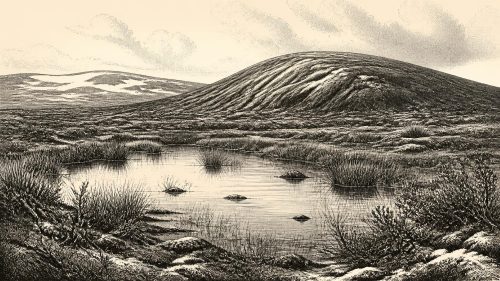
The Derryvree material points to a cold, open and wet landscape rather than a familiar green Ireland. Plant macrofossils, pollen and associated environmental evidence have been read as a tundra or muskeg mosaic: shallow freshwater, wet margins, mosses, sedges and sparse low-growing vegetation. Finds reported from the sequence include bogbean (Menyanthes trifoliata), dwarf willow, mountain-avens and lesser clubmoss. Such plants do not conjure a continuous carpet of identical vegetation. They indicate a patchwork of favourable microhabitats around pools, saturated ground and exposed mineral soils under a harsh periglacial climate.
The presence of bogbean is especially revealing. It is a plant of wet ground and shallow water margins, so its fossil seed is tangible evidence that liquid freshwater existed locally during the deposit’s formation. It does not imply mild conditions or a densely vegetated marsh. In a landscape with long winters, frost-disturbed soils and little or no woodland, sheltered hollows could preserve standing water while surrounding ground remained exposed, thinly vegetated and seasonally severe.
At the scale of the island, conditions were neither static nor uniform. Later reconstructions of the British–Irish Ice Sheet show rapid and regionally asynchronous growth: some ice sectors expanded early, while others advanced later or behaved differently because of topography and marine margins. Around this broad period, Ireland was moving towards far more extensive glaciation. It would be misleading, therefore, to depict the whole island either as a single ice cap or as wholly hospitable open country. Derryvree provides a local window; ice-sheet reconstructions supply the larger, changing frame.
Animals and the Cave Record
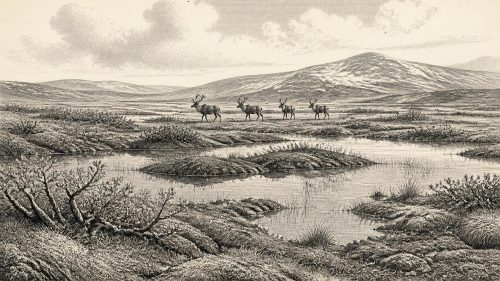
The cave evidence from southern Ireland confirms that sizeable mammals reached the island during Marine Isotope Stage 3. Castlepook Cave, also called Mammoth Cave, has yielded remains attributed to animals including reindeer, giant deer, mammoth and spotted hyaena. The collection was formed over a considerable period and under processes that included carnivore activity, water movement and the disturbance inherent in early excavations. A species list from the cave is therefore not a census of one valley, one season or one contemporaneous herd.
Recent re-dating has been important. Improved pretreatment and accelerator radiocarbon techniques produced ages for some Castlepook fauna substantially older than earlier determinations had suggested, placing significant elements of the assemblage in Marine Isotope Stage 3. This strengthens the case that cold-stage mammals occupied or passed through parts of Ireland before the Last Glacial Maximum. It also cautions against using old museum collections as though their chronology were settled once and for all: revised methods can change the chronological picture markedly.
Reindeer are the most historically consequential animals in this discussion because one femur from Castlepook bears a deep linear mark interpreted by zooarchaeologist Ruth Carden as damage made by a sharp stone tool on a fresh carcass. The bone has been publicly described as about 33,000 years old. If the interpretation of the incision is correct, it is evidence that a person processed a reindeer in Ireland during the Upper Palaeolithic. It is an extraordinary possibility—but it needs to be stated at its proper scale. The femur is not a house floor, a hearth, a toolkit, a burial, a camp or proof of continuous occupation.
People: A Possible Visit, Not a Population
There is no basis for naming a people in Ireland in 30,456 BCE, assigning them an ethnicity, or treating them as ancestors of later Irish communities. There is also no secure evidence for a permanent population at this date. The most that can responsibly be said is that the marked Castlepook femur may record a brief human encounter with an animal carcass during the wider period. If so, the people concerned were mobile Upper Palaeolithic hunter-gatherers capable of reaching a cold, unstable north-western edge of Europe and using sharp stone tools. Whether they came as a small hunting party, scavenged an already dead animal, or visited only intermittently cannot be recovered from the available evidence.
That restraint matters because later glaciation was destructive. Ice erosion and redeposition can remove, scatter or bury traces of camps, paths and shorelines. The absence of surviving camps is thus not proof that nobody ever entered Ireland; equally, destruction cannot be used to turn a single marked bone into evidence for widespread settlement. Archaeology must hold both propositions together: the record is incomplete, and its surviving material remains limited.
No Polities, but Real Connections
Political affairs, diplomacy and organised warfare leave no identifiable evidence for Ireland at this depth of time. There were no known kingdoms, borders, institutions or written agreements. Even the word “Ireland” requires care: it is a modern name for an island whose coastlines, neighbouring seas and glacial connections differed from those of today. Lower global sea level exposed more of the continental shelves, although routes through the Irish Sea region were shaped not only by sea level but by ice, changing drainage and dangerous coastal environments.
Connections nevertheless mattered. Animals, people and ice all moved through a wider British–Irish and north-west European world. The same climate fluctuations that affected Ireland altered vegetation, animal ranges and possible routes elsewhere. A reindeer carcass in a Cork cave and freshwater plants in Fermanagh do not demonstrate trade or diplomacy, but they show that Ireland was not ecologically isolated. Its populations of animals, and any occasional human visitors, formed part of wider movements across changing landscapes.
Everyday Life Beyond Recovery
Nothing allows us to reconstruct a typical household, diet or belief system in Ireland for this date. No Irish dwelling, cooking hearth, clothing fragment, ornament, grave, art panel or structured ritual deposit has been securely tied to this particular horizon. If humans did visit, their practical concerns may have included shelter from weather, stone-tool maintenance, carcass processing and moving through terrain where food and water were unevenly distributed. These are reasonable inferences from Upper Palaeolithic lifeways and the possible butchery mark, not observations of an Irish camp.
Religion, learning and culture are similarly beyond direct demonstration. The cave should not automatically be described as a shrine, and the reindeer bone should not automatically be made into a ceremonial object. Its importance is more fundamental: it may preserve a fleeting physical trace of human action at a time when nearly all human stories have been erased. Derryvree, meanwhile, preserves an ecological story—water, plants, sediment and returning ice—whose scale is longer than a human lifetime.
On the Edge of Expansion
For Ireland, the principal development around 30,456 BCE was environmental instability on the approach to major glaciation. The freshwater episode represented at Derryvree belongs to a period before renewed ice covered the locality. Across the following millennia, the British–Irish Ice Sheet expanded greatly, reshaping land surfaces and limiting the habitats available to plants, animals and people. The Last Glacial Maximum was still ahead in its greatest Irish extent, but its approach is the essential context.
This is therefore not a year of rulers or battles. It is a cautiously dated interval in which Fermanagh preserves a cold freshwater landscape and Cork preserves the remains of Ice Age fauna, perhaps including the mark of human hands. The evidence is fragmentary, local and often uncertain. Yet it establishes something important: long before the later recolonisation of post-glacial Ireland, this island’s changing margins held water, tundra plants and large mammals, and may have received rare human visitors.
Primary Sources
- A reconsideration of the radiocarbon dating of the Marine Isotope Stage 3 fauna from southern Ireland
- The Irish Quaternary Fauna Project
- A Middle Midlandian Freshwater Series at Derryvree, Maguiresbridge, County Fermanagh, Northern Ireland
- Figure 6.— The Subdivision of the Quaternary Period in Ireland
- Growth and retreat of the last British–Irish Ice Sheet, 31,000 to 15,000 years ago: the BRITICE-CHRONO reconstruction
- BRITICE-CHRONO Maps and GIS Data of the Last British-Irish Ice Sheet 31 to 15 ka
- Trimlines, Blockfields and the Vertical Extent of the Last Ice Sheet in Southern Ireland
- Deglaciation Chronology of the Donegal Ice Centre, North-west Ireland
- The Colonization of Ireland: A Human Ecology Perspective
- Anthropogenic Changes to the Holocene Nitrogen Cycle in Ireland
- The Late Quaternary History of East-central Ireland
- Introduction to the Glacial Sand and Gravel Landscapes of Northern Ireland
- Menyanthes trifoliata
- HERITAGE ARTEFACTS of County Cork
- Phylogeographic, Ancient DNA, Fossil and Morphometric Analyses Reveal Ancient and Modern Introductions of a Large Mammal: The Complex Case of Red Deer (Cervus elaphus) in Ireland
- Reconstruction and 36Cl Based Geochronology of the Deglaciation of Central Ireland
- New Insights on the Fauna of Ireland’s Younger Dryas
- Ice Age Ireland
- BRITICE-CHRONO: Constraining the Retreat of the Last British-Irish Ice Sheet
- Landscapes and Environments of the Last Glacial-interglacial Transition: A Time of Amazingly Rapid Change in Ireland