Ruth Carden’s Linear Mark30332 BCE
Thirty thousand three hundred and thirty-two BCE is a modern chronological label within a broad, uncertain Late Pleistocene interval, not a recoverable Irish year. Derryvree, County Fermanagh, records a cold, treeless freshwater wetland between glacial advances, demonstrating locally open, wet tundra conditions. Cave deposits, especially at Castlepook, County Cork, contain reindeer, mammoth, hyaena and other fauna, although dates and contexts remain imperfect. A reindeer femur with a linear mark, interpreted by Ruth Carden as stone-tool butchery, may be Ireland’s earliest human evidence. It cannot prove settlement. Together, environmental and faunal archives show a climatically variable landscape, ice and human presence.
Dateline
“30,332 BCE” is a useful modern filing point, not a year for which Ireland’s deep past can be reconstructed event by event. No written calendar, named community, ruler or dated incident survives from this period. The responsible view is therefore regional and probabilistic. This point lies in the Late Pleistocene, within Marine Isotope Stage 3 and before the Last Glacial Maximum. The evidence consists chiefly of cave bones, buried wetland sediments, pollen and plant macrofossils, cave mineral deposits, landforms and radiocarbon measurements. These can illuminate ranges of centuries or millennia; they cannot identify what happened in Ireland in one particular calendar year.
A Date Within Broad Ranges
At this depth of time, dating requires care. Radiocarbon years before present are counted from AD 1950 and are not identical to calendar years. Their conversion depends upon calibration curves, and the resulting ranges can be wide. The famous organic sediment at Derryvree near Maguiresbridge, County Fermanagh, produced the conventional radiocarbon determination BIRM-166: 30,500 years BP, with a substantial uncertainty. When calibrated, it belongs broadly to a span of roughly 36,900–31,700 calibrated years BP, or approximately 34,950–29,750 BCE. Thus 30,332 BCE sits within the wide chronological horizon relevant to the deposit, but it cannot be assigned to a particular season, pool, animal or human action represented there.
That distinction matters especially because the final major expansion of the British–Irish Ice Sheet came later. Research on the ice sheet’s maximum extent generally places its most extensive phases in the later part of the last glacial cycle, around 27,000–23,000 years ago in many sectors, with regional advances and retreats not everywhere synchronous. Ireland around this article’s nominal date was therefore not simply an island buried beneath uniform ice. It was a changing northern landscape: some areas were glaciated earlier or locally, others retained ice-free or ice-marginal ground, and conditions could alter sharply across relatively short distances and long spans of time.
Derryvree’s Buried Wetland
The Derryvree sequence is among the clearest Irish witnesses to this complicated world. Roadworks through a drumlin exposed lower till, then organic freshwater silts and sands, followed by a further thick till. Till is unsorted debris laid down by glacier ice. The ordering of these layers demonstrates that ice had occupied the locality, that a period of open water and sediment accumulation followed, and that ice later returned or advanced across the site. It does not prove that all of Ireland followed the same sequence at the same time.
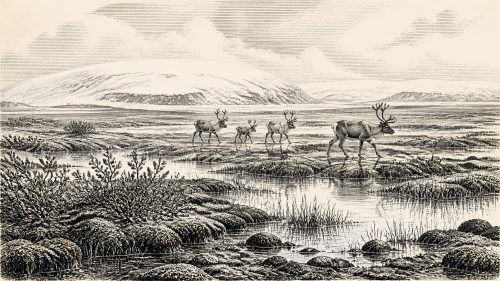
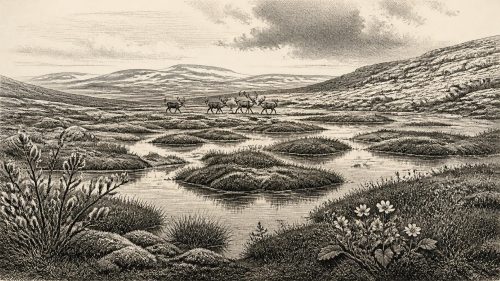
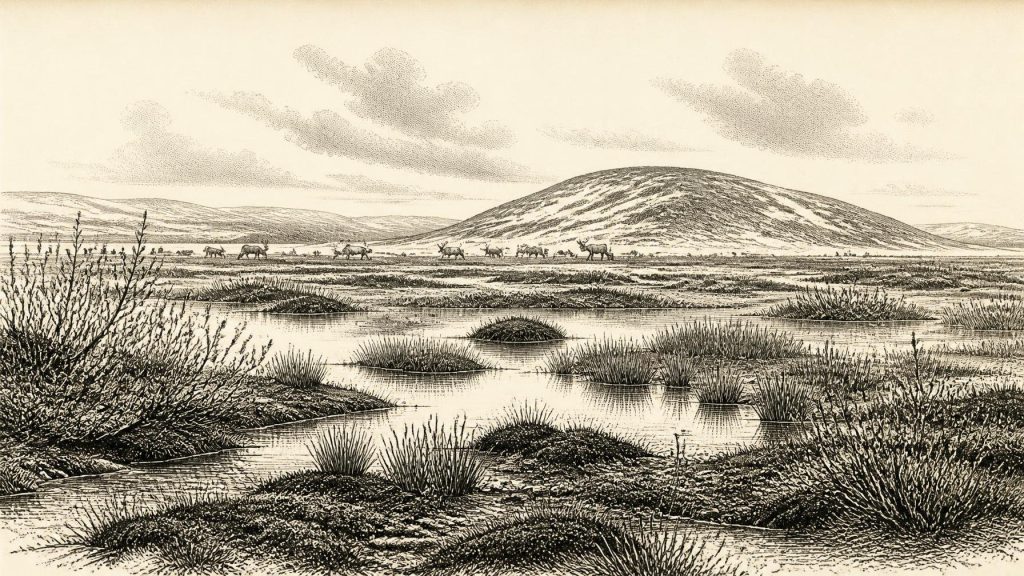
Fossil plant remains from the organic beds point to a cold, treeless wetland or muskeg, rather than woodland. Sedges, mosses, dwarf willow, mountain avens, bogbean and aquatic water-milfoil indicate damp ground, pools and shallow freshwater, with open tundra-like surroundings. Such a plant community implies summer growth and liquid water, even in an overall severe climate. It also cautions against imagining either a lifeless white wilderness or a modern Irish bog. The terrain was probably a patchwork of wet depressions, mossy margins, mineral-rich water, gravelly or silty ground and exposed vegetation, vulnerable to frost action and changing drainage.
The record is environmental rather than social. It tells us that plants grew and sediments accumulated at one Fermanagh locality during an interval between glacial episodes. It does not reveal a village, a route, a language or a boundary. Nonetheless, it is invaluable: the survival of such delicate macrofossils beneath later ice makes Derryvree one of the few direct Irish archives for conditions close to the broad period under consideration.
Caves, Fauna and Castlepook
In southern Ireland, limestone caves preserve a different kind of archive. Castlepook Cave near Doneraile in north County Cork, long known as Mammoth Cave from its rich bone deposits, has yielded remains associated with a Late Pleistocene fauna. Reassessment and improved radiocarbon methods have shown that some older Irish cave dates needed revision: contamination and earlier pretreatment procedures could make bones appear younger than they were. Castlepook is especially important because it contains evidence from before and after the Last Glacial Maximum, although cave assemblages are not neat snapshots. Bones may have been carried in by predators, scavengers, water or sediment movement, while early twentieth-century excavations recorded context less precisely than modern fieldwork demands.
The animals represented in the wider southern Irish cave record include reindeer, woolly mammoth, spotted hyaena, brown bear, wolf or fox, hare and lemming, as well as giant deer in relevant assemblages. Their presence demonstrates that Ireland, at least episodically, supported or received a cold-climate fauna with herbivores, scavengers and predators. Reindeer are particularly useful for visualising the open country suggested by Derryvree: animals adapted to mobile life across exposed, seasonal landscapes rather than dense forest. But faunal remains alone cannot show whether any particular animal lived precisely in 30,332 BCE, nor whether species were continuously resident rather than arriving during more favourable intervals.
The Mark on a Reindeer Bone
One object makes Castlepook central to Ireland’s earliest human story: a reindeer femur bearing a deep linear mark interpreted by palaeozoologist Ruth Carden as damage made by a sharp stone tool during carcass processing. County Cork’s heritage publication assigns the bone broadly to about 31,000 BCE. If the mark is correctly identified and belongs to the same broad age as the bone, it is potentially evidence that people handled a reindeer in Ireland during the Upper Palaeolithic—far earlier than the formerly established terminal-Pleistocene evidence for human activity.
This is a major possibility, not a licence for certainty. The bone was recovered from an old cave collection, not from a newly excavated, sealed occupation floor. No securely associated stone-tool assemblage, hearth, shelter, burial, food store or cluster of butchered carcasses has yet demonstrated a contemporary camp at Castlepook. The mark cannot tell us whether hunters killed the reindeer, found it already dead, processed it outside the cave, stayed briefly nearby, or returned repeatedly. Nor can one femur establish a permanent population. It supports a carefully framed interpretation of possible human activity, while further excavation and analysis test that interpretation.
People, If Present
If small groups did reach Ireland in this broad period, their way of life would have been mobile and practical. Across north-west Europe, Upper Palaeolithic hunter-gatherers used stone tools, knowledge of animal bodies, seasonal movement and close familiarity with terrain. In Ireland, however, the Castlepook evidence does not yet allow archaeologists to specify tool types, clothing, dwellings, kinship, language or the size of a visiting group. It is reasonable to infer that a person capable of butchery possessed learned skills; it is not responsible to turn that inference into a detailed portrait of an Irish hunting society.
There is likewise no evidence for political affairs, diplomacy, formal warfare, territorial states or organised trade in Ireland at this date. Their absence from the record is not proof that all social relations were simple; it reflects the limits of the surviving evidence. A possible encounter between people and a reindeer may imply movement across a wider north-west European world, but Ireland’s changing coastlines, sea channels and ice conditions make the routes uncertain. Lower global sea levels did not automatically create an easy land bridge from Britain. Palaeogeographical studies instead stress that any connections were contingent and that the Irish Sea region was shaped by ice, water and rapidly changing relative sea level.
Belief and Culture Beyond Recovery
Religion, storytelling, art and learning are almost wholly beyond direct recovery for Ireland around this point. There are no securely dated Irish cave paintings, carved objects, burials or ritual places belonging to this horizon. The reindeer femur’s apparent cut is evidence of a practical act, not an image, symbol or ceremony. A future discovery of a stratified stone-tool concentration, pigment, worked bone or occupation surface could transform the picture; for now, claims about Ice Age Irish beliefs would be invention.
Yet the environmental evidence conveys a culture of survival in the broadest sense. Anyone moving through this country would have needed to read weather, water, animal tracks, shelter and the changing availability of food. The alternation of open ground, freshwater wetlands, caves and advancing ice made local knowledge consequential. That is an interpretation founded on the landscape and on the requirements of hunter-gatherer life elsewhere, not a direct description of a known Irish community.
An Unfinished Irish Past
The most important development around 30,332 BCE is therefore not a recorded event but a research problem: Ireland was part of a climatically volatile Late Pleistocene world whose animal and environmental archives have survived only in fragments. Derryvree preserves a cold freshwater wetland between glacial deposits. Crag Cave in County Kerry preserves episodes of speleothem growth, showing that liquid water and comparatively milder phases occurred intermittently during the last glacial period. Castlepook preserves a striking faunal archive and a reindeer femur that may carry the earliest sign of human butchery on the island.
Together, these records replace older, overly simple pictures of an empty, permanently frozen Ireland. They do not establish continuous settlement, a nation, or an exact day in the lives of hunters. Around the modern label 30,332 BCE, the safest conclusion is a more compelling one: parts of Ireland held cold, open and locally wet habitats; large mammals and carnivores were present during the broader interval; glaciers were advancing and retreating on longer rhythms; and people may have entered this demanding landscape, leaving behind no village and perhaps only a single disputed mark on reindeer bone.
Primary Sources
- A Reconsideration of the Radiocarbon Dating of the Marine Isotope Stage 3 Fauna from Southern Ireland
- Episodic Speleothem Deposition Tracks the Terrestrial Impact of Millennial-Scale Last Glacial Climate Variability in SW Ireland
- Spatio-Temporal Dynamics of Speleothem Growth and Glaciation in the British Isles
- Dimensions and Chronology of the Last Ice Sheet in Western Ireland
- Late Pleistocene Chronostratigraphy and Ice Sheet Limits, Southern Ireland
- Pleistocene Glaciations in Ireland
- Radiocarbon Constraints on the Age of the Maximum Advance of the British–Irish Ice Sheet in the Celtic Sea
- Maximum Extent and Dynamic Behaviour of the Last British–Irish Ice Sheet West of Ireland
- Advance and Retreat of the Marine-Terminating Irish Sea Ice Stream Into the Celtic Sea During the Last Glacial: Timing and Maximum Extent
- Oscillating Retreat of the Last British-Irish Ice Sheet on the Continental Shelf Offshore Galway Bay, Western Ireland
- Response of the Irish Ice Sheet to Abrupt Climate Change During the Last Deglaciation
- Irish Pleistocene Biostratigraphy
- Figure 6.— The Subdivision of the Quaternary Period in Ireland
- Heritage Artefacts of County Cork
- 2022:564 — Castlepook Cave, Castlepook South, Cork
- New Insights on the Fauna of Ireland's Younger Dryas and Early Holocene from Alice & Gwendoline Cave
- Preliminary Assessment of the Archive of Faunal Remains from Excavated Irish Cave Sites
- The Island of Ireland: Drowning the Myth of an Irish Land-Bridge?
- The Problem of a Late Quaternary Landbridge Between Britain and Ireland
- IntCal20 Northern Hemisphere Radiocarbon Age Calibration Curve
- The IntCal20 Approach to Radiocarbon Calibration Curve Construction: A New Methodology Using Bayesian Splines and Errors-in-Variables
- Radiocarbon Dating and Chronological Modelling
- Ireland's Palaeolithic Archaeology – Fleeting Footprints in a Frozen Land