
Sacred Plunder
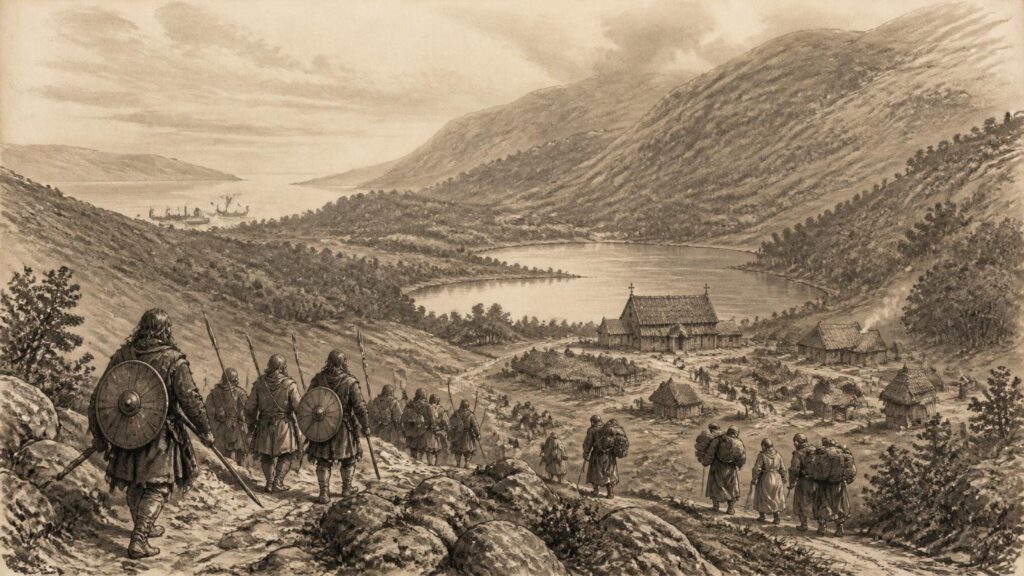
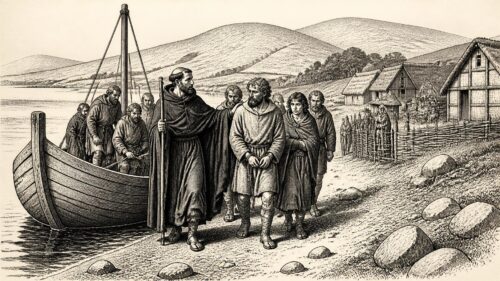
AI generated historical illustration, not a contemporary photograph.
At a Glance
Glendalough’s Viking raids belong to a documented Irish history, but not to the simple tale of helpless monks repeatedly overwhelmed by northern invaders. The surviving records show attacks in the ninth and late tenth centuries; they also show a wealthy, politically connected ecclesiastical settlement that endured, rebuilt and remained important long after the raiders had gone. What they do not provide is a cinematic eyewitness account of longships beneath the Wicklow mountains, nor a reliable measure of every human loss.
Mountain Sanctuary
Glendalough, Gleann Dá Loch or the valley of the two lakes, lies deep in the Wicklow uplands. Its landscape has encouraged an enduring image of secluded sanctity: steep slopes, dark water, wooded approaches and the remains of churches gathered about the lower lake. Yet the early medieval settlement was not simply an isolated hermitage. It was a major religious community with lands, people, workshops, learning, pilgrimage, patronage and connections extending far beyond the valley. That combination of spiritual prestige and material resources helps explain why it appears in the record of Viking attacks.
Tradition associates Glendalough with St Kevin, Cóemgen, a holy man whose life is preserved in later Latin and Irish saints’ Lives. These texts are invaluable evidence for medieval devotion and for the reputation that Glendalough later acquired, but they cannot be read straightforwardly as contemporary biography. The familiar stories of Kevin’s closeness to wild animals, his retreat in the valley and miraculous encounters belong to hagiography: literature intended to express sanctity, teach values and enhance the standing of a cult. Archaeological work and annalistic notices provide firmer, though still incomplete, grounds for reconstructing the growth of the community.
Recent research by University College Dublin archaeologists has complicated the old picture of a lone saint entering an empty wilderness. Excavations and survey have identified early medieval activity at both the upper and lower parts of the valley, while an enclosure near the upper lake produced evidence suggesting that settlement in the landscape may have begun before, or at least alongside, the traditionally imagined arrival of Kevin. Such evidence does not disprove religious tradition; it does show that the social history of the place was more complex than later devotional narratives allow.
By the eighth and ninth centuries, Glendalough was one of the important ecclesiastical centres of Leinster. The word “monastery” can mislead if it suggests a small, enclosed body of monks detached from ordinary life. Great Irish churches were estates, communities and centres of authority. Clerics, tenants, craftsmen, dependants, travellers and pilgrims could all be involved in their life. Their churches and graveyards formed only part of a wider settlement. They held movable wealth in books, vessels, shrines, metalwork, livestock and food stores, and they possessed political value because rulers and dynasties sought their prayers, legitimacy, learning and revenue.
Glendalough’s topography offered seclusion, but it did not make the community unreachable. Routes through the valleys linked it to the eastern lowlands and the Irish Sea coast. An attacking party did not need to establish a permanent settlement in the mountains to strike it. A force able to land, obtain local intelligence, march rapidly and withdraw with portable goods could exploit the same geography that later visitors have mistaken for absolute remoteness. The raiding record therefore speaks not only of Viking mobility but of Glendalough’s position within a connected Leinster.
Written Witnesses
The principal evidence for raids comes from the Irish annals. These year-by-year compilations were written and copied within learned ecclesiastical culture. They preserve information of extraordinary value, but they are neither modern newspapers nor neutral administrative ledgers. A notice may be no more than a sentence. It may name attackers only as “heathens”, “foreigners” or Gaill; it may offer no leader, date within the year, number of victims or account of what was taken. The manuscripts that survive are later copies, and the chronology of early medieval Irish annals can be difficult to align precisely with modern calendar years.
This difficulty matters at Glendalough. Standard modern accounts normally speak of raids in 834, 836, 890 and 983. In the modern English translation of the Annals of Ulster hosted by CELT at University College Cork, however, the entry headed U834 is calibrated to AD 833. That entry states that Glenn Dá Locha, along with Slane and Finnubair Abae, was plundered by heathens. Historians conventionally refer to this occurrence as the raid of 834 when comparing the various annalistic chronologies. The discrepancy is not proof that the event is doubtful; it is a reminder that medieval annal headings and modern dates must not be treated as mechanically identical.
The annals’ language is spare but telling. “Plundered” indicates an assault intended to secure goods, captives or other forms of profit. It does not automatically mean that every building was destroyed, that the whole community fled permanently, or that the site ceased functioning. Conversely, a short entry should not be taken to mean that the event was trivial. A successful raid on an ecclesiastical centre could disrupt worship, damage buildings, remove wealth, terrorise dependants and weaken the prestige of local patrons, even if the institution survived.
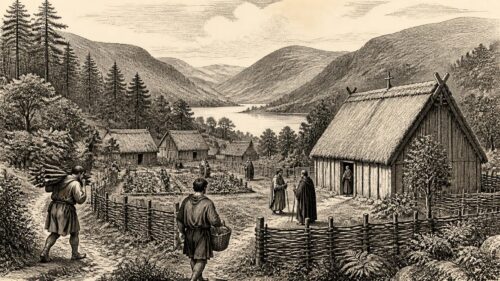
Another notice, conventionally placed in 836, is especially important because it records the destruction of a dertrach, literally an “oak house”. Modern archaeological discussion commonly interprets this as a timber church or ecclesiastical building. The phrase is valuable because it directs attention away from the stone ruins most visible today. Much of the early medieval built environment at Glendalough was likely timber, earth, thatch and other perishable material. Burning an oak-built church could be devastating without necessarily leaving a ruin that can still be recognised amid later construction, repair and burial activity.
The sources must therefore be read at two levels. At the first, they provide documentary evidence that Glendalough was attacked. At the second, they preserve the categories through which churchmen described violence: plunder, burning, heathens and foreigners. They are not a complete inventory of raids, losses or recoveries. Silence may mean that no attack occurred, but it can also mean that a particular event was not recorded in the textual traditions that survived. Certainty should be reserved for what the notices actually say; wider reconstructions must remain interpretation.
First Raids
The first securely recorded Viking attack on Glendalough belongs to the early phase of Scandinavian activity in Ireland. Viking raiding had reached Ireland by the closing years of the eighth century, initially concentrating on vulnerable islands and coasts. During the early ninth century, attacks increasingly reached larger ecclesiastical centres and penetrated farther inland. This was not because Irish monasteries were defenceless treasure houses existing outside politics. Rather, prominent churches were wealthy nodes in an Irish landscape already accustomed to warfare, cattle raiding, hostage-taking and conflict between rival rulers.
Irish forces had attacked churches before the Viking Age. The annals contain earlier accounts of Irish kings and armies violating ecclesiastical sites, killing clerics, burning settlements or seizing resources. This does not diminish the violence of Scandinavian raids. It corrects a misleading contrast between a peaceful Christian Ireland and an otherwise unprecedented foreign brutality. Viking raiders entered an existing political world in which churches had wealth, immunity, patronage and strategic importance. They brought new maritime reach and new military pressures, but they also participated in patterns of predation that contemporaries already understood.
The attack conventionally dated 834 grouped Glendalough with Slane and Finnubair Abae. The pairing is significant. It places the Wicklow community within a wider field of ecclesiastical targets rather than portraying it as a remote place singled out by chance. The record does not identify the raiders’ ships, their commander, their route or the property they removed. It would be unsound to supply these missing details from imagination. Nevertheless, the choice of several well-known churches suggests purposeful raiding directed at institutions capable of yielding valuables and prestige.
The 836 attack is often connected by historians with activity from the Wicklow coast, particularly the area of Arklow. This is a plausible reconstruction of an inland campaign, not a full itinerary preserved by a contemporary observer. The suggestion is supported by the wider pattern of coastal landing places and river-valley movement. It should not be embellished into an exact march, an identified fleet or a detailed battle in the glen. The annals give us the fact of destructive assault; the landscape allows historians to discuss possible access, but not to watch the raid unfold.
The destruction of the oak-built structure underlines why modern visitors should not use the surviving stone churches as a simple guide to ninth-century damage. St Kevin’s Church, the round tower and other familiar monuments embody later phases of Glendalough’s long history, much of it after the earliest Viking incursions. The principal monastic complex was repeatedly altered. Timber buildings can disappear almost completely, while stone buildings may survive because they were rebuilt, repaired, reused or valued by later communities. Archaeology is indispensable here, but it cannot make every annalistic phrase visible again.
Nor should the round tower be turned into a single-purpose “Viking refuge”. Round towers were distinctive ecclesiastical monuments, probably serving several functions including bells, visibility, status and the protection of valuables. Their height and restricted entrances have naturally encouraged stories of monks escaping raiders by climbing inside. Such use may sometimes have been possible, but no surviving source proves that Glendalough’s tower saved a named group during a named attack. To treat the tower as a perfect anti-Viking fortress is to substitute a later popular image for historical evidence.
Changing Warfare
By the middle of the ninth century, Viking activity in Ireland had changed. Seasonal raiding did not disappear, but Scandinavian groups also established defended bases and settlements, most consequentially at Dublin. These developments created new political actors rather than a permanent, uniform army called “the Vikings”. The people described in Irish sources as foreigners could be raiders, traders, settlers, mercenaries, kings, allies or rivals. They could co-operate with Irish rulers, fight one another and become embedded in Irish political life.
This context is essential for understanding the later attacks on Glendalough. A raid was not always an isolated act by strangers arriving from across the sea. It could be related to local alliances, tribute, campaigns and contests for regional dominance. Irish rulers could employ Scandinavian forces; Scandinavian leaders could exploit divisions among Irish dynasties. The annals sometimes preserve such alliances clearly, and sometimes leave motives obscure. It is therefore unsafe to explain every assault on a church solely as religious hatred or indiscriminate robbery.
Scholarship on Viking church-raiding has stressed the need to distinguish the early opportunistic phase from later political economies. Once Scandinavian kings exercised power in Dublin, straightforward plunder of wealthy churches was not necessarily the most efficient source of income. Tribute, trade, control of routes and negotiated political relationships might produce greater and steadier returns. Yet this did not make ecclesiastical centres safe. Raiding persisted when it offered strategic benefit, when control weakened, or when a particular campaign required quick wealth and intimidation.
The 890 raid belongs to this later setting. Irish annalistic traditions record the plundering of Ardbraccan, Donaghpatrick, Dulane and Glendalough. The targets extended from the rich central-east through Meath and Leinster to the Wicklow valley. The record is too concise to establish the order in which they were hit, the size of the raiding force, or whether all places were struck in one uninterrupted expedition. What can be said is that these churches lay within a region affected by the power and reach of Viking Dublin and by the contested politics of Irish kingship.
It is reasonable, but still interpretative, to associate the 890 attacks with Dublin’s Scandinavian sphere. Glendalough was not on the coast, yet it was within reach of eastern routes and not beyond the capacity of organised armed groups. The clustering of targets near the central-east points to a campaign operating in a politically dense landscape. It also demonstrates that the establishment of Dublin did not place an impassable barrier between the Viking town and the religious communities of Leinster. Connections could be commercial as well as violent, and the boundary between those forms of contact was often contingent.
The later tenth-century attack conventionally dated 983 must likewise be handled carefully. Modern historical summaries include it among Viking raids on Glendalough and associate it with Dublin-based Scandinavians. The episode belongs to a period in which Leinster, Dublin and the high kingship were entangled in shifting conflict. But the limited wording of the annals cannot sustain a confident reconstruction of the raiders’ individual identities, their route through Wicklow or the exact scale of destruction. Its importance lies in showing that Glendalough remained exposed within a contested political region, not in providing material for a detailed tale of siege.
Monastic Wealth
Why was Glendalough worth attacking? The answer begins with the nature of an important church. A large ecclesiastical community could receive gifts from kings and aristocrats, collect dues from lands, maintain herds, host travellers and pilgrims, employ specialists, and possess liturgical objects made from precious materials. Manuscripts, bells, shrines and metalwork were spiritually meaningful, but they also embodied labour, skill and status. Food stores, animals, cloth and captives could be equally valuable to a raiding force.
Churches were also repositories of political authority. An abbot or superior might belong to a powerful kin-group, and succession to ecclesiastical office could be deeply bound up with secular dynastic interest. Attacking such a centre could humiliate its patrons, damage a rival’s resources and announce control over a region. The distinction between “religious” and “secular” targets, so natural in a modern framework, is too sharp for early medieval Ireland. At Glendalough, religious observance, settlement, lordship and economic life were interwoven.
The material record supports the view of Glendalough as a complex and active community. UCD fieldwork has identified evidence for early medieval settlement, enclosures and craft activity, while research at the upper lake has stressed that the valley contained dispersed ecclesiastical and settlement sites rather than a single isolated group of buildings. The later medieval fabric now visible should not obscure this deeper settlement pattern. A raid upon “Glendalough” could have affected more than the core church enclosure: it may have threatened households, farms, storehouses, roads and dependent communities across the valley.
There is, however, a limit to what archaeology can demonstrate about a particular raid. No excavated layer can presently be assigned with certainty to the 834, 836, 890 or 983 attacks in a way that would provide a full material narrative. The absence of a neatly identified destruction horizon does not refute the annals. Raids might remove portable goods, burn timber that leaves ambiguous traces, damage buildings later repaired, or affect areas not yet excavated. Conversely, it would be irresponsible to label every burnt deposit or broken object at Glendalough as Viking evidence.
This distinction between documentary evidence and archaeological inference is vital. The written sources record named assaults. Archaeology establishes the scale, evolution and complexity of the settlement, and it cautions against seeing the present ruins as a frozen ninth-century scene. Together, the evidence makes Glendalough’s vulnerability intelligible. Neither source type permits historians to calculate the number of deaths, identify every stolen artefact, or recover the feelings of individual inhabitants on the day of an attack.
Enduring Community
The most important corrective to popular disaster narratives is that Glendalough endured. A place repeatedly recorded as plundered, burned or attacked was not necessarily annihilated. Indeed, its repeated appearance in the annals is partly evidence of continuing significance. A church that had permanently vanished would not remain a prize. Glendalough retained high status through the tenth, eleventh and twelfth centuries, even as its place in Irish ecclesiastical politics changed.
The annals record later burnings that were not Viking raids. Glendalough was affected by Irish political and ecclesiastical conflict across the eleventh century, and it was burned again in 1163. The distinction matters. Medieval Ireland’s violence cannot be assigned entirely to Scandinavian raiders, nor can every fire at a monastic settlement be made to stand for a Viking attack. The long record of assault reveals persistent competition over an important institution, involving Irish as well as Scandinavian actors.
In the later eleventh and twelfth centuries Glendalough stood at the centre of renewed ecclesiastical and political ambitions. Its association with powerful rulers and its relationship with Dublin show that it remained part of regional affairs, rather than being abandoned to the mountains. The ecclesiastical reforms of the period altered older monastic structures, and Glendalough’s eventual incorporation into the diocese of Dublin in the early thirteenth century marked a major institutional change. Yet the settlement’s churches, burial places and pilgrimage associations retained enduring importance.
Survival did not mean that raids had no consequences. Loss of wealth could take years to repair. A burnt timber church could require labour, timber, skilled builders and renewed patronage. The seizure of people, animals or books could fracture a community in ways the annals do not record. Repeated insecurity may have encouraged the safeguarding of valuables, the strengthening of enclosures or changes in relations with secular patrons. These are reasonable possibilities, but they must be expressed as possibilities, not converted into facts without direct evidence.
Nor did recovery necessarily mean a return to an earlier condition. Every rebuilding involved choices. A community might alter its church plan, redistribute land, seek a new patron or change how it stored wealth. The visible medieval Glendalough of today is therefore the product of many centuries of adaptation. It is a memorial not only to Kevin and to Viking violence, but to the persistence of communities who invested in the valley after each recorded disruption.
Popular Memory
Glendalough’s modern reputation has often compressed a complex history into a single picturesque formula: peaceful monks, Viking longships and a round tower used as refuge. The formula is memorable because the landscape is dramatic and the Viking Age is culturally vivid. It is also inadequate. It overlooks the wealth and influence of monasteries, the participation of Irish rulers in church warfare, the changing character of Scandinavian power in Ireland, and the long chronology of rebuilding after attacks.
Folklore and devotional tradition have their own historical value, especially in showing how Glendalough was remembered. Stories linking St Kevin to the upper lake, animals and remote cells express a vision of holy withdrawal that has shaped generations of visitors. They should not be dismissed as meaningless merely because they are not contemporary reportage. But neither should they be used as proof that Kevin founded every surviving monument, that an individual cave certainly served as his dwelling, or that ninth-century raiders behaved exactly as later stories imagine.
The same caution applies to modern visual culture. A nineteenth-century antiquarian engraving, a tourist illustration or a reconstruction of armed men advancing through the valley can communicate atmosphere, but it cannot substitute for evidence. No source allows a reliable portrait of the raiders who struck Glendalough in 834 or 836. We do not know their names, their clothing, their precise weapons, the number of ships they used or whether local allies accompanied them. Responsible historical interpretation makes that uncertainty visible rather than disguising it.
What can be recovered is a more meaningful story. Glendalough was not merely a victim at the edge of Europe. It was a substantial Irish religious centre embedded in networks of lordship, learning, pilgrimage and exchange. Its recorded raids reveal the reach of Scandinavian maritime power, but also the value of Irish ecclesiastical communities within the politics of the island. The same records that tell of plunder also preserve the continued life of abbots, bishops, rulers and institutions associated with the valley.
Historical Balance
Glendalough’s Viking raids are real events, documented in the annalistic tradition and recognised by modern scholarship. The attacks conventionally dated 834, 836, 890 and 983 establish a pattern of recurrent vulnerability across roughly a century and a half. The 836 destruction of an oak-built ecclesiastical structure offers especially vivid evidence of damage. The 890 campaign places Glendalough among major church centres of the central-east. The later attack shows that its political exposure continued into the age of Viking Dublin and changing Leinster kingship.
Beyond that secure framework, restraint is necessary. It cannot be proved that every raid came by one route, that the settlement was wholly destroyed on any occasion, or that the surviving round tower was used in a particular emergency. There is no basis for precise casualty totals, dramatic last stands or inventories of lost treasures. The historical record is powerful precisely because it is limited: a few compressed notices, read alongside archaeology and the evolving landscape of Irish politics.
That limitation does not diminish Glendalough. It makes the site more human. The valley’s history was not a brief golden age ended by Vikings; it was a long history in which sanctity, land, power, craft, violence and remembrance were repeatedly entangled. Viking raids interrupted that history and left a lasting mark on how the period is imagined. They did not end the community’s capacity to endure, adapt and remain one of the most resonant places in Ireland’s medieval past.
Glendalough’s raids are revealing when viewed not as isolated assaults on helpless monks, but as attacks on a wealthy, connected ecclesiastical community within contested Leinster. The article’s caution about annalistic dates, sparse descriptions and ambiguous archaeological burning complicates any attempt to measure destruction or identify raiders. Equally significant is the settlement’s resilience: repeated violence did not end its religious, economic or political importance. This raises a question about how institutions recovered in early medieval Ireland. How should historians balance documentary notices of plunder with archaeological evidence of continuity when interpreting whether Viking attacks transformed Glendalough’s society, or exposed pre-existing vulnerabilities?