
Carbon Burden
At a Glance
Tax Burden
Irish research describes carbon taxation as placing a larger share of income burden on poorer households than on more affluent ones. One ESRI bulletin states that carbon taxation is regressive in this sense, while also noting that compensation for low-income households can change that pattern. An earlier ESRI report reaches a similar conclusion, saying direct impacts on households in different income brackets are regressive. These passages frame the issue as one of unequal household exposure rather than a uniform charge. [2] [5]
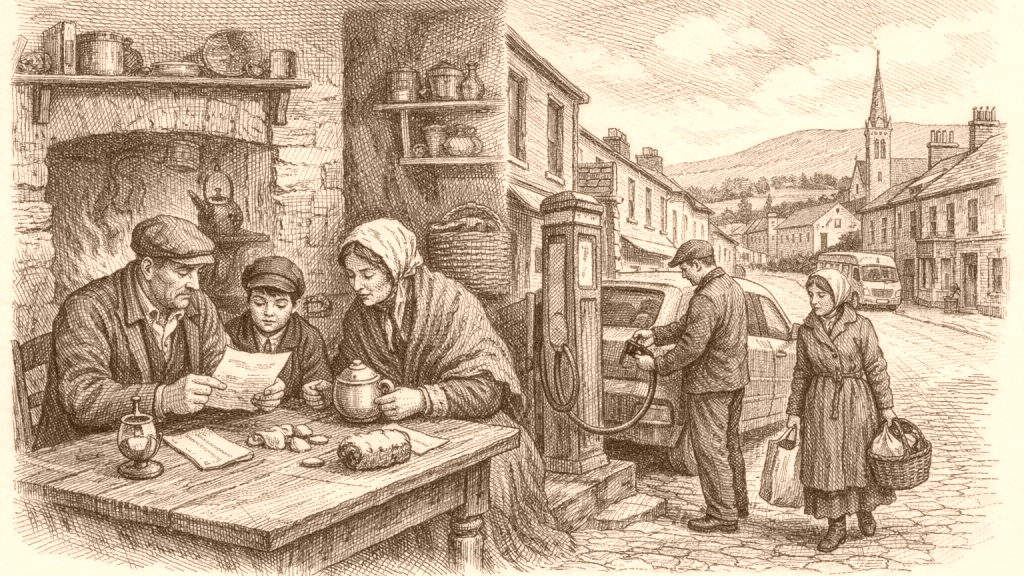
A 2024 ESRI paper links the burden to spending patterns on essential energy. It says essential household energy consumption makes up a significant portion of spending, especially for lower-income households, and that household budgets vary with reliance on fuels for heating and transport. The same paper adds that carbon footprints vary widely across households and that higher-income households generally emit less as a percentage of income. The comparison is drawn from the modeling described in the paper itself. [1]
Household Effects
The studies consistently describe households at the lower end of the distribution as most exposed to adverse effects. In 2022, ESRI research says the paper addresses impacts across income bands and within the same income band, and identifies households with the largest burden, such as families with children or single people. In 2019, another ESRI study finds that households face higher overall prices, with a rise in the consumer price index and a small decline in real disposable income in the modeled year. [2] [6]
The modeled effects are not presented as identical across all household types. The 2022 bulletin says the analysis searches for differences between households with children and those without, and between couples and single people. The 2024 distributional paper likewise says the net impact of reforms depends very significantly on the nature of expenditure and the share of revenue used. Those statements show that household cost effects are treated as varied and contingent within the studies, not as a single average outcome. [2] [1]
Price Change
One ESRI model of an incremental rise in the tax identifies fuel prices as especially affected. It says LPG, diesel, and gasoline prices rise the most in the scenario examined, while energy and transport sectors are hit hardest. The same paper reports that households face higher prices overall and that real disposable income falls slightly in the modeled year. This gives a direct comparison between fuel-price pressure and the broader household-budget effect that follows. [6]
The distributional papers also note that the scale of the burden changes with the kind of spending being modeled. The 2024 ESRI report says immediate impacts vary with reliance on heating and transportation fuels and also with emissions embodied in other goods and services. It adds that other factors, including uneven application across fuels and industries, influence the equation. The result is a picture of carbon pricing as a broad price-shaping policy with different effects across consumption categories. [1]
Revenue Recycling
Several studies focus on what happens when carbon-tax receipts are returned to households. The 2019 ESRI paper says returning revenues reverses the regressive effect and makes the net policy effect progressive. It contrasts a universal carbon cheque with a targeted mechanism, saying the targeted approach is more progressive and reduces income inequality. The same paper also says the targeted method resembles recycling through the tax and welfare system and has lower administrative costs than a universal payment. [3]
Later work expands the recycling options beyond simple transfers. A 2024 ESRI bulletin says revenue recycling can be done by reducing other taxes or by giving money directly to households, and that these approaches have different efficiency and equity effects. It then reports that combining a sales tax cut with increased welfare payments can improve both efficiency and equity. This is presented as a mixed scheme rather than a single recycling rule, showing the range of policy designs studied. [7]
Policy Balance
The 2024 work emphasizes a trade-off between distributional protection and wider economic effects. It says lowering other taxes creates economic benefits but can increase income inequality, while raising household transfers improves equity but can have negative macroeconomic outcomes such as reduced GDP. The same bulletin also states that pure revenue-recycling schemes can achieve reduced emissions and either improved economic performance or income equity, but not all three at once. The comparison is explicit within the modeled scenarios. [7]
The 2024 distributional paper similarly reports that reform outcomes depend on the expenditure chosen and the share of revenue returned. It says the net impact in terms of winners and losers depends very significantly on both factors. The same study also notes that additional carbon revenues are used in modeled reforms, with different consequences for household budgets. Read together, the passages show that the design of recycling matters at least as much as the existence of recycling itself. [1] [7]
Historical Record
The documented sequence in these materials runs from an earlier report to newer modeling exercises. The 2004 ESRI report discusses household gainers and losers under carbon taxes; the 2019 studies examine emissions, inequality, and incremental increases; the 2022 bulletin adds household-type differences; and the 2024 papers revisit distributional impacts and mixed recycling schemes. The sequence shows continued analysis of the same policy problem over time, with later studies using more detailed models and scenarios. [5] [3] [6] [2] [1] [7]
One committee listing records a 2003 report titled Proposal for the Introduction of a Carbon Energy Tax, showing that the issue also appeared in parliamentary committee work. That listing does not provide the report's text or conclusions, only its title and date in the archive page. As a result, the material here confirms an institutional discussion of carbon energy taxation, but it does not by itself show the content of the committee's arguments. The research trail is therefore incomplete in this source set. [4]
Source References
Hover over a number to see the source. Select it to open the source.

- [1] The distributional impact of carbon pricing and energy related taxation in Ireland | ESRI
- [2] The heterogeneous effects of carbon taxation in Ireland | ESRI
- [3] Carbon taxation in Ireland: distributional effects of revenue recycling policies | ESRI
- [4] Committee Reports::List of Committees::[Joint] Committee on Environment and Local Government
- [5] Carbon Taxes: Which Households Gain or Lose? (2001-EEP/DS7-M1) Final Report prepared for the Environmental Protection Agency | ESRI
- [6] The effects of an incremental increase in the Irish carbon tax towards 2030 | ESRI
- [7] Efficiency-equity trade-off in the Irish carbon tax: A CGE investigation of mixed revenue recycling schemes | ESRI





How do Irish studies describe the distributional and household-budget effects of carbon taxation and revenue recycling?