

Consent Planned
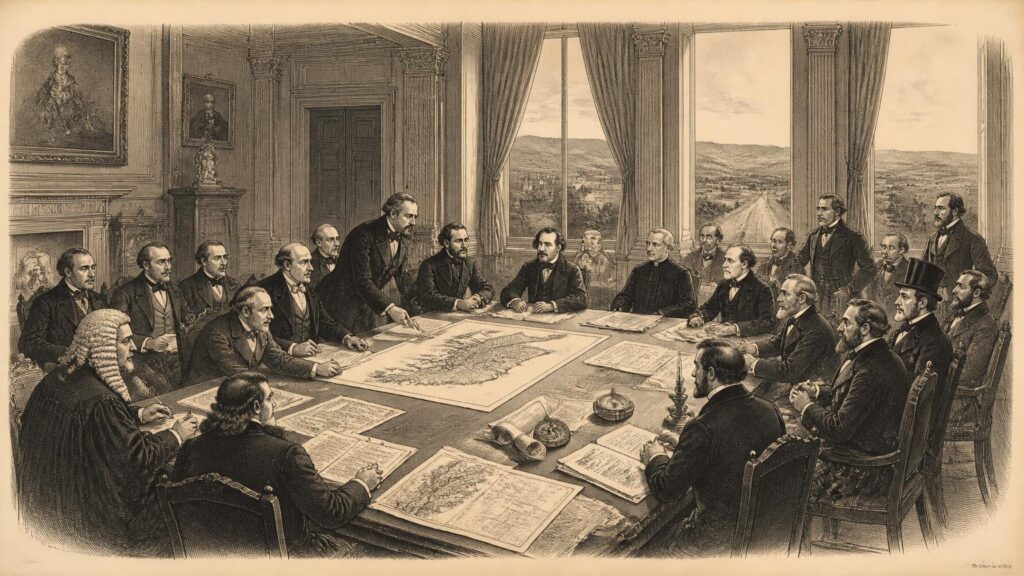
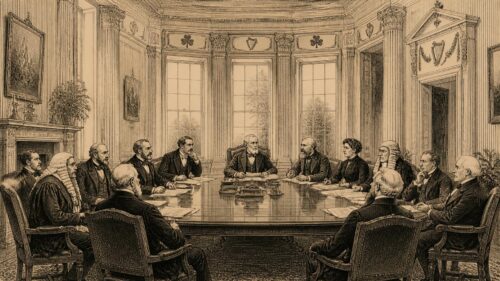
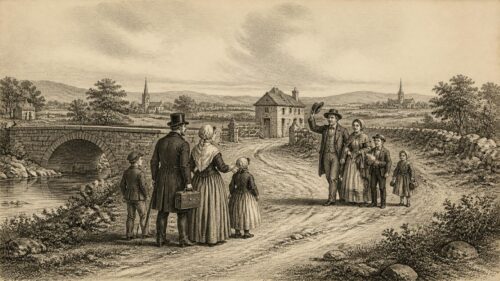
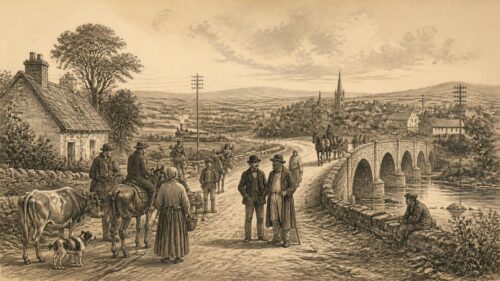
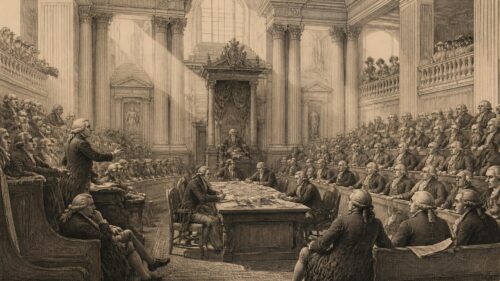
AI generated historical illustration, not a contemporary photograph.
At a Glance
Historical Setting
Irish unity planning is not simply a contemporary argument about whether a border poll should be held. It is a long historical argument about how constitutional aspiration, democratic consent, public confidence and the protection of differing identities might be brought into relationship without returning to coercion. The question has altered sharply across the century since partition. Earlier constitutional claims commonly treated the territorial unity of Ireland as a principle to be asserted. Later peace process thinking increasingly treated unity, if it came, as an outcome that would need to be chosen peacefully and made workable for people whose political traditions, social lives and attachments to Britain did not disappear at the moment of a vote. The modern planning debate therefore belongs to the history of partition, conflict, negotiation and institutional experiment.
Partition followed the Government of Ireland Act 1920 and the political settlement of 1921–22. Six north-eastern counties remained within the United Kingdom as Northern Ireland, while the Irish Free State was established in twenty-six counties. This was not merely a division of administrative territory. It produced two political systems, two public administrations, divergent economic policies, distinct party systems and, in time, different relationships with Britain and Europe. Nationalists in Northern Ireland lived with a constitutional position they did not accept; unionists regarded the Union as a safeguard for their British identity and political security. Any later discussion of unity inherited those realities.
It is tempting to narrate the matter as an uninterrupted contest between two fixed camps. That is too simple. The meanings of nationalism, unionism and Irish citizenship have changed, as have the social composition of Northern Ireland and the Republic. Nor have constitutional options always been restricted to the binary terms of a unitary Irish state or continuation of the Union. Federal arrangements, joint authority, strong regional institutions, cross-border bodies and shared sovereignty have all appeared in serious political discussion. The debate about planning is important precisely because it asks what form, sequence and guarantees might attach to constitutional change rather than treating the destination as self-explanatory.
Partition Legacies
The early decades after partition created habits of separation. The border affected trade, transport, policing, education, welfare administration and everyday movement, even where families, farms and local economies crossed it. In the North, majoritarian government at Stormont operated from 1921 until 1972. Its record, including discrimination in housing, local government and employment alleged by the civil-rights movement, deepened nationalist alienation. In the South, the constitutional imagination of the State retained a strong all-island claim. These were not mirror images: they were different political experiences which nevertheless reinforced one another.
The Constitution of 1937 gave formal expression to an aspiration towards national unity. Before 1999, its Articles 2 and 3 contained a territorial claim over the whole island. That language mattered symbolically and politically, but it did not supply a programme for reconciling unionists to a united state. In practice, governments in Dublin had to balance constitutional aspiration against the need to preserve peaceful relations with London and to protect nationalist citizens in Northern Ireland. The difficulty became acute after violence intensified from the late 1960s. The outbreak generally called the Troubles demonstrated that constitutional language could not be separated from questions of security, equal treatment and legitimacy.
Historical memory also complicates the planning debate. Nationalist memory may draw on the island’s pre-partition political unity, the violence of partition and the exclusion of northern nationalists. Unionist memory may stress resistance to Home Rule, attachment to British institutions, military sacrifice, fears of domination by a Catholic-majority southern state and the experience of political violence. Neither body of memory is an impartial archive; each selects, emphasises and transmits. Yet neither can simply be dismissed as folklore. A workable constitutional conversation must distinguish verifiable history from inherited narratives while acknowledging that people’s political conduct is often shaped by both.
Forum Experiments
The New Ireland Forum of 1983–84 was a major early effort to make the problem of constitutional design explicit. Initiated under Taoiseach Garret FitzGerald, it brought together Fine Gael, Fianna Fáil, Labour and the Social Democratic and Labour Party. Sinn Féin did not participate, and unionist parties declined to take part. Those absences imposed clear limits: the Forum was not a negotiation between all the principal traditions of Northern Ireland. Even so, it assembled extensive submissions and offered a sustained nationalist examination of possible political futures during a violent period.
Its final report did not confine itself to a single blueprint. It considered three broad models: a unitary state, a federal or confederal arrangement, and joint authority exercised by the Irish and British governments in Northern Ireland. The importance of this exercise lies less in any one proposal than in its method. It acknowledged that constitutional change required institutional thought. A unitary state, the report recognised, would require a new non-denominational constitution formulated through a broad constitutional conference. That was a notable movement away from assuming that existing southern institutions could merely be extended northwards.
The Forum’s discussion of unionist concerns is historically significant. It recorded fears about the loss of the British connection, the position of Protestant and unionist minorities, and the cultural influence of the Catholic Church. Its language was inevitably shaped by the political assumptions of its participants and time. Nonetheless, the report conceded a point that later became central: unity could not endure if it asked unionists merely to surrender identity and confidence. The Forum’s defect was not an absence of constitutional imagination. Rather, it had no unionist mandate and no agreed British governmental process through which its concepts could be tested.
The political response was severe. Margaret Thatcher publicly rejected the three principal alternatives in late 1984, an episode remembered through the phrase “out, out, out”. That phrase has become a shorthand for the failure of the Forum, but it can obscure its longer afterlife. The Forum helped normalise discussion of constitutional models, increased contact between southern parties and the SDLP, and formed part of the wider context from which the Anglo-Irish Agreement of 1985 emerged. Historical causation should be stated cautiously: the Forum did not cause the later peace settlement. It did, however, preserve the idea that institutional accommodation was more promising than unilateral declaration.
Agreement Foundations
The Belfast or Good Friday Agreement of 10 April 1998 transformed the legal and political setting. It was approved in referendums north and south on 22 May 1998, and its interlocking arrangements came into force on 2 December 1999. The Agreement was not a timetable for unity, nor a settlement that declared the constitutional question permanently closed. Instead, it established rules for disagreement. Northern Ireland would remain part of the United Kingdom unless a majority there decided otherwise; if a majority supported a united Ireland, the British and Irish governments would be under an obligation to give effect to that choice.
This is often called the principle of consent, but the phrase should not be reduced to a slogan. Consent operates at several levels. It protects the existing constitutional position from unilateral alteration. It also validates the possibility of change through a democratic choice. In the Agreement’s constitutional provisions, the birthright of the people of Northern Ireland to identify and be accepted as Irish, British or both was recognised, alongside their right to hold both citizenships. The intended settlement was therefore not a demand that identity follow sovereignty. It was an attempt to uncouple personal belonging from a single constitutional label.
The Northern Ireland Act 1998 gave the principle a place in United Kingdom law. Section 1 provides that Northern Ireland remains part of the United Kingdom unless a majority of its people consent otherwise, and that the Secretary of State shall lay before Parliament proposals to give effect to a vote for a united Ireland. The Act also gives the Secretary of State responsibility for directing a poll where it appears likely that a majority would favour departure from the United Kingdom. It does not set a numerical threshold, prescribe a campaign period, or offer a detailed transition design. Those silences are among the reasons planning has become contentious.
The Irish constitutional change was equally consequential. Following the Nineteenth Amendment, Articles 2 and 3 were replaced. Article 2 affirms a birthright to be part of the Irish nation for people born on the island, while Article 3 states the aspiration to unite all who share the territory in harmony and friendship, recognising that unity can be brought about only by peaceful means with the democratically expressed consent of majorities in both jurisdictions. The old territorial claim was removed. In its place came an explicitly consent-based national aspiration and constitutional room for shared executive institutions.
Institutional Architecture
Planning is sometimes discussed as if it begins only when a referendum date is announced. The Agreement suggests a different view. It created institutions intended to make practical cooperation possible under either constitutional preference: the Northern Ireland Assembly and Executive, the North South Ministerial Council, implementation bodies, the British Irish Council and the British Irish Intergovernmental Conference. These were designed to address governance in Northern Ireland, relations across the island, and relations between the two islands. Their existence does not predetermine unity, but it means that the island is no longer organised solely through separation.
The North South bodies are especially relevant to the historical debate. They created formal channels for cooperation in areas such as waterways, food safety, language, trade and special European Union programmes. Their value has been practical as well as symbolic. Officials and ministers have worked across the border on matters where geography and daily life make isolation inefficient. Yet it would be inaccurate to portray them as a concealed united state. Their powers are defined, their operation depends on political agreement, and they are part of a settlement that protects Northern Ireland’s current position as well as allowing constitutional change.
The architecture matters because it produces a distinction between preparation and campaigning. Building cross-border transport, research, health cooperation or environmental capacity can be defended as useful in its own right. Critics may regard such work as gradual constitutional preparation; supporters may regard it as fulfilment of the Agreement’s all-island potential. Both interpretations can be sincerely held. The historical fact is that the Agreement deliberately established North South cooperation while leaving sovereignty contingent on consent. Any serious account must retain both parts of that formula.
Brexit Pressure
Brexit returned the border to the centre of public attention. The United Kingdom’s vote to leave the European Union in 2016 produced a result in Northern Ireland that differed from the overall UK result. The ensuing negotiations exposed how deeply European membership had supported an open land border, shared regulation and all-island economic relationships. The Protocol, later adjusted through the Windsor Framework, became politically divisive, particularly among unionists who argued that new arrangements affecting trade between Great Britain and Northern Ireland weakened the Union in practice.
It would be misleading to claim that Brexit created the unity question. The question was embedded in the 1998 settlement and preceded it by generations. Brexit did, however, alter its context. It made constitutional, commercial and identity issues visible in the same arguments: customs procedures, food standards, EU law, representation, British citizenship and Irish citizenship could no longer be treated as wholly separate topics. It also gave urgency to questions that planning advocates had long posed. What happens to public services? How are east-west relationships protected? How might a new constitutional arrangement relate to the European Union, the United Kingdom and the Common Travel Area?
Brexit also cautions against simplistic constitutional forecasting. A change in trading rules may affect political attitudes, but attitudes are not mechanically determined by economics. Community identity, trust in institutions, local experience, party mobilisation and fear of loss all matter. Election results and opinion surveys provide evidence of a particular moment, not a referendum result in advance. The Agreement’s border-poll mechanism is legal, but its practical use would occur in a social atmosphere shaped by confidence or anxiety. Planning advocates therefore argue that uncertainty itself is a reason to publish detailed options; opponents often answer that speculative planning can manufacture instability. This disagreement is central, not incidental.
Planning Arguments
Those who favour systematic planning make several arguments. First, they contend that constitutional change on this scale would affect every major public system: taxation, pensions, welfare, health, education, policing, courts, local government, infrastructure, public debt, currency arrangements and international representation. Leaving such matters until after a vote could produce a vacuum of information, encourage exaggerated claims and make voters choose amid avoidable uncertainty. They argue that preparatory research is not a promise that unity will occur, but an ordinary duty of responsible government where a lawful constitutional pathway exists.
Second, advocates stress democratic fairness. In this view, a voter cannot exercise meaningful consent if offered only an abstract proposition. The question is not merely whether Northern Ireland should join a united Ireland, but what form of Ireland would result, what protections would be entrenched, how long transition would take and which institutions would survive. Some proposals therefore call for a green paper, an independent commission, citizens’ assemblies, sectoral studies and public engagement across traditions. A 2026 proposal in Dáil Éireann for a Planning for Constitutional Change Bill illustrates how the issue has moved from speeches and party manifestos into arguments about formal state preparation.
Third, supporters of planning argue that unionist participation must shape the work from the beginning rather than be solicited after decisions have hardened. This is an ethical argument and a practical one. A bare majority can decide a legal question, but it cannot by itself create mutual confidence. Planning, at its strongest, therefore asks not how to absorb a defeated minority but how constitutional structures might guarantee British identity, cultural expression, citizenship rights, representation and continuing east-west ties. Whether such assurances would persuade many unionists is unknown; no honest historian can promise that they would. But their absence would plainly make persuasion less likely.
Planning Objections
Opponents of state-led unity planning do not all reject discussion of the constitutional future. Some object to the timing, arguing that official preparation before clear evidence of a likely majority could be read as Dublin or London taking sides. Others fear that institutional planning may inflame insecurity, particularly if it is framed as an inevitable route to unity rather than contingency work. In a society marked by violent conflict, perceptions of process are themselves politically consequential. A technically sound report can fail if a large section of the public believes it was written over their heads.
There is also a constitutional objection. The Secretary of State’s statutory role in calling a poll concerns an assessment of likely majority support in Northern Ireland. The law does not require either government to publish a complete constitutional prospectus beforehand. From this perspective, elaborate pre-poll negotiations risk confusing a decision about sovereignty with negotiations that can only have authority after democratic endorsement. The counterargument is that waiting for a vote might make later negotiations dangerously compressed. The disagreement is not over whether detail matters, but over when detail can legitimately be developed and by whom.
Another objection concerns the word “unity” itself. It can imply a finished, homogeneous national condition, whereas the historical record of the island is plural and contested. Unionists may suspect that apparent inclusivity conceals assimilation. Nationalists may fear that extensive guarantees would dilute the democratic meaning of reunification. These anxieties reveal why institutional language must be precise. Respect for British identity is not identical to a veto over change; majority rule is not identical to licence to disregard a substantial minority. The Agreement’s achievement was to make both propositions part of the same constitutional settlement.
Identity Questions
Questions of identity cannot be left to ceremonial symbolism. They concern citizenship, language, flags, commemorations, education, cultural funding, policing, legal traditions and ordinary encounters with the state. The Good Friday Agreement’s recognition of British, Irish or dual identity established a vital principle: a constitutional boundary should not compel people to falsify who they are. Yet translating that principle into a changed constitutional order would require choices that no historical document has made in advance. Retaining British citizenship rights is one matter; ensuring that public institutions feel equally legitimate to unionists is another.
Historical experience gives reasons for caution. The southern state’s early decades included a close public association between political culture and Catholic moral authority, even though Irish society has changed profoundly since then. Unionist concerns about domination were not invented from nothing, though they were often expressed in ways that denied equality to nationalists. Likewise, nationalist distrust of Northern Ireland’s former institutions arose from documented discrimination and exclusion, not merely ancient grievance. Planning worthy of the name must confront these histories without freezing either community inside them.
There is no single unionist view, just as there is no single nationalist or non-aligned view. Religious background, class, age, locality, migration, gender, language and political generation all influence how people understand belonging. The category often called “other” or “neither” has become increasingly important in electoral and public discussion, but it too is diverse. A planning process that assumes three neatly bounded blocs will miss lived complexity. That is one reason citizens’ forums attract interest: they may enable discussion outside party negotiation, though they cannot substitute for democratic institutions or legally binding agreements.
Economic Questions
Economic claims are among the loudest features of unity debate and among the easiest to oversimplify. It is possible to identify real issues without pretending that a single spreadsheet can answer them. Northern Ireland’s public expenditure is supported through the UK fiscal system; the Republic has different tax structures, social insurance arrangements, health provision and public-service administration. A constitutional transition would raise questions concerning revenue, welfare entitlements, pensions, civil-service terms, public debt, healthcare access and the future of public bodies. Estimates depend heavily on assumptions about growth, policy convergence, UK financial arrangements and the duration of transition.
The island also contains economic connections that are already tangible. Cross-border workers, supply chains, tourism, energy systems, universities and local communities create incentives for cooperation. But integration has limits. Differences in currency, regulatory practice, housing markets, labour law and public finance remain significant. The historical lesson is not that economics decides constitutional allegiance. Rather, economic credibility matters because constitutional choices are experienced through wages, hospitals, schools, journeys and retirement security. Promises of automatic prosperity, whether unionist or nationalist, should be treated as political claims requiring evidence rather than as historical facts.
A serious preparatory programme would make uncertainty visible rather than conceal it. It might set out alternative fiscal scenarios, identify decisions that require negotiation with the United Kingdom, distinguish immediate administrative continuity from long-term reform, and explain who would bear costs. It would also need to ask what should remain distinctive at regional level. A future settlement could preserve substantial devolved institutions, but such a choice would involve trade-offs in representation, accountability and equality. The purpose of planning is not to eliminate disagreement. It is to make the disagreements intelligible before they become crises.
Shared Practice
The Irish Government’s Shared Island initiative represents a different but related approach. Established in 2020, it presents itself as an effort to use the potential of the Good Friday Agreement to deepen cooperation, connection and understanding among all communities and traditions. Its work includes dialogue, research and practical investment. It is not a statutory blueprint for constitutional change, and official descriptions do not present it as one. Its significance lies in a quieter proposition: cooperation can be valuable whatever constitutional preference people hold, and practical relationships may create a better setting for difficult political conversations.
This approach has supporters and critics. Supporters see investment in common infrastructure, research, culture and civic contact as a way to reduce the distance created by partition. Critics may question priorities, object to governmental language, or fear that cooperation is being used to make a political destination appear inevitable. Such arguments are unsurprising. The history of Ireland teaches that symbols and institutions are rarely neutral in reception. Still, it is possible to distinguish an evidenced programme of cross-border cooperation from the stronger assertion that it proves a future referendum result. The first is a documented policy; the second is speculation.
There is a broader historical point. The most durable parts of the 1998 settlement did not require unanimity of political aspiration. They required parties and governments to construct procedures through which incompatible aspirations could coexist. Shared practice is valuable not because it dissolves disagreement, but because it gives disagreement a less destructive setting. North South cooperation, east-west dialogue and local civic relationships can make constitutional debate more informed. They cannot, by themselves, settle sovereignty.
Democratic Thresholds
The border-poll provisions invite debate over thresholds and sequencing. Legally, the core test is a majority in Northern Ireland, accompanied by a majority in the Republic for the necessary constitutional change. Politically, many observers argue that a major constitutional change achieved by a very narrow margin would pose formidable difficulties. That is an interpretation, not an additional legal rule. It should not be confused with an invented requirement for a supermajority, nor should the absence of such a requirement be mistaken for evidence that a narrow result would be easy to implement.
Important questions remain unsettled. What evidence should persuade a Secretary of State that a poll is likely to succeed? How frequently should the question be put if a poll fails? What wording would adequately describe the proposition? Should negotiations produce an agreed framework before polling, or should a vote authorise negotiations whose outcome would then require a further referendum? The Agreement and the Northern Ireland Act provide some answers, but not a complete constitutional manual. That incompleteness was partly unavoidable in 1998, when the immediate purpose was to end conflict and establish consent, not write a future constitution.
The absence of a settled answer does not mean anything is permissible. Any process would need scrupulous impartiality, transparent electoral administration, reliable public information and respect for the Agreement’s rights commitments. It would also require close British-Irish cooperation. The British and Irish governments are not outside observers of the constitutional question; they are co-guarantors of the treaty framework. Their relationship has historically been strongest when it has combined candour about disagreement with a shared determination to prevent constitutional conflict becoming communal conflict.
Future Lessons
The planning debate is best understood as a dispute about democratic responsibility under conditions of uncertainty. One side fears that planning turns a contingent possibility into an official project and unsettles a fragile equilibrium. The other fears that refusing to plan leaves the public unable to make an informed choice and makes any eventual transition more hazardous. Both fears draw strength from Ireland’s history. Constitutional questions have often been mishandled when one tradition presumed it could decide for the other; they have also been mishandled when governments avoided hard questions until events overtook them.
The historical record offers no formula guaranteeing a peaceful united Ireland or a permanent Union. It does offer a discipline. Claims about the past should be checked against documents and institutions, not embellished into destiny. The New Ireland Forum demonstrates the value and limits of constitutional imagination without unionist participation. The Belfast Agreement demonstrates that consent, parity of esteem and intergovernmental partnership can turn a destructive conflict into a constitutional process. The subsequent growth of cross-border cooperation demonstrates that practical work can proceed amid unresolved sovereignty.
For that reason, the strongest case for planning is not that unity is inevitable, imminent or morally self-executing. It is that a constitutional future explicitly permitted by the peace settlement should never be approached without serious attention to rights, institutions, finance, identity and reconciliation. Equally, the strongest warning against reckless planning is not that discussion must be forbidden, but that preparation must not become triumphalism. A future worthy of the Agreement would ask people to decide freely, with knowledge rather than myth, and would bind any majority to build a state in which those who voted otherwise remain fully at home.
Article’s distinction between legal consent and practical conditions for legitimate change is revealing. The Belfast Agreement permits a majority decision, yet the article argues that durable unity would depend on public-service arrangements, protected British and Irish identities, and east-west relationships. This creates a tension: planning might inform voters and reassure communities, while being perceived as prejudging a result or unsettling confidence. The comparison with the New Ireland Forum suggests that institutional imagination cannot substitute for participation across traditions. How could any pre-poll planning process provide detail for meaningful consent while ensuring unionist voices shape its assumptions, safeguards, and constitutional models?