

Curious Nation
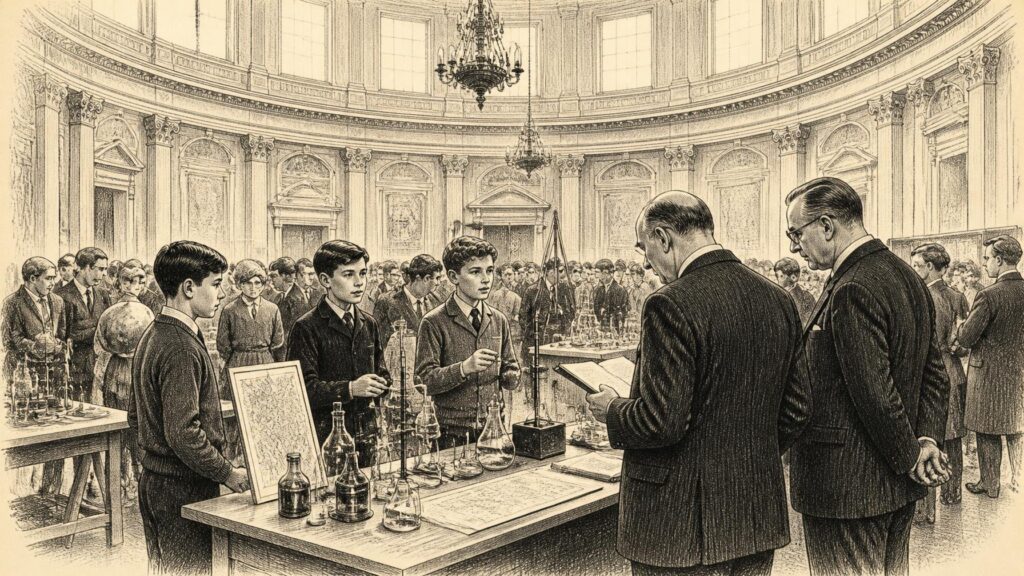
AI generated historical illustration, not a contemporary photograph.
At a Glance
For more than six decades, the Young Scientist Exhibition has offered an unusually public answer to a private educational question: what happens when a school pupil is encouraged not merely to learn scientific knowledge, but to ask an original question, pursue evidence and defend a conclusion before strangers? Founded in Dublin in 1965, the exhibition became one of the most recognisable annual rituals in Irish scientific life. Its history belongs not only to laboratories and schools, but also to the Mansion House, the RDS, Aer Lingus, television cameras, teachers, industry, public policy and the changing ambitions of an island.
Origins Abroad
The origin story of the Young Scientist Exhibition begins outside Ireland, but it is firmly rooted in Irish academic and educational networks. Its founders were the Reverend Dr Tom Burke, a Carmelite priest and physicist, and Dr Tony Scott, a physicist associated with University College Dublin. Both men had worked in atmospheric physics. Burke had also taught science and mathematics, including at Terenure College, and had a marked interest in the practical communication of scientific ideas. Scott, formerly one of Burke’s pupils, became his colleague in research and in the larger task of persuading young people that science could be an active pursuit rather than a body of material to be memorised.
In 1963 the pair travelled to New Mexico in connection with scientific work involving a Nolan–Pollak photoelectric nucleus counter developed at UCD. There they encountered the American science-fair model. Later accounts published by UCD and by the exhibition itself describe a schoolboy demonstrating a home-built rocket near Socorro and explaining that it was intended for a local fair. Burke subsequently visited the wider fair system, in which local events could feed into state and national competitions. The image has acquired the quality of a founding legend: two Irish physicists watching a rocket rise from a schoolyard and carrying the idea of a new institution home across the Atlantic.
That story should be treated with care. It is not mere folklore, because it appears in retrospective institutional accounts connected to the founders, and its central elements are corroborated by UCD’s published history of the exhibition. Yet the precise details, including the identity of the pupil and every aspect of the demonstration, rest largely on later recollection rather than on a contemporary Irish record made at the moment. Tony Scott himself reportedly attempted to identify the young American exhibitor in later years without success. The historical importance of the episode does not depend on every remembered detail. What is securely documented is that Burke and Scott encountered American science fairs in 1963, concluded that an Irish adaptation was possible, and organised one within little more than a year.
The adaptation mattered. The American model was not simply imported wholesale. Ireland in the early 1960s had different school structures, fewer large-scale public opportunities for pupils to display independent scientific work, and a smaller industrial base. Burke and Scott had to find sponsorship, secure institutional approval, persuade schools to participate, recruit judges and create a workable method for categorising and assessing projects. Their achievement was organisational as well as imaginative. A science fair became, in Irish conditions, a national exhibition with a distinctive relationship to education, public culture and economic aspiration.
Irish Context
The exhibition emerged during a period in which the Irish state was rethinking education, economic development and the role of technical knowledge. The later 1950s and early 1960s saw policy makers turn away from economic isolation towards export-led growth and industrial development. The Programme for Economic Expansion became a prominent symbol of that shift. It did not create the Young Scientist Exhibition, but it formed part of the climate in which a public initiative designed to encourage scientific aptitude could appear timely, practical and patriotic.
Science education was also changing. Secondary schooling remained unevenly accessible, laboratory provision varied greatly, and science could still appear to many pupils as a formal, examination-driven subject. Yet new attention was being paid to experimental teaching, scientific training and the needs of a modernising economy. In this setting, the proposed exhibition made a powerful claim: scientific thinking was not confined to universities, specialist workplaces or distant international laboratories. It could begin with an observation made by a teenager in a classroom, kitchen, farmyard, local stream or workshop.
This claim explains why the exhibition was able to draw support from bodies whose purposes were not primarily educational. Aer Lingus, then the national airline, became the founding sponsor. The airline was a fitting, if revealing, partner. It was a state-linked enterprise in a technologically dependent international industry, and it could present support for young scientists as both public service and enlightened self-interest. The connection also gave the new event administrative capability, publicity and a nationally recognised name. Later histories agree that Aer Lingus handled early promotion and administration, while Burke and Scott concentrated on schools, judges, standards and the broader educational purpose.
There was no inevitability about the outcome. Ireland had distinguished scientific figures and institutions before 1965, but an annual national platform for school research required sustained labour. Burke’s flair for publicity and personal persuasion, combined with Scott’s patient organisational work, proved crucial. Letters went to schools; academics and graduates were invited to judge; sponsors were reassured that the undertaking would have public value. The exhibition therefore illustrates an important feature of Irish voluntary and civic history: durable institutions often arise from the meeting of a few energetic individuals with sympathetic organisations, rather than from a single act of government.
Founding Moment
The first Young Scientists’ Exhibition opened in January 1965 in the Round Room of Dublin’s Mansion House. The setting was highly symbolic. The Mansion House was associated with civic ceremony and political life; its use placed school science squarely in public view. Taoiseach Seán Lemass opened the exhibition, stressing the importance of science and technology to Ireland’s development. Contemporary reporting described the event as the first of its kind in the country. In form, it was an exhibition and competition. In meaning, it was a statement that youthful intellectual work deserved an audience beyond teachers and examiners.
The inaugural event attracted 230 participants or entries, depending on the contemporary and later account consulted. The slight variation in language is useful: early histories sometimes count pupils and sometimes projects or entries, and these are not identical measures. What is clear is that the turnout was substantial for a new undertaking. The founders had not merely gathered a handful of enthusiasts in Dublin; they had demonstrated a reservoir of interest among pupils, teachers and families. The Mansion House was soon found to be too restricted for the scale envisaged.
The first overall winner was John Monahan of Newbridge College in County Kildare. His project concerned digestion in the human stomach and used a physical display of flasks and tubing to explain the process. This detail is revealing. The project did not depend on inaccessible equipment or professional laboratory resources. It translated a scientific question into an intelligible demonstration. The ability to explain became, from the beginning, part of the exhibition’s culture. An entrant was expected not simply to have made something or collected information, but to account for the question, method, evidence and conclusion.
Early categories closely reflected school subjects, including physics, chemistry, biochemistry, geography and mathematics. That arrangement made practical sense. It enabled organisers to recruit judges with relevant expertise and helped teachers understand where projects belonged. But it also expressed the educational boundaries of the period. Science was initially divided along familiar disciplinary lines, and individual competitors predominated. Later changes would broaden both the subjects considered appropriate and the forms of collaboration permitted.
It is tempting to regard the first exhibition as a simple celebration of youthful brilliance. The evidence suggests something more collaborative. Pupils made and presented the work, but teachers helped them shape questions and sustain projects; volunteer judges supplied specialist scrutiny; a sponsor underwrote the practical costs; organisers assembled the event; and visitors transformed research displays into a public occasion. The founding achievement lay in bringing these different worlds into one room.
RDS Home
Success brought an immediate logistical problem. The exhibition moved in 1966 to the Royal Dublin Society in Ballsbridge, where it has remained. The move was facilitated by Tony Scott’s involvement with the RDS science committee and by the Society’s historic commitment to the promotion of science, agriculture, industry, arts and equestrian pursuits. The relocation was more than a search for floor space. It joined a young educational event to one of Dublin’s longest-established institutions for public improvement and exhibition.
The RDS gave the competition a scale which the Mansion House could not sustain. Its halls could accommodate increasing numbers of stands, pupils, judges, accompanying teachers and members of the public. It also altered the physical experience of participation. In the Round Room, the first exhibition had the intimacy of an experiment whose organisers were discovering whether it could work. At the RDS it could become an annual national gathering, capable of growing without abandoning the visible, stand-by-stand encounter between an entrant and a questioner.
The location has helped make the exhibition part of the January calendar. For many Irish households, schools and newsrooms, the event came to signal the return of public life after Christmas. It generated reports about striking projects, winners, inventions and emerging social concerns. This visibility has sometimes led observers to focus excessively on the overall prize. The RDS setting, however, makes a different truth visible: the exhibition is a temporary city of projects. The winning stand is important, but hundreds of others produce the broader effect.
The venue also connects the event with a longer Irish tradition of displaying improvement to the public. Nineteenth- and twentieth-century agricultural shows, industrial exhibitions and RDS events treated exhibition as a means of instruction, commerce and civic confidence. The Young Scientist Exhibition inherited this logic while changing its subjects. Its exhibits were not principally finished commodities. They were research processes, prototypes, surveys, experiments and arguments offered by school students. The public was invited to inspect not only what young people knew, but how they had come to know it.
School Science
At the centre of the exhibition is a particular educational ideal: enquiry should be active, visible and owned by the learner. Burke and Scott repeatedly expressed the wish that pupils would see science outside the classroom and all around them. This was not an argument against classroom teaching. Rather, it was an argument that the classroom should open onto ordinary life. A worthwhile project might begin with a local environmental observation, an engineering inconvenience, a pattern in health or behaviour, a mathematical problem, or a question prompted by a familiar object.
That ideal helps explain the exhibition’s unusual durability. A syllabus changes; a textbook is replaced; a particular industrial skill may lose relevance. The practice of framing a question, gathering evidence, testing an explanation and responding to criticism remains widely useful. The competition’s judging process has therefore mattered as much as its public spectacle. Documentary accounts describe judges assessing methodology, research records, accuracy, experimental procedure and the entrant’s understanding. In principle, a polished display without a defensible process should not be enough.
There is an important distinction here between the exhibition’s aspiration and the experience of every participant. Access to laboratory space, teacher time, materials, family support and specialist advice has never been distributed evenly. Some schools possess long traditions of participation and strong scientific resources; others face greater barriers. A historical account should not pretend that an all-island competition automatically levels those inequalities. It can offer opportunity, recognition and encouragement, but it cannot by itself repair differences in educational provision.
Nevertheless, the exhibition has often made school research visible to pupils who might otherwise have encountered science chiefly as an examination subject. Teachers have been indispensable to that process. The celebratory narrative of the young inventor can obscure their work: helping pupils distinguish a question from an assumption, maintaining safe practice, finding materials, keeping diaries, refining written reports, preparing presentations and coping with disappointment. The exhibition’s history is therefore also a history of teaching labour, much of it unrecorded beyond school communities.
Its presence in public culture has brought further benefits and pressures. Television and newspapers have amplified extraordinary projects, especially those that promise medical, technological or commercial applications. Such attention can inspire pupils, but it can also encourage the mistaken belief that science matters only when it produces an immediate invention. The longer historical contribution of the exhibition may lie elsewhere: in teaching that negative results, careful surveys, replication, classification and clear explanation are also legitimate intellectual achievements.
Northern Dimension
In 1972, schools from Northern Ireland participated for the first time. This was a significant development. It occurred during the Troubles, when political violence and deep division shaped daily life across the island. The exhibition did not dissolve those realities, nor should its history be romanticised as a simple story of scientific harmony. Yet it created a practical all-island space in which pupils could meet under rules centred on research, presentation and evaluation rather than constitutional identity.
The value of that arrangement was institutional rather than sentimental. It made participation across the border normal within a national educational event. Entrants could share an RDS hall, compete in common categories and encounter work from schools they might otherwise know only by name. Later official accounts have consistently described the exhibition as open to students from Ireland, north and south. This all-island character became one of its defining features.
Interpretively, the 1972 change shows how cultural institutions can create forms of contact that differ from formal politics. The exhibition was not a peace process and should not be described as one. Its contribution was smaller, quieter and more durable: it offered a recurring setting in which scientific curiosity supplied a shared language. In periods of tension, such settings can matter precisely because they do not demand agreement on every other question.
The significance of all-island participation also extended beyond symbolism. It widened the pool of projects, teachers and schools, strengthened links with educational authorities on both sides of the border and reinforced the idea that science education could be a common concern. The exhibition’s history consequently complicates any narrow reading of it as a Dublin event. Its institutional home is in Dublin, but its constituency has long been broader.
Changing Forms
The early exhibition largely reflected individual competition and conventional subject divisions. Over time, its organisers altered that framework. Group entries were introduced in 1976, recognising that collaborative work was increasingly central to scientific and technological practice. The decision was not without tension. Retrospective accounts note that Tom Burke initially favoured individual work. That hesitation is understandable in a competition designed to identify and reward personal initiative. Yet teams eventually became an important feature, making room for projects that required shared skills and allowing pupils to learn the often difficult arts of division of labour, negotiation and collective presentation.
Project classifications also changed with educational curricula and wider social interests. Biology grew in prominence after the introduction of newer science syllabi in the 1970s. Later categories came to include biological and ecological sciences, chemical, physical and mathematical sciences, technology, and social and behavioural sciences. The category structure is historically important because it registers an expanding idea of what counts as a valid young person’s research question. The exhibition gradually moved beyond a narrow image of science as apparatus, calculation and chemical reaction.
The later incorporation of social and behavioural research was particularly consequential. It acknowledged that systematic investigation of human experience, attitudes and institutions can be rigorous, provided its methods and ethical responsibilities are sound. Projects on health, sport, technology use, social prejudice, environmental behaviour and education have consequently shared space with engineering prototypes and laboratory-based experiments. The exhibition has sometimes been called a science fair in ordinary speech, but its historical development has made it a broader forum for evidence-based enquiry.
The addition of a Technology category in 1998 marked another major shift. Digital systems, electronics and engineering design had become more prominent in schools and in public discussion of Ireland’s economy. The category created a clearer home for students working with computing, devices and technological solutions. It also reflected a changing national language, in which innovation, entrepreneurship and information technology increasingly occupied public attention. Such shifts did not replace the older sciences; they changed the balance and public image of the event.
Modernisation should not be mistaken for a clean break with the past. The underlying procedure remains recognisable: formulate a question, undertake work, record it, prepare a display and submit to questioning. The continuity is one reason the exhibition can connect a 1965 digestion demonstration with later work in computing, artificial intelligence, climate research or public health. The topics transform, while the expectation that a pupil should explain evidence endures.
Corporate Patronage
The exhibition’s sponsors tell a parallel history of Ireland’s changing economy. Aer Lingus supported the event from its beginning and remained associated with it for thirty-three years. When that relationship ended in 1998, Esat Telecom became involved; after BT acquired Esat, BT Ireland assumed the title sponsorship. The exhibition’s public name changed accordingly, but the underlying institution continued. These changes are more than branding milestones. They show how private and semi-state organisations have helped sustain civic and educational initiatives which neither schools nor government departments could easily fund alone.
Corporate support has always raised a question of balance. A sponsor can supply money, logistical expertise, publicity and connections to specialist fields. It can also attach an institution’s public identity to commercial names and contemporary industrial priorities. The exhibition has navigated this by retaining a broad educational mission and by involving schools, volunteer judges, government bodies, universities and other partners. Its history suggests that sponsorship is most durable when a company’s interests overlap with, but do not wholly define, the public purpose of the event.
BT’s long period of sponsorship brought further emphasis on technology, interactive experiences and teacher engagement. In 2026, Stripe became title sponsor, opening another chapter in the institution’s history. That transition should be understood in the context of continuity rather than rupture. Sponsors have changed several times since 1965; the exhibition’s central structure has survived because its legitimacy rests on pupils, teachers, judges and schools as much as on any corporate partner.
Government participation has also increased in visibility. Departments and public agencies have used the exhibition to present work on agriculture, weather, environmental protection, education, overseas development, statistics and research. This can be read as an acknowledgement that the event reaches audiences difficult to gather elsewhere: pupils already engaged in enquiry, teachers seeking usable resources and families willing to spend time with scientific questions. It also demonstrates the exhibition’s evolution from a single sponsored competition into a wider public festival of knowledge.
Public Stage
The exhibition has always been theatrical in the best sense. Entrants stand beside their displays and explain work to judges, visitors, journalists and peers. The physical arrangement demands communication. A pupil cannot hide entirely behind a written report; a judge cannot assess only a poster. Questions are asked, hesitations exposed, methods clarified and enthusiasm tested. For many participants, the experience of speaking seriously to an adult expert may be as important as any prize.
This public dimension distinguishes the event from school assessment. Examination systems can reward individual performance under standard conditions; the exhibition rewards the capacity to carry a project through a more open-ended process. The entrant must make decisions about research design, documentation, visual presentation and explanation. These are not exclusively scientific skills. They are civic skills too, because they concern how a person offers reasons in public and responds when those reasons are challenged.
The media has long helped create the exhibition’s atmosphere. RTÉ archive footage from 1965 records the Mansion House opening and the early winners. Later broadcasts show projects ranging across robotics, alternative fuels, communication, recycling and other concerns of their periods. Such records are valuable historical evidence. They capture the changing appearance of displays, the language used to describe science, the expectations placed on young people and the visual style of each decade. They also remind historians that enthusiasm for science has repeatedly been mediated through television, photography and news reporting.
Publicity, however, has its limits. The most memorable project in a news report may not be the most methodologically important, and the pupil who speaks easily on camera may not represent every entrant’s experience. The exhibition’s public culture can favour novelty and confidence. Its better tradition, visible in judging criteria and teacher testimony, is more patient: it values careful work, honest uncertainty and the ability to learn from critique. That tension between spectacle and method is not a flaw unique to the Young Scientist Exhibition; it is a recurring feature of public science everywhere.
Research Culture
The exhibition’s influence is often described through the later careers of winners and participants. Some have become researchers, entrepreneurs, engineers, teachers, physicians or public figures. Such stories are genuinely compelling, and they demonstrate that early recognition can have lasting effects. Yet they should not be used as proof that every entrant is destined for a scientific profession, nor that the event’s value depends on producing exceptional adult achievers.
A more defensible interpretation is that the exhibition has helped establish a visible research culture among Irish school pupils. It has made projects, notebooks, data, prototypes and questioning familiar elements of secondary-school life. In doing so, it has provided a counterweight to the idea that science belongs only to experts. Participants encounter expertise, certainly, but they also practise a version of it: they identify a problem, document their own work and explain the limits of what they can claim.
The exhibition has additionally linked Irish school research to international opportunities. Irish winners have gone on to represent the country at European and international science competitions. These achievements have reinforced the prestige of the domestic event, but they also reveal a two-way relationship. International competitions offer recognition and comparison; the Irish exhibition supplies a national infrastructure through which pupils can prepare. The result is an institution locally rooted yet outward-looking, much like the scientific careers it seeks to encourage.
Its language has naturally altered over the decades. Early organisers spoke readily of science, industry and modernisation. Later discourse includes STEM, innovation, coding, entrepreneurship, sustainability, wellbeing and artificial intelligence. These words can become fashionable shorthand, and historians should be wary of treating them as neutral descriptions. Still, the changing vocabulary records changing anxieties and hopes. Projects increasingly address climate, health, social equality, digital systems and global development because those are among the questions young people see around them.
Civic Legacy
The strongest historical case for the Young Scientist Exhibition is not that it transformed Ireland single-handedly, nor that every project produced a practical result. Such claims would outrun the evidence. Its importance lies in the repeated creation of a civic space where young people’s investigations are taken seriously. Year after year, pupils have been told that curiosity can be organised, that evidence can be displayed, and that questions asked in ordinary places may deserve disciplined attention.
This legacy is especially notable because the exhibition began in a society often described, with some justice, as culturally cautious and economically constrained. By placing teenagers at the centre of a public scientific event, Burke and Scott challenged the assumption that authority must precede enquiry. They did not eliminate hierarchy: judges remained judges, teachers remained guides and sponsors remained powerful. But they made room for the pupil as an active contributor rather than a passive recipient of scientific knowledge.
The event’s survival has depended on its capacity to renew itself while preserving that principle. It has accommodated teams, new categories, changing technologies, Northern participation, international pathways and different sponsors. It has also retained its fundamental scene: a young person beside a project, being asked what they found and how they know. This combination of adaptability and ritual explains why the exhibition has remained meaningful across generations.
There is a final lesson in the history of its founders. Burke was a priest, teacher and scientist; Scott was a physicist, organiser and long-serving judge. Their collaboration resists simplistic accounts of twentieth-century Ireland as divided neatly between faith, education, science and enterprise. The exhibition they founded was possible because those worlds overlapped. A religious teacher could be an atmospheric physicist; a national airline could sponsor school science; a civic venue could host research by teenagers; and a public competition could become an all-island educational tradition.
Present Continuity
In its seventh decade, the Young Scientist and Technology Exhibition remains historically recognisable despite the transformations around it. Its title sponsor, project themes and digital tools have changed beyond anything envisaged in the Round Room in 1965. Yet the institution continues to bring school pupils to the RDS to present work publicly, to encounter questioning and to see other young people treating problems as investigable rather than merely given.
Its future cannot be assumed. Public institutions require funding, careful governance, teacher capacity, equitable access and trust in their standards. New technologies create opportunities but also difficult questions concerning authorship, data, artificial intelligence and research ethics. Social inequalities in access to support remain important. The exhibition’s history offers no automatic answer to these challenges, but it supplies a useful inheritance: its founders built a durable national event by making curiosity practical, public and collaborative.
That inheritance is why the exhibition deserves its place in Irish history. It has been a competition, a spectacle, a school activity, a sponsored event and a route towards international recognition. More fundamentally, it has been an annual demonstration that inquiry belongs in the common life of the country. From the Mansion House to the RDS, from handwritten reports to contemporary technologies, it has invited generations of young people to ask not only what the world is, but how they might responsibly find out.

The article’s account of the exhibition suggests that its greatest achievement may be less the discovery of future scientists than the creation of a recurring civic space where teenagers publicly defend evidence. Yet this ideal sits beside persistent inequalities in laboratory access, teacher time and specialist support, which can shape who is able to participate confidently. Its all-island character further gives the event a significance beyond competition, particularly because Northern schools joined during the Troubles. How should the exhibition balance celebrating exceptional projects with strengthening equitable participation and its quieter role as a shared all-island forum for enquiry in Ireland?