
The Dublin Society Charter1750 CE
In 1750, George II chartered the Dublin Society for Promoting Husbandry and Other Useful Arts, formalising an elite-led body that encouraged agricultural, industrial and artistic improvement through premiums, advice and practical education. Its drawing-school association, though imprecisely dated, reflected efforts to train craftsmen. In December, the Duke of Dorset returned as lord lieutenant, reshaping political expectations before later conflicts over revenue and executive authority. Charles Lucas, writing from London, advanced civic arguments in print. Beneath these institutional developments lay restricted representation, Anglican privilege, penal disabilities, unequal commerce and rural insecurity, despite population growth, agricultural adaptation, and Ulster’s expanding linen economy.
Dateline
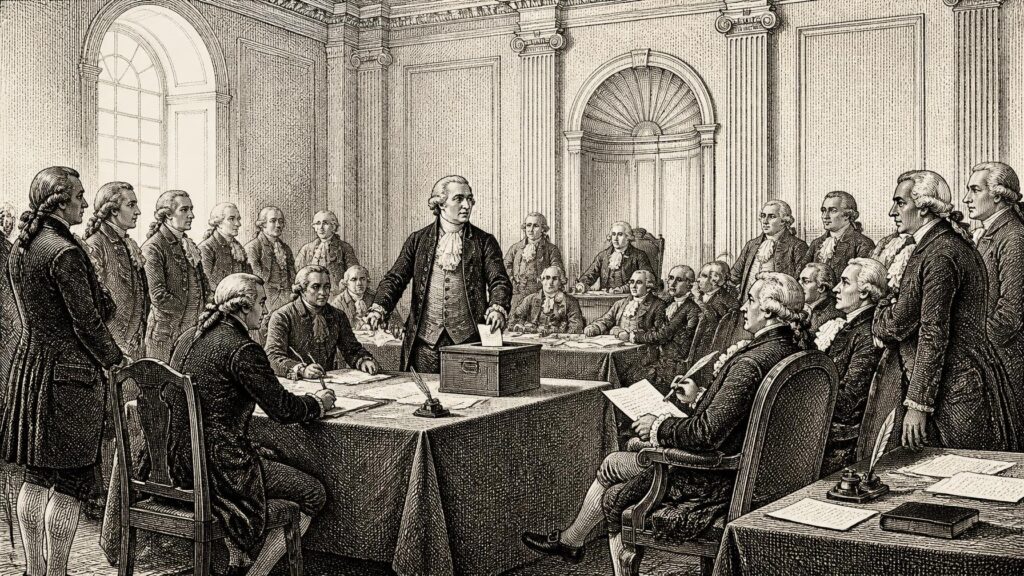
Three securely dated developments give 1750 an unusually clear shape in Irish history. On 2 April, George II granted a charter incorporating the Dublin Society for Promoting Husbandry and Other Useful Arts in Ireland; on 3 May its members first met under the new constitution in Parliament House, Dublin. At the year’s end, on 6 December, the British privy council declared Lionel Cranfield Sackville, first duke of Dorset, lord lieutenant of Ireland, an appointment conventionally dated from 15 December. These were not dramatic events in the manner of a battle or rebellion. Yet together they illuminate how mid-Georgian Ireland was governed, how its leading inhabitants imagined economic “improvement”, and how public argument was beginning to press against the limits of the political system.
Charter and Corporate Ambition
The April charter gave a durable legal identity to an organisation founded in Dublin in 1731. Its full title mattered. The Dublin Society was not simply a learned club or a fashionable gathering. It existed to advance husbandry, manufactures and the “useful arts”: practical knowledge that could make land, labour, materials and skills more productive. The charter placed the enterprise in a formal relationship with the crown and identified a governing company drawn from Ireland’s political and landed elite. William Stanhope, earl of Harrington and outgoing lord lieutenant, was its president; Henry Boyle, the powerful speaker of the Irish House of Commons and chancellor of the exchequer, and George Stone, Church of Ireland archbishop of Armagh, were among its named leaders.
On 3 May, members elected under that constitution at Parliament House on College Green. The venue captured the Society’s position. It was independent neither of government patronage nor of the social order represented in the Irish parliament. But its programme extended beyond routine administration. It offered premiums, advice and recognition for work in farming, manufacture, design and natural knowledge. In an Ireland where large numbers lived from small-scale agriculture and household production, the language of improvement promised that expertise could be made useful. It also reflected the assumptions of the propertied class: that progress would be directed from above, through landlords, clergy, officials and gentlemen able to sponsor experiments and distribute rewards.
The Society’s charter therefore belongs firmly to 1750, while many achievements often associated with it should not be pulled back into this year. Its later botanical, scientific, educational and collecting institutions were still in the future. Nor should the modern name mislead: it was not yet the Royal Dublin Society, a style adopted much later. In 1750 it was the Dublin Society, newly incorporated and poised to become an important channel through which Irish elites promoted agricultural, industrial and artistic improvement.
A Drawing School, Carefully Dated
1750 is also conventionally associated with the Society’s provision of rooms for a drawing school at Shaw’s Court, near Dame Street. The connection is historically important, but the evidence deserves caution. The Society had already subsidised the artist Robert West’s teaching and had awarded drawing premiums during the 1740s; later accounts place the school in Shaw’s Court in 1750. Yet a nineteenth-century history of the Society acknowledged that the precise opening date of its original school could not be recovered because the relevant minute book was missing. What can responsibly be said is that, by about this point, the Society was turning drawing from a private accomplishment into practical instruction linked to trades, ornament, landscape and design.
That purpose was economic as well as cultural. A joiner, engraver, weaver, silversmith or builder needed the ability to copy, measure and devise patterns; a growing Georgian city required craftsmen who could interpret plans and produce finished work. The ideal was not an isolated fine-art academy but a training system that joined taste to manufacture. This modest institutional development helps explain why the charter mattered beyond the meeting rooms of Dublin gentlemen: it supported a long-term effort to attach education to the material life of the kingdom.
Dorset’s Appointment
The other firmly dated landmark came in December. Dorset had previously been lord lieutenant from 1730 to 1737, and his return followed the departure of Harrington. The lord lieutenant was the king’s representative and the senior figure in an executive that connected Dublin Castle to British ministers and the crown. The appointment did not itself transform daily government overnight: Dorset was appointed from Britain, and viceroys were often absent from Ireland for long periods. But it altered the political expectations surrounding the next parliamentary session.
The immediate setting was a governing system dependent on relationships rather than modern parties. Boyle commanded considerable influence in the Commons through office, experience and electoral connections. Stone, primate of all Ireland, was at once a senior Anglican churchman and an important political operator. The earl of Kildare, James Fitzgerald, possessed extensive influence through rank, land and parliamentary patronage. Dorset’s return brought a seasoned court politician into a field already crowded with powerful interests. The sharper crisis over control of Irish revenue and the authority of the executive belonged to 1753 and 1754, not to 1750; it should not be presented as if it had already erupted. Still, the December decision created the alignment from which that conflict would grow.
Irish political life was also constitutionally constrained. The Irish parliament legislated, but proposed bills passed through the machinery of Poynings’ Law and required approval by the British privy council before they could be introduced in Dublin. Westminster’s Declaratory Act of 1719 had additionally asserted a British parliamentary right to bind Ireland and confirmed appeals to the House of Lords in Britain. These arrangements made questions of money, patronage and legislative initiative especially sensitive. A dispute over an office or a surplus was never merely personal: it could raise the larger question of who was entitled to speak for the Kingdom of Ireland.
Lucas and the Public Argument
Charles Lucas’s activity in 1750 reveals that constitutional argument was not confined to peers and officeholders. Lucas, an apothecary and Dublin civic reformer, had been driven from Ireland after his campaigning during the Dublin election politics of 1748–49. Living in London, he published The Liberties and Customs of Dublin Asserted in 1750. The work defended the city’s civic claims and criticised abuses connected with municipal government. Its importance lies less in any immediate legal victory than in its insistence that political authority could be scrutinised through law, custom and public print.
Lucas wrote from exile, not from a popular democracy. The electorate was very limited, and borough government could be controlled by corporations and patrons. Nevertheless, pamphlets, newspapers, petitions and municipal controversies created a public sphere in which politically engaged readers could argue about liberty, taxation and civic rights. The vocabulary later associated with “patriot” politics had roots in such disputes. In 1750, its audience was still predominantly urban, Protestant and male, but it was already wider than the formal chambers of Parliament House.
Most People Beyond the Constitution
The institutions celebrated in Dublin did not represent the whole island. The established Church of Ireland held legal privilege, its bishops sat in the House of Lords, and its tithes were collected from agricultural production irrespective of the cultivator’s faith. Roman Catholics formed the great majority of the population but remained excluded from parliamentary voting under the law of 1728 and faced a continuing body of penal restrictions affecting property, education, office-holding and religious organisation. Presbyterians, numerous in Ulster, also stood outside the Anglican establishment and encountered legal and financial disabilities. Religious practice on the ground was more varied than statute books alone suggest, but the hierarchy of law and power was unmistakable.
For most households, the governing facts of life were lease, rent, crop, livestock, family labour and vulnerability to prices and weather. Ireland was recovering from the catastrophic subsistence crises of the early 1740s, commonly remembered as the Great Frost and its aftermath. It would be misleading to claim a single national condition for 1750: regions, estates and households differed greatly. But the middle decades of the century formed part of a wider period of population growth and agricultural adaptation. Potatoes, oats, dairy produce and small plots supported many poorer families, while cattle grazing, butter, beef, hides and provisions linked other districts to markets across the Irish Sea and Atlantic world.
Linen, Land and Uneven Prosperity
Ulster’s linen manufacture was especially significant. Spinning and weaving often took place within dispersed rural households, connecting women’s and men’s labour to merchants, bleachers and export networks. Linen did not make all Ulster prosperous, nor did it erase dependence on land; nevertheless, it supplied an expanding alternative source of cash income in many districts. Elsewhere, grazing and the provisioning trades could enrich merchants and larger farmers while leaving labourers and cottiers exposed. The contrast between a Dublin Society devoted to improvement and the insecurity of many tenants was not accidental. Improvement could mean new knowledge and opportunity, but it could also mean landlords seeking higher returns from land they controlled.
Dublin, Cork, Belfast, Limerick, Waterford and smaller ports connected these worlds. Dublin was the seat of the courts, parliament, administration, booksellers and elite consumption; its building trades and service economy depended on food, fuel and materials brought in from surrounding counties and coastal trade. Catholic merchants participated substantially in commercial life despite legal discrimination, while Protestant corporations and officeholders retained political advantage. Ireland’s commerce was also shaped by imperial regulation: access to markets, navigation rules and trade restrictions were matters decided within a British imperial framework, not by an autonomous Irish economic policy.
A Year of Foundations
Nothing in 1750 settled Ireland’s constitutional tensions or transformed the lives of the rural majority. Its importance is more structural. The Dublin Society acquired a charter and a public corporate form; Lucas carried Irish civic argument into print from London; and Dorset’s appointment reset the balance at Dublin Castle before the confrontations of the early 1750s. The year thus shows an Ireland of active institutions and growing commercial connections, but also of restricted representation, entrenched religious inequality and profound social division. Its most consequential events were foundations and appointments whose effects would be felt in the years ahead.
Primary Sources
- Setting Forth · The RDS Art Collection · RDS Digital Archive
- A History of the Royal Dublin Society
- Dublin Society Council Minute Book (1750–1757)
- A List of the Members of the Dublin-Society Named in the Charter
- Improvement as Philanthropy: The Royal Dublin Society
- Premiums and Progress—How the Dublin Society Shaped Eighteenth-Century Ireland
- From 1731: The Royal Dublin Society
- Boyle, Henry
- Stone, George
- Fitzgerald, James
- Lucas, Charles
- Search Results: Sackville, Lionel C., 1st Duke of Dorset
- Acts of the Privy Council of England, Colonial Series, Volume V
- The Irish Enlightenment
- Consumption and Living Conditions, 1750–2016
- Famine and Economic Change in Eighteenth-Century Ireland
- A Taxing Enquiry: How Many People Were There in Pre-Census Ireland?
- The Rise of a Catholic Middle Class in Eighteenth-Century Ireland
- Catholic Inheritance under the Penal Laws in Ireland
- The Enlightenment Critique of Empire in Ireland, c. 1750–1776
- A Non-Famine History of Ireland?
- History of the Commercial and Financial Relations between England and Ireland from the Period of the Restoration