

Trusted Machines

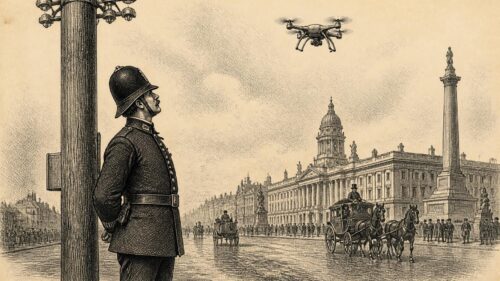
AI generated historical illustration, not a contemporary photograph.
At a Glance
Artificial intelligence did not arrive in Ireland as a wholly unprecedented problem. Its speed, scale and apparent novelty are real, but the questions it poses—who collects information, who makes consequential decisions, who may inspect a system, and what remedy belongs to the citizen—belong to a longer Irish and European history of regulating power through law. The Irish story of AI regulation is therefore not merely a chapter in technological policy. It is part of a continuing argument about privacy, public administration, economic development and trust.
That argument has become unusually important in Ireland. The State has sought, simultaneously, to attract international technology business, foster domestic innovation, protect constitutional and European rights, and preserve public confidence in services increasingly mediated by data. These purposes can reinforce one another, but they can also conflict. A regulatory system which is too weak may invite harm and diminish confidence; one which is unintelligible or poorly resourced may create only the appearance of control; one which is needlessly rigid may discourage useful deployment. Ireland’s recent institutions were built amid precisely this tension.
This is a history in motion rather than a finished settlement. Documentary evidence exists in Acts, European regulations, government strategies, Oireachtas proceedings and regulatory records. Those sources establish dates, legal powers and declared policy. They do not, on their own, prove that citizens trust particular systems, nor do they guarantee that official ambitions will be realised. Interpretations offered here are accordingly identified as interpretation. Popular tales of all-seeing machines or wholly autonomous public administration are treated as modern folklore unless supported by evidence.
Early Anxieties
Before artificial intelligence became a familiar public phrase, Irish law was already responding to the social consequences of automated information. The most important precursor was not a robot or a chatbot but the expanding use of computers to hold, compare and circulate personal records. In the later twentieth century, public and private bodies acquired greater capacity to turn scattered facts about individuals into searchable administrative knowledge. This altered the balance between citizen and institution. A paper file could be difficult to find and harder still to combine with other files; an electronic record could be copied, linked and transmitted with an ease that made mistakes, surveillance and exclusion more consequential.
Ireland’s Data Protection Act 1988 emerged from this European moment. It gave domestic effect to obligations associated with the Council of Europe’s Convention 108 and established principles for the handling of personal data. The legislation was not drafted for contemporary machine learning, large language models or facial analysis. Yet its central concern now appears prescient: the fact that administrative efficiency does not by itself justify unrestricted processing of information about people.
The historical setting matters. Ireland in the 1980s was also pursuing a path of economic openness. Financial and internationally oriented service industries required dependable cross-border information flows. Regulatory protection of data was therefore connected to commerce as well as civil liberty. The apparent opposition between regulation and development was never complete. A country that could demonstrate lawful and reliable treatment of information might become a more credible place in which to do business. This relationship between rights and reputation would become still more significant in the digital economy.
There is a temptation to narrate the 1988 legislation as the beginning of a straight line leading inevitably to AI regulation. That would be an interpretation, not a documented fact. Contingency was everywhere. The technologies changed, European law changed, and the political importance of internet platforms was not foreordained. Still, the legislation established a durable public proposition: people whose lives are shaped by information systems require enforceable protections, not merely assurances of good conduct.
Privacy Foundations
Data protection became the most substantial institutional foundation on which Irish thinking about trustworthy digital systems was later built. The relevant legal landscape developed through the Data Protection Acts of 1988 and 2003, European directives, the General Data Protection Regulation and the Irish Data Protection Act 2018. By the time generative AI became a household subject, citizens, firms and public bodies were already accustomed—at least in principle—to the ideas of lawful processing, purpose limitation, security, rights of access and independent supervision.
These principles are not identical to AI governance. A system can use no personal data and still present risks, for example by producing misleading synthetic material, enabling unlawful manipulation, or making unreliable inferences in a safety-critical setting. Conversely, a data-protection complaint may concern conduct that has little to do with AI. Nonetheless, the two fields overlap deeply. Many powerful AI applications depend upon extensive data collection, classification and reuse. They can also make it harder for a person to understand why a decision was reached or what information influenced it.
The establishment of the Data Protection Commission under the 2018 Act marked an important institutional turning point. The Commission became Ireland’s independent supervisory authority for data protection and, for many organisations with their main European establishment in Ireland, a lead supervisory authority under the GDPR. This position gave Ireland an unusually visible role in European debates about the enforcement of digital rules. It also meant that questions concerning regulatory capacity, timeliness and public confidence were not abstract matters of constitutional design. They became part of Ireland’s international standing.
Trust, in this setting, has more than one meaning. For individuals, it may mean confidence that personal information will not be misused, or that a harmful decision can be challenged. For a business, it may mean a stable legal framework whose demands can be understood and planned for. For the State, it may mean confidence that essential services can use technology without compromising equality, due process or legitimacy. These forms of trust can overlap, but they are not interchangeable. A system trusted by investors may still be feared by people affected by it; a system praised for efficiency may still be unacceptable if it cannot be meaningfully questioned.
Historical records offer no basis for claiming that data protection solved these difficulties. Rather, they show the construction of a language and an administrative machinery through which such difficulties could be addressed. That inheritance shaped the Irish reception of artificial intelligence. It encouraged a rights-conscious approach, while also revealing the challenge of enforcing complex rules against entities whose operations were international, technically sophisticated and commercially powerful.
European Turning
The European Union’s development of the Artificial Intelligence Act gave this emerging field a clearer legal form. Regulation (EU) 2024/1689 entered into force on 1 August 2024. Its adoption marked the creation of a harmonised European framework designed to support innovation while protecting health, safety and fundamental rights. Ireland did not create that regulation alone, and it would be historically inaccurate to portray the Act as an Irish invention. Yet, as a Member State with a major digital economy and established experience of cross-border data regulation, Ireland had a substantial interest in how European rules would be implemented.
The Act uses a risk-based structure. Certain practices are prohibited because the law judges their potential harms unacceptable. Other systems are classified as high risk and must meet demanding requirements relating to risk management, data quality, documentation, logging, human oversight, robustness and accuracy. Transparency obligations address other circumstances in which people need to know that they are dealing with a machine or with artificially generated material. The architecture is notable because it rejects two simplistic positions at once: that all AI should be treated alike, and that voluntary good intentions are sufficient for systems capable of affecting rights or safety.
The phased timetable is especially important for historians because it prevents a misleading impression of a single moment of legal transformation. Prohibitions and AI-literacy provisions began applying from 2 February 2025. Governance rules and obligations for general-purpose AI models followed from 2 August 2025. Many further provisions became applicable from 2 August 2026, while rules for particular high-risk categories have later application dates. The schedule reflects the practical reality that technical standards, national authorities and affected organisations require time to prepare. It also demonstrates that legal enactment is only the opening of regulation, not its conclusion.
The European framework treats transparency as a condition of informed choice. A person should not be left to guess whether an apparent human interlocutor is automated, nor should public-interest material created or manipulated by AI escape appropriate identification where the law requires it. This does not make all synthetic content unlawful. Nor does it establish a universal right to know every detail of every model. Rather, it creates specific duties proportionate to particular uses and risks.
Interpretively, the Act can be read as an attempt to make trust institutional rather than sentimental. It does not ask the public simply to believe that developers are benevolent. It asks providers and deployers to document systems, manage foreseeable risks, submit to oversight and, where necessary, alter or withdraw non-compliant products. Whether that arrangement proves effective will depend on enforcement, resources, technical expertise and the willingness of authorities to use their powers. The historical significance lies in the effort to translate a broad moral demand for trustworthy AI into operational legal duties.
Corporate Gravity
Ireland’s position within this story derives partly from economic geography. Over several decades, the State became a prominent European base for international technology companies. This brought employment, investment, expertise and tax revenues, but also concentrated difficult questions concerning platform governance, data processing and regulatory supervision. The presence of major firms did not mean that Irish institutions controlled the entire technological landscape. Many systems were designed elsewhere, deployed across borders and embedded within global supply chains. It did mean, however, that Irish regulatory choices could have effects beyond the State.
That corporate gravity has repeatedly complicated public discussion. One narrative depicts regulation as an obstacle imposed upon innovation. Another portrays large technology firms as so powerful that national regulation is inherently futile. Both are too crude. Regulation can impose costs, particularly on smaller organisations with limited compliance capacity. Yet predictability, clear standards and public confidence may also support adoption and investment. Equally, national authorities cannot govern global technology alone, but coordinated European law creates leverage that a small state acting in isolation would lack.
Ireland’s policy documents have openly embraced both sides of this position. They seek to make the country a location for innovation and investment while insisting that development should be human-centred, ethical and accountable. This is not a contradiction that can be removed by rhetoric. It is a permanent governing problem. A regulator must avoid becoming either a ceremonial promoter of industry or a body that sees every technical advance chiefly as a threat. Public trust depends in part on whether citizens can see that the balance has been reached fairly.
The phrase “regulatory hub” deserves careful treatment. It can suggest expertise, consistency and accessible administration. It can also provoke anxiety if people conclude that a state’s economic interests will soften its defence of rights. The evidence does not permit an easy verdict on such concerns. It does show why institutional independence, transparent decisions, adequate staffing and effective routes for complaint are essential. Trust cannot be demanded from the public as payment for innovation. It has to be earned by practices that withstand scrutiny.
Modern folklore has often supplied more dramatic images: a hidden algorithm deciding every job application, a facial-recognition network observing every street, or a sentient machine quietly directing public policy. Some of these images draw attention to genuine risks, but they should not replace evidence. The actual systems at issue vary greatly in capability, purpose and legal status. Historical analysis is most useful when it refuses both complacency and exaggeration.
National Strategy
Ireland’s first National Artificial Intelligence Strategy, published in July 2021 under the title AI Here for Good, was a key statement of national intent. It envisaged the use of AI for productivity, public services and societal challenges, while placing emphasis on a people-centred and ethical approach. Its language repeatedly connected public confidence to transparency, accountability and intelligibility. This was significant because it framed trust not as an afterthought to commercial adoption but as a condition for legitimate adoption.
The strategy belonged to a period when European AI legislation was still developing. It could therefore set ambitions but could not settle every legal question. Its value lies partly in showing how Irish policy-makers understood the issue before the final European framework was in place. They recognised that opaque systems making consequential decisions could generate difficulties of explainability and accountability. They also identified a need for skills, research capacity, public-sector readiness and engagement with ethical questions.
A strategy, however, is not legislation. It does not independently create offences, compel disclosure or establish a remedy for every wrong. Historical accounts should retain this distinction. Government strategies record priorities and proposed direction; statutes and regulations create binding legal frameworks; regulators administer and enforce particular powers; courts determine disputes within the law. Confusion between these forms can make a policy programme look more complete than it is.
The strategy’s most durable contribution may have been conceptual. It made a public commitment that Ireland should pursue AI which is acceptable to society, not merely technically impressive or commercially profitable. Such language creates expectations. Once a government describes trust, accountability and human-centred development as national objectives, citizens and parliamentarians may reasonably ask how those objectives will be measured, who will be answerable for failures, and whether affected communities have been heard.
The refreshed national digital and AI agenda of 2026 continued this dual emphasis on economic opportunity and trusted adoption. It included commitments concerning public services, literacy, regulatory capability and public engagement. Its mention of a national conversation on AI is notable. In historical terms, it acknowledges that the legitimacy of technological governance does not rest exclusively with engineers, firms or departmental officials. Public confidence is shaped by whether people feel that systems have arrived through understandable processes and that their concerns can influence policy.
Legislative Settlement
In 2026 Ireland moved from broad strategy towards a more specific domestic framework for implementation of the EU Act. The Regulation of Artificial Intelligence Act 2026 established the national structures required for implementation and enforcement, while the AI Office of Ireland became the central coordinating body. The Office was designed to work within a distributed model, drawing on the functions and expertise of existing sectoral regulators rather than concentrating every supervisory function in one institution.
This design was a practical response to the breadth of AI. A system used in medical care, financial services, transport, employment or education may already be subject to different bodies of law and different regulators. A single office could not instantly acquire equal specialist competence in every field. Coordination, therefore, became central. The AI Office of Ireland acts as a national focal point, supports coherent implementation, provides a point of contact at European level and is intended to promote safe and responsible use alongside compliance.
The distributed approach has advantages and risks. Its advantage is that established regulators may understand the sectors in which AI is deployed. Its risk is fragmentation: citizens and businesses may be uncertain which authority is responsible, while inconsistent approaches may develop between fields. The success of the arrangement will depend on clear allocation of functions, information sharing, common standards and visible accountability. These are matters of institutional practice, not matters that can be resolved merely by announcing an office.
Oireachtas discussion surrounding the legislation made the public-trust purpose explicit. Parliamentarians and ministers addressed transparency, accountability, public awareness and the need to ensure that AI serves human wellbeing. The debates also revealed anxieties about private dominance, unequal access to knowledge and the possibility that people might feel compelled into digital systems without meaningful consent or alternatives. Such concerns are not proof that every AI deployment is harmful. They are evidence that democratic legitimacy has become an inseparable part of the regulatory question.
The new framework should not be mistaken for a wholly separate Irish AI code. The central legal obligations derive from the European regulation, which applies directly across the Union. Irish legislation chiefly provides domestic architecture for supervision, coordination, designation of authorities and penalties. That distinction is important. It locates Ireland within a larger European constitutional and legal order while preserving the State’s responsibility to ensure that rules operate effectively at home.
Trust Conditions
Public trust is often invoked as though it were a quantity that governments or companies can simply increase through communication. History suggests a sterner view. Confidence in institutions normally rests upon repeated experience: rules are clear, officials are competent, complaints are heard, mistakes are corrected and powerful actors are not beyond reach. Technology may make each condition harder because systems can be opaque, rapidly changing and dependent upon technical knowledge unavailable to most citizens.
Transparency is one condition, but it is not the whole answer. Merely disclosing that an AI system exists may be of limited help if a person cannot understand its role, contest its result or obtain human review where that is appropriate. Conversely, complete disclosure of technical detail may be neither practical nor useful, especially where it would expose security vulnerabilities or confidential information. The regulatory challenge is to provide meaningful information: what a system does, who is responsible, what data and assumptions matter, what risks have been assessed, and what recourse exists when something goes wrong.
Accountability is a second condition. An automated outcome should not create a vacuum in which everyone points elsewhere: developer to deployer, deployer to data supplier, supplier to an inscrutable model. The EU framework’s documentation, logging and human-oversight requirements for high-risk systems are intended to resist that vacuum. Their effectiveness will depend on how carefully they are applied. A human nominally placed “in the loop” is not meaningful oversight if that person lacks time, authority, training or access to challenge the system.
Literacy is a third condition. The public does not need to become a nation of computer scientists in order to exercise civic judgment. People do, however, need enough understanding to recognise common limitations: an apparently fluent system may be wrong; a generated image may not record a real event; personal information entered into a tool may have consequences; and a machine recommendation is not necessarily a neutral fact. Ireland’s recent commitment to AI literacy acknowledges that informed trust differs from blind trust.
Access and equality form a fourth condition. If automated tools improve a service for people already comfortable online but make it harder for others to obtain help, confidence will fracture along lines of age, disability, income, language or location. Public bodies must therefore consider channels beyond the newest interface. This is not nostalgia for paper administration. It is recognition that a public service remains public only if people can realistically use it and question it.
Public Deliberation
The most durable lesson from Ireland’s recent experience may be that regulation must be accompanied by public deliberation. Consultation is not a decorative exercise in which decisions already made are explained after the fact. At its best, it identifies harms that designers and officials have overlooked, exposes unequal effects, and tests whether legal language corresponds to ordinary experience. At its weakest, it becomes a procedure that gathers comments without altering outcomes. The difference is visible only over time, in published reasoning and institutional responsiveness.
Ireland has used consultations in relation to European AI proposals and national implementation. Parliamentary committees have heard evidence about the public good, dominance by large companies, transparency and the need for citizens to have a say in the technological systems entering their homes and services. These are documented features of the policy process. Whether they will produce an enduring culture of participation remains uncertain. A national conversation cannot be declared complete because a report is published or a meeting is held.
There is a particular reason for caution in a country with a highly internationalised technology sector. Decisions about model design, training data, product launches and corporate governance may be made outside Ireland, even when the effects are felt within it. Irish institutions cannot determine every feature of global AI. They can set conditions for systems used in the State, cooperate through European structures, enforce rights within their jurisdiction and articulate the public values that commercial actors must respect.
Interpretation suggests that Ireland’s strongest contribution may lie not in attempting technological self-sufficiency but in demonstrating credible governance within an interconnected European system. That requires technical competence, but it also requires the older civic virtues of independence, candour and procedural fairness. A regulator that explains its decisions, acknowledges uncertainty and corrects error can cultivate greater confidence than one that promises total control over a technology no institution fully commands.
Historical Measure
By November 2026, Ireland’s AI governance architecture had acquired a clearer institutional shape than it possessed only a few years earlier. The AI Office of Ireland had been established; the European Act was applying in phases; and government policy linked regulation, innovation, literacy and public engagement. These are substantial developments. They should not be exaggerated into proof that the central problems have been solved. The most demanding provisions still require continuing implementation, national authorities require sustained capability, and AI itself will continue to change.
The proper historical measure is therefore neither celebration nor alarm. Ireland’s record shows a recurring attempt to reconcile openness to economic and technological change with a legal tradition attentive to privacy, rights and European cooperation. The 1988 data-protection settlement, the GDPR era, the 2021 national strategy and the 2026 implementing institutions form connected stages in that attempt. Each reflects its own circumstances; none makes the next inevitable.
Trustworthy machines, if that phrase is to mean anything, cannot be machines that never err or systems beyond human comprehension. They are systems governed by institutions willing to identify risk, impose limits, explain decisions, protect the vulnerable and provide remedies. The machine is only one part of the story. The enduring subject is the public relationship between citizens, law and power. Ireland’s emerging AI history will be judged not by the novelty of its tools alone, but by whether that relationship remains intelligible, contestable and worthy of confidence.









Ireland’s attempt to combine its role as a technology hub with credible AI oversight raises a significant question about how trust is earned. The article usefully distinguishes ambitious strategies from binding law, and suggests that transparent, properly resourced institutions matter more than promises of innovation. Its distributed enforcement model may bring sectoral expertise, yet coordination across health, employment, education and other fields could prove decisive when harms cross boundaries. Public participation may determine whether regulation appears legitimate to those affected. How should Ireland balance specialist expertise, national coordination and citizen involvement so AI governance protects rights while supporting valuable innovation?