

Distant Neighbours
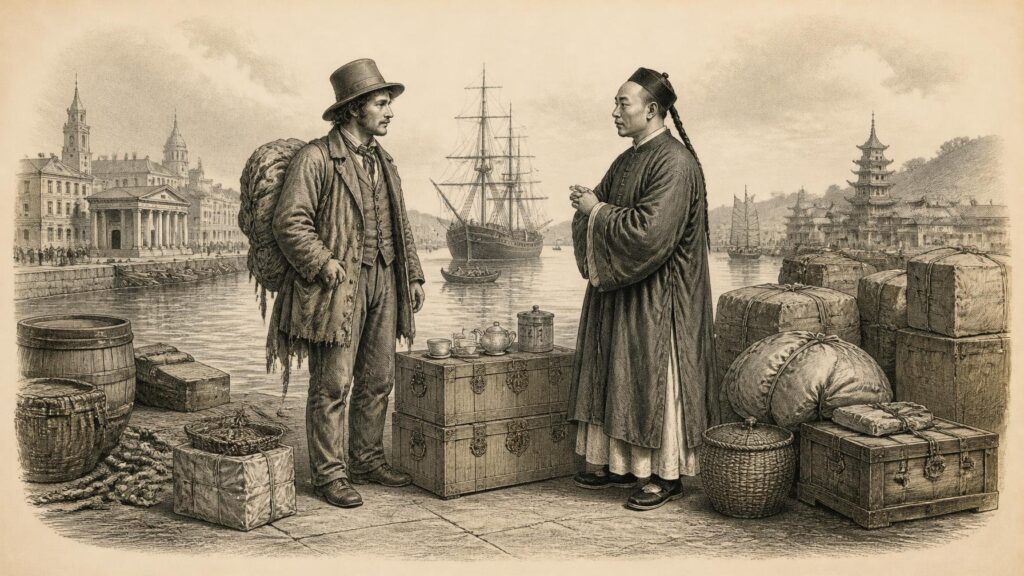
AI generated historical illustration, not a contemporary photograph.
At a Glance
Ireland and China were never near neighbours, and for much of their history neither possessed a sustained official relationship with the other. Yet the distance between them was repeatedly crossed by missionaries, soldiers, diplomats, emigrants, students, traders and officials. Their encounters reveal an Irish history extending well beyond the island, but they also caution against easy claims of national innocence. Irish people could approach China as citizens of a small country marked by colonial experience; they could also act within British imperial structures, or participate in religious projects that sought to remake Chinese lives.
Early Encounters
The earliest Irish connections with China were intermittent and usually indirect. Before the nineteenth century, Irish knowledge of China travelled largely through European books, Jesuit reports, merchant networks and the intellectual fashions of the Enlightenment. China appeared in Irish sermons, travel writing, philosophy and the decorative arts as a distant civilisation: ancient, populous, sophisticated and frequently imagined through European assumptions. Such material is evidence of reception rather than of a bilateral relationship. It tells us more about Irish curiosity, commerce and religious debate than about direct contact with Chinese people.
There were, however, Irish figures involved in Britain’s expanding intercourse with Qing China. George Macartney, the first Earl Macartney, was born in County Antrim and led the British embassy to the Qing court in 1793. His mission was sent by the British Crown, not by an Irish state, and it should not be retroactively presented as an Irish diplomatic venture. Nevertheless, Macartney’s background matters because it illustrates the ambiguous position of elite Irish and Anglo-Irish men in imperial service. Their careers linked Ireland to places far beyond Europe while serving a state that governed Ireland without its consent.
The Macartney embassy is often remembered for the controversy over court ritual, especially the question of the kowtow. That episode has acquired a symbolic status in later histories of supposed civilisational misunderstanding. The fuller significance lies elsewhere: Britain sought improved trading terms and a permanent diplomatic foothold, while the Qing court approached the visitors through established systems of tribute and foreign relations. Neither side entered a neutral meeting place. Ireland was represented only indirectly, through a man serving British interests. The distinction is essential when writing a history of Ireland and China rather than a general history of Britain in China.
Imperial Entanglements
The nineteenth century created harsher and more consequential connections. Irish-born officers, soldiers and administrators served throughout the British Empire, including in China. Sir Hugh Gough, born in County Limerick, became commander-in-chief of British forces during the First Opium War. He played a prominent military role in the campaign that ended with the Treaty of Nanking in 1842. Chinese historical memory regards that treaty as the first of the unequal treaties: an agreement imposed after military defeat, opening treaty ports and ceding Hong Kong to Britain.
This is not a comfortable chapter, nor should it be softened by invoking Ireland’s own subordinate position within the United Kingdom. Gough’s birthplace did not make the war an Irish national enterprise, but neither does it erase Irish involvement in imperial violence. A serious account must hold both facts together. Ireland did not possess an overseas empire of its own, yet Irish men and women participated in the institutions, armies, churches and commercial networks of the British Empire. The Irish relationship with China therefore includes both solidarities born from anti-colonial feeling and complicities produced by service to imperial power.
That tension later gave Irish missionaries a language through which to distinguish themselves from British colonial actors. Their claims should be read critically. A missionary’s Irish nationality could make him or her less readily associated with Britain in particular local circumstances, especially after Irish independence. It did not automatically remove the unequal power of a foreign religious worker operating in China, nor did it make conversion culturally neutral. Irishness could be a real political difference, but it could also be used as a moral alibi.
Presbyterian Manchuria
One of the longest institutional connections began with the Irish Presbyterian mission in Manchuria. The Presbyterian Church in Ireland records that ninety-one Irish Presbyterian missionaries served in north-eastern China between 1869 and 1951. Their field lay in Manchuria, a region shaped by Chinese, Russian, Japanese and Korean geopolitical pressures, as well as by internal migration and social change. The mission established stations and outstations, combining churches with schools and medical work. This was a durable form of contact, involving ministers, doctors, nurses, teachers, Chinese converts and local employees, rather than a handful of passing travellers.
Its surviving records complicate any simple story of benevolent service. Hospitals and schools undeniably offered treatment, training and practical assistance; individual missionaries often developed deep linguistic knowledge and long local relationships. At the same time, the mission’s purpose was religious conversion. It worked within the wider nineteenth-century expansion of Protestant missions, an expansion closely entangled with Western power even where missionaries themselves criticised imperial behaviour. The institutions were sites of care, but also of persuasion, discipline and cultural translation.
Irish Presbyterian women were especially important to this history, though older accounts often gave them less attention than ordained men. Medical missionary Margaret McNeill’s diary, written during her work in Manchuria in the early years of the twentieth century, is preserved among sources for Irish women’s history. It records daily clinical work, travel difficulties, political violence and missionary perceptions of Chinese society. Such documents are valuable primary evidence, but they are not transparent windows onto China. They preserve a foreign observer’s viewpoint, shaped by Presbyterian belief, gender, class, race and the trauma of the Boxer crisis.
The Boxer movement and the international intervention of 1900 demonstrated the dangers inherent in foreign missions. Chinese hostility towards missionaries had many causes: resentment of external privileges, disputes involving converts, local social tensions and the association of Christianity with imperial power. Missionaries and Chinese Christians were among those threatened or killed, but the foreign military response also brought grave violence. Irish mission archives consequently document suffering and courage, yet they belong within a history of unequal international intrusion rather than outside it.
Columban Venture
The most distinctive Irish Catholic connection was the Maynooth Mission to China, later the Missionary Society of St Columban. Its origins lay in the ambitions of Edward Galvin of County Cork and John Blowick of County Mayo. Galvin travelled to China in 1912 after pastoral work in the United States. On returning to Ireland in 1916, he sought to build an Irish missionary society dedicated to China. The project won support at Maynooth; Rome formally approved the Society of St Columban in 1918. The first group departed for China in 1920, and Galvin led the work in the Hanyang district, now part of Wuhan.
The timing is revealing. The society emerged during the Irish revolutionary period, when ideas of national distinction carried unusual force. The Columbans presented themselves as an Irish missionary body at a moment when Irish political independence was being claimed and contested. Hurling photographs from their China mission have acquired an almost emblematic quality: an Irish sporting culture transplanted to central China, asserting that its bearers were not simply British. Yet such gestures were not politically innocent. They expressed a longing for national identity abroad while placing Chinese students and converts within a mission directed from Ireland.
The Columbans were drawn to rural districts rather than chiefly to treaty-port society. Their work involved parishes, catechesis, schools, orphanages, clinics and training institutions. Columban Sisters, who began travelling to China from the mid-1920s, brought nursing, teaching and medical skills. Their contribution was vital, though it was often framed within the restrictive gender expectations of religious life. The mission’s own journals, letters, photographs and film now form a substantial archive. They are important because they preserve local detail from years of civil war, famine, Japanese invasion and revolution. They also require careful reading because institutional records tend to emphasise sacrifice, progress and religious success.
Irish enthusiasm for the China mission drew strength from the post-Famine expansion of Irish Catholic religious life. Large numbers of Irish men and women entered orders in the late nineteenth and twentieth centuries, and overseas mission offered vocation, status and a sense of collective purpose. China was imagined as a great spiritual field, frequently through language now recognised as paternalistic. The desire to baptise and educate was sincere for many participants, but sincerity does not resolve the ethical difficulty of seeking to transform another society’s religious life.
Humanitarian Work
The humanitarian dimension of the Columban presence was real and is among the strongest documented elements of the connection. During the catastrophic Yangtze floods of 1931, Galvin was involved in relief administration around the three cities then known as Hanyang, Hankow and Wuchang. Columban personnel operated clinics, assisted refugees and appealed overseas for funds. Their records describe overwhelmed cities, displacement and hunger on a vast scale. The crisis made medical and relief work central to the public identity of the mission.
It would be wrong to reduce this work to propaganda. Nursing, food distribution and clinical care mattered materially to people living through disaster. Equally, relief and evangelisation were not neatly separate categories in missionary practice. Humanitarian service could build trust, secure access and make Christian institutions more visible. Chinese recipients were not passive figures in this process: they judged foreigners, sought aid, accepted or rejected religious instruction, and maintained their own networks of family, village, temple and association. Unfortunately, Irish missionary collections normally preserve the Irish side of those decisions more fully than the Chinese side.
This imbalance is a recurring problem in the archive. The Columban record is extensive partly because its authors understood the value of communication. Letters home elicited donations; magazines sustained public interest; images demonstrated that Irish money and vocations were producing results. Consequently, historians can reconstruct a remarkable amount about Irish experience in China while still needing Chinese sources to understand how local communities interpreted the mission. A relationship is never adequately told through only one party’s papers.
Wartime Witnesses
The Japanese invasion of China transformed the conditions under which Irish missionaries lived. After 1937, warfare brought occupation, bombing, displacement and acute insecurity. Ireland remained neutral during the Second World War, but Irish nationals in China could not stand outside the conflict. Mission archives recorded air raids, disrupted travel, shortages, imprisonment and the vulnerability of Chinese civilians. They also carried news back to Ireland, although wartime censorship and the politics of neutrality complicated the publication of atrocity reports.
The Irish connection was therefore neither simply national nor simply religious. It was embedded in global war. Irish missionaries in China lived among Chinese communities under attack from Japan; some were located in areas divided between occupiers, Nationalists and Communists. Their foreign nationality could occasionally offer protection, but it could also attract suspicion. The histories of these years should not treat them as detached observers. They were participants in local systems of welfare and authority, dependent on Chinese colleagues and exposed to events they could not control.
Missionary testimony can add texture to the history of wartime China, particularly where local documentary survival is uneven. Yet its emotional force should not be confused with comprehensive evidence. Missionaries saw China from particular locations: compounds, hospitals, parishes, roads and refugee spaces. Their letters often focused on people known to them and on dangers immediate to their institutions. The value of such testimony lies precisely in its partiality, when that partiality is acknowledged.
Revolutionary End
The defeat of Japan in 1945 did not bring stable peace. Civil war resumed between the Nationalists and Communists, and the Communist victory in 1949 altered the status of all foreign missions. The new People’s Republic regarded foreign religious institutions with deep suspicion, shaped by the long history in which missions had often enjoyed external protection and special privileges. Foreign missionaries were increasingly constrained, arrested or expelled. By 1954, the Columbans had left China; the Presbyterian mission’s foreign presence had also ended in the early 1950s.
For Irish religious orders, the departure was both a human rupture and an institutional defeat. Decades of language learning, parish building, medical work and personal friendship could not secure a place for foreign missionaries in the new political order. Some Irish missionaries went on to Korea, the Philippines and elsewhere. In Ireland, memories of China were retained through magazines, memoirs, fundraising networks and religious houses. For Chinese Christians, however, the history did not end with expatriate departure. Churches, congregations and theological institutions continued under conditions determined by the Chinese state and Chinese believers themselves.
It is tempting to portray the expulsions simply as the tragic destruction of a good Irish work. That interpretation is understandable from the viewpoint of the missionaries, but incomplete historically. The end of the missions must also be seen as part of China’s assertion of sovereignty after a century of foreign encroachment. The question is not whether individual missionaries were humane or courageous; many demonstrably were. It is whether a foreign mission could ever be wholly disentangled from the unequal international order against which the new regime defined itself.
United Nations
Official Irish attitudes towards China developed gradually after independence. Ireland’s position at the United Nations became particularly significant during the Cold War dispute over Chinese representation. In 1957, Ireland voted in favour of discussing the question of China’s seat in the General Assembly. The vote was controversial at home, where critics depicted it as sympathy for “Red China”. Frank Aiken, Minister for External Affairs, treated the matter as a question of international realism and the proper functioning of the United Nations.
This episode deserves attention because it shows Irish foreign policy moving beyond reflexive alignment. The government did not establish relations with Beijing at once, but it was willing to recognise that the exclusion of the People’s Republic from representation was increasingly untenable. Aiken’s approach reflected a broader small-state interest in multilateral institutions: if rules and representation mattered, they mattered especially to states without great-power influence. It also reflected the practical fact that the government in Beijing governed mainland China, whatever ideological hostility the Cold War created.
Ireland’s engagement with China at the United Nations was not an uncomplicated act of anti-imperial solidarity. Irish policy was shaped by neutrality, Western economic connections, Catholic public opinion, anti-communism and concern for missionaries. Still, it offered a route towards a later formal relationship. The United Nations provided a place where Ireland and China could meet as states before they maintained embassies in one another’s capitals.
Diplomatic Recognition
On 22 June 1979, Ireland and the People’s Republic of China signed a joint communiqué in New York establishing diplomatic relations at ambassadorial level. The text recognised the government of the People’s Republic as the sole legal government of China and committed both states to friendly relations, sovereignty, non-interference, equality, mutual benefit and trade. Ambassadors were exchanged in 1980. This was the clear beginning of formal bilateral relations, even though it rested upon much older personal, missionary and multilateral connections.
The 1979 agreement should not be treated as the sudden discovery of a relationship. Rather, it converted a loose historical web into official state practice. Ireland’s diplomatic presence in Beijing and China’s representation in Ireland made possible regular work on trade, consular matters, education, culture and political dialogue. It also established the framework within which differences could be expressed. Diplomatic recognition does not imply agreement on every question; it makes sustained contact possible.
Later governments placed China within wider Irish strategies for Asia, especially as Ireland’s economy became more outward-looking. High-level visits, educational agreements and commercial missions gave the relationship a more visible public profile. In 2012, the two governments announced a strategic partnership for mutually beneficial cooperation. Such diplomatic language should be read as evidence of official aspiration rather than as a complete description of lived relations. The relationship has always been asymmetrical in scale: China is a continental power, while Ireland is a small European state. Its importance to Ireland lies partly in managing that asymmetry through the European Union, multilateral institutions and specialised economic links.
Economic Models
A striking story connects Shannon, County Clare, with China’s era of reform and opening. Brendan O’Regan’s work around Shannon Airport and the Shannon Free Zone helped establish an influential Irish model of development based on attracting industry, encouraging exports and creating special economic incentives. Accounts of Sino-Irish relations often note that a Chinese delegation, including Jiang Zemin before he became China’s president, visited Shannon in 1980 to study the free-zone experiment.
Claims that Shannon directly created Shenzhen or China’s special economic zones should be treated cautiously. China’s reforms resulted from decisions made within China, shaped by Chinese political leadership, domestic experimentation, the legacies of socialist planning and links with Hong Kong and the wider world. Shannon was one reference point among many. Its historical importance lies not in a simplistic claim of Irish authorship, but in the fact that Irish development policy offered an example that Chinese visitors considered worth examining.
This episode marks a change in the terms of connection. The missionary relationship had often cast Ireland as a provider of religious and humanitarian expertise to China. The Shannon encounter involved a more reciprocal language of economic policy and modernisation, even if the countries’ resources remained radically unequal. By the late twentieth century, Irish policymakers increasingly saw China not as a mission field but as a major state, market and educational partner.
Migration Communities
Relations between states are only one part of the story. Chinese migration made the connection visible in Irish streets, homes, workplaces and family histories. The Chinese communities of Ireland and Northern Ireland developed through several migration streams, including people from Hong Kong who had first moved through Britain. In the decades after the 1950s, restaurants and takeaways became important businesses and social anchors. They altered everyday Irish eating habits while providing livelihoods for families often working long hours in an unfamiliar society.
The familiar image of the Chinese restaurant can obscure the diversity of these communities. Migrants differed by place of origin, language, class, migration route, citizenship and generation. Cantonese-speaking families connected to Hong Kong and the New Territories did not share identical experiences with later students and professionals from mainland China, Malaysia or elsewhere. Nor were Chinese people in Ireland merely representatives of a distant state. They created local associations, raised children, dealt with racism and bureaucracy, built businesses and negotiated complex identities as Irish residents and citizens.
Migration also exposes the continuing importance of Britain in this history. Hong Kong’s former status as a British colony shaped routes to the United Kingdom and Ireland, as did changing British immigration law. This was another connection produced through empire, although its outcome was the formation of durable Chinese-Irish communities rather than the movement of imperial officers abroad. The history belongs as much to Dublin, Cork, Galway, Belfast and smaller towns as it does to Beijing or Shanghai.
Cultural Exchange
Education has become one of the most significant arenas of modern exchange. Chinese students have studied in Irish schools, English-language colleges and universities, while Irish institutions have sought academic partnerships in China. Mandarin entered Irish post-primary education and later the Leaving Certificate framework. Festivals, language programmes, art events and sister-city links have added further layers of contact. These activities are sometimes presented as uncomplicated cultural bridges; in reality, they operate amid unequal access to money, visas, language and institutional power.
Cultural exchange is strongest when it permits complexity rather than requiring praise. Chinese New Year celebrations in Ireland can create welcome public visibility, but they do not by themselves resolve questions of representation, racism or belonging. Similarly, Irish interest in Chinese culture should not depend solely on commercial opportunity. The deepest contacts are often ordinary and durable: friendships, classrooms, mixed families, business partnerships, local community work and the memories transmitted across generations.
There is little reliable basis for folklore about ancient direct Irish-Chinese contact. Claims that medieval Irish monks reached China, or that Celtic and Chinese symbols prove primordial connections, generally exceed the evidence. Similar motifs in art are not evidence of contact, and romantic narratives can obscure the documented history, which is already rich enough. The record begins not with a lost prehistoric bridge but with early modern European knowledge, imperial intermediaries, missionaries, diplomatic institutions and migration.
Historical Balance
The history of Ireland and China resists a comforting national legend. Ireland’s lack of a formal overseas empire distinguishes it from Britain, France or Portugal, but it does not exempt Irish people from the histories of empire, mission and unequal exchange. Irish soldiers fought in Britain’s China wars; Irish missionaries entered China with ideals of service and conversion; Irish diplomats later argued for a more realistic international recognition of Beijing; Chinese migrants transformed Irish society from within.
The most defensible interpretation is therefore neither one of permanent friendship nor one of unbroken exploitation. The relationship has been made through overlapping structures: British imperial power, Irish nationalism, global Christianity, Chinese sovereignty, Cold War diplomacy, migration and trade. Different participants experienced it very differently. A Chinese patient at a mission hospital, an Irish nurse in Manchuria, a Hong Kong restaurateur in Belfast, a student in Dublin and an ambassador in Beijing did not inhabit the same relationship.
That plurality is its historical value. Ireland and China have been connected not by a single grand encounter, but by many smaller and often unequal crossings. Recovering them requires attention to the sources left by Irish institutions, but also humility about what those sources cannot tell us. The archive is richest where Irish people wrote, photographed and organised. The task for future research is to bring Chinese voices, local records and family histories more fully into view, so that distant neighbours may be understood as participants in a shared, rather than one-sided, past.
The article complicates the appealing idea that Ireland’s links with China were uniquely sympathetic because Ireland experienced colonial subordination. Missionary hospitals, schools and famine relief provided tangible assistance, yet conversion, foreign institutional authority and imperial contexts could also shape unequal encounters. This tension seems especially important when comparing missionary memories with Chinese perspectives, which survive less fully in Irish archives. This imbalance deserves sustained historical attention. How should historians and the public weigh humanitarian commitment and personal relationships against the broader power structures that framed Irish religious activity in China, particularly when Chinese voices are less visible in surviving records?