
Irish Passports
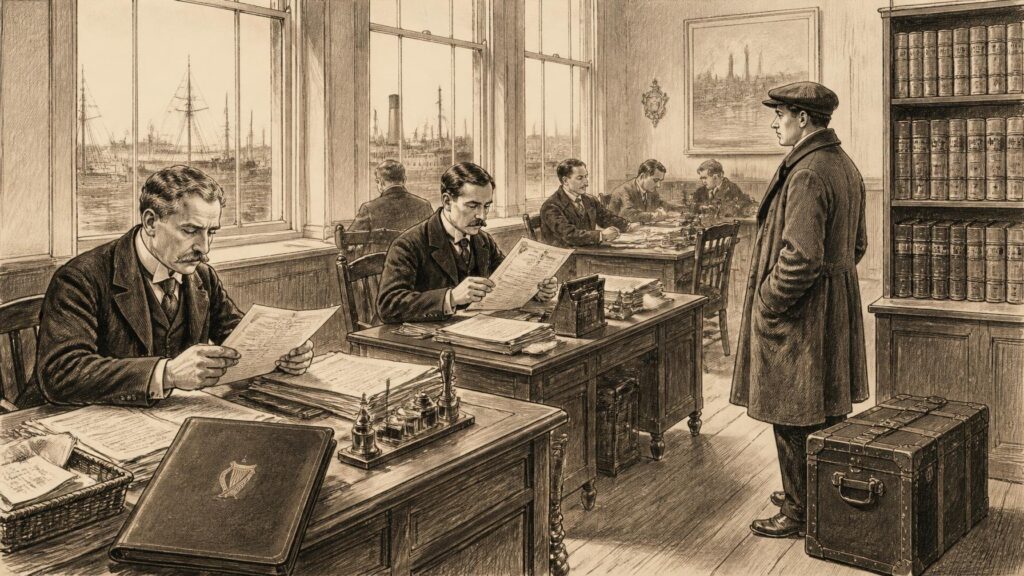
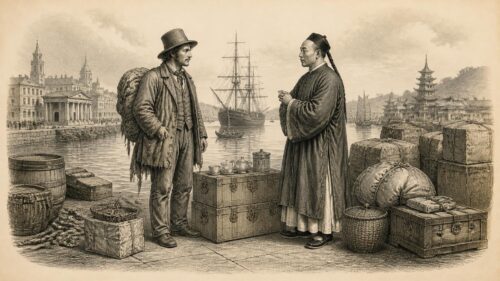
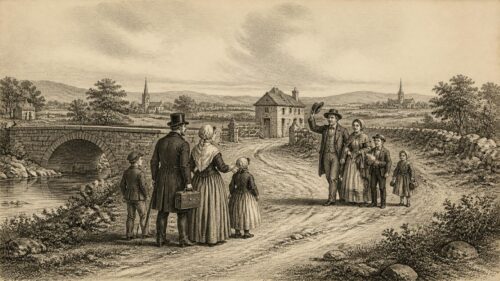
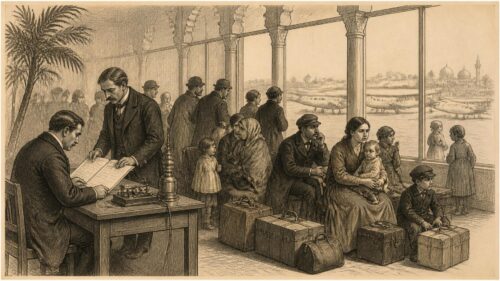
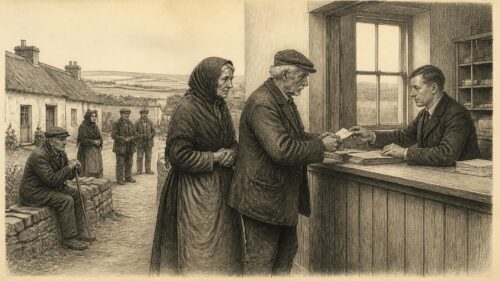
AI generated historical illustration, not a contemporary photograph.
At a Glance
The history of the Irish Passport Service is more than the history of a booklet carried at a frontier. It is the history of how an independent Irish state learned to name its citizens, defend their status abroad, record their descent, and administer a right which could be emotionally profound as well as legally exacting. From the first Irish Free State passports of 1924 to biometric documents and online applications, the passport has been both a practical instrument of travel and a compact declaration of sovereignty.
Border Legacies
Passports are often treated as timeless necessities, but their modern importance was shaped by the international disorder of the early twentieth century. Before the First World War, travel documentation existed, yet it was not ordinarily required for every cross-border journey. The war changed that practice. States became more concerned with military service, espionage, migration, public order and the supervision of foreigners. By the time Ireland emerged from revolution, partition and civil war, a passport was an increasingly important item in international life.
Ireland’s inheritance was unusually complicated. Before 1922, people born in Ireland were British subjects and travelled, when documentation was required, under British authority. The Irish revolutionary movement, however, had already sought outward signs of separate national existence. The republican government established after the 1918 election attempted to conduct foreign relations, make appeals abroad and represent an Irish polity distinct from Britain. That aspiration did not automatically create a generally recognised travel document. Recognition by other governments, and acceptance by their border officials, remained decisive.
The Anglo-Irish Treaty of December 1921 created the Irish Free State in December 1922, comprising twenty-six counties, while Northern Ireland remained within the United Kingdom. The new state had constitutional status within the British Commonwealth, rather than the fully republican form later associated with the word Ireland. It nevertheless needed to conduct ordinary governmental business: foreign representation, shipping, immigration, commercial travel and the protection of its inhabitants overseas. A passport service was therefore not a decorative adjunct. It belonged to the machinery through which the state became visible beyond its borders.
This did not mean that every inhabitant immediately possessed an uncomplicated Irish nationality. The Free State Constitution set out rules for citizenship, but the relation between citizenship, British subject status, domicile and the status of people born in Northern Ireland caused controversy. The archival record makes clear that the wording of a passport was inseparable from these uncertainties. The booklet’s cover, request page and description of its bearer could all become arguments about constitutional power.
It is tempting to tell this as a simple story in which an Irish passport replaced a British passport overnight. The evidence supports a more qualified account. The transition required negotiation, paperwork and compromise. It also required the state to decide who counted as a citizen in the first place. That unresolved question explains why the Passport Service’s history belongs as much to nationality law and diplomacy as to travel.
State Making
The Irish Free State began issuing passports to the public on 3 April 1924. The centenary was marked in 2025 by the Department of Foreign Affairs and its partner EPIC, the Irish Emigration Museum, through the exhibition On the Move: A Century of the Irish Passport. The date is important because it marks the passage from claim to routine administration. A state that could issue a document in its own name to citizens travelling abroad had created a practical expression of external authority.
The early passports were physically modest by later standards. They were paper documents, handwritten or completed by officials, and they used Irish and English. Their green covers bore a harp in gold. Yet the appearance of a passport should not obscure the size of the institutional task behind it. A government had to receive applications, establish identity, decide citizenship, collect fees, maintain records, communicate with consular officers and arrange for renewals or replacement documents. Officials abroad also had to deal with citizens who lost papers, were arrested, died, married, emigrated or encountered foreign authorities.
The Department of External Affairs, established in the Free State’s first years, was central to this work. A passport was a domestic record that had to function internationally. It required states other than Ireland to allow the bearer to enter, pass through or leave their territory. The familiar formula requesting that the bearer be allowed to pass “without let or hindrance” was not a magical guarantee. It was a request issued by a government and was meaningful only insofar as other authorities accepted the issuing state and trusted its document.
That practical dependence made the wording of the document politically charged. The government wished to show that the bearer was connected to an Irish state. British ministers and officials were concerned that passport language might imply an international personality or nationality broader than the Treaty settlement allowed. The dispute was partly constitutional and partly administrative, but for travellers it could have immediate consequences. A passport which a consul refused to recognise was not merely a failed symbol; it could disrupt a journey, a job, study, family reunion or emigration.
In this setting, the early passport office was an institution of state making. Its clerks and diplomats translated broad constitutional propositions into individual case files. They were required to treat evidence of birth, parentage, residence and nationality as matters that could affect a person’s ability to travel. In the modern era, such record keeping can seem impersonal. In the 1920s it was one of the means by which a new state made its authority durable.
Passport Dispute
Primary documents in the Documents on Irish Foreign Policy series show the depth of the 1923–24 passport dispute. In January 1924, Joseph P. Walshe circulated a memorandum identifying the outstanding issue: whether citizens of the Saorstát should be described as British subjects, or described in another way that retained some connection with Commonwealth status. The memorandum observed bluntly that the individual description “British Subject” was politically unacceptable to many Irish people, especially in Ireland and the United States.
This was not simply a disagreement over sentiment. British subject status was then a framework through which the British Empire and Commonwealth organised nationality and consular treatment. The British government wished the Free State’s documentation to conform to its understanding of the Treaty and imperial nationality. Free State ministers wished to avoid language that appeared to erase the separate citizenship they believed the new constitutional order had created. The passport became a testing ground for the question of whether Irish citizens could be internationally identified as Irish without thereby repudiating the formal constitutional connection to the Crown.
A March 1924 despatch from the Free State’s Governor-General, Timothy Healy, proposed a compromise description: “Citizen of the Irish Free State and of the British Commonwealth of Nations” for most holders. The proposal was an attempt to meet British objections while preserving a distinct Irish civic description. It illustrates a central feature of the early Free State: sovereignty was developed through incremental, sometimes awkward, arrangements rather than announced once and for all.
The compromise did not end all difficulties. The scholarly study by Michael Laffan, published in Irish Historical Studies, demonstrates that the passport question was tied closely to competing ideas of citizenship between 1921 and 1924. British authorities at times instructed their representatives not to accept documents that did not conform to their preferred formulation. The practical effect was a series of tensions over acceptance abroad and the authority to establish passport offices outside Ireland.
There is an important distinction here between evidence and interpretation. The official memoranda establish that senior Irish and British officials disagreed about wording and recognition. It is reasonable to interpret the dispute as a struggle over the meaning of independence, because passports were among the most visible documents through which states identified persons to the outside world. It would be too simple, however, to say that one phrase settled Ireland’s sovereignty. The Free State’s position evolved through many institutions: diplomatic representation, treaty practice, constitutional amendment, legislation and changing international relations.
By the later 1920s, a revised form became acceptable to Britain: the passport was issued by the Minister for External Affairs, remained in the name of King George V, and described the holder as a citizen of the Irish Free State. A 1938 departmental record retrospectively described this arrangement while noting that “Citizen of Ireland” had become the current description. The transformation of passport language over the interwar period therefore provides a concise record of constitutional change: from a dominion negotiating its place, to a state increasingly defining itself in its own terms.
Legal Citizenship
A passport is not citizenship itself. It is evidence of citizenship and identity, issued under rules that must be administered case by case. This distinction matters throughout Irish history. Political speeches may present passports as signs of belonging, but entitlement depends upon law, documentary proof and the decisions of public authorities. The history of the Passport Service is consequently inseparable from the history of Irish nationality legislation.
The Irish Nationality and Citizenship Act 1935 was an early statutory effort to give more precise form to the state’s rules. It was subsequently superseded by the Irish Nationality and Citizenship Act 1956, a foundational measure whose long title declared that it made provision for the acquisition and loss of Irish nationality and citizenship. The 1956 Act established rules on citizenship by birth and descent, naturalisation, renunciation and foreign births registration. It also included provisions for certificates of nationality and recognised the role of Irish diplomatic and consular officers in these matters.
For the Passport Service, this legal architecture mattered because officials could not lawfully issue a passport merely because an applicant had an Irish surname, family tradition or emotional attachment to Ireland. They had to determine whether the applicant was an Irish citizen. The modern Passports Act 2008 made this explicit: passports are issued by the Minister for Foreign Affairs to Irish citizens, and the Act also addresses data processing, biometric data, cancellation, surrender and offences connected with passports.
The citizenship rules have changed over time. Amendments in 1986, 2001 and 2004 altered important aspects of nationality law. The 2004 Act, which commenced on 1 January 2005, followed the Twenty-seventh Amendment of the Constitution and changed the automatic citizenship position for many children born on the island after that date. Such changes did not diminish the passport’s importance; they reinforced the need for careful examination of entitlement.
It is therefore misleading to describe an Irish passport as a document available simply to “Irish people” in an ethnic or cultural sense. Ireland’s law provides routes to citizenship by birth, descent and naturalisation, each with conditions. The difference is significant historically. It shows the state moving from broad political claims about a national community towards procedures capable of deciding individual applications. Those procedures can be demanding, but they are also safeguards: they protect the value and credibility of the document that is eventually issued.
Diaspora Claims
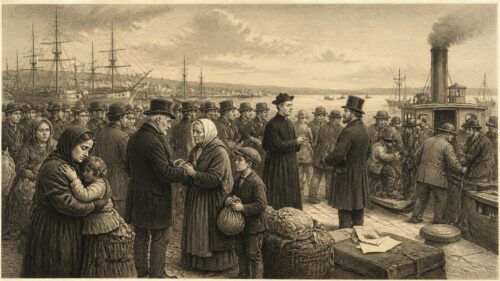
The passport has acquired special meaning for the Irish diaspora. Millions of people of Irish birth or descent have lived abroad, and migration has been a defining feature of modern Irish history. For emigrants, a passport could be a document of departure, an assurance of consular connection, or a reminder of a home left behind. For later generations, it could represent the recovery or confirmation of a legal tie which had survived migration.
The Foreign Births Register is particularly important in this story. Under Irish nationality law, a person born abroad may be entitled to citizenship through an Irish-born grandparent, or through a parent who was already an Irish citizen at the time of the person’s birth, subject to the relevant statutory conditions. Registration is not a symbolic ceremony; in many cases it is the legal step through which a person born abroad becomes an Irish citizen before applying for a passport. The register thus connects family history to a formal public record.
This arrangement should not be confused with an unlimited hereditary entitlement. The law has generational limits and timing requirements. A person whose Irish connection is genuine in family memory may nonetheless need to establish that an ancestor’s birth, parentage or registration meets the law in force. The Passport Service’s demand for civil certificates and supporting documents is often experienced as bureaucracy, but historically it is the administrative counterpart to a citizenship that extends far beyond the state’s territory.
The service’s overseas work also reflects a distinctive Irish pattern. An Irish passport holder might live in Boston, London, Sydney, Buenos Aires or Toronto and still depend on records held in Ireland and on diplomatic missions abroad. This has made the passport office a point of contact between the state and a dispersed population. The emotional power sometimes attached to receiving a first passport is understandable, but it should be distinguished from folklore about automatic entitlement. Family stories may guide research; they do not replace documentary evidence.
European Movement
Ireland’s accession to the European Economic Community in 1973 changed the setting in which Irish passports were used. Membership did not abolish the passport or make nationality irrelevant. Rather, it gave Irish citizenship a further practical dimension through the developing rights associated with European Community, and later European Union, citizenship. The Irish passport came to represent both national citizenship and access to a wider European legal space.
From 1 January 1985, Irish passports adopted the common European Communities format, a visible sign of the country’s European setting. The booklet remained unmistakably Irish, using the harp and bilingual presentation, but it also belonged to a family of European travel documents. This combination is historically revealing. The passport did not become less national because it conformed to a shared design; it became a means by which national citizenship operated in a more integrated continent.
Travel between Ireland and the United Kingdom has always required separate consideration because of the Common Travel Area. The area, developed through longstanding reciprocal arrangements, means that Irish and British citizens have not generally been treated as ordinary foreign travellers when moving between the two jurisdictions. Yet the existence of the Common Travel Area should not obscure the continuing importance of passports for air travel, international journeys and proof of identity. Nor did it remove the historic sensitivity of the border on the island of Ireland.
The practical attractiveness of an Irish passport has therefore changed with political conditions. In the late twentieth and early twenty-first centuries, it could offer documentary convenience as well as a connection to state and family history. Following the United Kingdom’s 2016 referendum on European Union membership and its withdrawal from the EU in 2020, public attention to Irish citizenship and passport applications increased markedly. That development was contemporary rather than a wholly new phenomenon: it drew upon older patterns in which the passport joined personal mobility to larger constitutional change.
Digital Service
The name “Passport Service” now describes a complex, technologically supported public service rather than a small office issuing handwritten papers. This evolution has been driven by security demands, rising application volumes and changing public expectations. A 2014 Oireachtas committee hearing recorded that approximately 250,000 passports had been issued in 1995; the annual total rose to more than 500,000 within five years and exceeded 631,000 in 2013. The figures show how a once specialised travel document became a routine identity document for a large share of the population.
Technological change was central. Ireland began issuing electronic passports in October 2006. These contained an electronic chip and strengthened the relationship between the printed booklet, the holder’s biographical data and security checks at borders. The Passports Act 2008 provided the principal legislative framework for the modern system, including rules on biometric data and the integrity of passport issuance. This was the first primary legislation devoted specifically to the issue of Irish passports.
The move online was another major change. The Comptroller and Auditor General’s examination of the Passport Service records the introduction of the passport card in 2015, facial recognition in 2016, online adult renewals in 2017, and a wider expansion of online eligibility in subsequent years. First-time online applications were extended in stages to applicants in Ireland, the United Kingdom, the European Union, the European Economic Area and then further countries. The same report records the integration of Foreign Birth Registration into the Passport Service in 2019.
These developments did not eliminate paper evidence. Birth certificates, marriage certificates, adoption records, identity documents and photographs still matter where the application is complex. Rather, digitisation reorganised the journey between applicant and state. The service increasingly verifies images, transmits applications, checks information against records and communicates electronically, while retaining the power to request further evidence. In historical terms, this is a striking reversal from the early Free State’s handwritten passports, but the underlying problem is recognisable: how can a state securely connect a particular person to a legal status?
There is a further interpretative point. Digital systems are often described as administrative modernisation, which they certainly are. But they also change the experience of citizenship. A passport application no longer necessarily requires a visit to a central office or consulate; it may begin with a phone, a digital photograph and a portal. The state becomes easier to reach for many applicants, including citizens abroad. At the same time, the system’s reliance on documentary consistency can expose the gaps left by migration, informal family arrangements, destroyed records or differences in names across generations.
Security Failures
A passport must be accessible to entitled citizens, but it must also resist fraud. The tension between those aims has repeatedly shaped the service. The most conspicuous modern example was the passport irregularities uncovered at the Irish Embassy in London in 1987. A report to the Oireachtas Public Accounts Committee found that passports had been improperly issued to people who were not Irish citizens, including through invalid post-nuptial citizenship declarations and unwarranted entries in the Foreign Births Entry Book.
The report did not find evidence that official funds had been misappropriated, but it identified serious fraud and described subsequent efforts to recover and cancel improperly issued passports. It also recorded changes in procedures and controls. The episode is historically important because it shows that the passport system’s weaknesses can arise not only from forged documents or criminal outsiders, but from failures within an administrative process entrusted with deciding citizenship and identity.
Security reforms are sometimes presented as obstacles imposed upon applicants. The 1987 case demonstrates why they are also protections for genuine citizens. A passport’s international usefulness depends upon other states trusting its issue. If the procedures for establishing identity or nationality are unreliable, every bearer may face greater scrutiny. The modern emphasis on biometrics, secure production, loss reporting, cancellation powers and verification should be understood against this background.
None of this means that administration is infallible. Historical records reveal changing laws, human error, disputed documents and exceptional cases. A mature account must resist two opposite myths: that an earlier, simpler system was automatically more humane, and that digital verification has made mistakes impossible. Both claims are unsupported. What can be said is that the Passport Service has become more formalised, more technologically equipped and more conscious of the consequences of error.
Historical Meaning
The Irish Passport Service offers a compact history of the Irish state itself. Its first decades were shaped by the task of distinguishing Irish citizenship from British nationality while operating within a contested constitutional settlement. Its later development depended upon statute, diplomatic practice, diaspora administration, European integration and technological change. Each passport application brings those larger histories into an individual encounter with the state.
The green booklet is sometimes treated as a simple emblem of Irishness. It is more accurately understood as a legal and administrative achievement. It records that the issuing authorities have accepted evidence sufficient to recognise a named person as an Irish citizen and to request their safe passage abroad. That may carry pride, memory and hope, especially for emigrants and descendants. Yet those meanings rest upon procedures that are necessarily exacting.
There is no need to reduce the passport either to bureaucracy or to romance. Its history contains both: the meticulous work of registrars and clerks, the constitutional arguments of ministers and diplomats, the anxieties of travellers, and the aspirations of families separated by the Irish Sea or oceans beyond. A century after the first Free State passports were issued, the Passport Service remains a living institution of Irish sovereignty, connecting a state on the western edge of Europe with citizens whose lives extend across the world.
The article shows how Irish passports have balanced legal entitlement, personal belonging and changing constitutional circumstances, from Free State disputes over citizenship language to diaspora applications and European mobility. Particularly striking is the gap between the emotional significance of ancestral connection and the documentary evidence required for citizenship, especially through the Foreign Births Register. This suggests that passports can unite dispersed communities while also defining legal boundaries around membership. How should we interpret the Irish passport’s evolving role: principally as evidence of citizenship, as a symbol of sovereignty, or as a bridge between Ireland and its global diaspora within Europe?