
Druid Office
At a Glance
Royal Counsel
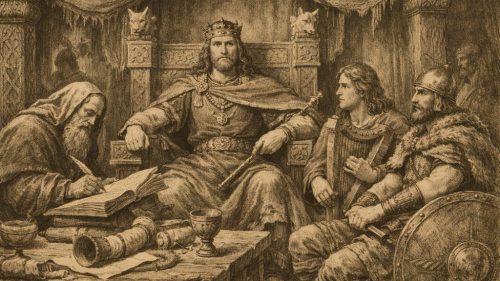
One text places the druid within the ordered household of the high king. In that account, the high king keeps ten officers in constant attendance, and the druid is listed among them alongside a prince, brehon, bard, physician, musician, and stewards. The passage gives the druid a defined role at court rather than a loose presence at the margins. It is presented as part of a formal arrangement attached to kingship, not as an isolated wonder-working figure. [1]
The same passage states what that officer does: the druid offers sacrifices and forebodes good or evil to the country by means of skill and knowledge. The wording links ritual action with prognostication, so the office combines sacred practice and interpretive speech. The text does not separate these functions into different people. Instead, sacrifice and foretelling belong to the same position, which suggests a religious and advisory authority within the king’s immediate sphere. [1]
Prophetic Voice
Another text presents the druid chiefly as a prophet. It says that after many years, according to the prophecy of the druid, Britus was shooting arrows in the king’s presence when an arrow from him pierced the king’s temple and killed him immediately. Here the druid’s importance lies in foreknowledge rather than action. The passage does not explain how the prophecy was made, only that later events are described as matching it. [2]
This prophecy also shows that druidic speech can structure the narrative of kingship and death. The druid is not shown in ritual performance or legal judgment, but in advance knowledge of an event that becomes fatal for the king. The scene is brief, and that brevity matters: the text preserves the prophecy’s result, not its method or setting. The druid is therefore a figure of authoritative warning, reduced here to one decisive utterance. [2]
Occult Power
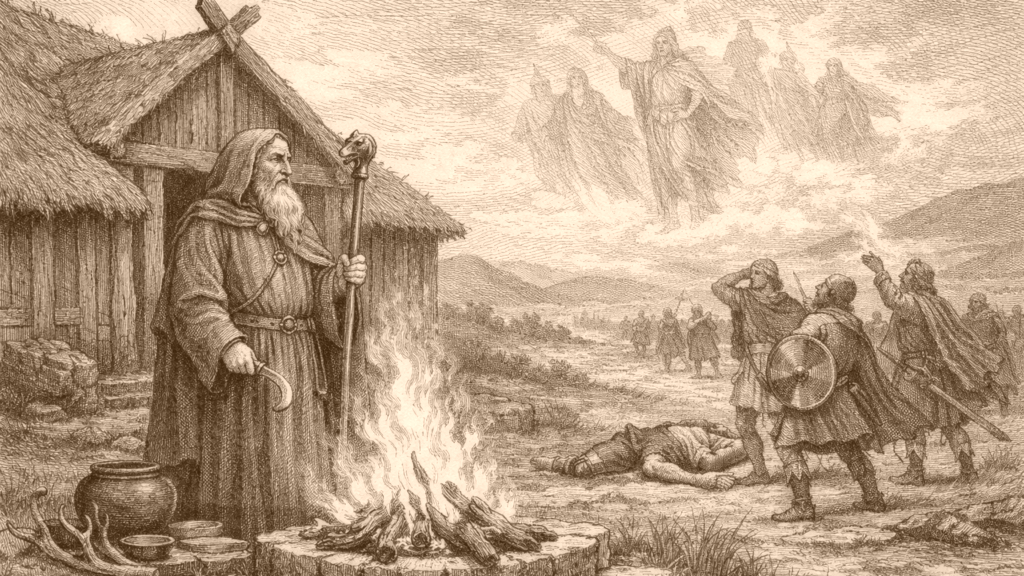
A different narrative expands the druid’s role into open supernatural action. The druids there are a group in conversation, and their words are overheard by servants and horse-boys. One druid then moves away from the camp in disguise, turns his face toward the army three times, and uses occult power to cast a magic breath over the crowd. The text presents the druid as an active agent whose speech and movement have immediate effects on others. [3]
The result is confusion and violence among the warriors. Each man takes on the druid’s appearance, and those pursuing him turn on one another, striking blindly because each believes he is attacking the druid himself. In this account, the druid’s power is not administrative or advisory but disruptive and collective. The episode gives him control over perception, but it does not explain the source of that power beyond the text’s own claim of occult force. [3]
Shared Functions
Read together, these passages show a common range of druidic functions. The druid may stand at court as an officer, speak as a prophet, or act through occult power in conflict. One text emphasizes sacrifice and foretelling; another makes prophecy part of a king’s death; a third gives a druid a visible battlefield effect. None of these passages define the office in exactly the same terms, but all connect the druid with special knowledge that ordinary men do not have. [1] [2] [3]
The evidence also shows important differences. The court passage names a single druid among several officers; the prophetic passage gives only the prophecy; the battle narrative speaks of druids in the plural before focusing on one figure. Because the excerpts preserve different literary settings, the role shifts between official, seer, and magical antagonist. The texts therefore do not preserve one uniform profile, but a cluster of related functions attached to druidic authority. [1] [2] [3]
Narrative Limits
What is missing is as instructive as what is present. These passages do not describe a druid teaching law, governing territory, or leading a people in the ordinary political sense. They also do not set out a full doctrine or professional training. Instead, each passage isolates a particular use of the druid: ritual service, prophetic warning, or supernatural intervention. The office is visible, but only through short narrative snapshots rather than systematic explanation. [1] [2] [3]
That limited view makes certainty difficult. The texts show how different traditions could associate druids with sacrifice, prophecy, and enchantment, but they do not allow a single historical reconstruction of the office in all periods. The safest conclusion is narrower: in these passages, a druid is a specialist in sacred and hidden knowledge whose speech or action can affect kings, armies, and outcomes. Beyond that, the evidence remains fragmentary. [1] [2] [3]
Historical Frame
The references occur in different works: the Irish version of the Historia Britonum includes a druidic prophecy, The Siege of Knocklong contains a druid episode, and Keating says that in Cormac's time a druid was among the officers attending the king. [2] [3] [1]
Even so, the shared pattern is clear enough for cautious comparison. Whether attached to a king’s court, a prophecy before royal death, or a battle of deceptive appearances, the druid functions as a mediator of hidden forces. The texts do not flatten him into one stereotype; they present a learned ritual figure, a seer, and a wielder of uncanny power. Those roles overlap, but each passage preserves a distinct emphasis. [1] [2] [3]
Source References
Hover over a number to see the source. Select it to open the source.

How do the cited Irish and pseudo-historical texts define the druid’s functions as adviser, ritual specialist, and prophetic figure?