

Enterprise Renewal
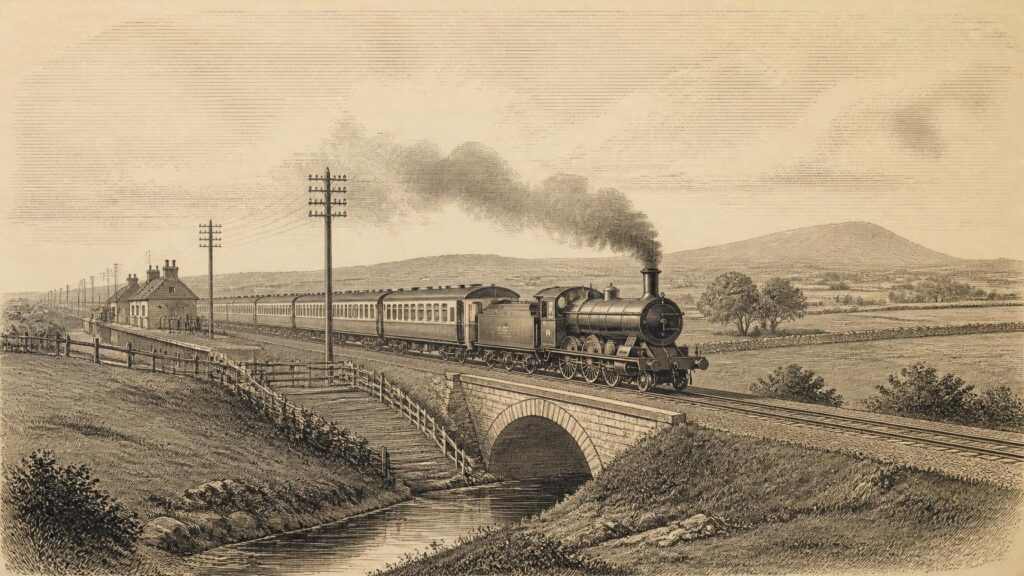
AI generated historical illustration, not a contemporary photograph.
At a Glance
The present Enterprise rail upgrade is not merely a purchase of new trains or an exercise in shortening a timetable. It is the latest chapter in the history of a line which has outlived partition, private-company collapse, nationalisation, widespread railway closures, political violence and repeated changes in the machinery of government. The railway between Dublin and Belfast has remained unusually important because it joins the island’s two largest cities while also passing through places whose commercial and social life has long depended upon cross-border movement. To understand the proposed renewal, it is necessary to see the Enterprise not as a modern brand alone, but as an inheritor of a nineteenth-century main line and a survivor of the twentieth century’s divisions.
Railway Foundations
The physical route on which the Enterprise operates predates the service by almost a century. Railway building in Ireland began with the Dublin and Kingstown Railway, authorised in 1831 and opened in 1834. The northern trunk route developed in stages. By 1852, the Dublin and Belfast Junction Railway had completed the connection from Drogheda to Portadown by way of Dundalk, producing the essential spine later used by Belfast–Dublin expresses. This was a commercial undertaking, designed in an age when railways linked ports, markets, garrison towns and provincial centres as much as capitals.
Dundalk became central to the arrangement. In 1876, the Great Northern Railway of Ireland, generally known as the GNR(I), was created through the merger of the North Western Railway, the Northern Railway of Ireland and the Ulster Railway. Its headquarters and workshops at Dundalk stood on a system whose routes reached Belfast and Dublin, Derry through Portadown and Omagh, and Enniskillen. The company’s geography was genuinely island-wide. Its tracks were not laid with the later political frontier in mind, and the north–south main line was originally only one element in a much wider web of rail communication.
That context matters because the line’s subsequent importance arose partly from contraction. What later appeared to be the natural railway connection between two separate jurisdictions was, before partition, a major corridor within a single network. The main line survived where many branches did not. It retained a strategic role because it linked urban populations, industrial districts and ports, but also because it was the route most difficult for successive administrations to abandon without appearing to sever an essential connection.
Partition Consequences
Partition in 1921 changed the administrative and economic environment through which the GNR(I) ran, but it did not instantly divide the company. The railway became a cross-border enterprise before the word Enterprise was attached to its flagship train. Its lines and staff operated on both sides of the new boundary, while its principal route carried passengers and goods between Belfast and Dublin. Customs arrangements and differing public policies made management more complicated, and the political geography of the island increasingly pressed upon an infrastructure created for another era.
The Cross Border Archives Project records that partition, the spread of road transport and the arrival of air services between Dublin and Belfast in 1947 all contributed to declining railway traffic and profitability. This was not a simple tale of a railway being defeated by the motor car. Railways continued to move people and freight, and the main line remained valuable. Yet rising operating costs, competition, and the expense of maintaining a dispersed system made it increasingly difficult for the GNR(I) to sustain its older network.
There is a temptation to interpret the Dublin–Belfast route as an inevitable symbol of political reconciliation. The documentary record suggests a more practical beginning. The line survived because rail service was still needed, because there was no easy substitute for a trunk connection, and because both governments had an interest in avoiding complete dislocation. Symbolic importance grew from that persistence. It should not be projected backwards as the original motive for every railway decision.
Express Beginnings
In 1947 the GNR(I) answered its commercial difficulties with an ambitious service. At 10.30 on 11 August, a seven-coach steam train left Belfast for Dublin as the inaugural Enterprise. It was hauled by Class V locomotive No. 83, Eagle. The service was presented as Ireland’s first regular non-stop rail operation over more than one hundred miles. Its name deliberately conveyed speed, initiative and modern business confidence at a moment when airlines and road vehicles threatened the railway’s traditional traffic.
The non-stop character was important in practical terms. Earlier cross-border journeys could be delayed by customs examinations at stations such as Goraghwood and Dundalk. Shifting examination arrangements to the termini allowed the new express to maintain a more competitive schedule. The journey of roughly two and a quarter hours was remarkable for the time and demonstrated that the established railway could still market itself as rapid transport rather than merely inherited infrastructure.
It is worth being precise about what can be documented. The inaugural date, the steam-hauled formation and the company’s response to air competition are supported by railway and archival accounts. More romantic claims sometimes attached to the service—such as the idea that it immediately united two peoples divided by politics—belong to retrospective interpretation rather than to the surviving operational evidence. The first Enterprise was first of all a railway company’s commercial answer to a changing transport market. Its subsequent cultural meaning came through decades of use.
Financial Crisis
The Express did not cure the GNR(I)’s underlying finances. In January 1951 the company announced its intention to discontinue services in Northern Ireland, giving many employees notice. Both governments intervened, agreeing to cover deficits and assist with materials and equipment. The episode demonstrates an enduring feature of the Belfast–Dublin railway: its operation could not be treated solely as a private commercial matter. Closing the system would have affected towns, workers and cross-border trade, while also creating a conspicuous breach in communications between the two jurisdictions.
Support delayed rather than prevented the company’s demise. By the end of 1952 its deficit had reached £1.9 million. Legislation in the following year jointly nationalised the concern and created the Great Northern Railway Board. This was a striking administrative arrangement. A railway operating across the border was brought under a jointly supported body at a time when North–South relations were often formal, cautious and politically constrained. It provides a historical precedent for later joint operation, though it should not be confused with the institutional forms created after 1998.
The Great Northern Railway Board did not preserve the old system intact. Its eventual dissolution in 1958 divided assets between the Ulster Transport Authority and Córas Iompair Éireann. The broad GNR(I) network was then rapidly reduced. Branches and alternative routes disappeared, leaving the Dublin–Belfast main line as the conspicuous survivor. Thus the modern Enterprise runs through a landscape shaped as much by lost railways as by the line that remains.
Line Survival
The endurance of the route was never guaranteed. In Northern Ireland, official reviews and closures in the 1950s and 1960s dramatically diminished the network. Translink’s railway history notes that the Benson Report of 1962 recommended retaining only the commuter lines to Larne and Bangor and the Belfast–Dublin main line, while other routes were threatened or closed. By the time Northern Ireland Railways assumed responsibility under the Transport Act 1967, the network had shrunk from about 900 miles to 210 miles.
That reduction altered the Enterprise’s position. It was no longer simply the premier service on a large Great Northern system. It became one of the most visible survivors of a process in which rail traffic was concentrated on fewer corridors. The main line linked Belfast with Portadown, Newry, Dundalk, Drogheda and Dublin, serving intermediate communities while retaining its capital-to-capital function. In the Republic, the route likewise endured amid rationalisation that removed many former rail connections.
Survival did not mean immunity from decline. The line required continuing capital attention, competent co-operation between operators and a sufficiently attractive service to compete with roads. Yet the fact that both jurisdictions retained it is historically significant. A railway can cross a frontier only if its owners, regulators, staff and passengers repeatedly make that crossing workable. The Enterprise became a durable institution because practical necessity outweighed the attractions of abandonment.
Diesel Transition
Steam gave the original service much of its visual distinction, but diesel traction represented the next necessary adaptation. The Great Northern Railway Board introduced more powerful diesel mechanical railcars, ending steam operation on the Enterprise. The change reflected wider post-war railway practice: diesel vehicles offered greater operational flexibility and reduced the labour-intensive demands of steam, even if they lacked the romance later associated with named engines such as Eagle.
In 1970, Northern Ireland Railways introduced new Enterprise locomotives named Eagle, Falcon and Merlin, consciously recalling earlier steam locomotives on the route. The names expressed continuity while the technology changed. Blue and maroon Enterprise liveries appeared during the early 1970s, followed by further relaunches and rolling-stock changes in subsequent decades. These were more than cosmetic exercises. A named express required a distinct public identity if it was to command attention in a transport market increasingly shaped by private cars and coaches.
New trains arrived again in 1981, when two services, Great Northern and Northern Counties, were introduced; a third, Belfast and County Down, followed in 1984. The names preserved memory of former railway companies and regions, but should not be mistaken for evidence of seamless institutional continuity. They were commemorative choices made by a later railway. The old network had largely disappeared. What endured was the main route and a service tradition capable of being renewed.
Troubled Journeys
The Troubles formed an unavoidable part of the Enterprise’s history. Railways were vulnerable infrastructure: tracks, trains, bridges and stations could be disrupted, attacked or rendered suspect by security threats. Translink’s historical account records bomb damage to stations and rolling stock in the 1970s, and notes that the Enterprise was derailed near Scarva in 1976. The wider rail network also suffered attacks, including bombings at Great Victoria Street, Lurgan and other locations.
It would be inaccurate to present the Enterprise as operating untouched through those years. Services could be affected by bomb scares, security procedures and the wider atmosphere of conflict. Nevertheless, the continued existence of the Dublin–Belfast link matters. It maintained a routine, if sometimes fragile, means of travel between cities during a period when movement and identity could carry heightened political meaning. Railway staff and passengers were not abstract symbols; they were people conducting ordinary work, family visits, business journeys and educational travel within abnormal circumstances.
Folklore and personal recollection are valuable for conveying the unease and resilience of such travel, but they should be distinguished from verifiable operational history. Many passengers remember the route as a small zone of normality amid conflict. That is a legitimate personal interpretation, not a measurable fact applicable to every journey. The documented record supports the more modest conclusion that the service continued despite serious disruption and risk, making its survival a notable feature of the period.
Joint Planning
By 1989 Iarnród Éireann and Northern Ireland Railways had formulated joint plans for improving cross-border rail travel. This represented an important transition. Earlier arrangements had preserved the route, but the late twentieth-century approach increasingly treated it as a shared service requiring co-ordinated investment rather than as two adjoining national railways merely accepting each other’s trains.
The 1990s upgrade was especially consequential. New sections of track were installed to accommodate heavier trains, higher speeds and new rolling stock. The manual signal at Poyntzpass was removed. The project was funded jointly by London and Dublin, showing that practical railway co-operation could proceed across constitutional difference. In 1997 General Motors locomotives and De Dietrich Ferroviaire coaches entered service in green and grey Enterprise colours. This was the formation that fixed the modern visual image of the service in many passengers’ memories.
The upgrade did not create a high-speed railway in the continental sense. It improved an existing mixed-use main line, with constraints imposed by alignment, crossings, station calls and interfaces with suburban operations. That distinction is useful when assessing present ambitions. The history of the Enterprise is one of incremental modernisation: heavier rail, better signalling, improved vehicles and revised timetables. Its achievements are real, but they have generally emerged from sustained renewal rather than one transformative reconstruction.
Service Identity
The Enterprise is exceptional in being jointly operated by Iarnród Éireann and Translink Northern Ireland Railways. The joint character is visible in the service’s equipment, staffing arrangements, ticketing and public presentation, but its deeper significance lies in administration. The railway requires continuing co-operation over safety, timetabling, fleet maintenance, standards, investment and passenger information. Such ordinary collaboration is easily overlooked precisely because it has become familiar.
The service also has a layered identity. For some it is a fast intercity connection; for others it is the train to Newry, Dundalk or Drogheda. For commuters and students it may be a regular part of life; for visitors it can appear a ceremonial route between two capitals. These uses sometimes compete. An express timetable favours speed, while intermediate stops make the railway more useful to communities between Belfast and Dublin. The history of the line has repeatedly involved balancing those roles rather than choosing only one.
The name Enterprise has proved unusually durable. It has survived changing locomotives, liveries, operators and political contexts because it can represent both historical continuity and fresh ambition. Yet it is important not to turn a commercial name into a myth of permanence. The service endured because public authorities and railway organisations repeatedly committed resources to it. Names can help build recognition; track renewals, skilled labour and public funding keep trains running.
Recent Renewal
The most recent phase began before the new fleet contract. An hourly Belfast–Dublin service was introduced in October 2024 with support from Ireland’s Shared Island Fund. This increase in frequency marked a significant operational improvement, making the railway more useful for day travel and reducing the need for passengers to organise their plans around a sparse timetable. It also demonstrated demand for a stronger connection before the replacement trains arrive.
The scale of the planned programme is substantial. In May 2026, the partners formally signed a contract with Stadler for eight new Intercity trains. The investment, covering fleet and associated infrastructure, is stated as €698 million or £548 million, with €165 million supported through the PEACEPLUS programme and the remaining funding shared between the relevant departments in Ireland and Northern Ireland. The trains are due for delivery late in 2028, subject to the normal realities of manufacturing, testing, infrastructure works and entry into service.
The proposed fleet is designed for the line rather than borrowed from a generic commuter specification. Official plans describe trains of about 400 seats, step-free interiors, unaided boarding at each exterior door, improved provision for luggage and bicycles, passenger information systems, power outlets, a premium section and dining facilities. These details show that the project is concerned with accessibility and passenger experience as well as headline journey times. That is historically apt: every major Enterprise renewal has sought to define what an intercity journey should feel like in its own era.
Tri Mode
The new Enterprise trains are intended to be tri-mode, capable of operating with electric, diesel and battery power. This is significant because the Belfast–Dublin route is not yet a fully electrified railway. The design offers a means of operating through differing stages of infrastructure provision while preserving the possibility of future electric running. It also acknowledges a basic historical fact: cross-border rail improvements must work across two networks with distinct investment programmes and technical legacies.
Official statements describe the fleet as Ireland’s first tri-mode trains and envisage a target express journey of under two hours when combined with associated infrastructure improvements. The word “target” should be retained. It is not a completed timetable, and it depends on vehicle performance, capacity works, line-speed enhancements and operational planning. Historical writing is best served by distinguishing a funded contract and a stated objective from an outcome already delivered.
The environmental argument is central to the renewal. The All-Island Strategic Rail Review identifies rail investment as a means of reducing road congestion, accidents, air pollution, noise and transport emissions, while recognising that major projects require appraisal and careful control of cost and environmental effects. The Enterprise fleet may reduce reliance on diesel over time, but its full environmental value will depend upon actual usage, electricity supply, future electrification and the extent to which travellers shift from cars or other modes. Those are reasonable inferences, not guarantees contained in a train order.
Future Corridor
The All-Island Strategic Rail Review places the Enterprise within a larger vision for the island’s railways. It identifies existing constraints: much of the network remains single track, and capacity around major cities is limited. The review envisages stronger cross-border planning structures, improved accessibility and, in the longer term, higher speeds on principal intercity routes. Its illustrative modelling assumes interventions operating by 2040 and indicates that maximum speeds of up to 200 kilometres per hour might be achieved on much of the principal network. Such modelling is not a promise that every recommendation will be built.
The most responsible interpretation is that the current fleet programme provides a practical foundation rather than a final destination. New trains can improve frequency, reliability, accessibility and acceleration, but they cannot alone remove every bottleneck on a nineteenth-century route. Passing loops, platforms, signalling, track layout and electrification will influence what passengers eventually experience. The Enterprise’s history repeatedly shows that rolling stock and infrastructure must advance together.
There is also a human geography behind the phrase “economic corridor”. The railway serves cities, but it also links intermediate towns and their surrounding districts. Its value cannot be measured only by the fastest end-to-end journey. Regular service can widen access to employment, education, family networks, public services and cultural events. Those benefits are plausible and historically consistent with the route’s role, though their scale must be demonstrated through future evidence rather than assumed from promotional language.
Historical Meaning
The upgrade deserves attention because it joins past and future unusually closely. The Enterprise began as a competitive response to aeroplanes and road vehicles in 1947. It then survived the collapse of its parent company, nationalisation, severe network reduction and the unsettled decades of the conflict. Since the late twentieth century, it has increasingly embodied practical co-operation between railway organisations and public authorities on either side of the border. Its present renewal follows that pattern: the project is financed and governed through institutions whose existence reflects both older arrangements and the political architecture of the peace process.
There is no need to claim that a train can resolve the complexities of Irish history. Railways do not abolish borders, settle constitutional questions or erase memories of conflict. Nor should the Enterprise be treated as a sentimental relic. It is a working transport service, dependent upon budgets, maintenance, staff and passenger confidence. Its historical importance lies precisely in that combination of ordinariness and persistence. It has kept a route open when many comparable lines vanished.
If the new fleet enters service as planned, it will be another renewal rather than an ending. The principal continuity will not be the shape of the trains, their propulsion system or their interiors. It will be the continuing decision to maintain a railway connection between Belfast and Dublin. From the GNR(I)’s steam express of August 1947 to the planned tri-mode fleet of the late 2020s, the Enterprise has repeatedly adapted because the connection it provides has remained worth preserving.

The proposed tri-mode fleet illustrates how the Enterprise has repeatedly adapted without abandoning its cross-border role. Rather than representing a wholly new era, it continues a pattern of incremental renewal shaped by practical constraints, shared funding and competing passenger needs. The article also highlights a persistent tension: an hourly intercity service must connect two capitals efficiently while remaining useful to communities such as Newry, Dundalk and Drogheda. As accessibility, decarbonisation and faster journeys become priorities, how should planners balance express performance against intermediate connectivity, and what lessons from the Enterprise’s earlier renewals should guide that choice for the coming decades?