An Bord Uchtála Begins1953 CE
In 1953, the Republic introduced adoption through An Bord Uchtála, formalising arrangements previously governed by families, churches and voluntary agencies. The Health Act extended a means-tested, graded system of medical provision rather than universal care. Fianna Fáil pursued restraint amid unemployment, rural insecurity and emigration. Dublin and Belfast jointly assumed control of the Great Northern Railway, demonstrating practical cross-border co-operation despite partition. An Tóstal promoted tourism and cultural confidence, while Samuel Beckett’s Paris première of En attendant Godot marked a literary milestone. In Northern Ireland, coronation television broadcasts reinforced British connections. Institutional change unfolded amid economic, religious and political divisions.
Dateline
In 1953, Ireland’s public life was marked less by dramatic constitutional change than by the quiet construction of institutions, the pressures of economic retrenchment and the highly visible persistence of partition. The year began with a major change in family law: for the first time, adoption had a statutory framework in the Republic. It continued with arguments over health provision, public expenditure and emigration, while a new all-island railway body showed that practical co-operation could survive where political reconciliation did not. Meanwhile, festival organisers promoted a welcoming, culturally distinctive Ireland to visitors, and Samuel Beckett’s Paris premiere opened an extraordinary new chapter in Irish literature.
A New Adoption System
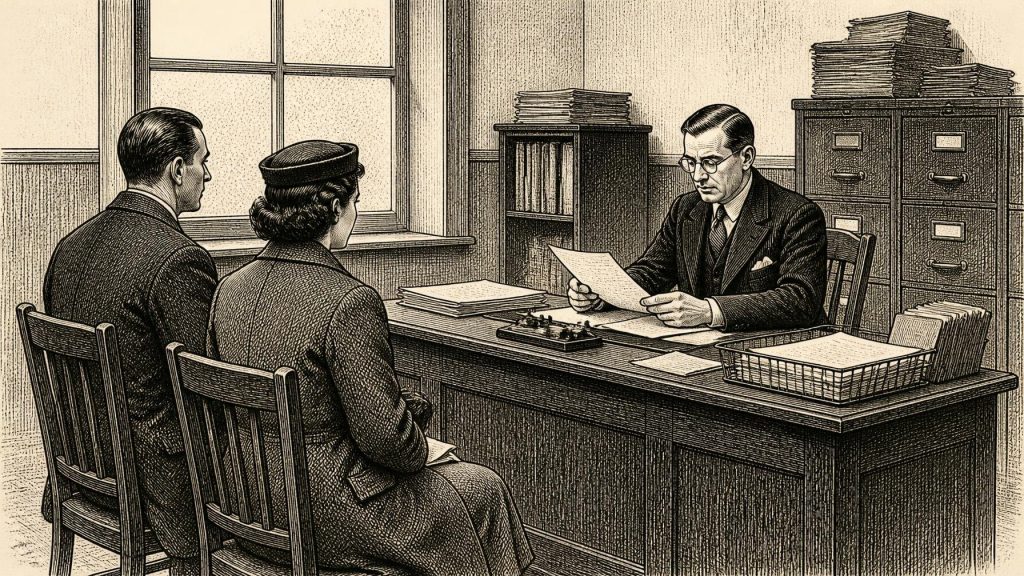
On 1 January, the Adoption Act 1952 came into operation. This was a decisive legal development. Informal arrangements for children to be raised by people other than their birth parents had long existed, often involving extended families, religious institutions or voluntary agencies, but there had previously been no general Irish legal mechanism for adoption. The Act created An Bord Uchtála, the Adoption Board, and provided for formal adoption orders and an Adopted Children Register.
The change should not be mistaken for an uncomplicated social revolution. Adoption operated within a society in which unmarried motherhood carried severe stigma, religious bodies played a central role in welfare, and institutional care shaped many women’s and children’s lives. The law supplied a state process, but it did not remove those wider inequalities or the power of the agencies through which many arrangements were made. Its rules required applications and hearings, recognised adoption societies, and allowed the Board to seek medical evidence. The arrival of this apparatus of forms, registrars, hearings and official decisions brought family formation more directly under state supervision.
The immediate demand was substantial. A later official accounting recorded 2,500 applications during 1953 and 400 adoption orders in that first calendar year. Those figures should be read carefully: many early applications concerned children who had already been informally placed before the legislation commenced. Even so, they reveal how much private family practice was being drawn into a new legal system. In a year often remembered for austerity and departure, the establishment of An Bord Uchtála was a lasting institutional event.
Health, Eligibility and the State
Another important measure reached the statute book on 29 October: the Health Act 1953. It amended and extended the Health Act 1947, addressing institutional services, health-authority administration, eligibility and charges. Its provisions were not all automatically operative on enactment; commencement was to be fixed by ministerial order. That distinction matters. The legislation belongs firmly to 1953, whereas its practical application unfolded afterwards.
The Act nonetheless made clear the character of Irish health policy at mid-century. Rather than establishing a universal health service on the British National Health Service model, it retained a graded system. It set out entitlement to institutional and specialist services for insured people, people below specified means limits, qualifying small farmers and others deemed unable to provide for themselves without undue hardship. It also provided for maternity-related medical, midwifery, hospital and specialist services for eligible women, while allowing contributions in other cases. In-patient charges could be levied on people outside the fully entitled categories.
These provisions followed the political trauma of the Mother and Child Scheme controversy earlier in the decade. By 1953, questions of health were inseparable from questions of family income, local authority capacity, professional authority and Catholic social influence. The year’s Act did not settle every dispute about medical provision, but it confirmed that access to care would be organised through categories of need and means rather than through a single universal entitlement.
Economy Under Restraint
Éamon de Valera remained Taoiseach throughout the year, leading the Fianna Fáil government returned in 1951. Seán MacEntee, Minister for Finance, presented the Budget on 6 May. He argued that the government had brought current revenue and expenditure nearer to balance and reduced a worrying balance-of-payments problem. Yet his statement also proposed at least £3.5 million in administrative economies. Current expenditure for 1953–54 was set at approximately £101 million, a ceiling MacEntee linked to the need for greater national output before taxation could be eased.
The fiscal language was technical, but its social setting was unmistakable. Dáil debate repeatedly returned to unemployment, prices, falling housebuilding and emigration. Opposition deputies used sharp and sometimes inflated rhetoric, so their numerical claims cannot simply be treated as neutral statistics. Still, the political argument records a widely felt reality: many households saw little prospect of secure work, especially outside the larger towns. For younger people in rural districts and small towns, leaving for Britain, the United States or elsewhere remained an established, painful route to wages and independence.
The demographic background reinforced the anxiety. The 1951 census counted 2,960,593 people in the State, only marginally more than in 1946. Detailed census material continued to appear in the early 1950s, allowing administrators and the public to see the fragile population recovery of the previous decades. The dramatic national population fall later recorded between 1951 and 1956 had not yet happened in full, and should not be projected backwards as a completed fact in 1953. But the conditions from which it grew—restricted employment, small-farm insecurity and outward migration—were already central to politics and everyday conversation.
Railways Across the Border
Partition did not prevent every shared undertaking. On 23 June, the Oireachtas passed the Great Northern Railway Act 1953, matching legislation in Northern Ireland. The Act provided for the future operation of the Great Northern Railway (Ireland), which had run an important network across the border, including the Dublin–Belfast route. The two governments agreed to acquire the undertaking, paying £4.5 million in compensation, shared equally.
The resulting Great Northern Railway Board began operations on 1 September. It had ten members, five appointed from each jurisdiction, with its chairmanship designed to alternate. The arrangement was a practical answer to a business whose tracks, workshops, workers, freight and passengers did not conform neatly to the political boundary. It also exposed the financial difficulty of sustaining rail transport amid road competition and operating losses.
This was not a step towards constitutional unity. The governments remained divided by incompatible positions on sovereignty, and the border remained a major political fact. Yet the railway settlement demonstrated a narrower form of diplomacy: officials in Dublin and Belfast could negotiate compensation, shared deficits, staffing and the management of a cross-border service when mutual necessity required it. For travellers and railway workers, the change made the consequences of partition administrative rather than merely abstract.
Displaying Ireland
From 5 to 26 April, the first An Tóstal, advertised as “Ireland at Home”, offered a contrasting public image. Supported by the Irish Tourist Board and national tourism publicity bodies, the festival connected Easter with pageantry, local events, arts, sport and displays of Irish life. Its organisers hoped to attract visitors and encourage Irish people to travel within the country. In Dáil discussion later that year, the choice of Easter was explicitly linked to its historical associations and international recognition.
An Tóstal was therefore more than entertainment. It was an effort to turn heritage, landscape, music, Irish-language culture and hospitality into economic activity at a time when foreign currency and employment mattered. The festival’s optimistic imagery sat beside the harsher realities debated in the Budget: migration, limited jobs and pressure on public spending. That tension is part of its significance. It presented an Ireland that was rooted, welcoming and culturally confident, while the State sought ways to retain people who could not easily find livelihoods at home.
Culture also acquired a landmark beyond the island. On 5 January, the Irish-born writer Samuel Beckett’s En attendant Godot received its first production at the Théâtre de Babylone in Paris, directed by Roger Blin. Beckett was living in France and wrote the play in French; this was not an Irish première, and its first Dublin production would not come until 1955. Nevertheless, the Paris opening was directly relevant to Irish cultural history. A writer formed in Dublin, though long resident abroad, had introduced a work that would become one of the most influential plays of the twentieth century. Its spare setting, unsettling comedy and refusal of easy explanation stood far from the celebratory national imagery of An Tóstal.
Coronation and Northern Screens
In Northern Ireland, 1953 brought a different kind of public spectacle. Queen Elizabeth II was crowned at Westminster Abbey on 2 June. For unionists, the coronation affirmed Northern Ireland’s place within the United Kingdom and Commonwealth world; for nationalists, it inevitably underscored the political division of the island. The event’s symbolism was sharpened by a technological change. BBC television became available in Northern Ireland in May through a temporary transmitter outside Belfast, installed in time for coronation coverage.
Television sets were expensive and scarce, and reception was imperfect. Radio, newspapers, cinemas, churches, workplaces and public gatherings still structured most shared experience. But the new service allowed some viewers in the North to watch a major royal ceremony live, making television part of domestic and civic life earlier than it would become in the Republic. The contrast should not be overstated: a temporary transmission facility did not instantly create a mass television culture. It did, however, give the coronation a new immediacy and connected Northern homes to a British broadcast event of exceptional scale.
Thus 1953 was a year of beginnings that were cautious, uneven and revealing. The Republic created a formal adoption authority and legislated further on health while struggling to reconcile restraint with social need. North and south jointly remade a railway company even as political partition endured. Festival promoters celebrated an Ireland worth visiting; Beckett’s first staged play pointed towards a more international and unsettling literary future. Across the island, institutions and technologies were changing, but they did so in a society still deeply shaped by church authority, economic uncertainty, migration and the border.
Primary Sources
- Adoption Act 1952
- Adoption Act, 1952, Rules, 1953
- Adoption Board — Irish State Administration Database
- Reflections on the Irish Domestic Adoption Process 1952–2022
- Report — Appropriation Accounts 1953–1954
- Health Act 1953
- Health Act 1953, Section 16: Medical Care for Mothers
- Great Northern Railway Act 1953
- Irish Railway Factsheet: Great Northern Railway (Ireland)
- Financial Statement — Dáil Éireann, 6 May 1953
- Committee on Finance: Vote 50—Industry and Commerce — Dáil Éireann, 4 November 1953
- An Tóstal Ireland at Home: April 5th to April 26th, 1953
- Census 1951 Reports
- Census of Population, 1951, Volume I: Population, Area and Valuation
- Census Through History
- Irish Emigration History
- MacEntee, Seán (John) Francis — Dictionary of Irish Biography
- De Valera, Éamon (‘Dev’) — Dictionary of Irish Biography
- BBC Northern Ireland: Magic Box Exhibition
- The Queen’s Accession and Coronation
- Waiting for Godot / En attendant Godot — PlayographyIreland
- En attendant Godot/Waiting for Godot: Genesis and Reception
- O’Kelly, Seán Thomas — Dictionary of Irish Biography