

Watched Republic
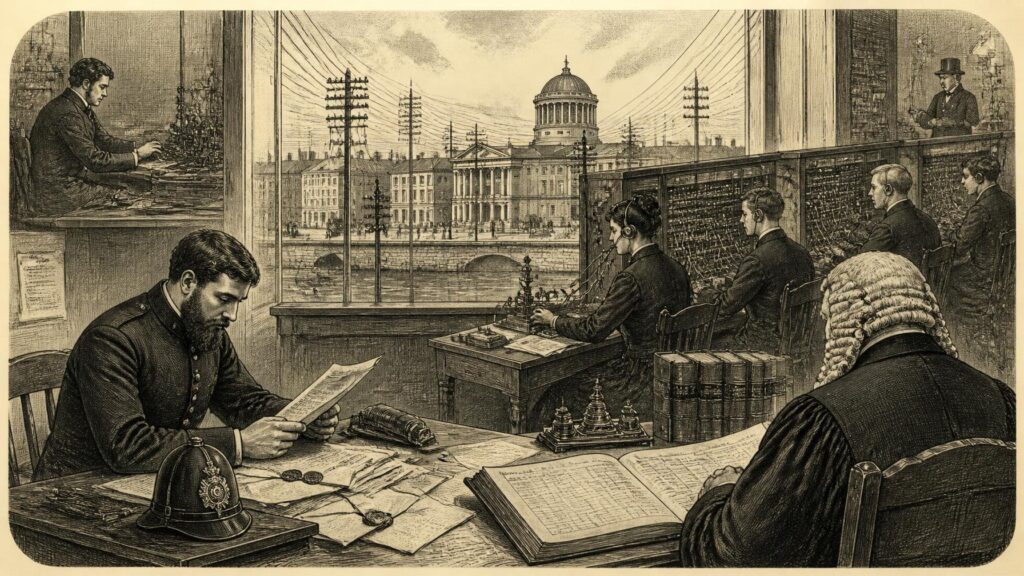
AI generated historical illustration, not a contemporary photograph.
At a Glance
Public safety and digital rights became a defining Irish constitutional and European question when the ordinary traces of modern life—telephone connections, locations, internet access and subscriber details—were made available for policing and security purposes. Ireland did not merely receive this debate from elsewhere. Its statutes, courts, regulators and litigants helped shape it. The history is therefore not a simple contest between liberty and security, but a record of changing technologies, changing dangers and repeated attempts to make exceptional state powers answerable to law.
Private Signals
Every age has had its private channels. Letters, telegrams, telephone calls and, later, electronic messages have enabled the intimate business of family, trade, politics and friendship. They have also offered opportunities to criminals and to those planning violence. The public authority’s interest in communications is consequently not new. What changed during the late twentieth and early twenty-first centuries was the scale at which communications could be recorded, sorted, linked and searched.
The modern digital-rights argument begins with a distinction that may appear technical but is historically important: the difference between content and communications data. Content is the spoken word, written message, image or recording itself. Communications data, often called metadata, concern the surrounding facts: who contacted whom, when, from what device or location, for how long, and through which service. A message’s contents may remain unread while its associated data can still disclose a detailed pattern of life. Repeated records can suggest a person’s home, workplace, friendships, religious observance, medical concerns or political associations.
That capacity made communications data attractive to investigators. It can corroborate alibis, identify contacts between suspects, locate a lost or endangered person, reconstruct movements after a serious crime, and lead police towards evidence which might otherwise disappear. The historical difficulty lies not in denying those possible uses, but in deciding what safeguards should precede access, how long data should be retained, which offences justify intrusion, and whether information gathered about everybody can fairly be treated as a reservoir for investigations into a few.
In Ireland, these questions met a legal culture already attentive to correspondence, privacy, executive power and judicial supervision. The Irish constitutional order did not begin with a fully articulated, freestanding digital-rights code. Yet its protections for the dwelling, the family and personal rights, together with European human-rights standards and later European Union law, furnished principles through which new technologies could be assessed. Digital rights were not an entirely novel liberty; they were an emerging form of older concerns about the citizen and the state.
Early Safeguards
Before the internet became commonplace, Irish law had already moved to regulate interception. The Postal and Telecommunications Services Act 1983 contained prohibitions concerning the interception of telecommunications messages. A decade later, the Interception of Postal Packets and Telecommunications Messages (Regulation) Act 1993 created a more explicit statutory framework. Its significance lies in its recognition that access to communications should not rest merely on administrative practice or institutional habit.
The 1993 Act provided for ministerial authorisations in specified circumstances and for the oversight of a designated High Court judge. The judge could investigate authorisations and inspect official documents. Where the designated judge considered that an authorisation should not have been given, continued or extended, the statute required that concern to be communicated to the relevant Minister, after which cancellation was required. This was not a system of open public scrutiny: interception necessarily operated in a sphere of secrecy. Nevertheless, it supplied a recognisable legal architecture—defined authority, formal authorisation and external judicial inspection.
That arrangement reflected the conditions of its time. Interception was generally conceived as a focused measure directed at an address, line or person. Digital networks would upset this assumption. Instead of a finite number of calls passing through a national telephone system, communications would create vast, automatically generated records across commercial networks, mobile masts, servers and platforms. The central question would shift from whether the state could listen to a selected communication to whether service providers could be obliged to store the transactional history of an entire population.
It is tempting to tell this story as though earlier Ireland stood outside surveillance and the digital era suddenly introduced state interest in private life. The documentary record does not sustain that simple picture. Older interception law demonstrates continuity of official concern; the later data-retention controversy demonstrates discontinuity in scale, automation and reach. Historical interpretation is strongest when it holds both propositions together.
European Framework
Data protection supplied a second line of development. Ireland’s Data Protection Act 1988 belonged to a European movement to regulate the automatic processing of personal information. Its commencement in 1989 came before smartphones, social media and cloud computing, but its premise was durable: information about identifiable people required rules, accountability and a means of redress. The Act was part of the institutional background from which an Irish data-protection authority developed.
European integration deepened the importance of that field. The European Convention on Human Rights protected private life and correspondence, while the Charter of Fundamental Rights of the European Union later stated separate rights to respect for private life and to protection of personal data. The difference mattered. Privacy traditionally guarded a private sphere against intrusion; data protection developed rules for the collection, use, retention and disclosure of information. In a digital society, the two frequently overlap, but they are not identical.
Ireland’s position within the European Union made domestic law part of a larger legal conversation. European directives required national implementation; national judges could ask the Court of Justice of the European Union to decide questions of Union law; Irish regulators became significant because many technology companies operated European establishments in the State. The country was therefore both a national jurisdiction and a place from which disputes of continental consequence could emerge.
The Data Protection Act 2018 later reorganised this terrain around the General Data Protection Regulation and the EU law-enforcement data-protection directive. It established the Data Protection Commission in statutory form and addressed processing by competent authorities for the prevention, investigation, detection and prosecution of criminal offences. This is an important corrective to an occasional misconception that privacy law simply prevents policing. The 2018 framework expressly contemplated law-enforcement processing, but sought to place it within rules of legality, purpose, necessity, security and supervision.
Retained Traces
The attacks of 11 September 2001, subsequent attacks in Europe and fears surrounding international terrorism altered the political atmosphere in which communications legislation was made. Governments argued that communications data were vital to counter-terrorism and serious-crime investigations. The European Union adopted the Data Retention Directive in 2006. It required providers of publicly available electronic communications services and public communications networks to retain specified categories of traffic and location data for periods fixed by national law within a prescribed range.
Ireland enacted the Communications (Retention of Data) Act 2011 to give effect to that directive and to replace an earlier data-retention arrangement contained in anti-terrorism legislation. The statute’s stated purposes included preventing serious offences, safeguarding the security of the State and saving human life. It expressly excluded the content of communications. That exclusion was politically and legally important, but it did not settle the rights question. The retained records could identify sources and destinations of calls, dates, times, durations, types of communication, users’ equipment and locations.
Under the original 2011 scheme, providers were required to keep certain telephone data for two years and certain internet-access, email and internet-telephony data for one year. The legislation created a process for disclosure requests and required providers to maintain security safeguards. It also provided for a complaints procedure and designated-judge oversight. The statutory design, in other words, did not present retention as unregulated. Its later vulnerability arose from the breadth of the retention obligation and the adequacy of protections around state access.
Parliamentary debate revealed the competing assumptions. Supporters emphasised investigations into grave offences, the prospect of recovering a missing person, and the limited character of data as compared with message content. Critics questioned whether the distinction between content and data understated the power of modern analysis; they also asked whether access controls were sufficiently independent. Neither position was irrational. The record instead shows a recurring problem in public law: an investigative tool may have legitimate uses, while the legal mechanism that makes it generally available may still be overbroad.
Irish Challenge
The most consequential Irish intervention came from Digital Rights Ireland Ltd. In 2006, the organisation brought proceedings in the High Court concerning the legality of measures connected with the retention of electronic-communications data. The case eventually reached the Court of Justice of the European Union after the Irish High Court referred questions about the validity of the European directive. An Austrian constitutional case was joined with the Irish reference.
On 8 April 2014, the Grand Chamber delivered its judgment in Digital Rights Ireland and Seitlinger and Others. It declared the Data Retention Directive invalid. The Court accepted that retention pursued a public-interest objective connected with combating serious crime. Yet it held that the directive entailed a particularly serious interference with the Charter rights to private life and personal-data protection and exceeded the limits of proportionality.
The judgment did not rest on a belief that communications data had no value to public safety. Rather, it considered the directive’s design insufficiently confined. Its obligations covered, in effect, all persons, all electronic communications and all traffic data without differentiation, limitation or exception linked to an objective of fighting serious crime. The Court also criticised the absence of rules limiting access to what was strictly necessary and the absence of prior review by a court or independent administrative body in the ordinary course. Retention periods and data-security provisions were also central to its analysis.
The historical importance of the case is difficult to overstate. An Irish challenge helped invalidate an EU-wide measure. It also altered the language of later debate. Retention could no longer be defended merely by asserting that metadata were not content or that serious crime was a pressing concern. Legislatures had to confront a more exacting set of questions: Is the measure necessary? Is it targeted? Who authorises access? Is independent review real rather than nominal? What data are genuinely required? How is abuse prevented?
Digital Rights Ireland should not be converted into folklore about a lone national victory that settled every future dispute. The Court decided a specific challenge to a particular directive in a joined reference from Ireland and Austria. National laws, later EU judgments and different factual settings remained to be considered. But the documented outcome established a durable principle: the digital traces of ordinary people cannot be collected and made accessible on an indiscriminate basis without strict legal limits.
Judicial Turning
The invalidation of the directive did not automatically erase the practical and legal questions surrounding Ireland’s 2011 Act. The national legislation remained significant to investigators and to criminal proceedings. The continuing uncertainty became clear in litigation brought by Graham Dwyer, who challenged the validity of provisions under which telephony data used in his murder trial had been retained and accessed.
In 2020, the Irish Supreme Court made a reference to the Court of Justice in Dwyer v Commissioner of An Garda Síochána. The case raised questions about universal retention, the safeguards governing access and the consequences of finding a national measure incompatible with EU law. Its background illustrates why data-retention litigation resists easy categorisation. It concerned constitutional and European rights, statutory interpretation, policing, a grave criminal investigation and the admissibility of evidence. Public safety and individual rights were not abstractions at opposite ends of a debate; both appeared in the hard facts of criminal justice.
The Supreme Court’s own account of the litigation records that the High Court had found the access provision in the 2011 Act inconsistent with EU law. Subsequent proceedings and judgments showed the continuing difficulty of applying European requirements to completed investigations and criminal trials. In 2024, a majority of the Supreme Court dismissed an appeal in the criminal proceedings involving Dwyer, while a dissenting judgment took a sharply different view of the implications of the retention regime and the admissibility of the relevant evidence.
That disagreement is historically revealing. It does not demonstrate that law had failed to provide an answer; appellate courts exist precisely because serious questions can require competing analyses. It does show that data-retention cases are not resolved by one maxim. The severity of alleged offending, the nature and extent of access, the state of law at the relevant time, the purpose of exclusionary rules and the character of the rights infringement can all bear upon the outcome.
Revised Balance
The Communications (Retention of Data) (Amendment) Act 2022 was Ireland’s legislative response to the altered European legal landscape. Its provisions were brought into operation for key bodies on 26 June 2023. The amended framework retained the public-safety purposes of crime prevention, national security and protection of life, but introduced a more differentiated system of retention, preservation and production.
One important device is the preservation order, sometimes described as a quick-freeze measure. Rather than requiring a provider to keep all relevant categories of data in anticipation of unknown future cases, an order can preserve specified data already held at a particular point. A production order can require the disclosure of specified data. The framework makes judicial authorisation central to these orders. This change embodies a historical lesson drawn from the earlier litigation: the more an intrusion is tied to a defined investigation and subjected to prior independent scrutiny, the stronger its claim to necessity and proportionality.
The 2022 amendments also differentiated categories of information. User data could be retained for a defined period, while traffic and location data were treated with greater caution. General and indiscriminate retention of traffic and location data was linked to national-security grounds and judicial approval, rather than presented as an ordinary all-purpose policing instrument. The legislation also addressed internet source data, a category relevant to identifying the source of online activity in particular circumstances.
It would be misleading to describe the revised law as a complete abandonment of retention, just as it would be misleading to call it unrestricted surveillance. It is a negotiated statutory attempt to preserve investigative capacity while incorporating the limits demanded by European case law. Whether the balance is successful in every application will remain a matter for courts, oversight bodies, legislators, service providers and citizens. Law is not static merely because a new Act has been passed.
Safety Claims
Public safety arguments deserve to be treated seriously in historical writing. Communications data can assist in locating vulnerable people, identifying offenders, tracing networks involved in child exploitation, fraud or organised crime, and establishing the sequence of events surrounding violent offences. Investigators may face a genuine problem of speed: some information held for commercial reasons may be deleted before a warrant or request can be obtained. A regime of preservation or limited retention responds to that practical concern.
Yet the history also warns against accepting necessity as a conclusion rather than an argument. A state may show that data are useful without proving that blanket retention of everyone’s records is necessary. It may show that an emergency exists without proving that every agency should have the same access. It may identify a legitimate aim without proving that existing controls are independent, effective or transparent. Digital-rights law asks the state to bridge those gaps with evidence, precise legal authority and safeguards.
This is why judicial authorisation has become so significant. A judge is not simply an extra signature in an administrative process. Prior independent scrutiny requires the public authority to articulate a defined purpose, identify the requested material and justify the measure against a legal threshold. It also creates a record capable of later examination. Such procedures cannot remove all risk, but they help move power from discretion towards accountable decision-making.
Oversight has another historical value. Surveillance powers are difficult for the public to assess because their use may be secret and because operational details can be sensitive. Designated judges, regulators, courts and published reports cannot make every operation visible, but they can reduce the danger that secrecy becomes insulation from legal standards. The 1993 interception framework and the later data-retention statutes show an Irish tendency to attach special oversight mechanisms to communications powers, even though the adequacy of those mechanisms has repeatedly been contested.
Rights Practice
Digital rights are sometimes presented as the concerns of technology specialists or large multinational companies. Ireland’s experience points to a broader meaning. The person whose location history is retained may never use the phrase “metadata”. The person whose personal details are wrongly disclosed may not describe the injury in the language of Article 8 of the Charter. Rights become real through ordinary experiences: a request for access to information, a complaint to the Data Protection Commission, a challenge to evidence, a demand that records be erased when no longer required, or an insistence that officials explain the legal basis for a disclosure.
The Data Protection Commission’s public guidance expresses the storage-limitation principle plainly: identifiable personal data should not be kept longer than necessary for the purpose for which they are processed. That principle does not displace a statutory retention duty or a valid preservation order. It does, however, provide an important counterweight to the institutional instinct that more information and longer retention are always safer. Data held without need can become a risk in itself—vulnerable to misuse, unauthorised access, error or breach.
Irish digital-rights history also has an international dimension through litigation about transfers of personal data from Ireland to the United States. The Schrems proceedings, though different from communications retention, underline the State’s unusual place in global data governance. Irish courts and the Irish data-protection authority have dealt with questions whose implications extended across the European Union and beyond. The common historical thread is jurisdiction: information may travel rapidly across borders, but legal accountability must still be located somewhere.
For that reason, public safety and digital rights should not be treated as rival possessions, with more of one necessarily meaning less of the other. Effective policing depends upon public trust, lawful evidence, secure systems and clear authority. Rights protection depends upon rules that can operate even when the alleged offence is grave and public anxiety is high. The difficult work is to design institutions able to honour both propositions at once.
Historical Meaning
The Irish record from the 1980s to the present is not a straight march from secrecy to liberty, nor from innocence to security. It is a sequence of adjustments. The 1983 and 1993 measures addressed interception in a communications environment still shaped by post and fixed telephony. The 1988 data-protection legislation recognised the growing importance of automated personal information. The 2011 retention regime brought the State into the era of large-scale communications metadata. The Digital Rights Ireland judgment exposed the constitutional and European limits of indiscriminate design. The 2022 amendments attempted a more granular settlement.
Documented evidence supports that chronology. Interpretation begins when one asks what the sequence means. A reasonable interpretation is that Irish law has increasingly moved from broad statutory permissions towards a demand for tailored powers, independent authorisation and demonstrable necessity. That movement has not eliminated disagreement. It has instead made the terms of disagreement clearer and more legally disciplined.
There is little value in folklore here. The attractive tale that metadata are harmless because they are not message content is contradicted by the capacity of combined records to reveal private patterns. The opposite tale—that any retention power inevitably produces a police state—is equally incapable of explaining carefully supervised, limited investigative measures. History offers no automatic verdict. It supplies records of laws made, cases argued, powers exercised and safeguards found wanting or strengthened.
Ireland’s contribution matters because it demonstrates that a relatively small state can become a decisive site of legal development. An Irish challenge helped invalidate a European directive. Irish legislation was subsequently revised in response to European jurisprudence. Irish courts confronted the consequences in criminal cases. The question remains active because technology continues to change faster than the categories through which law first understood communication. The enduring task is not to choose safety or rights, but to ensure that safety is pursued through rights-respecting law.








Ireland’s shift from broad retention towards judicially authorised preservation and production orders highlights a crucial uncertainty: can targeted access provide investigators with timely evidence without recreating the population-wide surveillance concerns exposed by Digital Rights Ireland? The article suggests that metadata, although distinct from content, can reveal patterns of life, making safeguards as significant as investigative purpose. The revised framework therefore invites comparison between quick-freeze methods and earlier mandatory retention, particularly in urgent cases involving serious crime, national security or vulnerable people. How convincingly do you think judicial authorisation and differentiated data categories reconcile investigations with proportionality, privacy and public trust?