Shannon Tragedy
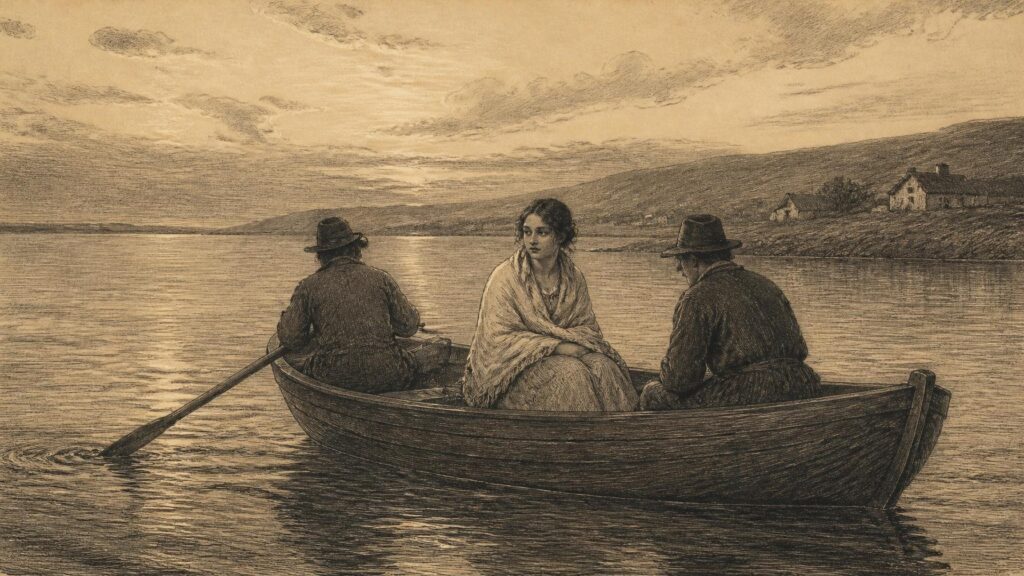
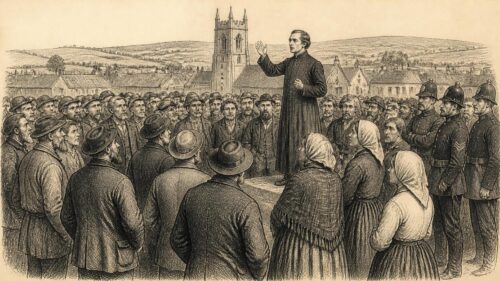
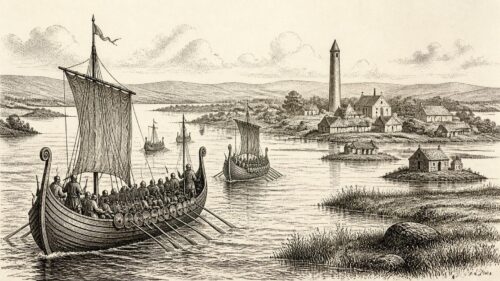
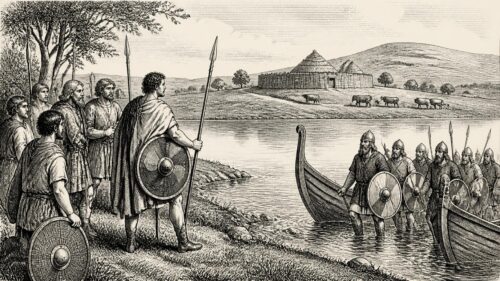
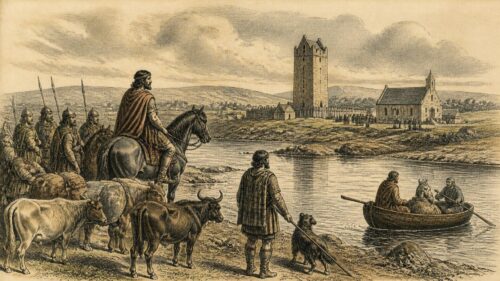
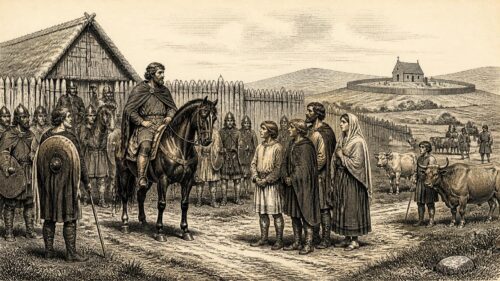
AI generated historical illustration, not a contemporary photograph.
At a Glance
‘The Colleen Bawn’ is not the name Ellen Hanley was born with, but the name through which her death became one of the most persistent stories of nineteenth-century Ireland. Behind it stands a young woman from County Limerick, killed in 1819, two men tried and executed in 1820, and a long afterlife in fiction, melodrama, opera, tourism and local remembrance. The historical record is substantial but incomplete. It establishes a violent crime and the legal pursuit of those held responsible; it does not justify every picturesque detail repeated in later retellings. To recover Ellen Hanley’s history, it is necessary to distinguish surviving evidence from interpretation, and both from the accumulated folklore of the Colleen Bawn.
Name Origins
The phrase cailín bán, usually rendered in English as ‘fair-haired girl’ or ‘fair maiden’, became attached to Ellen Hanley after her death. In English-language tradition it appears as ‘Colleen Bawn’, a spelling that is itself a reminder of how Irish speech was turned into marketable Victorian English. It does not tell us what Ellen called herself, how her family named her, or whether the phrase was used consistently during her lifetime. The most secure historical point is that documents and later reference works identify the victim as Ellen, or Ellie, Hanley; after her marriage or purported marriage she was often styled Ellen Scanlan. The National Library of Ireland’s manuscript catalogue explicitly describes legal papers concerning the murder of “Ellen Hanley, [known as ‘The Colleen Bawn’]”, preserving both the woman and the later legend in a single archival description.
The title has therefore always done two things at once. It has kept the story memorable and it has made its subject less distinct. ‘Colleen Bawn’ offers an image of youth, beauty, innocence and Irishness rather than an adult historical person with a family, a locality and limited power in a deeply unequal society. The phrase encouraged audiences to regard Hanley as an emblem: a murdered bride, a victim of seduction, an idealised Irish girl, or a scenic ornament within a tale of the Shannon and Killarney. Those meanings belong chiefly to the story’s later cultural history. They should not be mistaken for direct evidence about her character.
That distinction matters because the case has long attracted romantic elaboration. Nineteenth-century accounts, local recollections and theatrical adaptations have supplied vivid scenes: a false priest, a hurried elopement, a doomed boat journey, a bride’s ring, reluctant horses at an execution, a grave worn away by souvenir seekers. Some elements may preserve genuine recollection; others arose long after the crime, and some are plainly shaped by the demands of a familiar melodramatic plot. The proper starting point is not a finished legend but an unsensational fact: a young woman disappeared in 1819; a body was recovered from the Shannon; two men were prosecuted; and the case became a public cause célèbre.
Family Setting
Ellen Hanley was born in County Limerick, generally dated to 1803, though precise details of her early life are less secure than many later accounts suggest. The Dictionary of Irish Biography, published by the Royal Irish Academy, identifies her as a Limerick woman and records that she was identified after death by the unusual double teeth in her upper jaw. Clare County Library’s local-history account places her childhood in the Ballycahane and Bruree district and says that, after the death of her mother, she was reared by maternal relatives. Such accounts help to locate her within the rural world of early nineteenth-century Munster, but they should be read with care: local tradition often preserves material absent from formal records, yet it can also absorb details from later printed narratives.
Her age is central to the moral power of the story. Most accounts describe her as about fifteen or sixteen when she died. At that age she was legally and socially vulnerable, particularly in a relationship with a wealthier man. John Scanlan came from a family of considerably greater status and property. The difference between the two was not merely personal. It reflected the rigid gradations of landholding, religion, education and social authority that structured rural Ireland under the Union. A woman of modest farming background who entered a connection with a gentleman could find her reputation, security and future dependent upon decisions made elsewhere.
To call Scanlan ‘Ascendancy’, as some later summaries do, is useful only if the term is not allowed to flatten the evidence. It signals his family’s position among the local propertied order; it cannot, by itself, explain the murder or prove every motive attributed to him. The case did, however, become intelligible to contemporaries through class. Public interest intensified because the accused principal was well connected, because the victim was a young woman of humbler station, and because observers doubted whether the law would punish a man of influence for violence against someone with few protectors. The trial’s outcome would consequently acquire significance beyond the individual defendants.
The usual account says that Hanley became acquainted with Scanlan, was courted by him, and left her relatives with him in July 1819. The status of their union has never been straightforward. Sources differ over where a ceremony may have occurred and whether it had legal force. Modern writers have sometimes called it an elopement, sometimes a marriage and sometimes a sham marriage. The historical caution is simple: Hanley appears to have believed herself married or committed as a wife, while the documentary certainty of a valid marriage is not established by the material readily available. That uncertainty should be preserved rather than repaired with a confident but unsupported story.
River Crime
The known outline of the crime is grim. Hanley disappeared after travelling in the Shannon estuary region. Her remains were later found at Moneypoint, County Clare, on the opposite side of the river from much of the Limerick setting of the affair. Clare County Library places the discovery in the autumn of 1819 and describes the body as having been found after several weeks in the water. The Dictionary of Irish Biography gives 6 September 1819 as the date on which her body was found, while the archival guide to Irish women’s history likewise identifies that date in describing the police papers.
The body’s condition made identification difficult. The distinctive dental feature reported in the biographical record became the basis upon which Ellen Walsh identified the remains as Ellie Hanley. This is one of the case’s most hauntingly concrete details, but it should not be sentimentalised. It tells us that ordinary women participated in the work of recognition when official systems were limited by decomposition, distance and the absence of modern forensic techniques. It also reveals why the recovered body, rather than a witness account of the killing, was so important to the later prosecution.
Accounts agree that Stephen Sullivan, a servant or employee associated with Scanlan, was the immediate killer, and that Hanley died in a boat on the Shannon. They also agree that her body was weighted and thrown into the water. The precise sequence, the weapon, the extent of Sullivan’s hesitation and the wording of the instructions he received rest partly upon subsequent testimony and reportage. The Dictionary of Irish Biography records Sullivan’s eventual confession that he struck Hanley with a musket in a boat on the night of 14 July 1819 and cast her body overboard at Scanlan’s instigation.
The two suspects fled or went into hiding after the crime. Scanlan was arrested first, and his trial opened at the Limerick assizes on 11 March 1820 before Justice Richard Jebb. The case attracted intense notice because Scanlan’s family could afford an eminent defence. Daniel O’Connell, then already a formidable barrister though not yet the national political figure he would become, appeared for him. The Royal Irish Academy biography records both O’Connell’s participation and the date of trial.
O’Connell’s role has sometimes been treated as an embarrassment to a later heroic reputation, or as proof that the case was a contest between principle and privilege. Neither formula is sufficient. A barrister’s duty was to defend a client, including an unpopular client accused of a dreadful crime. O’Connell’s presence demonstrates Scanlan’s access to legal resources; it does not turn O’Connell into an accomplice in the crime, nor does it prove that he shared Scanlan’s social assumptions. The case has a legitimate place in the history of O’Connell’s legal career precisely because it reveals the professional world from which his later political authority emerged: adversarial advocacy, jury persuasion, assize procedure and public controversy.
According to later summaries of the defence, O’Connell argued that Scanlan had no rational reason to arrange Hanley’s murder if he could simply abandon her, especially if their union lacked legal standing. The strategy apparently failed. Scanlan was convicted and hanged at Limerick on 16 March 1820. The Dictionary of Irish Biography states that he maintained his innocence until the end.
The choice of New York was significant. The play was an Irish cultural commodity made for an Atlantic audience. Irish emigrants and their descendants formed a substantial public, while non-Irish audiences were already accustomed to stage Irishness. Boucicault, a Dublin-born dramatist with transatlantic ambitions, supplied recognisable Irish speech, music, comic vitality, scenic landscape and a moral plot in which innocence is imperilled but ultimately restored. This was not ethnography. It was a carefully engineered popular entertainment that used Ireland as both subject and spectacle.
The drama substantially changes the story’s moral architecture. Eily O’Connor, unlike Ellen Hanley, is not finally murdered. In the climactic theatrical rescue, Myles na Coppaleen dives into a stage lake and saves her. The act transformed a historical killing into a melodrama of suspense and reprieve. The historical case ended in death and execution; Boucicault’s version offered audiences danger, heroism, comic relief and emotional restitution. The choice was commercially astute. It also changed public memory. Generations could encounter a living Eily before they learned of the dead Ellen.
The text itself demonstrates the invented nature of its characters and scenes. In the surviving 1860 printed play, Eily is called the Colleen Bawn, while Hardress Cregan, Myles na Coppaleen, Danny Mann and others enact a plot unmistakably derived from Griffin rather than from a court transcript.
The exact totals reported by different sources should not be forced into false precision. Theatre historians distinguish between runs at particular houses, later revivals and totals calculated in different ways. What is beyond doubt is that The Colleen Bawn enjoyed an exceptional run and was widely treated as a landmark in the development of the long-running West End success. Oxford Academic describes its Adelphi engagement as record-breaking and notes the flood of related commercial products, including sheet music, songs, fashions and theatrical imitations.
Its success was inseparable from Victorian appetite for sensation drama. Audiences were promised danger made safe by theatrical mastery: moonlit water, a threatened heroine, secret plots, comic dialect and a final restoration of moral order. The Irish setting was essential to that package but was also filtered through stereotype. Almost all the characters spoke in an Irish accent in the Adelphi production, a feature contemporary critics discussed. The University of Massachusetts digest preserves the observation that some reviewers thought the general use of brogue excessive.
This critical discomfort points to a larger ambiguity. Boucicault’s play helped put Irish characters, settings and musical idioms at the centre of an enormously successful popular drama. Yet it did so in forms designed for English and American consumption. The result could foster affection, recognition and theatrical opportunity, while simultaneously turning Irishness into accent, comic eccentricity and romantic scenery. Later scholarship has therefore treated the play as both an important contribution to Irish theatre and a powerful producer of the ‘stage Irish’ image.
Commercially, the play mattered to Boucicault’s career. The Kent biography describes it as providing financial security for Dion and Agnes and connects its success to his subsequent theatrical ventures. University of Kent, Dion Boucicault biography Its effects thus reached beyond one story. It contributed to the economics of modern theatre, to Boucicault’s standing as an entrepreneur and performer, and to the circulation of Irish dramatic forms throughout the English-speaking world.
Operatic Echoes
The story did not stop at the playhouse. Boucicault’s version became the foundation for Julius Benedict’s opera The Lily of Killarney, first performed in 1862. The Dictionary of Irish Biography identifies the opera as one of the principal cultural descendants of the Hanley case. Royal Irish Academy, ‘Hanley, Ellie’ The shift from Shannon murder to Killarney opera is revealing. It moved the narrative yet further from the specific geography of Ellen Hanley’s life and death towards a scenic Ireland capable of international musical consumption.
Opera intensified what theatre had already begun: landscape became a principal character. Lakes, mountains, boats, cottages and melody could carry an audience into an imagined Ireland where social tension was picturesque and catastrophe could be transfigured by music. This was not unique to the Colleen Bawn material; nineteenth-century audiences repeatedly encountered Ireland through stage scenery and song. Yet the genealogy matters. A real young woman’s death was converted first into a novel, then a rescue melodrama, then an opera whose title redirected attention towards Killarney.
That redirection had consequences for tourism. Historian Kevin Whelan has argued that Boucicault’s theatrical Killarney helped shape a tourist imagination of the region, including the visual and emotional expectations with which visitors approached it. History Ireland, ‘The Colleen Bawn and tourism in Killarney’ The argument is interpretative rather than a claim that one play alone created Killarney tourism. The lakes were already celebrated. But the drama supplied a vivid, repeatable theatrical image that could interact with travel, illustration, royal interest and souvenir culture.
The transformations also show how cultural memory can outrun historical geography. Hanley’s body was found in County Clare; the killing is associated with the Shannon; her family connections lay in County Limerick. Yet the phrase ‘Colleen Bawn’ now evokes, for many, a generalised romantic Ireland and particularly a lake-world of boats and cliffs. The literary and theatrical versions did not merely preserve memory. They displaced it.
Memory Sites
Hanley’s burial place near Killimer, County Clare, became a site of pilgrimage and curiosity. The Dictionary of Irish Biography says that she was buried at Burrane and that her grave was a major tourist attraction throughout the nineteenth century. Royal Irish Academy, ‘Hanley, Ellie’ Clare County Library similarly records that a Celtic cross was erected at the grave and later damaged or removed by souvenir hunters. Clare Libraries, ‘The Colleen Bawn’ The exact history of the markers requires further archival work, but the broad pattern is clear: a burial site became entangled with the commercial appetite created by the legend.
This practice raises an uncomfortable question. What does it mean to visit the grave of a murder victim because theatre and fiction have made her famous? Nineteenth-century tourism did not necessarily see a contradiction between piety, curiosity and consumption. A grave could be a place of prayer, sensation, moral reflection and souvenir collection at once. For Hanley, however, fame offered little restoration. Her body and name became objects of attention, while the historical person remained only partly recoverable.
Local history has performed valuable work in resisting complete abstraction. Clare Libraries places Ellen Hanley in named places, records the discovery at Moneypoint and directs attention to burial at Burrane. The Irish Manuscripts Commission identifies a collection of official reports and letters. The National Library of Ireland catalogues the legal papers. These institutional records pull the story back from theatrical Ireland to the administrative and geographical world in which a woman died, people investigated, witnesses identified remains, officials handled rewards and courts imposed sentences.
At the same time, place-based memory has its own folklore. Local writers have preserved names, family associations, tales of visits and objects linked with the crime. Such material should not be dismissed merely because it is late. Folklore is historical evidence of remembrance: it shows what communities chose to retain and how they understood it. Its limitations lie elsewhere. It cannot automatically establish an event in 1819 simply because someone repeated it in 1919 or 2019. A responsible account asks when a tradition first appears, who transmitted it, and whether it is corroborated by earlier material.
Evidence Limits
The Colleen Bawn is unusually well documented for a rural Irish murder of its period, but the documentation is not complete. We possess catalogued legal papers, notices of police correspondence, later biographies, literary works, theatrical texts and local-history accounts. We do not possess a full, unproblematic record of Hanley’s own voice. There are no known letters in which she explains her relationship with Scanlan, her understanding of the ceremony, her fears or her hopes. This absence should shape the article’s tone. It is more honest to acknowledge silence than to fill it with scenes borrowed from Griffin or Boucicault.
The most reliable propositions are therefore relatively narrow. Ellen Hanley was a young woman from County Limerick; she disappeared in 1819; her body was recovered at Moneypoint; John Scanlan and Stephen Sullivan were prosecuted; Scanlan was executed in March 1820 and Sullivan in July; Sullivan confessed before his execution; and the case inspired Griffin, Boucicault and Benedict. These points are supported by archival catalogues, institutional biographies and surviving texts. National Library of Ireland; Dictionary of Irish Biography; University of South Florida.
Less certain propositions include the legal validity and place of the marriage, the full sequence leading to the killing, the exact degree of premeditation at each stage, the private motives of Scanlan, and many details of the executions. There is also a fundamental interpretative difficulty in Sullivan’s confession. It is an important admission by the man who said he carried out the murder, but it was made at the point of death and apportioned ultimate blame to a man already executed. It cannot be read as if it were a modern recorded interview, free from religious, legal or emotional pressures.
Richard Fitzgerald’s later True History of the Colleen Bawn, first published in the late 1860s, is another essential but problematic source. Fitzgerald claimed personal knowledge of the woman and presented himself as a corrective to theatrical distortion. A digitised version is available through the Ex-Classics edition of Fitzgerald’s The True History of Ellen Hanley. His book is valuable because it preserves a nineteenth-century attempt to distinguish fact from drama. But it was written roughly half a century after the murder and itself participates in the culture of commemoration. It must be compared with earlier evidence, not treated as a final court of appeal.
There is a broader methodological lesson. ‘Authentic story’ is often the language used by later writers seeking to supersede previous versions. Yet authenticity is not achieved by rejecting fiction alone. It requires attention to provenance, chronology, genre and interest. A theatre script aims to entertain; a grave inscription aims to memorialise; a confession may seek repentance or redistribute guilt; a library catalogue identifies a collection rather than narrating events. Each can tell us something, but not everything.
Lasting Legacy
The Colleen Bawn endures because it sits at the junction of several Irish histories. It is a history of violence against a young woman; of uneven class power; of policing, law and execution; of Daniel O’Connell’s early courtroom career; of Irish fiction; of sensation theatre; of opera; of tourism; and of contested local memory. Reducing it to any single one of these obscures the others. A murder case alone does not explain the global theatrical success. A hit play alone does not explain why the underlying crime continued to trouble local communities.
Its endurance also exposes a recurring ethical problem in historical culture: the victim’s identity may be preserved only by being transformed. Ellen Hanley is remembered because artists made her Eily O’Connor, because audiences bought tickets, because tourists sought her grave, and because local historians kept asking what happened beneath the legend. Yet each transformation risked taking her further from herself. The affectionate epithet ‘Colleen Bawn’ could obscure the fact that she was not a type but a person whose surviving history was cut short before adulthood.
Modern readers need not choose between memory and criticism. The legend can be valued as a major achievement of Irish cultural history while its distortions are named. Boucicault’s play can be recognised as technically innovative and theatrically powerful without being mistaken for a factual account. Griffin can be read as a perceptive novelist without being used as a witness. Local tradition can be respected without being made to bear evidential weight it cannot sustain. Such distinctions do not diminish the story. They allow it to become more truthful.
Above all, the historical centre should remain Ellen Hanley. The court record and the later cultural archive make clear that her death was the event from which everything else proceeded. The novel, the stage lake, the comic boatman, the Killarney songs and the tourist grave are afterlives. They tell us much about Ireland and the wider world that consumed Irish stories. But the first obligation of history is to return, as far as evidence permits, to the young woman behind the name: a person from Limerick, found on the Clare shore, whose murder became famous precisely because later generations could not stop retelling it.