Famine Diaspora
At a Glance
Famine Records
The surviving material used here is not a single narrative of famine and diaspora but a set of institutional descriptions and record guides. One annal edition describes its manuscript basis, lacunae, and editorial limits, while the National Archives and National Library pages frame famine research as a matter of collections, reports, and surviving documents. The result is a picture built from records that are incomplete, edited, or catalogued for research use rather than from a continuous historical chronicle.
The annalistic sources themselves are presented as edited texts with manuscript provenance and gaps. One edition specifies the surviving manuscript witnesses and notes lacunae in the text, while another identifies fragments from different manuscripts and separate fragments that are not part of the same annals. These descriptions matter because they show that the documentary base for older Irish history survives in partial form, with preservation depending on particular manuscripts and later editorial work.
Hunger Departure
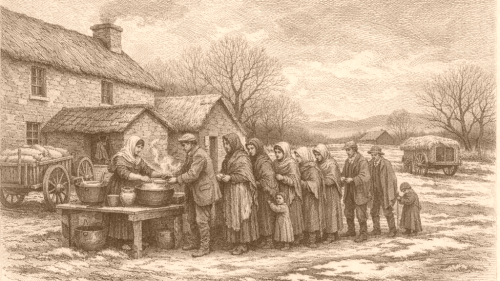
The clearest famine summary states that the Great Famine of 1845 to 1852 produced a peak in emigration and that the failure of the potato crop, together with insufficient alternative food supplies, led to destitution, death, and mass departure. A museum account similarly states that around one million people died through starvation and disease and a further one million were lost through emigration. Taken together, these institutional descriptions link hunger and departure as parallel consequences of the same crisis.
The same museum summary adds that 1847 was recognised as the most difficult year of the famine and that objects from across the country were used to illustrate conditions people faced during the period. The examples it names are practical rather than abstract: a griddle said to have been used for black bread, a tool for making potato ridges, and a hammer associated with a workhouse. This is a material culture account, not a demographic table, but it still points to famine conditions and institutional relief.
Relief Conditions
The archival and county pages preserve direct references to poor relief and workhouse conditions. Galway in 1911 is described as a county where workhouses were filled to overflowing, emigration was steep, and many people struggled to remain above water; the same page records those receiving poor law relief and divides them between workhouse and outdoor relief. Although this is a later census-era description, it explicitly links poverty, relief, and movement away from the county.
The National Library famine page notes that the project focused on what life was like before the famine and on consequences such as eviction and emigration. It also points to a nineteenth-century report that recorded the quantity of food consumed by labouring poor in specific poor law unions and says this report illustrates dependence on the potato. That evidence is narrowly framed, but it is enough to connect relief administration, food consumption, and vulnerability to crop failure.
County Loss
County-level summaries make the demographic consequences visible. One National Museum page states that between the end of the Great Famine and the 1911 census, about 550,000 people emigrated from Cork, and it adds that the decade before 1911 saw 43,593 departures compared with 148,009 in the decade from 1852 to 1861. These figures show a sharp difference between the post-famine peak and a later, lower level of emigration.
The Galway page gives a different but comparable picture of loss and movement. It states that the county remained susceptible to periodic famine after the decimation caused by the Great Famine and records later food shortages between 1858 and 1862, 1879 and 1882, and again in 1904 and 1912. It also gives a specific emigration figure for 1901 to 1911, showing that county migration remained a measurable fact long after the initial famine years.
Ocean Routes
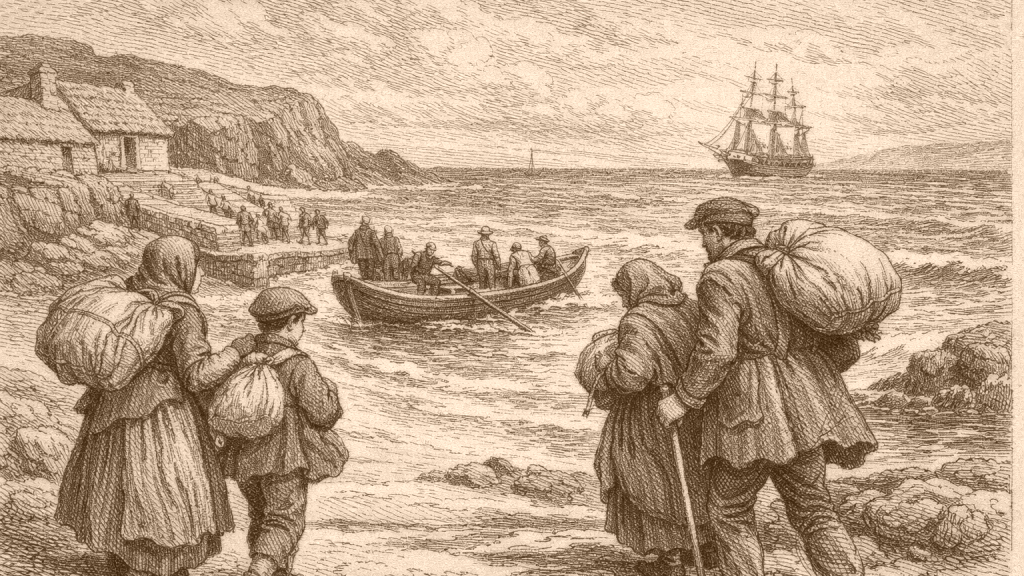
The evidence also identifies the Atlantic route as central to Irish departure. The Cork page says Queenstown was the port from which countless emigrants sailed to America and that around 2.5 million of the 6 million Irish who emigrated to America before 1950 left through Queenstown. Another museum page states that more than 6 million Irish people have emigrated to the United States since 1820, and that 81 percent of those who went between 1851 and 1860 were Irish. These are quantitative statements about route and scale rather than about individual travellers.
The same emigration page links the Famine to a ten-year period in which nearly two million people, about a quarter of the population, emigrated to the United States. It also notes that later emigration continued during times of hardship such as mass evictions and near-famines in the 1860s and 1870s. The document does not claim that every emigrant left for the same reason, but it does preserve the pattern of famine-triggered and hardship-driven movement.
Surviving Traces
The surviving traces of famine and diaspora are uneven and often fragmentary. The census history page says that only fragments of pre-1901 census records survive, gives the counties for which fragments remain, and notes that the 1841 and 1851 censuses are particularly valuable because they list household members absent on census night and family members who had died since the previous census. It also says that many returns were mostly destroyed in the 1922 fire, which further limits what survives.
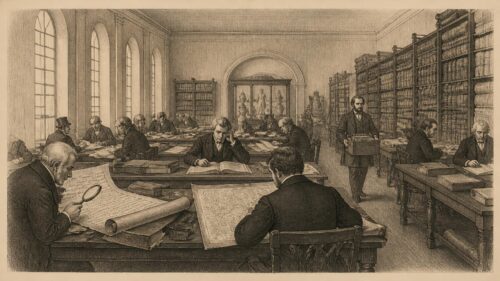
That emphasis on surviving fragments is echoed by the archival descriptions of annals and by the National Archives page that directs readers to essays and research papers on the Great Famine. The annals editions describe lacunae, supplementary entries, and text lost by mutilation, while the archives page frames famine materials as a research collection. Read together, these passages show that the present-day study of famine and diaspora depends on partial records assembled across institutions.