
Tuam’s New Cathedral1837 CE
In 1837, Victoria’s accession prompted an Irish general election in which Daniel O’Connell and his allies demonstrated Catholic political organisation despite a restricted, public franchise. Parliament debated Irish poor relief amid widespread insecurity, but legislation followed only in 1838. Tithe grievances, local crop failures, potato dependence and uneven employment exposed rural vulnerability. Tuam’s completed Catholic cathedral symbolised post-emancipation confidence, although religious divisions endured. Samuel Lewis’s dictionary, Ordnance Survey work and Dublin policing measures reflected administrative control. Ireland remained commercially and imperially connected, illustrated by HMS Terror’s repair at Lough Swilly, yet the Union, unequal landholding, poverty and representation remained unresolved.
Dateline
Ireland in 1837 stood between old conflicts and new systems. The calendar year brought a change of monarch, a general election, further debate over relief for the destitute, and notable efforts to describe, regulate and remake the country. None resolved Ireland’s deepest problems. The Union remained intact; landholding, poverty and religious inequality still shaped daily experience; and the political influence won by Catholics after emancipation was constrained by a narrow franchise. Yet the year left unusually revealing records: election tallies, parliamentary arguments, surveys, gazetteers and a major new Catholic cathedral at Tuam.
A New Queen and an Irish Election
William IV died on 20 June 1837 and was succeeded by his eighteen-year-old niece, Queen Victoria. Ireland was part of the United Kingdom, and the accession therefore brought a dissolution of parliament and a general election during the summer. The change in sovereign mattered symbolically, but it also set Irish political organisation in motion. Local committees, landlords, clergy, tenant voters and candidates had to decide whether the new parliament would strengthen the Whig ministry, Conservative opposition or Daniel O’Connell’s Irish reforming and Repeal interest.
O’Connell remained the commanding popular political figure. Catholic emancipation had enabled him to sit at Westminster, but it had not created representative democracy on modern terms. The Irish county franchise had been raised in 1829 to a £10 qualification, excluding many of the poorer voters who had helped make his earlier campaigns formidable. Voting was public, not secret. A tenant who voted against a landlord’s preference could face intimidation, pressure or the loss of employment and favour; a landlord could in turn find his local authority challenged by organised Catholic electors, priests and Liberal committees. Election contests were consequently social confrontations as well as constitutional exercises.
Dublin provided a vivid example. At the 1837 election Daniel O’Connell headed the poll with 3,556 votes, only fourteen ahead of the Whig Robert Hutton on 3,542. The Conservative candidates, George Alexander Hamilton and John Beattie West, followed closely. The figures reveal both the intensity of urban politics and the limited electorate on which parliamentary representation rested. O’Connell’s eldest surviving son, John O’Connell, was elected for Athlone on 24 July. The family’s parliamentary presence did not amount to an Irish legislature, but it gave the O’Connellite movement a means of applying pressure within the imperial parliament.
The election did not make Repeal of the Union imminent. O’Connell still worked tactically with Whigs where that offered practical gains, while retaining an Irish national claim that could mobilise a much wider public than the electorate itself. The year’s politics therefore mixed constitutional participation with a persistent reminder of exclusion: millions lived with the consequences of policy but possessed no vote.
Relief Debated, Not Yet Enacted
Poverty was the most urgent subject beneath these electoral manoeuvres. Ireland had no nationwide statutory poor-law system comparable to the English and Welsh arrangements. Support for the destitute instead came unevenly through family networks, landlords, religious charities, local institutions and occasional government relief. This was not merely an administrative gap. It reflected an agrarian society in which many labourers and cottiers had insecure work, tiny holdings and little protection when harvests or employment failed.
In February 1837 the House of Commons debated whether some poor-law provision for Ireland could any longer be avoided. In April, O’Connell spoke forcefully on the subject, linking misery to inadequate employment, poor housing and the country’s political relationship with Britain. George Nicholls, an English Poor Law Commissioner, produced a report on Irish conditions during the year. His investigation and the earlier Irish Poor Inquiry furnished government with material for legislation, but they did not settle the question of what aid should look like or who should pay for it.
It is important not to place the Irish Poor Relief Act in 1837. The act received royal assent only on 31 July 1838. In 1837, the issue was investigation, controversy and legislative preparation. Critics feared that a rate-funded system would burden occupiers and encourage landlords to remove poor tenants. Others regarded organised relief as indispensable in a country where destitution was already plain. These arguments mattered because they anticipated the workhouse-centred system that would subsequently reorganise local administration across Ireland.
Religious taxation remained an associated grievance. The Tithe War had been at its fiercest earlier in the decade, but the underlying objection had not disappeared: most Catholics and many Presbyterians resented compulsory payments for the established Church of Ireland. Tithe Applotment Books, compiled for assessments up to 1837, preserve the names of many occupiers of holdings over an acre. They also expose a basic limitation of official record-making: the poorest people, lodgers, labourers and those on minute plots could be far less visible than those liable to assessment.
Tuam and Catholic Confidence
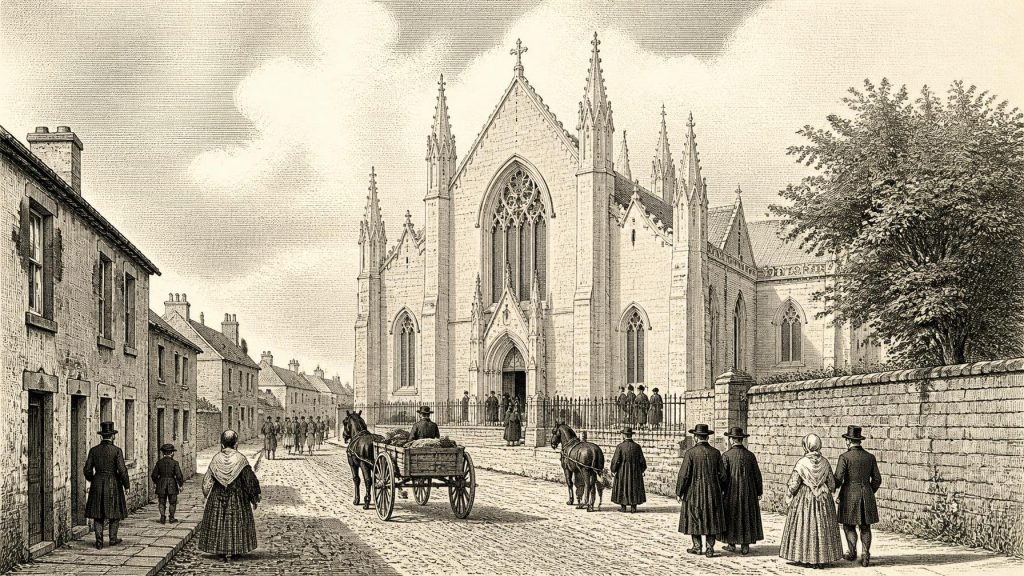
In Tuam, County Galway, the new Roman Catholic Cathedral of the Assumption represented a different kind of development: the visible institutional confidence of a church emerging from the penal era and emancipation. Begun in 1827 for Archbishop Oliver O’Kelly, the large Gothic Revival building was completed under his successor, Archbishop John MacHale. Its scale, limestone fabric, twin towers and high altar sent from Rome proclaimed that Catholic organisation was no longer confined to private worship or improvised chapels.
The precise ceremonial date requires care. The Dictionary of Irish Architects records the cathedral as consecrated on 18 August 1836, while later local tradition, a commemorative plaque and material preserved in the National Folklore Collection date Archbishop MacHale’s dedication to 18 August 1837. These accounts should not be collapsed into a falsely certain single event. What can responsibly be said is that the cathedral was newly finished and an established landmark in Tuam during 1837; an Ordnance Survey report on it was made on 31 December that year.
The building did not erase confessional division. The Church of Ireland remained established and retained its own cathedral in Tuam, while Presbyterian communities were particularly important in Ulster. But Catholic churches, schools, clergy and devotional networks increasingly provided the infrastructure through which communities organised education, charity, political communication and religious life. Tuam’s cathedral was therefore more than an architectural achievement. It was part of the changing public presence of Catholic Ireland.
A Fragile Rural Year
For a great many households, however, the decisive institution was neither parliament nor cathedral but the small potato plot. By the 1830s the potato was central to the diet of poor labouring families, especially where wages were irregular and holdings were minute. Dependence on one perishable crop made the annual interval before the new harvest—the ‘meal months’ of summer—particularly anxious.
Evidence collected for later official accounts indicates that potato crops failed in one or more western districts in 1835, 1836 and 1837, requiring limited relief from civil-contingency funds. That does not justify describing 1837 as a countrywide famine on the scale of the catastrophe after 1845. It does show that recurring local scarcity, unemployment and poor diet were already features of pre-Famine Ireland. A bad season could force households to borrow, pawn belongings, seek charity, migrate for work or reduce food consumption long before starvation reached the attention of Westminster.
The wider rural economy was divided. Grain, livestock, butter and linen connected regions to commercial markets, while many labourers lacked secure access to their proceeds. In Ulster, a downturn in linen compounded agricultural difficulty for some families. Elsewhere, fairs, small market towns and coastal ports remained essential points where animals, butter, grain, turf, fish and imported goods were exchanged. Ireland was commercially connected, but connection did not mean that resources or risks were evenly shared.
Describing and Policing the Island
Two publications of 1837 reveal the growing administrative appetite to render Ireland legible. Samuel Lewis’s A Topographical Dictionary of Ireland, issued in two volumes, assembled entries on counties, boroughs, parishes, villages, markets, churches, schools, industry and population. It is an invaluable contemporary guide, but not a neutral photograph of the country. Its statistical descriptions were compiled from available returns and its language often reflected the assumptions of property, improvement and official administration. Read critically, it captures an Ireland of crowded rural parishes, expanding towns, religious institutions and uneven economic opportunity.
More exacting still was the Ordnance Survey. Its six-inch mapping of Ireland had begun to appear earlier in the decade, and in 1837 the survey published its sole contemporary memoir: the detailed account of Templemore parish, including the city and north-western liberties of Londonderry. The intended memoir series was to combine maps with information on terrain, natural history, settlement, trade, buildings and social conditions. Financial and political hesitation meant that this ambitious national descriptive project was not continued in the same published form. Nevertheless, the work of surveyors, antiquaries and Irish-language scholars was transforming townlands, place-names and landscapes into official knowledge.
State power also took an urban form. A Dublin Police Act of 3 July 1837 adjusted the boundaries and administration of the recently created Dublin metropolitan police district, including Dublin Castle within the district. It was an amendment to the 1836 police settlement, not the original creation of the force. Yet it illustrated the same trend as the survey: government sought more standardised, centrally supervised means of managing space, order and information.
Coast and Connection
One small maritime episode linked Ireland to a much wider world. In 1837 HMS Terror, damaged during Captain George Back’s Arctic expedition, reached Lough Swilly in Donegal for temporary repair. The vessel’s arrival was not an Irish political event, but it was directly connected to an Irish harbour and to the practical skills of coastal repair, provisioning and shelter. It also reminded observers that Irish waters were part of imperial naval routes reaching from the Atlantic to the Arctic.
Thus 1837 was not a year of final settlement. Victoria’s accession and the election changed personnel, not the structure of the Union. Debates on poor relief recognised need without yet establishing a system. Tuam’s new cathedral embodied Catholic resurgence, while surveys and directories recorded the land and communities that government hoped to understand. Beneath these developments lay the unresolved facts of insecure labour, potato dependence, religious contention and unequal political power—facts that would shape the difficult years ahead.
Primary Sources
- 1837 General Election – Dublin
- Athlone 1832–1885
- General Elections Results 1832–2019
- Poor Laws (Ireland), House of Commons Debate, 13 February 1837
- Poor Laws (Ireland), House of Commons Debate, 1 December 1837
- Poor Law—Ireland; Daniel O’Connell, 28 April 1837
- Report of George Nicholls, Esq., to His Majesty's Principal Secretary of State for the Home Department
- Poor Relief (Ireland) Act 1838
- The Irish Crisis
- Why Was the Potato So Important?
- Tithe Applotment and Valuation Records
- A Topographical Dictionary of Ireland
- A Topographical Dictionary of Ireland, Volume II
- Ordnance Survey of the County of Londonderry: Memoir of the City and North-western Liberties of Londonderry, Parish of Templemore
- Templemore Ordnance Survey Memoir
- Historic Maps – All-Island Ireland
- County Galway, Tuam, Cathedral of the Assumption (RC)
- The Tuam Cathedral
- Dublin Police Act 1837
- Dublin Police Act 1836
- Constabulary and Police
- The Office of the Chief Secretary of Ireland: Chronology
- Items Relating to the Temporary Repair of the Arctic Discovery Vessel HMS Terror at Lough Swilly in 1837
- Background: Chronology of Key Events, 1800–1967