Whately’s Poor Inquiry1833 CE
In 1833, Irish government combined coercion, church reform and social investigation amid unrest and poverty. The Suppression of Disturbances Act expanded powers over meetings, movement and suspected rural disorder, constraining constitutional mobilisation associated with Daniel O’Connell. Tithe resistance persisted despite legislation adjusting arrangements, while the Church Temporalities Act abolished levies, reorganised bishoprics and revenues, but preserved Protestant establishment and endowments. O’Connell continued to advocate repeal, tithe reform and redress. In September, Archbishop Richard Whately began a Royal Commission examining poorer classes, inaugurating systematic inquiry into labour, land, charity and deprivation. The year left Ireland’s religious, political and economic crises unresolved.
Dateline
In 1833, Ireland stood at a grim intersection of coercion, institutional reform and searching enquiry. The most firmly dated landmarks came from Westminster, whose laws governed Ireland after the Union: on 2 April the Suppression of Disturbances (Ireland) Act received royal assent; on 14 August came the Church Temporalities Act. Neither measure settled the underlying crisis. The first enlarged the state’s powers against disorder, while the second reshaped the finances and hierarchy of the established Church of Ireland. By September, a Royal Commission under the Church of Ireland archbishop of Dublin, Richard Whately, had begun a far-reaching investigation into Irish poverty. Taken together, these measures showed a government that recognised Ireland’s distress but differed profoundly over whether it arose chiefly from crime, religious grievance, defective institutions, landholding, unemployment or deprivation.
Emergency Law and Rural Fear
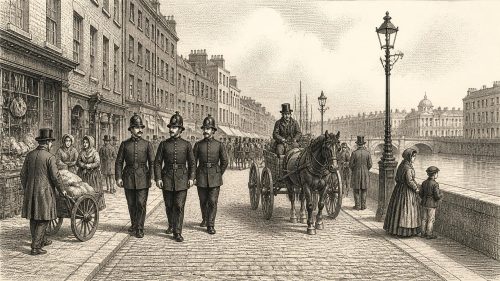
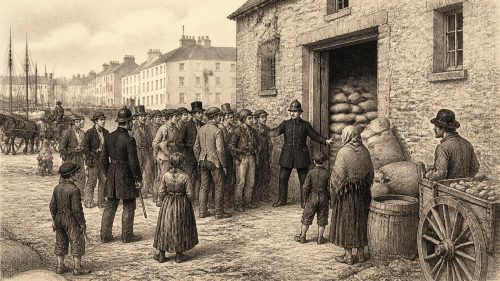
The coercion act was the year’s clearest assertion of executive force. Its formal title, An Act for the more effectual Suppression of local Disturbances and dangerous Associations in Ireland, reflected official claims that ordinary law could not contain agrarian violence, intimidation and illegal combinations. It gave the lord lieutenant wide authority to prohibit meetings considered dangerous to public safety and, in proclaimed districts, imposed exceptional restrictions upon movement and assembly. A person found outside home under suspicious circumstances between an hour after sunset and sunrise could be detained and required to establish a lawful reason for being abroad. Justices and authorised officers could demand that male inhabitants of houses present themselves at night. The act also made provision for trials before courts martial in specified circumstances.
These provisions made the countryside feel more closely watched and more vulnerable to military intervention. Yet the statute should not be mistaken for a description of all Irish people or places. It was an enabling law, used through proclamation, rather than proof that every parish was in revolt. Its importance lay in the political message: government treated local disorder as an emergency demanding exceptional power. The measure also constrained constitutional politics. Public meetings, which had become central to Daniel O’Connell’s mass mobilisation for Catholic rights and repeal of the Union, could now be more readily restricted. O’Connell remained committed to constitutional and non-violent agitation, but the act exposed the narrow space available for popular politics when ministers associated public grievance with rural violence.
The Unfinished Tithe Crisis
The immediate background was the Tithe War, the sustained resistance to payments supporting the Church of Ireland. Tithes had long been burdensome because they were levied on occupiers of land regardless of whether they belonged to the established church. Most Irish people were Catholic; Presbyterians and other dissenters could also resent the obligation. The controversy was not simply theological. It reached into the practical world of the holding, the household and the market: payment demands, legal expenses, seizures of cattle or goods, protection for collectors, and the danger of confrontation when debts were enforced.
Chief Secretary’s Office records make clear how dominant the issue remained in 1832 and 1833. Non-payment could be a deliberate political refusal, but it also flourished where small cultivators had little cash to spare. The state’s answer in 1833 combined force with piecemeal financial and legal adjustment. A further Composition for Tithes (Ireland) Act, passed on 29 August, addressed the claims of tithe owners and amended earlier arrangements. It did not remove the central grievance: tithe still existed. That outcome matters. The year brought important reform of church administration, but not the later settlement that transferred the charge more decisively onto landlords and converted it into a rent charge. In 1833, the conflict remained alive in daily rural relations.
Reforming an Established Church
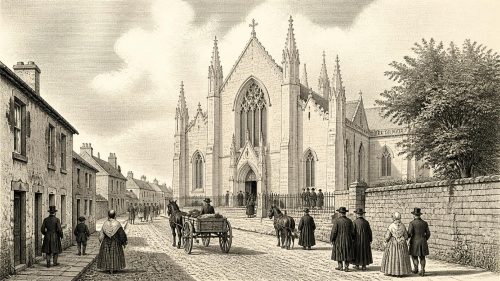
The Church Temporalities Act of 14 August was therefore both a response to pressure and a defence of establishment. It did not disestablish the Church of Ireland, nor divert its property to a general public purpose. Instead, it sought to make the institution less costly, more orderly and more defensible. The act abolished compulsory vestry assessments for church repair in the cases covered by the legislation. These local levies, sometimes called church cess, had been another source of resentment because they could fall upon people outside the established church.
It also abolished first fruits, a charge historically payable by clergy, and substituted an annual tax. Most visibly, it set out a staged programme by which vacant Irish archbishoprics and bishoprics would be united with other sees. The reduction was to happen as vacancies arose, rather than by abruptly removing existing officeholders. The legislation created the Ecclesiastical Commissioners for Ireland to administer the reformed system and channel revenues towards ecclesiastical purposes, including churches and smaller livings. In this limited sense the act was a major institutional reconstruction.
Its limitations were equally revealing. The Church of Ireland retained its established position and its endowments; the measure aimed at efficiency, not equality between denominations. Catholics could reasonably see the abolition of vestry cess as relief while still objecting to tithes and to the privileged constitutional status of a church attended by a minority. Protestant supporters of the establishment, meanwhile, could regard the reduction of bishops and reorganisation of revenues as an unsettling concession. Thus 1833 did not resolve the Irish church question. It changed its machinery while leaving its fundamental political and confessional imbalance in place.
O’Connell and Parliamentary Politics
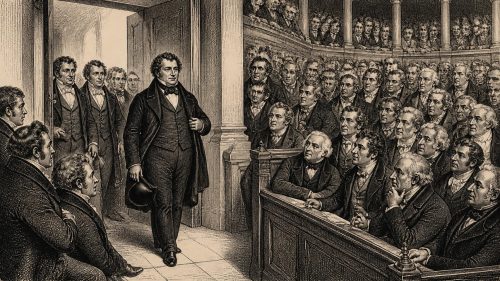
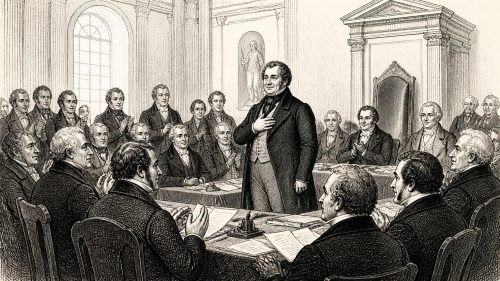
Daniel O’Connell was Dublin City’s MP in 1833 and the principal national figure able to connect parliamentary debate with organised public opinion in Ireland. Following Catholic emancipation and the Reform Act of 1832, repeal of the Union had moved to the forefront of his programme. A group of Irish MPs had been returned with some commitment to that cause, although repeal had little support among the dominant parties at Westminster. O’Connell also pressed for reform of tithes, local administration and political representation, while insisting that redress should be sought by lawful means rather than secret-society violence.
The coercion legislation sharpened a dilemma that would recur throughout his career. Ministers could present extraordinary powers as necessary protection for peaceful people; opponents answered that repression deepened alienation and punished constitutional activity alongside crime. The Church Temporalities debates likewise exposed the limits of reform from London. The act was significant, but it gave O’Connell and his supporters no reason to abandon the argument that Irish grievances were handled inadequately under the Union. In 1833, repeal was not yet the vast national campaign it would become in the 1840s, but the political language, parliamentary networks and popular expectations that sustained it were already in place.
Asking How the Poor Lived
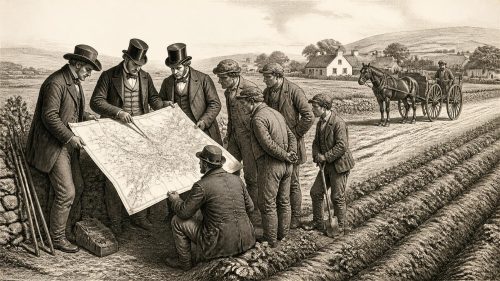
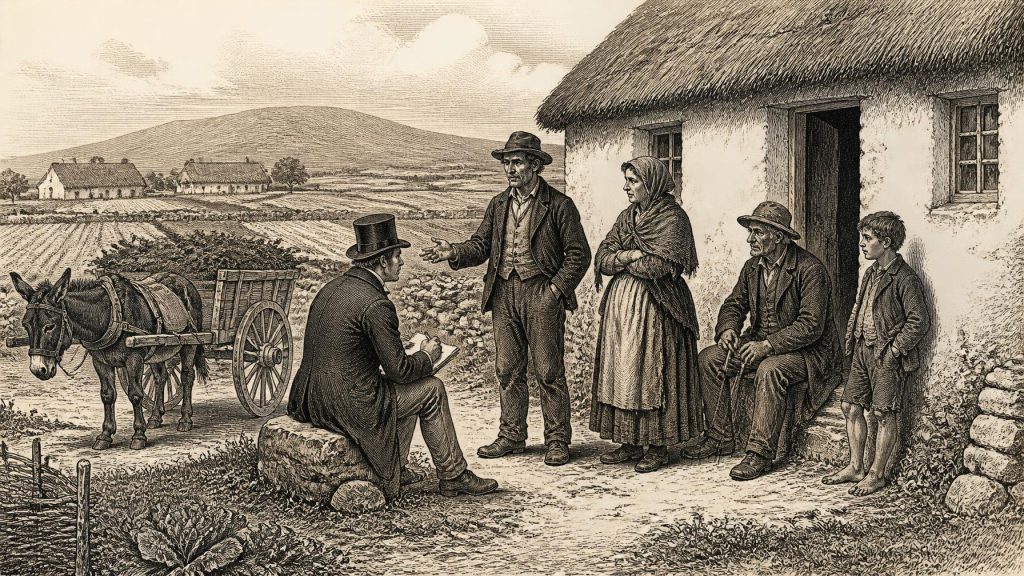
On 25 September, the Crown appointed the Royal Commission of Inquiry into the Condition of the Poorer Classes in Ireland. Whately chaired it, bringing an unusual combination of clerical office, intellectual authority and interest in social policy. Its appointment was firmly an event of 1833; its vast body of evidence and final reports belonged to the following three years. It would be wrong, therefore, to project its later conclusions backwards as if they were known in full that autumn. But the decision to investigate was itself momentous. It acknowledged that poverty could no longer be treated merely as a local charitable problem or as a by-product of disorder.
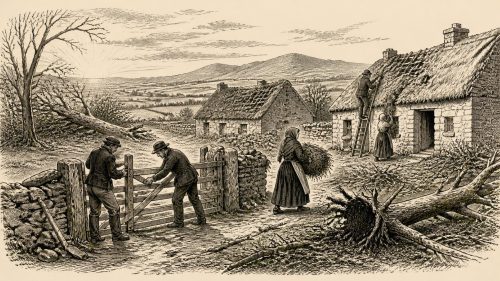
The inquiry opened a route into the social realities that contemporaries argued over so fiercely: insecure and poorly paid labour, seasonal employment, small holdings, reliance on informal charity, begging, emigration, education, agricultural conditions and the relationship between tenants, landlords and clergy. Its commissioners and assistants collected testimony on a scale unprecedented for pre-Famine Ireland. The process also made Irish society legible to the state in a new way, through questionnaires, returns, witnesses and printed reports. That did not make official observation neutral. What was asked, who was consulted and how answers were categorised shaped the picture produced. Nonetheless, the inquiry marked a shift from emergency policing alone towards systematic investigation of material life.
Everyday Institutions and Knowledge
The institutional changes of 1833 touched ordinary life unevenly. Vestries had handled more than church business: parish repairs, local rates, constables and elements of poor relief could all pass through these local structures. Altering church assessments therefore affected the machinery of local government as well as denominational relations. In towns, commerce, courts, government offices and print culture tied Ireland closely to Britain and the wider empire; in much of rural Ireland, the rhythms of cultivation, hiring, fairs, rents and parish obligations remained more immediate than parliamentary statute. The 1831 census, the most recent complete enumeration available to contemporaries, supplied the state with an increasingly important numerical backdrop, even though the detailed individual returns did not survive in full.
There were quieter signs of intellectual life. Katherine Sophia Baily’s anonymously published The Irish Flora appeared in 1833, offering a compact account of Irish flowering plants and ferns. Its appearance was notable not merely as a botanical book but as evidence of growing attention to Ireland’s natural environment, specimen collecting and scientific classification. In a year dominated by coercion and ecclesiastical legislation, such work recorded another Ireland: one of shore, bog, wood, field and mountain, observed through the disciplined naming of plants. It also reminds us that cultural history did not pause during political crisis.
By the end of 1833, no settlement had been reached. Coercion had armed the administration; church reform had made a concession without ending tithe resistance; and the Poor Inquiry had begun asking questions whose answers would trouble policymakers for years. The defining feature of the year was not a single Irish event but the coexistence of repression, reform and investigation. Ireland’s governing problem had become impossible to ignore, yet remained profoundly contested.
Primary Sources
- An Act for the more effectual Suppression of local Disturbances and dangerous Associations in Ireland
- Suppression of Disturbances (Ireland), 15 February 1833
- Suppression of Disturbances (Ireland), 19 March 1833
- Suppression of Disturbances (Ireland), 1 April 1833
- An Act to alter and amend the Laws relating to the Temporalities of the Church in Ireland
- Church Temporalities (Ireland), 6 May 1833
- Church Temporalities (Ireland) Bill, 17 June 1833
- An Act for the Relief of the Owners of Tithes in Ireland
- Legislative Reform
- Religion: State Religion, Tithes and Vestries
- The Registered Papers of the Chief Secretary's Office: 1833
- Poor Law Unions and Their Records
- Ireland in Official Print Culture, 1800–1850: A New Reading of the Poor Inquiry
- Christian Political Economics, Richard Whately and Irish Poor Law Theory
- Census through History
- Search the Census (c19)
- O'Connell, Daniel
- Flora History
- A Checklist of Collectors of Irish Native Flowering Plants and Ferns Represented in the Herbarium, National Botanic Gardens, Glasnevin, Dublin (DBN), with Biographical Annotations
- History of the Abbey
- Saint Vincent's College, Castleknock
- Part 17 of History of the Commercial and Financial Relations between England and Ireland from the Period of the Restoration