
Fuel Frontiers
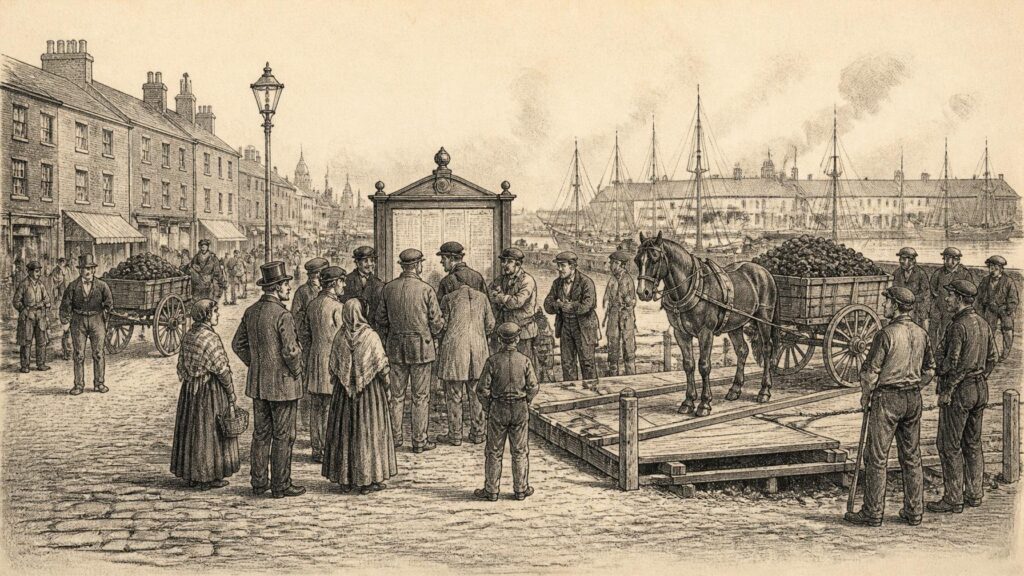
AI generated historical illustration, not a contemporary photograph.
At a Glance
Fuel protests have repeatedly revealed an uncomfortable fact of modern Irish life: a country can appear commercially agile and politically settled until the flow of diesel, petrol and heating oil is interrupted. In September 2000, road hauliers and fishers turned rising fuel costs into a national political question. In April 2026, convoys and blockades at ports, depots and the Whitegate refinery made that dependence still more visible. These were not identical episodes, nor were they simply rebellions against taxation. They were contests over work, rural distance, the cost of living, state authority, and the limits of protest when essential supplies are at risk.
Irish Context
“Fuel protests” can sound like a single, self-explanatory event. In Ireland, however, the phrase describes a recurring kind of mobilisation rather than one continuous movement. Its participants have included road hauliers, fishers, farmers, agricultural contractors, taxi drivers, motorists and rural householders. Their demands have varied: lower excise duty, protection from international oil-price shocks, a cap on pump prices, assistance for commercial users, reduced carbon-related charges, or simply recognition that transport and heating costs fall unevenly across the country. The common element has been the political force of a commodity which links a global market to the most ordinary domestic routines.
Ireland’s physical geography and economic development gave the issue particular sharpness. Dispersed settlement, long journeys to work and services, a heavy reliance on road freight, and the importance of diesel-powered farming and fishing meant that a change at the pump could rapidly become a wider increase in food, transport and household costs. A 2006 baseline assessment prepared for Forfás noted that national road-haulage volumes more than doubled between 1995 and 2002, while rail freight declined. That was the high-growth landscape in which fuel became not merely a private purchase but a visible business cost and a measure of regional inequality.
The evidence therefore supports a history of fuel protest as part of Ireland’s modern transport and energy history. It does not support a simpler legend in which every price rise automatically produced a united national revolt. Organised interests differed from unaffiliated demonstrators; commercial diesel users did not necessarily share the interests of private motorists; and protest rhetoric often compressed complicated prices into a single accusation against “the Government”. International crude prices, exchange rates, refining, distribution margins, VAT and excise all mattered. The political importance of taxation lay partly in its visibility: it was the element of the final price that governments could alter directly.
Cost Structure
The politics of fuel began with a structural difficulty. Petroleum products are traded in an international market, and Irish consumers have little control over crude-oil prices or disruptions abroad. Successive governments could influence tax rates and social supports, but could not command the price of oil. A Dáil answer during the 2009 downturn set out the basic official account: Irish pump prices reflected global market prices, the euro-dollar exchange rate, refining and transport costs, operating costs, excise duty and VAT. That explanation was technically important, but it was rarely sufficient politically. To a haulier filling a fleet, or a household ordering heating oil, the distinction between an international shock and a domestic tax was less consoling than the total on the invoice.
For commercial road transport, fuel was an especially unforgiving input. A lorry could not simply remain parked until the market improved if it was contracted to deliver food, medicines, construction materials or exports. Fuel spending rose before hauliers could renegotiate fixed-rate contracts, and international competition made it difficult to pass on costs. In 2000 the Irish Road Haulage Association stated that fuel represented 35 per cent of haulage costs. The precise proportion naturally differed by firm, route and vehicle, but the claim captures the sector’s vulnerability: diesel was not peripheral overhead but an operating necessity.
This dependence created a recurring contradiction in public policy. Lower duties could offer immediate relief and help firms facing external competition. Yet cheaper road fuel could also conflict with commitments to reduce emissions, limit congestion and encourage alternatives to private-car and road-freight dependence. That clash was explicitly present in the Dáil debate on the December 2000 excise resolution. While the Government emphasised competitiveness and relief for diesel users, Labour speakers warned that cutting fuel tax sat uneasily with the recently published climate-change strategy and the growth of transport emissions.
Fuel protest, then, was never solely about the arithmetic of tax. It expressed the question of who should bear the cost of an oil shock: consumers, transport operators, public revenue, oil companies, or future taxpayers funding climate and social policy. That is an interpretation drawn from the documented arguments of governments, sectors and opposition parties. It should not be mistaken for a claim that all protesters shared a fully developed common programme. Their unity was often practical and temporary, built around a price shock rather than a single ideology.
European Moment
The Irish protests of 2000 belonged to a wider European moment. High oil prices and anger at fuel taxation had already produced disruptive action in France and elsewhere. The British fuel crisis of September 2000, involving refinery and depot blockades, dominated international news and showed how quickly supply chains could be disrupted when tanker movements stopped. Scholarly work on the British protests has stressed the role of loose networks, media attention, police decisions and support from influential actors, rather than treating the events as a spontaneous uprising of otherwise identical motorists.
Ireland was affected by that atmosphere but should not be collapsed into the British story. The island’s two jurisdictions had distinct tax systems, governments, transport structures and political contexts. In Northern Ireland, hauliers brought articulated lorries to Belfast City Hall in September 2000 while representatives of farming, business, fishing and retail interests met the Northern Secretary. In the Republic, the Irish Road Haulage Association sought a meeting with the Taoiseach and pressed for a substantial reduction in diesel excise. The contemporaneous reporting demonstrates a shared regional crisis, but not one centrally directed all-island campaign.
The French example mattered as a tactical warning and a rhetorical resource. Irish hauliers spoke of possible port blockades comparable to the French action. Such language conveyed leverage: Ireland’s trade and fuel supplies depended on ports, depots and road distribution. Yet the possibility of disruption was not the same as a completed national stoppage. Historical accounts need to preserve that distinction. Threatened action, planned action, local demonstration and sustained blockade are different events, even where later memory merges them into one dramatic picture.
September Mobilisation
In early September 2000, the Irish Road Haulage Association asked Taoiseach Bertie Ahern to meet it over the price of diesel. The association sought a 20 per cent reduction in excise duty and said that approximately 1,200 hauliers were preparing nationwide protest action. Contemporary reports noted that the organisation had not ruled out blockades of ports or fuel depots. The association represented roughly a third of Ireland’s then 4,000 licensed hauliers, a reminder that even a prominent trade body could not automatically speak for every operator.
The timing was deliberate. The Government had declined to make a concession ahead of the December budget, and hauliers used a deadline to force public attention onto a problem they considered urgent. The Irish Times recorded the prospect of port blockades if no response came from Government. This was a politics of chokepoints. A slow convoy on a public road was demonstrative; obstruction at a port or terminal could threaten supply itself. The fact that such tactics were discussed indicates how central fuel distribution had become to the political bargaining power of transport workers and owners.
Other fuel-dependent occupations made their own case. On 19 September, much of the State’s fishing fleet was expected to tie up for a twenty-four-hour protest over rising costs. The Killybegs Fishermen’s Organisation estimated that fuel-price increases had already cost the industry £15 million that year and described fuel as taking a very large share of vessel running costs. A tied-up fleet was symbolically potent because it made visible a cost ordinarily hidden within the price of fish, but it was also a self-limiting tactic: the immediate economic loss fell first upon the fishers themselves.
The 2000 protests were therefore sectoral as much as popular. They brought attention to shared hardship, but their strongest arguments were occupational. Hauliers referred to contracts and competitiveness; fishers to the viability of vessels and ports; rural communities to transport dependency. That pattern matters because subsequent public recollection can turn such disputes into a generic revolt of “ordinary people”. The documentary record instead shows organised industries pressing specific claims while seeking broader sympathy from motorists, consumers and regional businesses.
Fiscal Response
The immediate political argument of 2000 culminated not in an unconditional surrender to protest, but in a budgetary decision made within fiscal and European constraints. In December, the Dáil considered a reduction in excise on auto diesel and changes affecting petrol. The Government stated that the revised diesel rate would be brought close to the European Union minimum and described the measure as significant for road hauliers, coach operators and other diesel users. With the accompanying VAT reduction due at the beginning of 2001, the stated overall reduction was 7.81 pence per litre of auto diesel and 3.02 pence per litre of unleaded petrol.
It would be too strong to say that the September protest alone caused those reductions. Budgets reflect revenue forecasts, inflation, party politics, European rules, lobbying and wider economic circumstances. The documentary evidence does show that diesel costs and haulier competitiveness featured prominently in the parliamentary justification. It also shows that the question had become contentious enough to be argued alongside climate policy. The most defensible conclusion is that the protests amplified and dramatized an existing policy problem; they formed part of the pressure surrounding the budget rather than providing a single, provable cause.
The debate exposed another enduring feature of fuel politics: relief is easier to announce than to distribute evenly. A duty reduction affects the pump price, but it may not match the scale of a particular operator’s exposure, and it helps motorists who were not in financial distress as well as those whose livelihoods were genuinely threatened. Targeted rebates can address that problem but introduce eligibility rules, administration and disputes over which occupations deserve protection. The tension between broad tax cuts and targeted supports would recur in later crises.
Oil Reliance
By the twenty-first century, Ireland’s dependence on imported oil made fuel supply a national-security as well as a household-budget concern. The growth of road haulage after the mid-1990s meant that many basic economic functions depended on reliable diesel deliveries. Supply resilience did not mean that Ireland lacked fuel; it meant that fuel had to keep moving from import and refining points through storage, depots, tankers and forecourts. A protest could therefore acquire national consequences without involving huge numbers of people. A relatively small group positioned at a strategic gateway could interrupt a much larger system.
This is the key historical link between 2000 and 2026. The two episodes emerged from different international crises and involved different coalitions, but both demonstrated the leverage of infrastructure. Ports, refineries and distribution depots are not simply industrial sites in the background of public life. They are the places where an international commodity becomes usable fuel for ambulances, buses, tractors, fishing vessels, delivery fleets and domestic heating. When access to them is restricted, the normal separation between economic grievance and public emergency can disappear quickly.
That observation does not justify treating every blockade as illegitimate. Democratic societies protect protest precisely because people may need visible disruption to be heard. But it does explain why the state distinguishes between demonstrations that inconvenience traffic and actions that threaten emergency supply. The line can be politically disputed, and the experience of those affected must be judged case by case. Still, Ireland’s fuel protests show that logistical power can create both bargaining strength and a rapid loss of public tolerance.
Spring Crisis
The April 2026 crisis unfolded amid a sudden international energy shock linked by the Government to conflict in the Middle East. On 24 March, before the nationwide blockades began, the Government announced temporary reductions in Mineral Oil Tax, calculated on a VAT-inclusive basis: 15 cent per litre for petrol, 20 cent for auto diesel and 3 cent for marked gas oil. It also raised the maximum diesel-rebate support for qualifying haulage and bus operators, reduced the National Oil Reserves Agency levy for a limited period, and extended the fuel allowance season by four weeks.
Those measures did not prevent protest. Beginning on 7 April, agricultural contractors, farmers, hauliers and supporters organised slow-moving vehicle convoys and demonstrations in towns and cities. The movement used the name “Can’t Afford to Move”, a phrase that captured the fusion of commercial and household grievance. As the week progressed, parts of the action escalated from road protest to blockades affecting strategic sites, including Whitegate in County Cork, Foynes Port, Galway Harbour and other distribution points. Contemporary reporting recorded that protesters sought reductions or caps on fuel costs and complained that earlier relief had not met the scale of the price rise.
The most consequential site was Whitegate, Ireland’s only oil refinery. The Government later said that disruption there placed oil intended for Ireland at risk of being redirected elsewhere and described blockades of streets, motorways, depots and ports as coordinated action that had gone beyond ordinary protest. That was the Government’s interpretation, and it should be identified as such. The independent, documented point is narrower: access to critical fuel infrastructure was obstructed, fuel distribution was seriously disrupted, and the resulting pressure extended far beyond those participating in the protests.
The crisis also demonstrated the difference between sympathy for a grievance and support for a tactic. Rising fuel prices were plainly burdensome, especially for households with poor transport alternatives and for businesses unable to reduce diesel use quickly. But as forecourts ran short and essential services faced uncertainty, public debate shifted. The question was no longer only whether the cost of fuel was unfair. It was whether a campaign against unaffordable fuel could legitimately deny fuel to others. That change in emphasis was central to the state response.
Public Order
On 9 April 2026, the Minister for Justice stated that the Defence Forces had been requested to assist An Garda Síochána in aid to the civil power and warned that large vehicles blocking critical infrastructure would be removed. The statement framed access to fuel and clean water as a basic-rights issue. It was an unusually stark formulation, reflecting the degree to which a dispute over price had become an emergency-management problem.
The National Emergency Coordination Group reported that blockades and wider congestion were severely limiting fuel distribution and impeding efforts to supply emergency services. It also noted concerns that workers, including essential workers, might lack fuel to travel to work, and that storage capacity at ports was becoming a concern. The Government authorised temporary flexibility in driving-hour and rest-period rules for drivers transporting liquid fuel, an administrative detail that illustrates the practical character of the emergency. The state’s objective was not merely to clear roads but to restore a functioning distribution network.
Health authorities gave the clearest account of the human stakes. On 10 April, Ministers said that the interruption of fuel supplies was affecting ambulance operations, home care, meals on wheels and respite services, with the west, mid-west and south-west particularly affected. Such official statements necessarily reflected the Government’s emergency assessment, but they identified concrete services whose operation depended on transport and heating fuel. This made the conflict morally more complex than a simple confrontation between protesters and police. People facing unsustainable costs and people dependent on uninterrupted care could both be harmed at once.
On 12 April, the Government announced a further package. It extended the temporary excise measures, reduced mineral-oil-tax rates again, postponed the planned May carbon-tax increase until the budget, enhanced transport supports, and introduced a fuel-support scheme for farming and fisheries. Government figures described the combined relief as taking 31 cent per litre from auto diesel and 27 cent from petrol, on a VAT-inclusive basis. The package followed enforcement action and negotiations with established representative organisations; it did not amount to acceptance of every demand made by the blockaders.
Historical Reading
The comparison between 2000 and 2026 is instructive, but it has limits. In 2000, the most visible Irish actions were driven by organised haulage and fishing interests during a Europe-wide fuel-tax crisis. In 2026, the protests developed amid an acute global supply shock and drew in agricultural contractors and a broader cost-of-living constituency before escalating into major blockades. The earlier dispute concentrated on excise and competitiveness; the later one combined tax, international conflict, household affordability, food production, carbon policy and distrust of political representation.
There is also a difference in the scale of state involvement. The 2000 episode featured threats of port and depot action and was followed by budgetary relief. The 2026 crisis led to formal emergency coordination, policing operations, Defence Forces assistance to civil power, and publicly articulated concern for health and emergency services. This does not mean that 2026 was simply “worse”, since severity depends on duration, geographical reach, supply levels and the condition of public services. It does mean that the later dispute crossed a threshold at which the security of supply became the dominant issue.
Folklore tends to simplify these events in two opposing directions. One version celebrates blockades as the only language a distant state understands. Another remembers them only as reckless attempts to hold the country hostage. Neither is adequate historical method. The documented record shows genuine cost pressure, sectors with limited alternatives to diesel, and governments that had meaningful but incomplete fiscal tools. It also shows that blockading critical supply systems could threaten people with no role in the dispute. A fair account must retain both truths.
Lasting Questions
The long-term lesson is not that Ireland can tax fuel without consequence, nor that blockades are a dependable route to justice. It is that an energy transition which does not address rural transport, commercial fleets, fishing, farming and home heating will remain politically fragile. Diesel dependence cannot be removed by instruction alone, particularly where viable alternatives are scarce and capital replacement is expensive. Yet permanent reliance on broad fossil-fuel tax cuts would leave the State exposed to repeated international shocks and would weaken environmental policy.
Historical perspective suggests several practical priorities: transparent explanation of fuel prices; rapid, time-limited relief during exceptional shocks; targeted assistance where dependence is demonstrable; stronger supply resilience; and credible investment in alternatives before penalties rise. It also suggests that governments should engage representative bodies early, while protesters should recognise the difference between making disruption visible and obstructing services on which vulnerable people rely. These are not conclusions mechanically dictated by the record, but interpretations informed by the two crises.
Fuel protests belong to Irish history because they illuminate a continuing national dilemma. The island’s economic life has been built around movement—of people, goods, fish, food, fuel and exports—while much of that movement has depended on imported oil. When its price rises sharply, arguments about tax become arguments about citizenship, distance, work and power. The events of 2000 and 2026 show that the pump is never merely a pump: it is one of the places where global disorder, domestic policy and everyday survival meet.

Fuel Frontiers shows that Irish fuel disputes expose a deeper tension: imported oil and road freight make rural livelihoods and essential services vulnerable, yet broad tax cuts may conflict with climate goals and fail to target those most affected. The comparison between sectoral action in 2000 and the 2026 blockades also suggests that control of infrastructure can turn economic grievance into a wider public emergency. This raises an important question about fairness, resilience and democratic protest. How should Ireland design fuel relief and transport policy that supports dependent communities while reducing oil reliance and safeguarding essential supplies during future crises?