
Slater Directories
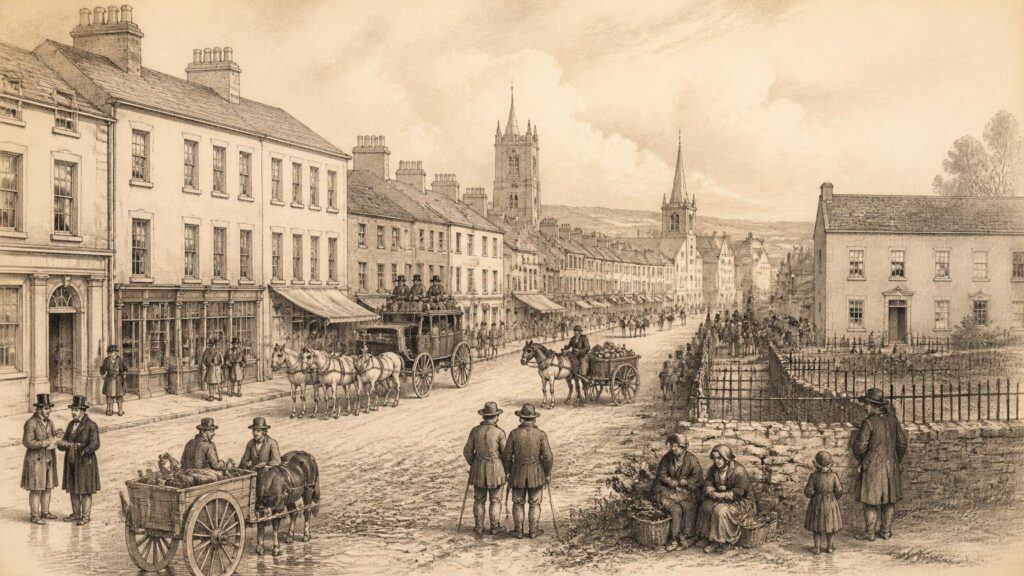
AI generated historical illustration, not a contemporary photograph.
At a Glance
In this context, “Slater” means not a single Irish family or an occupation, but the series of commercial directories associated with Isaac Slater: printed attempts to render nineteenth-century Ireland legible through names, trades, addresses, institutions and towns. Slater’s directories were commercial publications rather than official surveys, yet they have become unusually valuable witnesses to the country they selected, organised and, often, left unrecorded.
Directory Meaning
Slater’s Irish directories belong to a large nineteenth-century genre of practical reference books. They helped travellers, merchants, agents, customers and officials locate places and people. In their pages, an Irish town could be made available to a reader at a distance: its principal streets, inns, coaches, public offices, clergy, schools, banks, leading residents and named traders were arranged into a printed order. The directory did not describe Ireland in the manner of a traveller’s journal, a parliamentary report or a local history. It condensed selected facts into an instrument for movement, correspondence and commerce.
The best-known early volume was published in 1846 as Slater’s National Commercial Directory of Ireland. Its imposing full title announced more than an Irish undertaking. Alongside trade lists and alphabetical directories for Dublin, Belfast, Cork and Limerick, it included classified material for major English and Scottish towns. The surviving digitised copy runs to 1,120 pages. Its physical scale matters. This was neither a pocket list of shops nor a local pamphlet, but a substantial work designed to connect Irish commercial life with a wider network of British and Irish ports, markets, manufacturers and customers.
“Directory” can sound dry, but it should not be mistaken for neutral. Every directory rests on decisions: which settlements to describe, which occupations to distinguish, which inhabitants to name, what information to gather and how to sort it. Slater’s books imposed a particular view of society. They favoured the identifiable, stationary and commercially useful person: the trader with premises, the professional with an address, the official holding office, the proprietor, the clergyman, the schoolteacher, the hotelkeeper or the prominent farmer. Their usefulness lies partly in that selectiveness. Their danger lies in forgetting it.
Commercial Origins
Slater’s Irish enterprise emerged from an established directory tradition. Dublin had possessed directories and almanacs long before the nineteenth century. Peter Wilson’s Dublin trade directories, beginning in the mid eighteenth century, listed merchants and traders by name, address and occupation; later works enlarged the range of civic and official information available in print. Such books answered an urban need: people conducting business had to know where a professional lived, which merchant sold a particular commodity, when a market met, where a coach departed, or whom to approach in a public office.
Countrywide coverage developed later. James Pigot’s Commercial Directory of Ireland of 1820 is generally identified as the first directory to extend beyond the gentry to offer national coverage of this kind. A later Pigot edition appeared in 1824. Slater succeeded this line of publishing and produced expanded Irish editions in 1846, 1856, 1870, 1881 and 1894. The continuity is important: Slater did not create the idea of cataloguing Irish commerce from nothing. He inherited an established form, widened it, and issued it repeatedly through a period of extreme social disruption and change.
That succession also explains why the directories should be read comparatively. A name appearing in a Slater volume may be more meaningful when compared with a Pigot entry before it, or a later Slater entry after it. A business newly listed may suggest establishment, expansion or simply a changed method of collection. A business absent from a later edition may have failed, moved, changed hands, declined to participate, been omitted, or been placed under another heading. The printed record supplies leads and patterns; it rarely provides a self-sufficient explanation.
Provincial Order
The Slater series arranged the country by the four historic provinces and then treated towns and villages alphabetically within them. This was a practical system for readers who knew a county, a market town or a postal destination, but it also gave the directory an all-Ireland frame. Connacht, Leinster, Munster and Ulster appeared not as abstract regions but as sequences of settlements, each receiving a varying degree of descriptive and commercial attention.
Within a town entry, the reader might encounter a short account of situation and population, routes and conveyances, post-office information, prominent local institutions and carefully classified lists of people. Traders were commonly organised by calling rather than merely alphabetically. Bakers, blacksmiths, drapers, grocers, publicans, millers, medical practitioners, solicitors, auctioneers and other occupations became visible as parts of a local economy. Larger centres received more elaborate treatment, including alphabetical directories and street-based information. Dublin, Belfast, Cork and Limerick occupied a distinctive place in the 1846 title, confirming their importance as commercial and administrative centres.
The classifications are historical evidence in their own right. They preserve contemporary occupational language, sometimes more precise than the broad labels used in modern family stories. A person remembered as a “shopkeeper” may appear in a directory as a provision dealer, spirit merchant, ironmonger, chandler, bootmaker, stationer or draper. A searcher who uses only a modern occupational term can miss the relevant entry. Conversely, the proliferation of categories should not be taken to prove that every trade was large or prosperous. Classification was part of the publisher’s business model: the directory needed to make people and firms findable.
Urban Detail
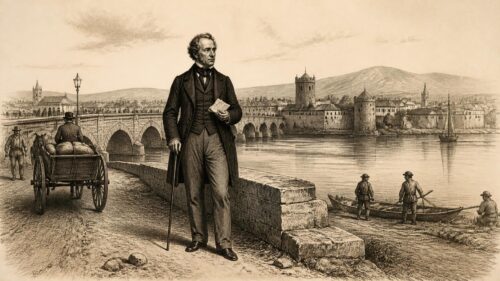
The city material is particularly revealing. Street names, addresses and occupational labels enable historians to place commercial activity in actual urban space. They can trace a solicitor’s chambers, a hotel near a railway or quay, a bookseller on a principal street, or the clustering of particular trades. The directory thereby complements maps, newspapers, rate books, estate records and later census material. It makes possible a local history built from addresses rather than from celebrated events alone.
It can also show the hierarchy embedded in the city. A town directory was never simply a list of everybody who lived there. The presence of a gentry list, a professional list or a commercial classification distinguished those people thought appropriate for consultation by readers. In a large city this might include residents of fashionable squares and suburban villas alongside businesses in dense commercial streets. The page thus maps status as well as location. It records the town as a place where residence, occupation, property and reputation were publicly intertwined.
Rural Reach
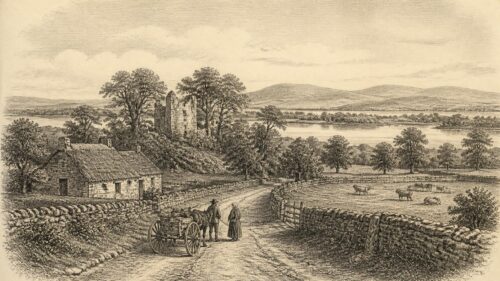
Slater’s significance is not confined to the four cities. The country entries make it possible to approach market towns and smaller settlements that are comparatively thinly represented in other surviving printed sources. They offer a snapshot of the local services upon which surrounding districts depended: shops, fairs, carriers, schools, religious institutions, craftsmen and professional intermediaries. A modest town with a few listed trades can disclose a great deal about the functions it performed for its hinterland.
Yet rural reach must not be confused with rural completeness. The series grew in scope from edition to edition, incorporating more towns and villages. In 1881 it began supplying names of principal farmers near the towns treated, with the relevant parish; that feature continued in 1894. This development widened the rural field of view, but it did not turn the directory into a record of the rural population as a whole. Smallholders, agricultural labourers, cottiers, domestic servants and people with no stable commercial address remained far less likely to be named.
Famine Moment
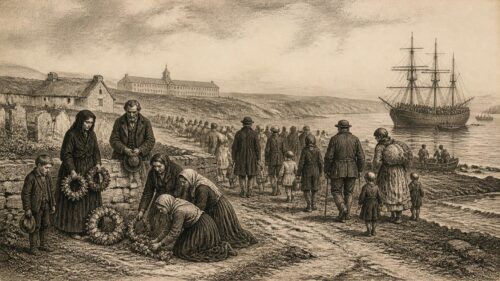
The date 1846 gives Slater’s first full Irish directory a grave historical resonance. The Great Famine extended from 1845 to 1852, and 1846 was a year in which the scale of the crisis became devastatingly apparent. Relief agencies, public works and local committees were already attempting to respond to acute distress. To open a commercial directory bearing that date is therefore to encounter a printed image of Ireland at the threshold of one of the most catastrophic transformations in its modern history.
It would nevertheless be wrong to call the 1846 directory a straightforward record of famine Ireland. Directories were assembled through surveys, advertisements, local replies and, at times, reuse of earlier printed information. Their information could lag behind publication by roughly a year. The volume therefore contains material gathered under different circumstances and at different moments. It presents the commercial and institutional fabric that its compilers could identify; it does not measure hunger, mortality, eviction, migration or relief dependency.
This limitation is not a reason to set the directory aside. It is a reason to read it with precision. In many places, it preserves a pre-collapse or early-crisis view of businesses, schools, inns, routes and named inhabitants. When set beside relief correspondence, workhouse records, newspapers, estate papers and later directories, it can help historians ask what changed. Did a later town retain the same range of trades? Did certain families remain visible? Did an inn, mill, school or professional practice disappear? Did the town’s relationship with its surrounding countryside alter? The directory cannot answer each question alone, but it helps establish the question’s local setting.
There is an ethical as well as methodological issue here. Slater’s pages may appear calm: categories are orderly, names are regularised, commerce is printed as if it were predictable. Famine disrupted precisely the lives least likely to have been granted a directory entry. The contrast between printed commercial order and the wider unrecorded suffering of labourers, tenants, servants and the destitute should not be softened into a story of resilience. The source is valuable partly because it shows the limits of what prosperous print culture chose to see.
Social Silences
The central caution is simple: a Slater directory is not a census. It was made to assist location and commerce, not to enumerate a population. As historical guidance on Irish directories emphasises, they generally omit tenement dwellers, servants, many tenant farmers and landless labourers. Absence from its pages is not evidence that a person was absent from a town or parish. It may instead reflect poverty, mobility, lack of a separate address, exclusion from the publisher’s sources, a decision not to be listed, a spelling difference or an editorial omission.
These silences are socially patterned. People who possessed premises, an established trade, a public role or recognised standing were easiest to convert into entries. Those whose work was seasonal, domestic, casual, agricultural or performed within another household were much less visible. This means that the directory gives a stronger account of the middling and commercial strata than of the social majority. It can illuminate the economy of a town centre while offering only indirect clues to the countryside and poorer districts on which that economy depended.
Women require especially careful treatment. A directory may list women as proprietors, teachers, lodging-house keepers, milliners, traders or householders, and such entries can be important evidence of women’s public economic roles. But the absence of a woman’s name does not establish economic inactivity. Women worked in family businesses, domestic service, agriculture, textile production, lodging, retail and innumerable forms of informal labour that a commercial listing could overlook or subsume beneath a husband’s, father’s or employer’s name.
Evidence Limits
Documented evidence supports several firm conclusions. Slater issued countrywide Irish directories across the nineteenth century; the books organised material by province, town and occupation; the 1846 edition included schoolteachers in the towns it treated; and later editions enlarged coverage. It is also documented that directories were commercial publications and that inclusion was incomplete. Those facts should shape every use of the source.
Interpretation begins when historians infer wider meaning. A dense concentration of grocers, publicans and carriers may indicate a lively market function; a town described through its post, transport and institutions may suggest its regional importance; repeated entries across editions may imply commercial continuity. Such interpretations can be persuasive, but they should be framed as inferences rather than as direct statements of motive, prosperity or social experience. A directory records that an entry was printed, not necessarily how profitable the business was or how its owner was regarded by neighbours.
Folklore Limits
Family and local folklore can be useful in directing research, especially where a remembered shop, public house, coach office or school is said to have belonged to a named person. But Slater cannot authenticate every tradition. A directory entry may corroborate that a person of a particular name and trade was present in a place around the period of publication. It cannot by itself prove kinship, ownership of a building, the exact duration of a business, political allegiance or the truth of a family anecdote.
Nor should a tidy directory entry be embroidered into a story of individual success without supporting evidence. The printed line is often the beginning of research, not its conclusion. Deeds, valuation records, parish registers, probate files, newspapers, local rates and surviving business papers are better suited to testing claims about ownership, inheritance, wealth and household relationships.
Print Methods
How did a nineteenth-century publisher acquire so much information? The answer is neither singular nor entirely recoverable for every entry. Directory publishers used direct inquiry, notices inviting information, local correspondents and earlier publications. Such methods gave them access to a broad field of names, but they also created unevenness. A responsive town might be richly detailed. A settlement where information was harder to obtain, or less commercially promising, might receive thinner treatment. Reused material could preserve an older address or a business that had changed before the book reached its reader.
The practical lesson is that the publication year is not always the date of every item of information. A person listed in 1846 may have supplied details in 1845; a change may have occurred before the volume circulated; an omission may be a fault of collection rather than a sign of absence. Researchers should therefore use cautious language: “listed in the 1846 directory”, “recorded under this occupation”, or “associated by the directory with this address”. Such phrases distinguish a dated printed assertion from a claim about an exact day or an uninterrupted reality.
Spelling presents another challenge. Irish surnames, townlands and street names could be rendered in variant forms, while occupations changed labels from one compiler to another. A search needs flexibility: look for alternative spellings, abbreviated forenames, changing parish names and possible anglicised or Irish forms. The directory’s own headings may supply the best route into an unfamiliar locality. Searching only for a surname can be less productive than searching by town, trade and neighbouring businesses together.
Later Editions
The later Slater editions extend the story far beyond 1846. Dublin City Library and Archive records the Irish series for 1846, 1856, 1870, 1881 and 1894. Across those decades, Ireland experienced famine, long-term emigration, agrarian conflict, the expansion of railways and communications, changing forms of retailing, and the gradual reshaping of towns. No directory offers a complete measure of these transformations, but a sequence of editions provides a valuable comparative frame.
The 1881 and 1894 volumes are particularly important for their attention to principal farmers near the towns discussed. That addition shows an attempt to enlarge the directory’s commercial geography beyond the shopfront and office. It also reflects the continued importance of agriculture to the economy addressed by the publication. Yet the term “principal farmers” is itself selective. It identifies a recognisable rural elite, not the entire agrarian world.
Changes between editions should be studied at more than one level. A researcher can compare individual names and addresses, but may also compare the list of trades, the size of the town description, the appearance of railway or postal information, and the changing number of named institutions. A town may look larger in a later volume because it grew, because the directory expanded its coverage, because more people responded, or because a revised editorial system grouped occupations differently. Historical conclusions require attention to all of those possibilities.
Research Practice
Used well, Slater is exceptionally productive. A sound approach begins with place. Identify the county, parish, townland or town as accurately as possible; locate the relevant provincial section; read the entire town entry before isolating a surname. The surrounding names often matter. They can show whether a business stood among other traders of the same kind, whether a person appeared in more than one category, and which institutions shaped the locality.
Next, separate what is directly stated from what is inferred. Direct evidence might read as a person’s name, occupation and address. A reasonable interpretation may be that the person maintained a visible local business. It would be unsafe, without further records, to claim substantial wealth, ownership of the property or a particular family relationship. The difference is modest in wording but fundamental in historical method.
Then triangulate. A directory entry is strengthened when it can be connected with another independent record: a newspaper advertisement, a valuation entry, a deed, a will, a parish register, a map, a photograph, a municipal record or a later census fragment. The National Archives notes that most surviving Irish census returns for 1821, 1831, 1841 and 1851 were destroyed in 1922, which makes alternative sources especially important. Directories cannot replace lost censuses, but they are among the printed materials that help recover parts of the social landscape those losses obscured.
Finally, preserve the wording. When transcribing an entry, retain the spelling, occupational title and address as printed, while recording the edition and page. Modernised notes are useful, but the original label may later prove significant. “Draper” is not identical to “tailor”; “merchant” is not identical to “shopkeeper”; an address on a street is not necessarily proof of residence there. Precision permits later researchers to revisit the evidence rather than inherit an embellished summary.
Historical Legacy
Slater’s directories endure because they join the local and the national. A few lines about a village shop or school can be read alongside the book’s larger claim to cover Ireland commercially. They show how nineteenth-century print connected provincial places to a national market and, through the title’s British and Scottish additions, to a wider archipelagic economy. The directories were tools of their own age, produced for use rather than posterity. Their survival has made them sources for a later age concerned with memory, genealogy, urban form and social history.
They should not be romanticised. The polished order of the page is not the whole of nineteenth-century Irish life. It excludes many people, smooths over uncertainty and reflects the interests of a commercial publisher. Nor should its omissions be treated as accidental trivia. They reveal how public visibility was distributed: the person with an address, occupation and perceived utility to commercial readers was more likely to enter the printed record than the labourer, servant, tenant or displaced poor.
Yet precisely because its viewpoint is clear, Slater can be read critically and fruitfully. It offers evidence of settlement, trade, service, transport, hierarchy and aspiration. It preserves thousands of names that might otherwise be difficult to place. It enables historians to reconstruct town economies in fine detail while also asking who was not being counted. The most responsible use of Slater is therefore double: to recover the people and places it records, and to recognise the larger Ireland that its commercial gaze only partly saw.

Slater’s directories offer a compelling paradox: they make nineteenth-century Irish towns visible through trades, addresses and institutions, while leaving many labourers, servants and poorer rural households largely unseen. The 1846 volume is suggestive because its commercial portrait sits at the onset of the Great Famine, yet its information may predate publication and cannot measure suffering directly. Comparing successive editions could reveal changing economies, but disappearance from print has possible meanings. How should historians balance the directories’ evidence of continuity or change against their socially patterned omissions when interpreting the effects of famine, migration and economic transformation in local Irish communities?