

Heritage Gathering
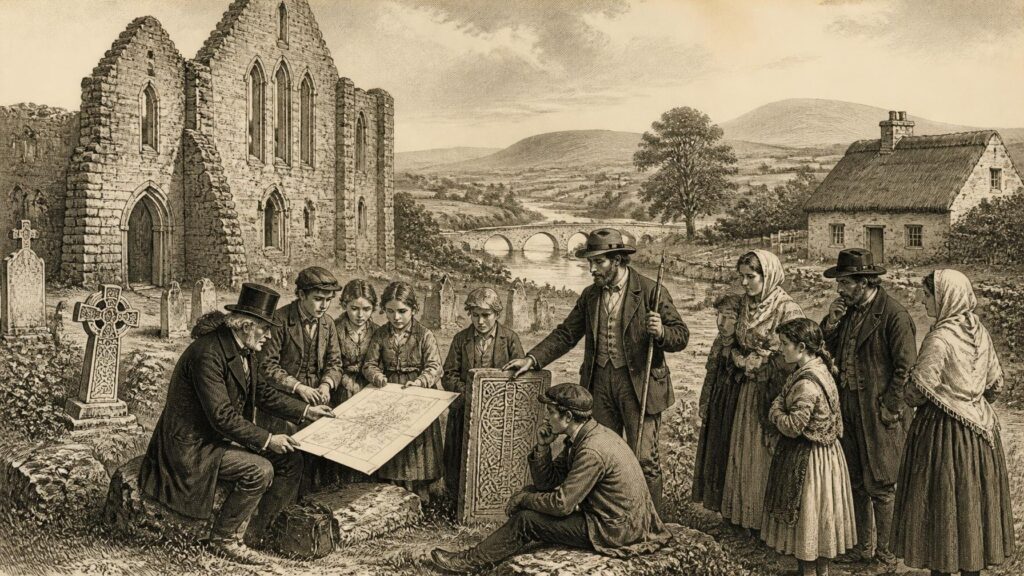
AI generated historical illustration, not a contemporary photograph.
At a Glance
National Heritage Week is Ireland’s public invitation to encounter heritage not as a fixed collection of monuments but as a living relationship between places, memories, skills and ecological systems. Its annual programme has made churches, archives, graveyards, rivers, old houses, workshops, museums, townlands and local stories available for shared attention. Yet its history also raises a harder question: who decides what is inherited, and how may communities care for it without turning the past into a decorative certainty?
European Origins
National Heritage Week belongs to a European family of public heritage occasions. Its immediate international setting is European Heritage Days, an initiative whose modern form emerged from experiments in opening historic buildings to the public. France’s late twentieth-century heritage days proved especially influential: the gesture was simple, but important. Buildings ordinarily associated with administration, privilege, worship, private ownership or specialist expertise could be opened, briefly, to people who had usually passed them by. The visitor was asked not merely to admire an impressive façade, but to recognise that public life had been shaped within such places.
The Council of Europe developed the European Heritage Days initiative in 1991, and it became a joint Council of Europe and European Union action in 1999. Its purpose was never only tourism. It connected access to a larger civic idea: that cultural inheritance can reveal both common European experience and regional difference. Ireland’s National Heritage Week is one national expression of that wider network, though it has developed its own character, calendar and range of activities.
The European connection matters because it explains two features that can otherwise seem contradictory. Heritage Week is at once local and international. A walk around a small graveyard, a conversation with a basket-maker, or a survey of plants along a riverbank may be rooted in a particular parish. But each can also be understood within wider concerns about conservation, public access, historic landscapes, migration, craft knowledge and environmental change. The European framework gives local organisers a common occasion without requiring them to surrender local distinctiveness.
It is tempting to imagine that such events emerged from an uncomplicated affection for old buildings. The documentary history suggests something more practical. Public heritage days were shaped by the recognition that places cannot be protected effectively if they remain invisible, inaccessible or understood only by specialists. Opening doors, arranging walks and explaining objects are methods of public education. They encourage people to notice what exists before loss, alteration or neglect makes its value more obvious.
That principle has particular force in Ireland. The island’s historic fabric includes prehistoric monuments, early medieval ecclesiastical landscapes, castles, demesnes, vernacular cottages, industrial works, urban terraces, harbours, bogs, field boundaries and waterways. None is self-explanatory. A ruined church may be an archaeological site, a burial place, a landmark in family memory and an element of a living landscape. A canal may be an engineering work, a habitat, a route of labour and trade, and a source of local stories. Heritage Week invites people to see such overlapping meanings rather than isolating one authorised interpretation.
The annual format is also significant. A festival has a beginning and an end, which can create urgency and visibility. It concentrates publicity, voluntary effort and institutional attention. Yet the best events point beyond the nine days. A building opened once may encourage an owner, local authority or community group to consider future access. A talk may prompt the cataloguing of family papers. A children’s wildlife walk may produce habits of observation that remain after the posters are removed. The week is therefore better understood as a catalyst than as the sum of its events.
Irish Framework
The institutional foundations of National Heritage Week lie in a broad change in how the Irish State defined heritage. The Heritage Act 1995 established An Chomhairle Oidhreachta, the Heritage Council, and gave it responsibilities that reached well beyond monuments alone. The Act’s language is important because it assembled a wide field: archaeological objects and monuments, heritage objects, architectural heritage, documents and genealogical records, flora and fauna, wildlife habitats, landscapes and seascapes, wrecks, geology, gardens, parks and inland waterways.
This was not the first Irish legislation concerning antiquities, buildings or wildlife. The Office of Public Works had acquired national-monument responsibilities in the nineteenth century, while successive National Monuments Acts created protections and procedures for archaeological remains. The State’s relationship with historic places, therefore, has a much longer history. What the 1995 Act provided was a particularly expansive statutory vocabulary and a body charged with proposing policy, promoting knowledge and appreciation, and helping to coordinate activity across the heritage field.
The breadth of that legal definition helps explain why National Heritage Week can include events that appear, at first sight, very different from one another. An architectural tour, a genealogy workshop, an archaeology lecture, a traditional-skills demonstration, a bat walk, a coastal clean-up with historical interpretation and an exhibition of photographs can all be heritage activities. They are not identical, and they require different evidence and different forms of care. But the statutory framework made it possible to treat them as related parts of a national inheritance.
The Heritage Council assumed responsibility for coordinating National Heritage Week from the Department of the Environment, Heritage and Local Government in 2005. Its own retrospective account describes a programme of about 500 events at that point. The change was more than administrative. Coordination by a specialist heritage body aligned the week with the Council’s wider mission of encouraging knowledge, enjoyment, protection and public participation. It also gave the programme a durable national home while leaving local organisers central to its delivery.
National programmes can sound highly centralised on paper, but Heritage Week depends on distributed labour. Local authorities, museums, libraries, archives, schools, voluntary groups, historical societies, environmental organisations, property owners, craftspeople and individual researchers create the individual occasions that visitors actually encounter. The national office provides a calendar, public platform, guidance, publicity and a recognisable identity. The material content is made locally, often by people who have spent years studying a street, preserving a tradition, recording oral testimony or caring for a threatened site.
The programme’s growth is documented in Heritage Council material, although totals must be read carefully. One official history records a progression from roughly 500 events in 2005 to more than 2,000 in later years. The published annual reports and event announcements use differing categories, sometimes counting events and sometimes including projects or digital activity. Such figures are valuable indicators of scale, but they are not a simple measure of historical importance. A small gathering around a local archive may have fewer participants than a major open day, while making a deeper contribution to community knowledge.
Still, the numbers show that the week became one of Ireland’s most visible heritage occasions. In 2014 the Heritage Council reported about 1,800 events and almost 295,000 participants, despite poor weather. In 2015 it reported more than 405,000 attendances at 1,826 events. These are administrative statistics, not an independent census of every visitor, but they demonstrate the programme’s substantial public reach. By the middle of the 2020s, official accounts were describing thousands of events and projects across the island.
The framework also contains an important limitation. A heritage week does not replace statutory protection, careful planning, sustained funding or specialist conservation. Opening a site does not repair masonry; a guided walk does not substitute for ecological survey; a family-history workshop does not authenticate every tradition passed down in a family. The week can make needs visible and build support for action, but it is only one part of the wider system through which heritage is researched, regulated, conserved and interpreted.
Broadening Meanings
The most consequential feature of Heritage Week may be its refusal to confine heritage to exceptional monuments. Older models of preservation often gave greatest prominence to grand houses, castles, churches, battle sites and elite collections. These deserve attention, but they cannot on their own account for how most people experience the past. The broad Irish definition made room for ordinary buildings, working landscapes, local records, industrial remains, natural habitats and practices carried in memory and skill.
This expansion changed the kinds of questions that could be asked. Instead of asking only who built a castle, an event might ask how a village formed around a river crossing, what labour supported a mill, how an estate shaped patterns of housing, or how a railway changed migration and trade. Instead of treating a field as empty ground around a monument, organisers might examine its townland name, hedgerows, drainage, biodiversity, former uses and archaeological potential. Such questions do not make every place equally old or equally rare. They do make the relationship between people and place easier to see.
In Irish historical practice, place is rarely a neutral background. Townlands, parishes, estates, electoral divisions, baronies and counties preserve different layers of administration, landholding and local identity. Their boundaries may be practical, political or customary; their names may survive in Irish, English or altered forms. A Heritage Week walk that uses maps, estate papers, folklore collections and visible features can reveal that a familiar route contains several overlapping geographies. But interpretation must remain disciplined. A name can suggest a connection; it does not automatically prove an event, ownership pattern or prehistoric date.
Archives are particularly important in this respect. They provide evidence that can complicate polished local narratives: valuation records, maps, census returns, letters, photographs, minute books, newspapers and institutional files may reveal emigration, eviction, poverty, religious division, conflict or exclusion alongside stories of community achievement. A heritage programme that presents only agreeable memories may be popular, but it risks reducing history to reassurance. The more valuable event introduces sources, explains their limits and allows audiences to understand why historians sometimes disagree.
Genealogy is another powerful route into public history. Family researchers often arrive at a parish register, graveyard or map with personal hopes, and their persistence can recover neglected records and connections. Yet genealogical evidence has to be handled cautiously. Common names, incomplete civil registration, variable spellings, mistaken ages and informal kinship terms can produce false certainty. Good Heritage Week sessions teach methods as well as supplying answers: compare records, identify the date and creator of a document, distinguish an original from a transcription, and acknowledge where the surviving evidence ends.
The programme’s themes since 2010 show its widening concerns. They have addressed family connection, industrial and design heritage, the centenary context of 2016, nature and people, storytelling, living heritage, sustainability, biodiversity, routes and networks. Themes can help a vast programme cohere, but they should not be mistaken for historical conclusions. They are invitations to investigate. A theme about connections might illuminate migration, transport, rivers, digital archives or family ties; it should not presume that every connection was harmonious or that every route brought equal benefit.
Industrial heritage offers a good example of the gains made by broadening the lens. Mills, mines, bridges, railways, canals, workshops and harbours were once often treated as obsolete infrastructure or unattractive remnants. They are now recognised as evidence of technology, capital, labour, skill, extraction and social change. Their history may include pride in local ingenuity, but also dangerous work, environmental damage and economic dependency. The strongest interpretation gives room to each dimension instead of converting industry into a picturesque backdrop.
This inclusive approach does not mean that everything old is automatically heritage, or that every cherished object requires formal protection. Heritage is selected through evidence, values, attachment and public discussion. That selection can be contested. A twentieth-century housing estate, a former factory, a migrant community’s meeting place or a neglected burial ground may matter deeply to one group while being overlooked by another. Heritage Week’s contribution is to create occasions when such claims can be articulated in public.
Public Encounters
Opening doors is one of Heritage Week’s most enduring practices. Historic properties, museums, libraries, archives and state sites can use the occasion to welcome visitors who might not ordinarily enter. The Office of Public Works, through Heritage Ireland, has long been a significant participant, bringing programmes to castles, abbeys, historic houses, gardens and other places in State care. Its role rests on a much older institutional history: the Office of Public Works was created in 1831 and acquired extensive responsibilities for national monuments during the nineteenth century.
Access changes perception. A building seen only from outside can appear remote, sealed and complete. Once inside, visitors may notice construction methods, repairs, service spaces, altered plans, reused materials and traces of changing occupation. Guides can explain that a site is rarely a frozen moment. A castle has usually been rebuilt, adapted, damaged and reinterpreted; a country house may contain evidence of domestic labour as well as its owners; a former institutional building may carry difficult memories that require more than architectural admiration.
Nevertheless, access is not an uncomplicated good. Fragile interiors, archaeological deposits, wildlife habitats and private archives need protection. Some places cannot safely accommodate large groups, and some owners cannot make buildings accessible without substantial resources. Conservation sometimes requires restriction. Heritage Week is at its best when it explains these realities plainly rather than presenting closed doors as a failure of goodwill. A carefully limited tour, a virtual display, a talk using records, or a view from outside may be more responsible than unrestricted entry.
The language of ‘hidden gems’ can also mislead. It suggests that a place has no history until a visitor discovers it. In fact, many supposedly hidden sites have been known to local residents, caretakers, researchers and families for generations. What is new is not the site itself but the temporary enlargement of its audience. Respectful programming acknowledges those existing custodians and avoids treating local knowledge as merely colourful material for outsiders.
Guided walks are equally influential. They turn streets, shorelines and fields into historical documents. A route may show the relationship between a market square and a courthouse, a quay and a warehouse, a school and a religious congregation, or a river and a town’s industrial growth. The physical act of walking can make scale, distance and topography intelligible in ways that a lecture cannot. Yet guides need to resist the temptation to fill every gap with anecdote. Silence, uncertainty and competing explanations are sometimes the most honest parts of a walk.
Many events use demonstration to connect material culture with practice. A blacksmith, weaver, stone mason, bookbinder, boat-builder or gardener can make skills visible that are otherwise concealed in finished objects. Such demonstrations reveal that heritage is made through hands, tools, materials and accumulated judgement. They can also challenge the assumption that ‘traditional’ means unchanged. Crafts have always adapted to markets, imported materials, new tools, regulation and changing tastes. Continuity is often real, but it is rarely static.
The majority of Heritage Week events are commonly free, which is crucial to its civic character. Free admission reduces one barrier, although it does not eliminate others such as transport, work schedules, disability access, language, confidence or unfamiliarity with cultural institutions. A programme that seeks broad participation must consider these obstacles. Family days, Irish-language events, sensory-aware sessions, online projects and activities held outside formal venues are not merely additions to a calendar; they are ways of asking who feels entitled to take part in heritage.
Community Knowledge
National coordination gives Heritage Week visibility, but community knowledge supplies much of its intellectual energy. Local historical societies, archaeology groups, tidy-towns committees, environmental organisations, museum volunteers and individual collectors often maintain records and observations that would otherwise remain dispersed. Their work may include transcribing memorial inscriptions, photographing buildings before alteration, recording place names, collecting oral histories, mapping industrial sites or identifying species along a stream.
This work deserves respect, but respect is not the same as uncritical acceptance. Local historians may know their area with remarkable intimacy while still relying on traditions that have shifted over time. Family testimony can preserve experiences absent from official documents, but memories may merge incidents, attach stories to the wrong person or reshape events through repetition. The proper response is neither to dismiss such material nor to treat it as self-proving. It is to record provenance, compare versions and state clearly whether a claim is documented, remembered or inferred.
Folklore requires especially careful handling. A story about a holy well, fairy tree, buried treasure, cursed house or battlefield can be historically valuable as evidence of belief, imagination, social practice or local identity. It does not, by itself, prove that supernatural events occurred or that an undocumented battle took place. This distinction need not drain folklore of meaning. On the contrary, it allows audiences to appreciate why stories endure, who told them, how they changed, and how they shaped behaviour towards a place.
Oral history has similar strengths and limits. It can capture speech, emotion, work routines, neighbourhood relationships and experiences of migration that formal records scarcely describe. Interviewers should identify the date of recording, the speaker’s relationship to events, and the difference between direct recollection and stories heard from others. Consent, privacy and future access matter too. Recording someone’s memory is not simply collecting content; it is entering an ethical relationship with a narrator.
Heritage Week can encourage sound local research by making method visible. An event organiser might display the map, photograph, census extract or catalogue entry that supports a claim. A talk can distinguish a building’s recorded construction date from an estimate based on style. A museum session can explain why object labels sometimes change when new evidence appears. These practices make historical inquiry less mysterious and help audiences understand that revision is a strength, not a failure, of responsible scholarship.
The Local Authority Heritage Officer network has been important in connecting national objectives with local circumstances. County-level officers and local authority partners can bring together planners, community groups, landowners, schools, ecologists, archivists and historians. This matters because heritage problems rarely fit neatly into one category. The repair of a historic bridge may involve engineering, ecology, planning and public access. The interpretation of a graveyard may involve ownership, conservation, genealogy, religious sensitivity and local memory.
Volunteers are indispensable, but there is a danger in assuming that voluntary enthusiasm can compensate indefinitely for under-resourced services. Cataloguing records, conserving buildings, maintaining collections and managing archaeological sites require trained staff, stable funding and long-term plans. Heritage Week can recognise volunteer achievement and draw new people into the field. It should not obscure the professional expertise and sustained investment on which good public interpretation depends.
The awards associated with the week reflect the value placed on local initiative. Categories have included living heritage, sustainability, water heritage, Irish-language activity, inclusion and children’s participation. Awards can give welcome recognition, but their deepest value lies in demonstrating the range of work communities undertake. A winning project is not a template that every locality must copy. The best local programme is one that begins with its own evidence, people, landscape and needs.
Living Traditions
The recognition of living heritage has enlarged the scope of National Heritage Week. The term refers to practices, knowledge, expressions and skills recognised by communities as part of their cultural inheritance. In Ireland this may include craft practices, music and dance traditions, oral forms, seasonal customs, foodways, sporting knowledge, language use and relationships with particular landscapes. Its key point is that heritage can be enacted rather than merely displayed.
Ireland ratified the UNESCO Convention for the Safeguarding of the Intangible Cultural Heritage in 2015. The National Inventory of Intangible Cultural Heritage followed, with the first thirty elements inscribed in 2019 after an open process and expert advice. The inventory provides official recognition, but it does not freeze practices in a museum case. UNESCO’s approach stresses that living heritage is transmitted and recreated by communities. A practice that changes is not necessarily inauthentic; adaptation may be how it survives.
This understanding has been particularly useful to Heritage Week organisers. A workshop in basket-making, lace, spinning, boat-building or traditional song can give participants direct contact with knowledge that cannot be fully communicated in a caption. The learner sees the pace of work, the resistance of a material, the sequence of decisions and the vocabulary used by a practitioner. Such encounters can create respect for skills that industrial production and changing patterns of employment have made less familiar.
Yet living heritage should not be reduced to performance for visitors. A craftsperson’s livelihood, a singer’s repertoire or a community’s ritual may have meanings that are not available for unrestricted public use. Some knowledge is seasonal, family-held, sacred or context-specific. Ethical interpretation requires organisers to work with practitioners, compensate expertise where possible, obtain permission for recording, and avoid representing one individual as the unquestioned voice of an entire tradition.
The Irish language has a special place in this field. Place names, song traditions, oral memory and local forms of speech can preserve historical meanings not easily conveyed in English translation. But Irish should not be treated merely as an atmospheric ornament for heritage publicity. Events conducted through Irish, bilingual interpretation and careful attention to original names can support language as a living medium of knowledge. They can also make visible the histories of language shift, revival and uneven survival across the country.
Tradition is often accompanied by claims of great antiquity. Some may be well supported; others are later reconstructions, commercial adaptations or modern community revivals. A responsible presenter need not diminish a revived practice by pretending it is unbroken. Revival itself is historically significant. It can show how people respond to loss, seek connection, organise collective effort and create new forms of belonging. Honesty about discontinuity can make the story more interesting, not less.
Heritage Week’s focus on living practice therefore shifts attention from possession to relationship. A historic object can be catalogued and stored; a skill requires people to learn, practise and teach it. Its survival depends on time, spaces, materials, audiences and often economic support. Public events can create interest, but safeguarding ultimately depends on whether practitioners can continue to work and whether younger people can see a future in carrying knowledge forward.
Natural Inheritance
National Heritage Week has consistently treated natural heritage as integral rather than supplementary. This reflects the Heritage Act 1995, which includes flora, fauna, wildlife habitats, landscapes, seascapes and geology within national heritage. It also reflects the reality that Irish history has unfolded through land, water, weather and biodiversity. A bog is not simply a natural environment; it can be a store of environmental evidence, a place of fuel cutting, a habitat, a source of folklore and a contested resource. A river can be a boundary, transport route, power source, fishery, hazard and remembered feature of local life.
Nature walks, bat surveys, shoreline events, botanical talks and river activities can therefore be historical as well as scientific. They show how human activity and ecological systems shape one another. Old estate plantings, field boundaries, drainage schemes, quarries, fisheries and canals all bear the marks of decisions made over generations. Such interpretation helps visitors understand that conservation is not simply an effort to preserve a romantic untouched countryside. Much of the landscape is lived-in, worked and historically altered.
Water Heritage Day, developed in collaboration with the Local Authority Waters Programme, has given particular visibility to rivers, lakes, wetlands and coasts. It directs attention to an element of heritage that is often passed at speed or encountered only in crisis, when flooding, pollution or erosion occurs. Water has shaped settlement and movement throughout Irish history, but it also demands contemporary stewardship. The historical story is inseparable from present questions of water quality, habitat health and climate resilience.
Wild Child Day similarly places children and families at the centre of engagement with natural heritage. Its value lies not merely in entertainment. Early observation of birds, insects, trees, stones and waterways can foster habits of attention. A child who learns to recognise a local species or notices the course of a stream may later understand why a proposed change matters. This is an interpretation of how education can support care, not a guarantee that one event will produce lifelong conservationists.
Climate change has made the link between natural and cultural heritage more urgent. Coastal erosion can threaten archaeological sites and burial grounds; intense rainfall can damage historic buildings and collections; changing temperature and moisture can affect habitats and materials. The theme selected for 2026, ‘Heritage at Risk’, makes this explicit. Risk, however, should not become a slogan applied indiscriminately. Different sites face different pressures, and claims about danger need evidence, monitoring and proportionate response.
Natural heritage also corrects a misleading hierarchy in which stone buildings appear permanent and nature appears temporary. In reality, geological processes operate over immense timescales, while habitats may be highly vulnerable to rapid change. A mature woodland, peatland or wetland can embody ecological relationships that take far longer to recover than the duration of a building project. Heritage Week offers a useful opportunity to think beyond the visible monument and towards the conditions that make places inhabitable.
Digital Memory
Digital technology has altered Heritage Week without replacing the value of place. Earlier programmes relied heavily on printed listings, local press, posters and word of mouth. By the 2010s, the Heritage Council was reporting growing use of online information and social media, alongside experiments such as a mobile application. The shift made it easier to search events by place, date and subject, and it allowed smaller organisers to reach audiences beyond their immediate networks.
The digital turn became especially important during the restrictions of the early 2020s. Online talks, virtual exhibitions, recorded interviews, podcasts, digitised documents and social-media projects enabled participation when gathering indoors or travelling was difficult. These formats were not simply emergency substitutes. They showed that heritage could be shared across distance, allowing people with mobility constraints, emigrant connections or limited local provision to join conversations that might otherwise be inaccessible.
But digital access has its own inequalities. Not every household has reliable broadband, equipment, time or confidence online. Digitisation also involves choices: what is scanned, described, translated, indexed and promoted will shape what later researchers can find. An archive that is not online has not ceased to exist, while a digitised image detached from its catalogue information can be misread. Digital projects work best when they explain provenance and encourage users to consult fuller records where appropriate.
There are ethical questions too. Publishing photographs of family collections, historic interiors, graves or archaeological locations may expose material to misuse, unwanted attention or commercial appropriation. Oral history recordings can contain sensitive personal information. Geotagging a vulnerable site may aid visitors but also increase damage. Good heritage practice asks not only whether material can be shared, but whether it should be shared in a particular form and with what safeguards.
Digital work can nevertheless deepen local participation. A community may use Heritage Week to identify photographs, transcribe letters, map remembered businesses, record dialect words or gather stories about a waterway. These projects make room for people who cannot attend a scheduled talk and can preserve material that might otherwise remain in private drawers. Their historical value increases when contributions are dated, attributed where consent permits, and retained with clear information about how they were collected.
The most promising digital approach is not one that declares the physical visit obsolete. It is one that links screen and site, catalogue and object, story and landscape. A scanned map can prepare a walker to recognise an old road line; a recorded memory can accompany a visit to a harbour; an online exhibition can lead a family to donate records to an archive. Technology becomes useful when it increases curiosity while preserving respect for evidence and place.
Difficult Histories
Heritage Week is often cheerful by design: it invites families out, celebrates voluntary work and encourages discovery. But heritage cannot be responsible if it deals only in agreeable inheritance. Irish places carry histories of conquest, plantation, dispossession, poverty, sectarian division, institutionalisation, migration, political violence and exclusion. They also carry histories of cooperation, creativity, labour, faith, care and resilience. The task is not to choose one register and suppress the other, but to interpret evidence in a way that acknowledges complexity.
Commemoration can be especially challenging. Anniversary years and major national narratives may draw attention to particular events, but they can also encourage simplified stories of heroes and villains. Heritage Week’s 2016 theme, ‘100 Years of Heritage’, coincided with the centenary of the Easter Rising and invited broad reflection on the previous century. That was an opportunity to move beyond a single event and consider how homes, landscapes, work, language, institutions and memories had changed. It also required care not to imply that all communities experienced the period in the same way.
Historic houses and estates offer another example. They can be admired for architecture, gardens, collections and craftsmanship, but they also emerged from particular systems of landholding and labour. A good tour may discuss owners and designers while also asking about servants, tenants, gardeners, builders and the source of wealth that sustained the property. This is not an attempt to make every visit accusatory. It is an effort to make the account historically proportionate.
Similarly, archaeological sites are not empty stages for imaginative storytelling. They are finite records. Excavation, erosion, souvenir hunting and careless access can destroy evidence. Visitors may reasonably want clear narratives, but archaeologists often work with partial material and probabilities rather than certainty. Heritage Week can help explain why the absence of a dramatic answer is not a failure. The painstaking recording of soils, finds and contexts is what allows later interpretations to be tested.
There is also a risk of ‘heritage washing’, in which difficult pasts are softened because organisers fear controversy or seek marketable stories. A former workhouse, military site, industrial complex or institution may attract visitors precisely because it has a compelling history; that is not a licence to convert suffering into spectacle. Interpretation should avoid sensational language, use evidence carefully and recognise the descendants or communities for whom the subject may remain personal.
Disagreement is not always a problem to be overcome. Different communities may attach different meanings to a monument, flag, graveyard, street name or commemoration. Heritage Week can create a space for informed disagreement if organisers establish respectful conditions and distinguish fact from opinion. The historical record may settle some questions, leave others open and reveal why people remember the same place differently. Such candour is more valuable than a false consensus.
Folklore and legend can assist rather than obstruct this work when properly framed. A ghost story attached to a former institution may tell historians something about fear, reputation or community memory even where its literal details cannot be verified. A legend about a monument may have been recorded long after the monument was built, yet still show how later generations understood it. The crucial distinction is between using a tale as evidence of belief and presenting it as direct evidence of the event it describes.
Future Stewardship
The future of National Heritage Week will depend on whether it remains more than a crowded calendar. Its enduring achievement has been to bring together categories often separated by administrative habit: archaeology and ecology, archives and oral history, buildings and skills, expert research and local observation. The programme can continue to thrive if it keeps making those connections visible while refusing easy claims of certainty.
The theme ‘Heritage at Risk’ for 2026 is timely because risk is now experienced across the heritage field. Historic fabric may be threatened by vacancy, unsuitable alteration or lack of maintenance. Archives and collections may face resource pressures. Living traditions may lose practitioners, premises or materials. Habitats may be altered by pollution, development and climatic change. Yet ‘at risk’ should not imply that all problems can be solved through public affection alone. Awareness must be joined to policy, funding, planning, training and long-term custodianship.
There is a practical democratic value in the week’s local scale. People are more likely to defend a river, building, record or tradition when they understand its significance and feel that their knowledge counts. This does not mean that heritage decisions should be made without expertise. Rather, expertise and public participation should meet. Conservators, archivists, ecologists, archaeologists and historians can explain evidence and consequences; communities can describe use, attachment, memory and local priorities. Good stewardship requires both.
Education will remain central. Schools, families and youth organisations can use Heritage Week to demonstrate that history is not confined to textbooks and that nature is not separate from culture. A child examining an old photograph, learning a place name, listening to an elder, handling a replica artefact or identifying a plant is encountering methods of attention. Those methods are more durable than a list of dates. They teach that claims about the past have sources, that places have layers, and that care begins with looking closely.
Inclusion must also be treated as a continuing task rather than a completed achievement. Ireland’s heritage includes the experiences of travellers, migrants, linguistic minorities, disabled people, religious communities, working people and groups whose records were historically neglected or controlled by others. Programmes should not add these histories only as special themes. They should ask, in every subject area, whose voices survive in the sources, whose labour made a place possible, and who has been allowed to define its meaning.
National Heritage Week has no single object at its centre, and that is its strength. It can encompass a medieval abbey and a local stream, an archive document and a song, a rare plant and a nineteenth-century terrace, a weaving demonstration and a discussion of industrial work. The programme does not make all these things equivalent. It invites the public to recognise their interdependence and to ask what evidence, care and conversation each requires.
Its most durable legacy may therefore be a habit of shared attention. When Heritage Week succeeds, it does not simply tell people to be proud of the past. It gives them reasons to investigate it, language to discuss it, and opportunities to take responsibility for what survives. That is a demanding form of celebration, but it is the one most likely to serve Ireland’s heritage after the week itself has ended.