

After Service
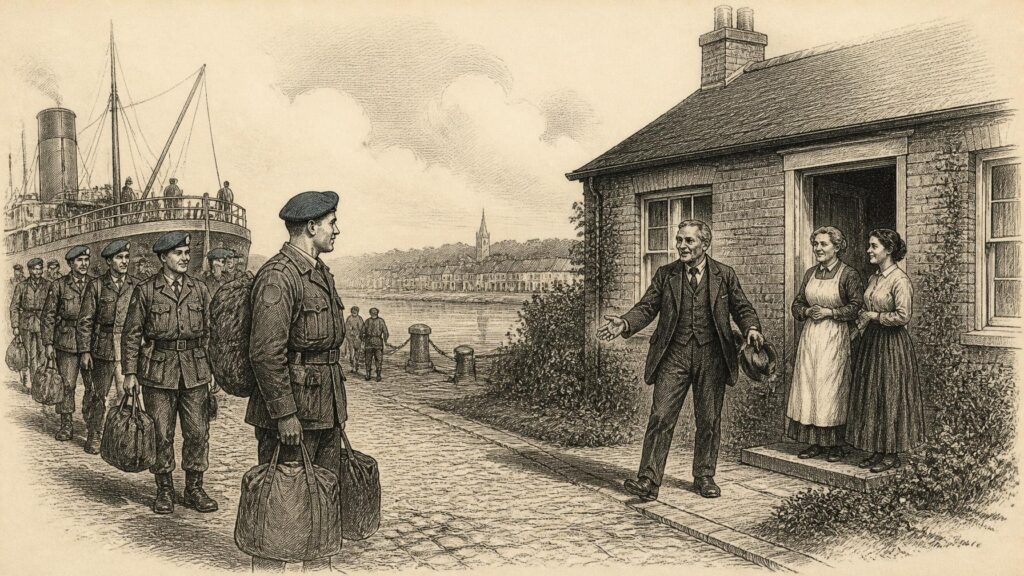
AI generated historical illustration, not a contemporary photograph.
At a Glance
Ireland’s international peacekeeping record has often been told through blue helmets, difficult patrols and names engraved in remembrance. Its domestic aftermath is less easily rendered. Some former members of the Defence Forces have returned from overseas service to find that leaving uniform also meant confronting poor health, isolation, insecure employment or the loss of a home. This is not a simple story in which peacekeeping causes homelessness. The documentary record does not permit such a claim. It is, rather, a history of overlapping pressures: military service and civilian transition, trauma and silence, demobilisation and housing scarcity, voluntary comradeship and the gradual recognition that veterans may need practical support long after their service has ended.
Irish Context
The phrase “veterans homelessness” can sound imported into Irish discussion. It is strongly associated in public imagination with the United States, where veteran policy has long been a major branch of government administration, or with Britain, whose large armed forces and imperial as well as post-imperial military history have produced their own institutions and campaigns. Yet the matter has a clear and distinct history in Ireland. The Republic’s Defence Forces have been relatively small, but their international service has been unusually visible. Ireland joined the United Nations in 1955 and first supplied military observers to the Middle East in 1958. From that point, overseas duty became central to the public identity of the Defence Forces.
That identity was never merely ceremonial. Irish personnel served in places where ceasefires were fragile, political authority uncertain and civilians exposed to immediate danger. The Defence Forces’ official history records the 1958 mission to Lebanon as the first contribution to peacekeeping. The Congo operation of 1960–64 was the first mission involving an armed Irish contingent, and more than 6,000 Irishmen served there; twenty-six lost their lives. Later deployments ranged across Cyprus, the Sinai, Lebanon, Bosnia, Somalia, East Timor, Kosovo, Chad and elsewhere. Service overseas carried professional esteem at home, but it also entailed separation from family, exposure to violence and ambiguity, and the sudden need to resume ordinary civilian routines after a tour ended.
“Veteran” itself has not always possessed a settled legal or administrative meaning in the Irish State. This has mattered. A person may have served in the Emergency, in border duties during the Troubles, in a UN battalion in Lebanon, in naval humanitarian operations, or in another capacity that does not fit popular assumptions about military experience. Irish veteran associations have therefore tended to define their communities through shared service rather than through one narrowly defined campaign. This broad approach reflects the actual history of the Defence Forces, but it can complicate data collection and policy design.
Homelessness, likewise, needs careful definition. Sleeping rough is its most visible form, but it is only one. A former soldier may live in emergency accommodation, a hostel, temporary supported housing, overcrowded lodgings, a vehicle, or an insecure arrangement with relatives. Some people move repeatedly before appearing in any official count; others avoid services altogether. National homelessness statistics are essential for understanding the wider emergency, but they do not routinely identify former Defence Forces personnel as a separate category. It follows that no responsible historian can produce a definitive total for homeless Irish veterans from the public record alone.
The absence of a reliable total should not be mistaken for absence of a problem. Parliamentary debates, departmental written answers and the long work of veterans’ organisations demonstrate that former personnel have required accommodation, advice and welfare intervention. The historical question is not whether every former peacekeeper experiences difficulty after service. Most do not, and peacekeeping service cannot be reduced to injury or deprivation. The question is how an institution and a society came to recognise that a minority of those who had served the State could encounter serious hardship after leaving it.
Emergency Legacies
The roots of organised support lie earlier than Ireland’s UN deployments. Óglaigh Náisiúnta na hÉireann, commonly known as ONE, was founded in 1951, in the years after the exceptionally large mobilisation of the Emergency period. Neutral Ireland had not fought as a belligerent in the Second World War, but it had maintained substantial military forces and auxiliary organisations. When the Emergency passed, thousands of people had to make the transition from a military or quasi-military world back into civilian life. Demobilisation is never solely an administrative event. It changes income, routine, status, social networks and, for some, access to accommodation.
ONE’s formation belongs to that context of post-Emergency mutual aid. Its purpose was not initially a modern clinical veterans service. It was an ex-service organisation shaped by fellowship, commemorative practice and practical assistance. That distinction is important. In the middle decades of the twentieth century, welfare was often delivered through associations, local networks, religious bodies and informal solidarity as much as through specialised state agencies. A former serviceman in distress could be helped because he was known as a comrade, not because a public system had mapped every component of his need.
This model had strengths. It preserved bonds made in service and created places where a person did not have to explain military life from the beginning. It also had limits. Mutual aid can be compassionate without possessing the resources to confront structural housing shortages, addiction, serious mental illness, family breakdown or long-term unemployment. The people most in need of assistance may also be the least able to approach an association. Pride, shame, distance from a former unit, or negative experiences of authority can all make help-seeking difficult.
The historical record of homelessness among Irish ex-service personnel therefore begins not with a sudden modern discovery but with a long, often quiet tradition of intervention. Residential homes and welfare supports developed because need was observed. They were not simply symbolic monuments to service. Their existence indicates that former personnel included elderly, disabled and homeless people who required somewhere stable to live. Such provision must be read with care: it does not establish that military service alone created homelessness, but it does establish that veteran-specific accommodation was judged necessary.
Over time, the constituency broadened. Veterans of the Emergency were joined by people whose service had taken place in a changed State and a changed world: personnel who had guarded the border during periods of political violence, and those who had worn the UN insignia abroad. The result was a layered veteran community. Its members did not share one war, one deployment or one social experience. They did, however, share the challenges of moving from a disciplined organisation into a civilian society that frequently celebrated overseas service while possessing no single, comprehensive veterans system.
Overseas Service
Ireland’s entry into UN peacekeeping altered the meaning of Defence Forces service. The 1958 deployment of unarmed observers to Lebanon was small, but historically decisive. It placed Irish officers within the emerging international machinery of Cold War peacekeeping. The following Congo mission was far larger and far more dangerous. It is often remembered through the Niemba ambush, in which Irish soldiers were killed, and through the siege at Jadotville, where an Irish company endured a prolonged attack before surrendering. Those events show why the word “peacekeeping” must not be allowed to imply safety.
Peacekeeping has always occupied an uneasy space between soldiering, diplomacy and humanitarian action. A force may be authorised to observe a truce, patrol a buffer zone, protect civilians, escort aid, monitor withdrawals or defend itself and its mandate. It may be deployed where political negotiations have barely begun or have broken down. Personnel can spend long periods on routine duties and then encounter sudden violence. They may witness injury and death without being free to act as conventional combat troops would. The requirement for restraint can itself be psychologically demanding.
The Defence Forces’ own historical account makes clear that Ireland’s overseas commitments continued well beyond Congo. The long association with UNIFIL in southern Lebanon became particularly formative. Irish contingents arrived after 1978 in an area shaped by invasion, militia activity, Israeli occupation, cross-border fire and later wider regional conflict. Generations of Irish personnel served there. Their tours created durable public images: Irish patrols in white armoured vehicles, troops at isolated posts, chaplains and medics, and annual ceremonies for the dead. But photographs of disciplined routine capture only part of the experience.
For some personnel, peacekeeping brought professional confidence, friendships and a powerful sense of useful work. Such outcomes deserve emphasis because an exclusively damaged portrait would be historically false. A belief in the mission, unit cohesion and family support can be protective. Research involving Irish Defence Forces personnel has found that members described both potentially traumatic incidents and sources of resilience, including comradeship and a sense of purpose. Yet the same research recorded chronic stress, armed confrontations and demanding rescue work. The evidence points to variation, not a uniform outcome.
Overseas service also sat alongside domestic obligations. From 1969, violence in Northern Ireland imposed intensive demands on the Defence Forces within the Republic. Soldiers could move between an Ireland marked by security tension and missions abroad framed as international peace support. The historical experience of a former member may therefore include multiple forms of duty, only some of them overseas. It would be misleading to label every Irish veteran in housing difficulty a “peacekeeping veteran”, even where peacekeeping is an important part of the national story.
Northern Ireland requires an additional distinction. Veterans resident there may have served in the British armed forces, the security forces, or other bodies, and their legal and welfare settings are different from those of former members of the Irish Defence Forces. Northern Irish research on veterans, trauma and reintegration is valuable in its own right, but it cannot simply be merged with the history of the Republic’s Defence Forces. The island’s shared geography does not erase its differing military structures, political histories or systems of public support.
Hidden Wounds
The language available to describe psychological injury has changed greatly since the first Irish UN missions. Earlier generations could speak of nerves, strain, drink, sleeplessness or difficulty settling down, without using the modern clinical vocabulary of post-traumatic stress disorder. Silence can obscure suffering in historical sources. It can also reflect the ordinary norms of military life, in which endurance and self-reliance are often valued. Neither silence nor later recollection should be treated as simple proof. The historian must distinguish documented diagnosis from personal testimony, and both from retrospective assumptions.
What can be said securely is that peacekeeping carries particular stressors. Personnel may be exposed to attacks, accidents, casualties and threatening standoffs. They may also experience moral frustration: seeing suffering yet having limited authority to stop it, dealing with hostile factions while trying to remain impartial, or carrying responsibility for civilians and comrades in conditions of uncertainty. The United Nations’ history of peacekeeping recognises that missions have increasingly been sent into volatile settings where there was little settled peace to keep. Irish service unfolded within that wider evolution.
Irish research remains limited, which is itself historically significant. A qualitative study of twelve Irish Defence Forces members found a range of potentially traumatic experiences, from migrant rescues at sea to armed standoffs. Participants identified both protective influences and weaknesses in organisational support. A separate study of serving personnel during the COVID-19 period reported notable levels of post-traumatic stress symptoms in its voluntary sample. Neither study can be used to calculate the prevalence of illness among all current or former personnel. Small, self-selected or context-specific research does not justify sweeping statistical claims. It does, however, challenge the assumption that non-war or peacekeeping deployments are psychologically uncomplicated.
There is an additional temporal problem. Difficulty may not emerge immediately on return. Some former personnel manage the transition for years, then find that retirement, bereavement, illness, relationship change or unemployment unsettles a previously workable life. International research on peacekeepers has similarly cautioned that distress can be associated with post-deployment stressors and can emerge long after a mission. This does not mean that a late housing crisis can automatically be attributed to an overseas tour. It means that life histories matter and that support systems should not confine attention to the first weeks after return.
Alcohol misuse, debt, physical injury and relationship breakdown are sometimes discussed in accounts of homeless veterans. They should be addressed without stereotype. None is inevitable in military life; none is exclusive to veterans; and none gives the public licence to treat homelessness as personal failure. Homelessness is generally produced by more than one cause. A person may have a modest pension but no affordable tenancy. Another may have work but be unable to sustain it during poor mental health. Another may be estranged from family, coping with disability or ageing without adequate support. The practical point is that housing and health cannot be separated neatly.
Housing Pressures
The broader Irish housing crisis forms the indispensable background to veteran homelessness. The State’s emergency accommodation figures measure only part of the problem, while rough sleeping and concealed homelessness are more difficult to count. When rents rise, social housing is scarce and private tenancies are insecure, former personnel are affected as citizens alongside everyone else. Veteran status does not insulate a person from the ordinary economic pressures of late twentieth- and early twenty-first-century Ireland.
There is a temptation to explain homelessness through one emotionally satisfying cause: a mission, an injury, a traumatic memory, a failed marriage or an institutional oversight. Such explanations may be true in individual cases, but they are poor history when generalised. The strongest interpretation is cumulative. Military service may be one element in a chain of vulnerability; it may also provide protective resources such as pension entitlement, comradeship, skills and a recognised community. Whether the balance turns towards security or crisis depends on the person and on the housing environment into which they return.
Public discussions have sometimes focused on the moral contrast between service and destitution: a person who represented Ireland abroad later sleeping rough under the national flag. That contrast has powerful rhetorical force. In 2019, parliamentarians referred to a campaign in which former Defence Forces personnel used tricolour sleeping bags to draw attention to homelessness. The image was deliberately unsettling. It asked the public to reconcile reverence for national service with the sight of veterans in insecure accommodation.
Its historical importance lies not in proving numbers but in making a neglected issue visible. Campaigns often simplify complex causes in order to secure attention. That does not make them dishonest. It means that their evidence must be read alongside official records. Departmental answers from 2020 stated that ONE provided board and lodgings for forty-nine homeless, elderly and disabled ex-service personnel across homes in Dublin, Letterkenny and Athlone, while the Irish United Nations Veterans Association accommodated four retired personnel at the Curragh. Those figures describe places supported at a particular moment, not the whole scale of need across Ireland.
The same answer described Veterans Support Centres intended to prevent homelessness through early intervention and to address loneliness. That approach recognises an important fact: homelessness prevention begins before a person loses a bed. Advice about welfare, housing applications, debt, health services, family stress and employment can be as important as emergency accommodation. A drop-in centre in or near a barracks may seem modest beside national housing policy, but it can restore contact to someone who has withdrawn from formal institutions.
The veteran-specific model also has potential hazards. It can create a hierarchy of deservingness, as though former soldiers are more worthy of housing than other people in hardship. That is neither a sound ethical position nor a necessary basis for veteran support. A better argument is that service can create distinctive needs and barriers, while housing remains a universal right and public responsibility. Specialist support should complement, not displace, broad investment in secure homes, mental-health care and anti-poverty measures.
Comradeship Networks
ONE has been the most prominent civilian organisation in this story, but it has not worked alone. The Irish United Nations Veterans Association, formed around those who served under the UN flag, has preserved the particular memory of peacekeeping service and offered practical fellowship. Associations of retired officers and other veteran bodies have also represented members’ concerns. Their structures reflect the stratification of military life, yet their shared presence shows that transition from service has long been understood as a collective issue.
Veteran homes are among the clearest physical expressions of this comradeship. They provide more than a roof. Residents can encounter people familiar with military routine, overseas postings, barrack humour and the difficulty of explaining service to civilians. For an isolated person, that recognition may be therapeutic even when no medical treatment is being offered. But these homes should not be romanticised. Supported accommodation is a response to hardship; the aim is security, independence and, where possible, a durable move beyond crisis rather than permanent institutional dependence.
State assistance has developed incrementally. Departmental arrangements have included financial support for recognised associations and the use of Defence Forces property for veterans’ centres. These measures reveal an evolving partnership rather than a single statutory veterans service. Historically, that gradualism reflects Ireland’s small defence establishment, the strength of voluntary organisations and the fragmented nature of housing, health and welfare administration. It has also left gaps. A veteran in crisis may have to navigate local authorities, social protection, medical services, charities and former-service networks separately.
In November 2025, the Department of Defence formally established an Office of Veterans Affairs. Its published remit includes engagement with veterans’ associations, research, advocacy across government and consideration of a veterans policy. The establishment of such an office is significant, even if its early remit is limited and individual cases remain directed to associations, departmental branches or Defence Forces offices. It acknowledges that veteran matters cannot be treated solely as ceremonial remembrance or pension administration.
This development should not be presented as a final solution. An office is an institutional beginning, not proof that accommodation needs have been met. Its value will depend on whether research improves the evidence base, whether agencies share responsibility effectively, and whether former personnel can obtain help without being passed from one body to another. The most important historical change may be conceptual: veterans are increasingly understood not merely as recipients of honours on commemorative days, but as people with continuing social, health and housing needs.
Public Recognition
Irish remembrance of peacekeeping has often been dignified and sincere. Memorial services, medals, veterans’ gatherings and official speeches recognise those who died or served abroad. The United Nations records ninety-one Irish peacekeepers killed while serving under its flag. Such sacrifice has helped make peacekeeping one of the Defence Forces’ most respected public roles. Yet remembrance can be selective. It is easier to commemorate dramatic events than to discuss the slow problems of ageing, loneliness, housing insecurity or untreated distress.
The tension is not unique to Ireland. Societies often prefer the clear moral language of courage and sacrifice to the complicated language of social care. But the two should not be opposed. Respect for service acquires practical meaning when it includes an accessible route to housing, health support and community connection. The history of veteran homelessness asks whether public admiration has been matched by systems capable of responding when a person’s life unravels after discharge.
It is equally important to resist folklore. The claim that all peacekeepers are traumatised is false. The contrary claim that peacekeeping is harmless because it is not conventional warfare is also false. The claim that every homeless former soldier is homeless because of service cannot be demonstrated. The claim that homelessness among veterans is merely an individual moral failing is contradicted by the accumulated evidence of dedicated homes, support centres, parliamentary concern and sustained advocacy. Good history holds these truths together rather than choosing the most convenient one.
The Irish case therefore offers a restrained but substantial lesson. Peacekeeping created a powerful international vocation for a neutral State and a generation-spanning identity for its Defence Forces. Its human consequences were not confined to the battlefield or the patrol route. For some, the aftermath involved difficult civilian transitions that could intersect with a worsening housing landscape. Voluntary organisations recognised this before a comprehensive state framework existed, providing accommodation and fellowship where they could. Later public policy has begun to catch up, though the evidence base remains incomplete.
Future Duties
The historical record supports several conclusions. First, reliable research matters. Ireland needs better information on the size, circumstances and routes into homelessness among former Defence Forces personnel, while protecting privacy and avoiding assumptions that military service is the sole cause. Secondly, prevention should be treated as seriously as emergency beds. A veteran who can obtain advice, reconnect with a support network or resolve a tenancy problem early may never enter homelessness statistics.
Thirdly, peacekeeping must be understood in full. It is a tradition of service that brought credit to Ireland and meaningful assistance to communities abroad. It could also expose individuals to danger, moral pressure and long separations. These realities are compatible. A mature history neither diminishes the achievements of Irish peacekeepers nor turns their experience into a universal tragedy. It accepts that honouring service includes attending to its uneven aftermath.
Finally, the work of housing veterans belongs within a wider commitment to housing everyone. Former personnel may require culturally informed, specialist routes into support, but their need for a safe home is not exceptional in principle. The most durable answer combines veteran organisations’ knowledge of comradeship with properly resourced public housing, health and welfare systems. In that combination lies the enduring meaning of “after service”: not a sentimental end to military history, but the continuing civic obligation to ensure that those who have returned are not left without a place to live.
The article resists a single-cause explanation of homelessness among Irish Defence Forces personnel, placing peacekeeping experiences alongside housing shortages, health, family relationships and employment transitions. This raises a policy dilemma: veteran-specific support may recognise service-related needs, yet broad housing solutions remain essential because veterans experience the constrained market as other citizens. The uncertain scale of hidden homelessness further complicates planning, since official statistics do not routinely record service. How should Ireland balance targeted, early intervention for veterans, including those whose difficulties emerge years after deployment, with universal housing and health measures that address the wider conditions in which insecurity develops?