

Protected Passage
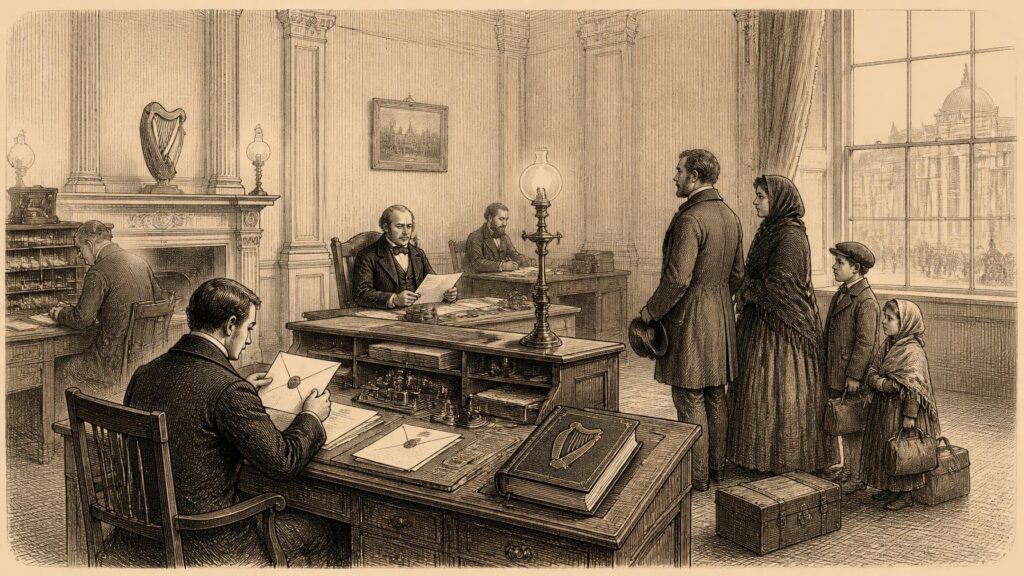
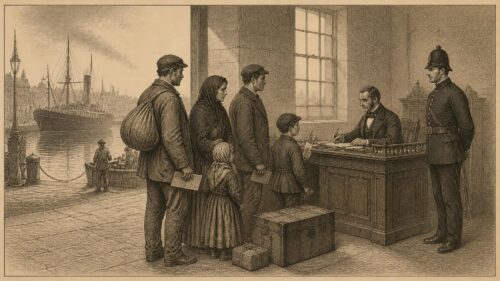
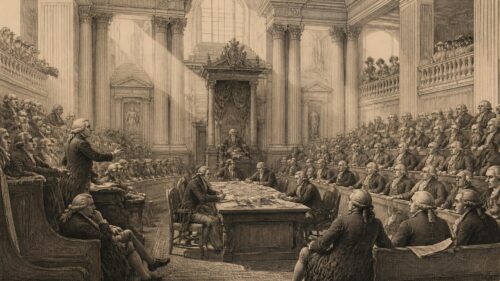
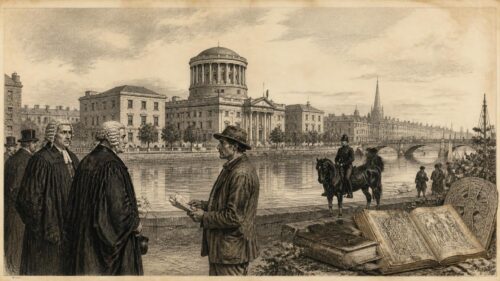
AI generated historical illustration, not a contemporary photograph.
At a Glance
Ireland’s International Protection Act 2015 was a major attempt to turn a fragmented asylum system into a single statutory journey. It brought the decision on refugee status, subsidiary protection and permission to remain into one procedure, recast the offices responsible for first-instance decisions and appeals, and placed the State’s treatment of people seeking refuge within a more explicit framework of international, European and domestic law. It was signed on 30 December 2015, commenced on 31 December 2016, and remained a defining instrument of Irish protection law for almost a decade.
Legal Inheritance
The Act belongs to a longer Irish story of migration, sovereignty and international obligation. Ireland had long been a country from which people departed: famine emigrants, labour migrants, political exiles and generations seeking livelihoods across Britain, North America and Australia. The State’s later position as a destination for migrants and people seeking refuge was therefore historically newer, though not without earlier precedents. By the late twentieth century, Irish law and administration had to address claims for protection made within the State by people fleeing persecution, conflict and serious harm elsewhere.
The central international inheritance was the 1951 Convention relating to the Status of Refugees and its 1967 Protocol. The Convention’s familiar definition concerns a person outside their country of nationality who has a well-founded fear of persecution for a Convention reason: race, religion, nationality, political opinion or membership of a particular social group. The 2015 Act printed the Convention and Protocol in its schedules. That was more than decorative legislative drafting. It made plain that Irish decision-making was to be understood in relation to an international legal tradition established after the devastation and displacement of the Second World War.
Yet refugee status was never the only form of protection relevant to Ireland. European law developed subsidiary protection for people who did not meet the Convention definition but nevertheless faced a real risk of serious harm if returned. In broad terms, that category addressed risks such as death penalty or execution, torture or inhuman or degrading treatment, and serious individual threats to civilian life caused by indiscriminate violence in situations of armed conflict. The distinction mattered. A person might be unable to prove persecution for a Convention reason, while still being unsafe to return.
Before 2015, Irish applicants could face a sequence rather than a unified examination. A person’s refugee claim was considered first. If unsuccessful, subsidiary protection and then leave-to-remain considerations could follow through separate stages. The result was capable of producing long waits and repeated interactions with different decision-making processes. The historical importance of the 2015 Act lies chiefly in its effort to replace that sequence with a single procedure. It was not the beginning of Ireland’s refugee law, nor a complete settlement of its difficulties, but it was a decisive administrative and legal reorganisation.
European Setting
Ireland’s protection law cannot be narrated solely as a domestic matter. Membership of the European Union placed the State within a developing Common European Asylum System, while Ireland’s distinctive arrangements in justice and home affairs required careful choices about participation in particular European measures. The legislation of 2015 was shaped by this mixed setting: national institutions applying concepts derived from international refugee law and European standards, within a State attentive to its own constitutional order and control over entry and residence.
The Act’s structure reflected the vocabulary of European asylum law. It dealt with qualification for refugee status and subsidiary protection; procedures for making and examining applications; inadmissibility; subsequent applications; appeals; family reunification; and rules concerning safe countries of origin. It also provided a legal basis for matters connected with temporary protection in the event of a mass influx. Such headings demonstrate that the statute was not merely about deciding individual claims. It was an effort to make an interlocking system, with rules for ordinary cases, exceptional circumstances, administration, review and removal.
This setting also explains a tension which runs through the Act. Protection law is concerned with the individual circumstances of a person who says return would expose them to danger. Immigration law, meanwhile, is concerned with the State’s authority over borders, entry, residence and removal. Neither strand can be ignored in a statute of this kind. The 2015 Act recognised rights, procedures and safeguards, but it also amended the Immigration Acts and set out consequences where a person was refused protection and permission to remain. The resulting legislation was therefore both protective and regulatory.
It is important not to mistake this tension for an historical anomaly. It was intrinsic to the legal field in which Irish legislators were working. International protection imposes limits on what a State may do to a person who faces prohibited harm on return. It does not abolish the State’s general power to regulate migration. The practical question, then as now, was how fairly, quickly and accurately Ireland could decide whether protection was owed, while maintaining procedures for cases in which it was not.
Legislative Passage
The International Protection Bill 2015 passed through the Oireachtas during the closing weeks of that year. In the Dáil debate on 10 December 2015, the Government presented the measure as a substantial reform intended to create a more efficient and coherent protection process. The speed of the legislative timetable should not obscure the scale of the project. The Bill repealed and replaced important parts of the earlier statutory framework, including the Refugee Act 1996 and provisions connected with subsidiary protection.
Its enactment was formalised on 30 December 2015, when it became Number 66 of 2015. Enactment did not mean immediate operation. The machinery required time: institutions had to be established or reconstituted, procedures prepared and pending cases managed through transitional rules. The principal new arrangements commenced on 31 December 2016. That interval is historically significant because it reveals the difference between passing an Act and building an operating system. Legislation may announce a new order in a matter of days; implementation depends on staff, guidance, premises, forms, records and institutional memory.
The transition was especially delicate because the new law encountered cases already moving through older procedures. The Act therefore contained detailed transitional provisions. Some applicants had claims at particular stages under the prior framework, while others had made applications or received decisions which could not simply be treated as if the former law had never existed. A government information note issued for transition applicants explained the change as the introduction of a single application procedure for refugee status, subsidiary protection and permission to remain, while also acknowledging the need to identify which rules applied to existing cases.
For historians, transitional provisions are often where the lived reality of legal change becomes visible. Grand principles can appear simple in a title or an explanatory memorandum. The transition clauses show the State confronting actual files, pending appeals, prior recommendations and people whose claims could not be paused while a new statutory architecture was assembled. The 2015 Act was thus a reform of both future applications and an inherited administrative backlog.
Single Procedure
The single procedure was the Act’s defining innovation. Under it, an applicant made one application for international protection. In the course of a connected process, the authorities considered whether the person qualified as a refugee, whether they were eligible for subsidiary protection, and, if neither status was granted, whether permission to remain should be given. The Department of Justice described this as an examination and determination of all grounds in one process.
Its intended advantage was plain. A person who failed at one stage would not necessarily have to commence an entirely new legal journey in order to have another basis for protection considered. In principle, the system reduced duplication, shortened the overall path to a final resolution and enabled decision-makers to assess the complete circumstances of a case. A UNHCR guide issued for the Irish procedure described the single process as the most significant change made by the Act and illustrated the three possible strands converging in one examination.
The word “single” should not be misunderstood to mean simple. A protection application could still involve an initial encounter with an immigration officer, a preliminary interview, a questionnaire, the gathering of country-of-origin material, a personal interview, a recommendation or decision, an appeal and a review of permission to remain. The single procedure joined questions which had previously been separated; it did not remove the fact-sensitive nature of asylum decision-making. A claim might involve trauma, language barriers, missing documents, changing conditions in a country of origin, family responsibilities and disputed accounts of past events.
Nor was efficiency the only aim. A unified process could support better decision-making if it ensured that all relevant grounds were considered without forcing applicants into successive legal categories. But efficiency and fairness are not automatically identical. A shorter system is beneficial only if the examination remains individual, informed and procedurally fair. The historical record of the Act must therefore be read in two registers. The documented legislative intention was to avoid unnecessary delay and repetition. Whether that aspiration was realised in every individual case depended on capacity, procedure, legal representation, evidence and the pressures placed upon the system.
Administrative Architecture
The Act altered the institutional map. The Office of the Refugee Applications Commissioner, which had examined claims under the earlier regime, was absorbed into the Department of Justice as the dedicated International Protection Office. The Refugee Appeals Tribunal was re-established as the International Protection Appeals Tribunal. These changes were intended to bring the organisations’ names and functions into line with the enlarged statutory scheme.
Names matter in public administration. “Refugee applications” described an earlier principal task; “international protection” embraced refugee status and subsidiary protection together. Likewise, an appeals body expressly identified with international protection signalled that its work extended beyond the older refugee-status model. Yet a change of title was not in itself a guarantee of changed experience. An office is an institution made real by the independence of its officers, the quality of interpreters, the availability of legal advice, the treatment of records, the reliability of country information and the time given to each file.
The Act gave international protection officers a formal place in the system and established the office of chief international protection officer. It also enabled the use of contracts for services to assist processing. That provision reflected a practical concern: a statute promising timelier outcomes needed a way to deal with fluctuating workloads. It also raised a broader issue familiar in modern administration. When decision-making involves the exercise of public power over matters of safety, family life and residence, any use of external assistance must remain compatible with lawful, careful and accountable decision-making.
Appeal was an essential element of the architecture. An applicant who received an adverse recommendation or decision in relevant circumstances could appeal to the tribunal. The appeal stage was not merely a bureaucratic extra. It offered a means by which factual findings, credibility assessments and legal conclusions could be reconsidered. The Act also contained provisions aimed at consistency and efficiency in the tribunal’s business. The aspiration was an orderly and dependable system; its success necessarily depended upon the resources and independence that such a system requires.
Applicant Safeguards
The 2015 Act included a number of safeguards and procedural entitlements. Applicants could receive permission to enter and remain in the State for the purpose of having the application examined, including an appeal. They were issued a temporary residence certificate. The statutory framework also contemplated access to information, interpretation where needed, communication in writing and an opportunity to give a personal account of the reasons protection was sought. These are not peripheral matters. A protection claim often turns on the applicant’s ability to explain experiences that may have occurred in another language, under traumatic conditions and far from the documentary systems of Ireland.
The treatment of unaccompanied children received particular attention. The Act required the Child and Family Agency to appoint a person to represent and assist an unaccompanied child seeking international protection. It also made provision for age assessment where a person’s claimed age was disputed. Such measures recognised that a child arriving alone was not simply an adult applicant with fewer years. Questions of care, guardianship, development, vulnerability and the child’s best interests arise alongside the assessment of the protection claim itself.
Confidentiality was another important principle. Applicants might fear repercussions against relatives, communities or themselves if information concerning a claim became known to the authorities of the country from which they fled. Legal protection therefore depends partly on administrative restraint: information must be gathered and tested without exposing an applicant to the very danger from which protection is sought. The Act’s procedural form cannot be separated from this human reality.
Permission to remain was also crucial. The Act required consideration of whether a person refused refugee status and subsidiary protection should nevertheless receive permission to remain. This recognised that removal can engage obligations beyond the strict tests for international protection, including obligations arising under the European Convention on Human Rights. It also allowed the State to consider matters such as family and private life. Permission to remain was not equivalent to refugee status or subsidiary protection; it was a distinct route with its own legal basis. Its inclusion within the single procedure was nevertheless one of the Act’s most consequential features.
State Powers
The statute also made clear that applicants had duties and that the State retained substantial powers. An applicant could be required to cooperate with the examination of the claim, supply available information, keep the authorities informed of an address and comply with specified reporting or residence conditions. The legislation permitted fingerprinting and made provision for detention in defined circumstances. It addressed inadmissible applications and subsequent applications, areas in which the State sought to avoid repeated or inappropriate use of procedures.
Such provisions should be read carefully rather than rhetorically. They did not mean that every applicant was detained, that every claim was inadmissible, or that a request for protection was treated as wrongdoing. They created legal powers and procedures whose application depended on the facts and legal conditions of each case. Equally, their presence demonstrates that the Act was not solely a charter of individual protection. It was a framework through which the State ordered entry, presence, investigation, decision and, where protection and permission were refused, potential return.
Section 16 was especially revealing. It allowed an applicant to remain in the State for the sole purpose of examination of the application and any appeal, but it also imposed conditions, including a restriction on leaving the State without ministerial consent and, as originally enacted, a prohibition on seeking or entering employment. This reflected the reception model operating at the Act’s commencement. It was a legal condition of temporary presence, not a general right to settle.
The Act’s provisions regarding safe countries of origin and prioritisation likewise illustrated the effort to manage caseloads. A safe-country designation did not erase the requirement for individual examination. Rather, it could affect how a claim was processed and the assumptions which an applicant might need to address. Prioritisation was designed to direct administrative attention to certain categories of cases. Both devices reveal the difficult balance between individual justice and system management: a system overwhelmed by delay may fail applicants, but a system that pursues speed without sufficient care may also fail them.
Labour Access
One major development associated with the 2015 framework came through constitutional litigation and subsequent policy change rather than from the original form of the Act alone. In 2017, the Supreme Court held in the case of N.H.V. v Minister for Justice and Equality that the absolute ban on employment for an asylum seeker with no realistic prospect of a prompt decision was unconstitutional. The judgment exposed the human and constitutional cost of a system in which an applicant might remain for a prolonged period unable to work.
The response included amendments and regulations allowing eligible applicants access to the labour market after a prescribed waiting period, subject to conditions. The change was historically important because it modified the social meaning of being an applicant for protection in Ireland. The original statutory restriction treated work as incompatible with the temporary status created by the claim. The later system acknowledged that prolonged exclusion from employment could not be sustained where the State had not reached a timely first-instance decision.
This episode is a useful warning against reading an Act as if its words fixed the entire legal world for all time. Statutes operate alongside constitutional rights, judicial decisions, European measures and later amendments. The International Protection Act 2015 supplied the principal framework, but its practical operation was shaped by legal challenge and political response. For a historical account, the proper conclusion is not that the Act was either wholly rigid or wholly remedial. It was a framework continually interpreted, challenged and adjusted.
Practical Record
The promise of the single procedure was that it would prevent the lengthy delays associated with sequential decision-making. In practice, speed remained a persistent concern. International protection systems do not operate in a vacuum. They are affected by changes in the number of applications, international crises, available accommodation, staffing, the complexity of individual cases and the volume of appeals. A rise in claims can place pressure on interviews, country research, interpretation, legal assistance and tribunal listing at the same time.
The Act was therefore both a reforming measure and an admission of earlier structural difficulty. Its emphasis on prioritisation, accelerated processes in certain cases and contractual assistance revealed official concern about delays and administrative capacity. The historical question is not whether the statute intended efficiency; the text and official explanation make that intention clear. The harder question is whether the institutions could consistently deliver it. That question cannot be answered merely by citing the Act itself, because statutes record powers and purposes more readily than they record waiting, uncertainty or the experience of those living within a procedure.
Accommodation became an especially visible part of the wider story of protection in Ireland. It is important to distinguish the legal determination of an application from the provision of reception conditions, even though applicants experienced them together. The Act dealt principally with the protection procedure and related immigration matters. The daily realities of housing, food, privacy, family life, education and access to services were governed through a wider web of policy, administrative practice and European obligations. Public controversy about accommodation should therefore not be collapsed into a claim that the 2015 Act alone created every condition of the asylum experience.
Nevertheless, the statute mattered profoundly to those realities because legal delay could lengthen the period during which a person remained an applicant. A more rapid and fair decision could allow a recognised refugee or beneficiary of subsidiary protection to begin rebuilding a life with greater security. An unfair or delayed decision could prolong dependency and uncertainty. This is an interpretation grounded in the structure of the system rather than a claim that every applicant’s experience was the same.
Critical Assessment
Any assessment of the Act must distinguish evidence from interpretation. The documentary evidence is clear: the Act consolidated refugee status, subsidiary protection and permission to remain within a single procedure; created or reconstituted key institutions; provided safeguards for children; and preserved substantial powers of immigration control. It also maintained a statutory basis for Ireland’s refugee resettlement programme. These were concrete legislative choices.
Interpretation begins when considering their significance. One reasonable reading is that the Act represented a maturation of Irish protection law. It moved away from a piecemeal, sequential model and accepted that a protection claim should ordinarily be assessed in its full legal context. On this view, the single procedure recognised that the difference between refugee status, subsidiary protection and other permission to remain may be legally vital, but should not force an applicant through needless separate journeys.
A second interpretation emphasises the countervailing expansion and clarification of State control. The Act gave detailed attention to admissibility, fingerprints, detention, safe-country designations, prioritisation, reporting duties and removal. From this perspective, its historical meaning lies not only in humanitarian protection but in the refinement of a managed migration system. These readings need not be mutually exclusive. Modern protection law is often built precisely from the attempt to reconcile obligations of refuge with governmental control of territory.
Folklore has little place in this account. There is no sound basis for treating Ireland’s protection system as either uniquely generous or uniquely harsh merely by national reputation. Nor is it accurate to present every person seeking asylum as following one uniform path. The law dealt with individuals whose reasons for flight, family circumstances, evidence and legal status differed widely. The historical record is better served by attending to the statute, the institutions and the documented changes than by repeating simplified stories of welcome or exclusion.
Changing Framework
The historical period governed by the 2015 Act came to a major turning point in 2026. The International Protection Act 2026 was enacted on 22 April 2026 and entered into operation for new applications on 12 June 2026, in connection with Ireland’s implementation of the European Union Migration and Asylum Pact. It introduced a new and much more extensive framework, including a new appeals body and provisions connected with screening, border procedures, reception, allocation and return.
This did not render the 2015 Act irrelevant overnight. The 2026 legislation contains transitional provisions and preserves the continued application and effect of the earlier Act for certain existing matters. That legal continuity is important. A statute’s historical life does not always end on the date a successor is commenced. Pending applications, appeals and transitional cases may remain governed by the rules under which they began. The 2015 Act therefore persists in the legal history of cases initiated during its operational era.
The replacement also helps to identify what was distinctive about 2015. The older Act emerged from the need to join previously separate forms of protection decision-making. The 2026 framework emerged from a later European legislative transformation, shaped by new EU regulations and a wider concern with common procedures, screening, allocation and crisis management. Both statutes belong to Irish history, but they answer to different moments in the relationship between Ireland, Europe and forced migration.
Historical Meaning
The International Protection Act 2015 should be remembered neither as a technical footnote nor as a complete solution to the problems of asylum administration. It was a landmark of institutional design. Its single procedure changed the formal route by which Ireland considered claims for refugee status, subsidiary protection and permission to remain. Its creation of the International Protection Office and International Protection Appeals Tribunal gave the system a new administrative vocabulary. Its provisions for children, appeals, temporary residence and human-rights-based permission to remain embedded important safeguards within a larger framework of State authority.
Its limitations were also historically instructive. Law can combine procedures, but it cannot by legislation alone guarantee swift, humane or error-free administration. The statute depended upon implementation: enough trained decision-makers, sound country information, accessible legal support, reliable interpretation, fair hearings and sufficient capacity to respond to changing patterns of displacement. The continuing debates over delay, work, accommodation and removal showed that reform of the legal route was only one part of the wider challenge.
For Ireland, the Act marked a stage in the country’s continuing adjustment to being a place where people seek safety. That adjustment has occurred against the deep background of Irish emigration, but it should not be romanticised by easy comparisons. The people governed by the Act arrived from diverse places and under diverse pressures. Their claims were assessed through a legal system whose task was not to retell national migration memory, but to determine present obligations with fairness and care.
By the time the 2026 Act replaced it for new applications, the International Protection Act 2015 had become a chapter in the history of the modern Irish State: a chapter in which international commitments, European law, constitutional principle and administrative practice met in the lives of people asking Ireland for protection. Its enduring lesson is that procedures are never merely procedural. They decide how a country translates its legal promises into a passage from danger, uncertainty and displacement towards either recognised protection or a final decision.



Emerald Archives highlights a central tension within Ireland’s International Protection Act 2015: its single procedure aimed to reduce delay by examining refugee status, subsidiary protection and permission to remain together, yet fairness still depended on resources, interpretation, evidence and meaningful appeals. The article’s contrast between legislative design and lived administrative practice is particularly important during transition from the earlier sequential system. Combining routes might spare applicants repeated traumatic accounts, but could also concentrate crucial judgements within one process. How should historians and policymakers judge whether the single procedure balanced efficient case management, safeguards and Ireland’s responsibilities towards people seeking protection?