Irish Passage
At a Glance
Irish Abroad
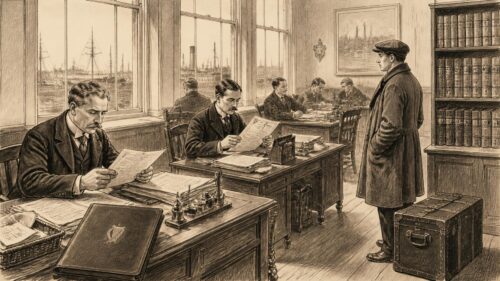
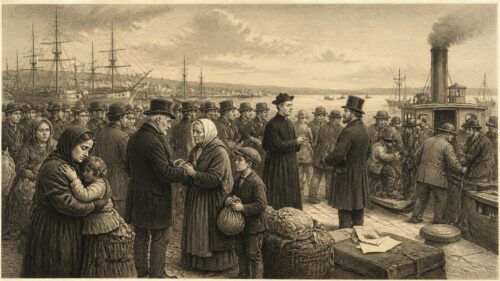
The available material presents Irish people abroad mainly through migration records and personal documents. One database is described as containing about 26,000 transcripts relating to Irish emigration to North America across the eighteenth, nineteenth, and twentieth centuries. Its contents include emigrant letters, passenger lists, newspaper articles, advertisements, official government reports, family papers, and extracts from books and periodicals. The description also shows that the collection is searchable by name, subject, or date, which makes comparison between different kinds of record possible.
The same database description also lists large counts for several record types, including letters, newspaper articles, official documents, and passenger lists. It records 2,576 letters written by Irish emigrants, 3,250 newspaper articles, 446 official documents from state or semi-state bodies, and 3,415 passenger lists. The lists are said to record names, age, occupation, departure place, and nationality, mainly from the 1790s onwards, with four earlier lists dating from 1700. That detail places personal mobility beside administrative enumeration.
Migration Records
A separate research library at the Ulster American Folk Park is described as housing books, journals, and maps on Irish migration. It also developed the Irish Emigration Database, an electronic collection of primary source documents on Irish emigration to the United States and Canada in the eighteenth and nineteenth centuries. The listed contents overlap with the larger database description, because emigrant letters, passenger lists, shipping news, family papers, and newspaper articles are all named here as well. The emphasis is practical rather than interpretive.
The same repository description ties the collection to a specific location outside Omagh, which matters because the archive is not only digital. The documentary base is therefore both online and held in a research library setting. A comparable note in the wider database description says the material was gathered from several repositories, including the Public Record Office of Northern Ireland, the Linen Hall Library, Queen's University Library, and Central Library, Belfast. That combination shows dispersed provenance without claiming a single origin.
Family Letters
Among the most revealing items are emigrant letters, because they preserve family relationships across distance. The database description gives examples from the Fitzgerald family of County Tipperary, including letters from New York and Quebec in 1847 that refer to family death and ill-treatment. It also names a letter from Margaret Armstrong of Lurgan to a cousin in Michigan in 1875, and another from Patrick and Margaret Hall to a son in Orange County in 1815. These examples show correspondence moving both outward and back toward Ireland.
The same selection also includes a letter from Mary, Catherine, and Nancy Gallagher in County Donegal to a cousin in Indiana in 1871. Although the description does not summarize the letters in a single theme, the examples themselves show that family matters, marriage, illness, and household affairs are preserved in transatlantic correspondence. The evidence here is limited to the named samples, yet those samples already show the variety of voices and destinations represented in the collection.
Women Abroad
The available material also makes women visible in migration records. The Irish Women's History source page lists the emigration database as including a large body of letters, with many written by women or concerning women. It also notes birth, death, and marriage notices copied from Irish and American newspapers. The examples include a Belfast death notice for Sarah Mackean in New York in 1843. This does not prove representativeness for every emigrant experience, but it does show that women appear in both correspondence and newspaper forms.
The wording of some sample entries is itself informative. One letter from Margaret Armstrong comments on marriage prospects, while another from Patrick and Margaret Hall discusses a mother's reaction to a son's marriage and emigration. Such passages indicate that domestic and kinship concerns survive within the archive, alongside movement across the Atlantic. The evidence remains sample-based, so no broader claim is made beyond what the cited entries explicitly show.
Digital Access
Several institutions present these materials through digital platforms rather than only through reading rooms. The Catholic Archives guide lists major online resources for Irish history across Ireland, Northern Ireland, Britain, North America, Australia, and beyond. It names the National Archives of Ireland, the National Library of Ireland, PRONI, and the Virtual Record Treasury of Ireland, alongside diaspora resources. This is a repository list rather than a narrative, but it shows the range of places where relevant records can now be searched.
The same guide gives concrete examples of digitized holdings: the National Library's Catholic Parish Registers, its digitised collections, and web archive; PRONI's catalogue, will calendars, valuation revision books, street directories, and maps; and the Virtual Record Treasury's reconstruction of the Public Record Office of Ireland. These descriptions are not all about emigration, but they matter because they provide the infrastructure for tracing people who left Ireland and the records that mention them elsewhere.
Museum Context
Irish people abroad also appear in museum collections that frame military and political history. The National Museum of Ireland states that its Historical Collections Online cover the military and political history of the Irish, both at home and abroad, from the sixteenth to the twentieth centuries. The sample records include uniforms, flags, letters, photographs, firearms, and personal relics of men and women who fought for an independent Ireland. This is a different body of evidence from the emigration databases, but it still places Irish lives outside the island in view.
The museum description also notes that most of the objects have never been on public display and that many cannot be shown because of preservation concerns. That limitation is useful context: the record of Irish lives abroad is not limited to what is exhibited, but includes stored and catalogued items as well. Taken together with the archival databases, the museum collection broadens the surviving documentary field without collapsing the differences between objects, letters, and administrative records.