Atlantic Kinship
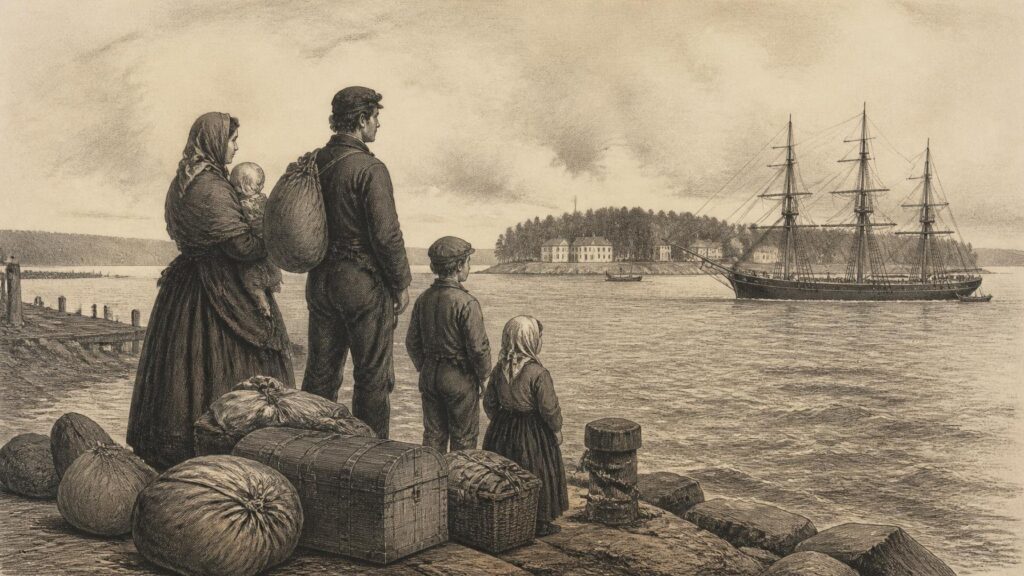
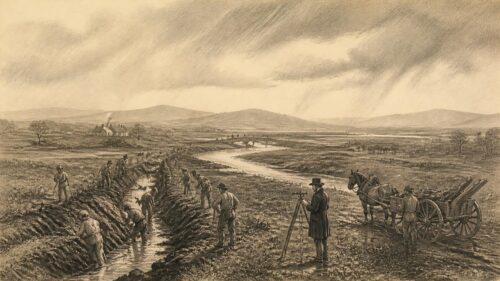
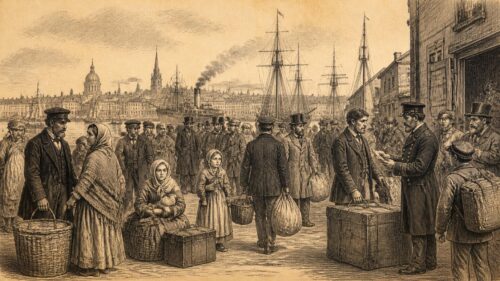
AI generated historical illustration, not a contemporary photograph.
At a Glance
Canadian Prime Minister Mark Carney’s visit to Ireland on 13–14 June 2026 was a contemporary diplomatic occasion with an unusually visible historical dimension. In Dublin he met Taoiseach Micheál Martin, attended an official dinner at Dublin Castle, and joined the announcement of a strengthened bilateral partnership. In County Mayo, meanwhile, he travelled to the birthplace of grandparents who had left Ireland for Canada more than a century earlier. The visit therefore joined statecraft to family migration, but its real importance lies in the much broader history of an Irish connection that helped make Canada and Ireland intelligible to one another across the Atlantic.
Recent Visit
The official language surrounding Carney’s visit was carefully modern. The Irish and Canadian governments stressed trade, investment, research, life sciences, security, maritime cooperation and the rules-based international order. Their joint statement also referred to shared democratic values, human rights and multilateral cooperation. These are familiar themes in twenty-first-century diplomacy, and they should not be treated as mere ceremonial wording. Ireland and Canada do cooperate closely in international organisations, while their commercial relationship has grown considerably in the period since the provisional application of the European Union–Canada Comprehensive Economic and Trade Agreement, usually called CETA, in September 2017.
Yet the visit was not presented simply as a meeting between two economically compatible states. Irish official statements explicitly marked the personal resonance of Carney’s Mayo ancestry, and the Canadian government has long described its Irish relationship in terms of historic and people-to-people links. The order of events mattered: Dublin Castle represented the formal business of government, whereas Mayo represented an ancestral landscape. Such a programme acknowledged that diplomacy can rest on inherited social networks, remembered departures and patterns of identification that are older than the nation-states now using them.
It is important, however, not to overstate what ancestry proves. An Irish grandparentage does not itself explain Canadian policy, nor does it make a prime minister a representative of the Irish diaspora in any simple sense. The documented significance of Carney’s visit lies in the agreements and discussions conducted by governments. Its symbolic significance lies in the way it drew public attention to a relationship built, in considerable part, through migration. Those are related but different claims. The former can be measured in official records; the latter requires historical interpretation.
The June 2026 visit followed a meeting between Martin and Carney in Ottawa on 25 September 2025, when the Taoiseach invited him to Ireland. That Ottawa meeting already linked the relationship’s future to its past. Its joint statement referred both to commercial ties and to a planned Canada–Ireland 180 cultural initiative for 2027, intended to mark 180 years since the Famine migration of 1847. In other words, the most recent diplomatic calendar has consciously used commemoration as a bridge between nineteenth-century migration and present cooperation.
Atlantic Beginnings
Relations between Ireland and Canada did not begin as relations between independent countries. For much of the relevant history, Ireland was governed as part of the United Kingdom and Canada was a British colony, later a self-governing Dominion. Ships, officials, soldiers, churches, merchants and migrants moved within imperial systems whose decisions were taken primarily in London. That shared imperial setting created channels of connection, but it was not a relationship of equals and should not be retrospectively described as an uncomplicated partnership between Ireland and Canada.
Irish people had reached what became Canada long before the nineteenth century, in several different circumstances. Some arrived through the armed forces, imperial administration, commerce and religious institutions; others came as settlers in British North America. Their experiences varied by class, religion, language, region of origin and destination. Protestant migrants from Ulster and Catholic migrants from many Irish counties could both be described as Irish, yet they did not necessarily share political commitments, social networks or attitudes to British rule. Nor did Irish migration unfold on vacant land. Newcomers settled in territories already inhabited, governed and claimed by Indigenous peoples, whose dispossession was integral to the expansion of colonial Canada.
The scale of nineteenth-century movement nevertheless made Ireland one of the most important sources of population for British North America. Canadian public history and demographic accounts frequently note the large place of people of Irish origin in Canada’s development. That observation is broadly sound, but it needs care. Ethnic ancestry is not a fixed historical category. Families intermarried, languages shifted, religious communities changed and descendants chose different identities. Modern census declarations of Irish ancestry reveal a durable cultural connection, not a simple count of people who can be assigned one permanent inherited character.
The relationship was also shaped by distance. A letter from Ireland could take weeks to arrive in Quebec, Saint John or Toronto; a return passage was expensive and difficult for many families. Separation was therefore real, even when correspondence and remittances continued. Migration remade identities on both sides of the ocean. Those who left did not stop influencing Ireland, but neither did they remain untouched replicas of the communities from which they came. The history of Irish Canada is a history of connection and transformation at once.
Famine Passage
No event has more powerfully structured public memory of the Irish connection with Canada than the Great Famine and the migration crisis of 1847. The Famine arose from potato blight and from social, economic and political conditions that left vast numbers of poor people dangerously dependent upon a failing food supply. Its consequences included death, disease, eviction, impoverishment and emigration on an enormous scale. Historians debate aspects of responsibility, policy and regional experience, but there is no doubt that the catastrophe changed Ireland and sent many migrants across the Atlantic.
Canada’s most enduring memorial landscape of that crisis is Grosse Île in the St Lawrence River, downstream from Quebec City. The island had operated as a quarantine station since 1832. In 1847 it became overwhelmed by vessels carrying migrants, many already weakened by hunger and illness. Parks Canada records that almost 99,000 immigrants arrived at the Port of Quebec that year, many of them Irish. Thousands died during the crossing or in quarantine, and thousands were buried on Grosse Île. The figures in different official presentations vary according to precisely what is counted, particularly deaths aboard quarantined vessels, but the essential scale of mortality is beyond dispute.
Grosse Île is sometimes reduced in popular language to a single image: the ‘coffin ship’. The phrase is evocative and has become deeply embedded in Famine memory, yet it can obscure variation among voyages and migrants. Conditions aboard many ships were indeed appalling, and disease spread with devastating speed among people already debilitated by deprivation. Still, the catastrophe did not begin in the Atlantic. Its roots lay in Ireland, in hunger and vulnerability; nor did it end at the quarantine station. Bereaved survivors continued to Quebec, Montreal and settlements further inland, where many faced further illness, poverty and separation.
Documentation also corrects one persistent form of sensational folklore. Tales have circulated of bodies being indiscriminately cast into the sea or thrown without order into pits at Grosse Île. Parks Canada’s historical material states that its consulted documentation does not support that particular claim. Mass burial areas existed, but clergy attended to burials and individual coffins were used. This correction does not diminish the horror of 1847. On the contrary, it illustrates why memorial history should resist both denial and melodrama. The facts are grave enough without embellishment.
The Irish memorial at Grosse Île has become a place where Canadian, Irish and diasporic visitors encounter the Famine as a shared history. Its twinning with the National Famine Museum at Strokestown Park in County Roscommon in 1998 made that connection institutionally explicit. Yet commemoration is not the same as complete historical recovery. The names and experiences of many who passed through the station remain imperfectly known. A memorial can honour the dead, but it cannot restore every biography, explain every decision to leave, or settle every argument about the wider causes of the disaster.
New Communities
Irish newcomers and their children became part of Canadian society in many ways. They laboured in cities and on canals, farmed, worked in trades and commerce, entered churches, schools, journalism, municipal politics and public service. In Quebec and Ontario, Irish Catholic and Protestant communities developed distinctive institutions while also participating in wider anglophone and francophone worlds. In Atlantic Canada, long-standing Irish settlement likewise acquired local forms. There was never one uniform Irish Canadian experience.
The familiar story of upward mobility is only partly true. Some migrants found opportunity, land or secure employment; others met unemployment, prejudice, ill health and unstable housing. Urban poverty could be severe. Religious tensions also mattered. Irish Catholic communities often encountered anti-Catholic hostility, while Orange and other Protestant associations became influential in parts of British North American public life. In this setting, ‘Irishness’ might be a source of solidarity, a target of suspicion, a political language or a family memory, depending on place and circumstance.
Canadian communities also received migrants from an Ireland marked by political division. Some sympathised with Irish nationalism; others were loyal to the Union and to British imperial institutions. The Canadian state’s later relationship with the independent Irish state cannot be understood as if all people of Irish descent shared the same national aspiration. Irish Canada included sharply contrasting readings of Ireland’s past and future. Those contrasts would remain relevant when the question of partition and later the conflict in Northern Ireland became internationally prominent.
It is likewise misleading to imagine all migrants as passive victims. The Famine refugees of 1847 were victims of exceptional hardship, but Irish migration over the longer nineteenth century also involved strategy and choice within constrained circumstances. Individuals used kinship networks, sent money home, followed neighbours and relatives, and made decisions in response to labour markets and land availability. Many journeys were painful, but migration was also an act through which families sought to shape their futures.
That agency had consequences for Ireland. Money sent from Canada and elsewhere could support relatives, finance further passages or alter local household economies. Letters provided practical information and sometimes idealised accounts of life abroad. The Atlantic was not merely a barrier separating emigrants from home; it was also a route through which ideas, money, news and political feeling travelled. These exchanges help explain why later Irish governments could regard Canada not only as a foreign country but as one of the countries in which a far-flung Irish population had established durable roots.
Political Currents
Irish political movements also found audiences in Canada. During the nineteenth century, debates over repeal, land, nationalism and imperial loyalty crossed the Atlantic through newspapers, voluntary associations and personal correspondence. The Fenian movement is an especially clear example of the transnational character of Irish politics. Fenians organised in North America and launched raids across the border into British North America during the 1860s. These incursions were not expressions of a Canadian national programme; they were attempts by Irish republicans based largely in the United States to exert pressure on Britain by striking at British territory.
The Fenian raids are often invoked as evidence that the Irish question helped prompt Canadian Confederation. They certainly heightened anxieties about defence and exposed weaknesses in colonial arrangements. But Confederation in 1867 had several causes, including political deadlock, railway and economic considerations, changing imperial policy and fears concerning the United States. It would be too simple to make the Fenians the sole cause. Their place in the story is significant precisely because it demonstrates how Ireland’s political crisis could affect Canadian calculations while still being only one element in a larger constitutional change.
Within Canada, Irish identities could be associated with opposite political positions. Some Irish Catholics supported reform, nationalist causes or later labour movements; many Protestants, particularly but not exclusively those linked to Orange traditions, were prominent defenders of imperial connection and British Protestant ascendancy. Such divisions had local consequences, including electoral mobilisation and episodes of public disorder. They remind us that the Irish presence in Canada cannot be written as a single harmonious contribution to a future nation.
There was, however, a different constitutional connection between Canada and the Irish Free State after 1922. The Anglo-Irish Treaty established the Free State as a Dominion within the British Commonwealth. Canada’s Dominion status offered a practical reference point for the form of self-government envisaged. The analogy was not exact: Irish politics, geography and the unresolved partition of the island created conditions unlike Canada’s. Still, Canada’s constitutional development mattered to Irish leaders seeking greater autonomy within, and eventually beyond, imperial structures.
Dominion Dialogue
During the 1920s, Ottawa and Dublin found common ground in the gradual redefinition of Dominion autonomy. The Irish Department of Foreign Affairs has emphasised the close working relationship that developed between the two governments at Imperial Conferences in 1922, 1926 and 1930. Both sought wider recognition of their authority in external affairs, both participated in the League of Nations, and both tested the constitutional boundaries of a Commonwealth whose older imperial assumptions were increasingly untenable.
The Canadian example was influential because it showed how a Dominion might exercise substantial self-government while remaining formally linked to the Crown. Irish ministers, including those associated with W. T. Cosgrave’s Cumann na nGaedheal government, examined this terrain closely. Cosgrave’s visit to Ottawa in January 1928 was an important early bilateral occasion. It did not create a wholly separate Irish foreign policy overnight, but it represented a growing willingness to deal directly across the Atlantic rather than solely through British channels.
The Statute of Westminster of 1931 is central to this history. It recognised that the British Parliament would not normally legislate for a Dominion without its consent, formalising an important stage in the development of the self-governing Dominions. Canada, Ireland, South Africa and others each had distinct interests in the constitutional process. It would be inaccurate to say that Canada and Ireland alone created the Statute, but their efforts were part of the wider transformation from empire to a looser Commonwealth of increasingly autonomous states.
The Irish state’s path then diverged. Constitutional change under Éamon de Valera progressively reduced the remaining role of the Crown, and the External Relations Act of 1936 created an unusual arrangement for external representation. The 1937 Constitution named the state Ireland and asserted a national claim over the whole island while recognising the existing territorial jurisdiction of the state. Such changes were watched in Ottawa because they raised questions about Commonwealth membership, migration, trade and diplomatic practice.
Irish diplomatic accounts credit Canada and Australia with resisting proposals by some Commonwealth governments to retaliate against Ireland after the External Relations Act, particularly in areas such as migration and trade preference. The episode is revealing. It shows that the relationship was not sustained merely by sentimental attachment to the diaspora. Canadian policymakers could see pragmatic value in preserving workable ties with Dublin during a period of constitutional uncertainty.
Formal Recognition
Canada and Ireland established resident diplomatic missions in their respective capitals in 1939. This is the conventional starting point for formal bilateral relations, and 2024 accordingly marked eighty-five years of diplomatic connection. The date requires a little context. The Second World War began in Europe in September 1939; Canada entered the war separately from Britain, while Ireland adopted neutrality. The two countries thus began their resident relationship at a moment when their wartime policies would not be identical.
Ireland’s neutrality was controversial internationally and remains debated by historians. It was shaped by sovereignty, military weakness, domestic political calculation and the unresolved partition of the island, among other factors. Canada’s position was different: it was a belligerent Allied power whose forces were engaged in the conflict. Yet the existence of diplomatic channels allowed practical matters to be handled even when broader wartime choices diverged. A mature relationship does not require identical policy; it requires means of managing difference.
After the war, Ireland declared itself a republic under legislation that took effect in 1949 and left the Commonwealth. The decision had symbolic and constitutional importance, but it did not end the connection with Canada. Indeed, one notable episode is associated with Ottawa: during a visit to Canada in 1948, Taoiseach John A. Costello publicly announced his government’s intention to repeal the External Relations Act and declare a republic. The episode has become part of Ireland–Canada diplomatic memory because it illustrates how an important Irish constitutional announcement was made on Canadian soil.
The later twentieth century saw normal diplomatic relations develop without the intensity of an alliance or the drama of a major rivalry. Embassies, consulates, trade contacts, cultural exchanges and migration kept the connection active. Such apparently ordinary diplomacy deserves attention. Durable international relationships are often built less by dramatic summits than by the continued work of officials, educators, businesspeople, families and voluntary organisations.
Divided Island
Northern Ireland gave the relationship a more politically charged character. Canada’s population included people with nationalist, unionist, Catholic and Protestant connections to Ireland, and the conflict that intensified from the late 1960s could prompt strong feeling abroad. Canadian governments had to navigate a difficult field: supporting peaceful resolution while avoiding the appearance of dictating constitutional outcomes to the governments and communities directly concerned.
Canada’s most conspicuous contribution came through General John de Chastelain. A former Chief of the Defence Staff, he became central to the Independent International Commission on Decommissioning. The British and Irish governments created the body in 1997, after the Mitchell principles and in the context of negotiations that produced the Belfast or Good Friday Agreement in 1998. De Chastelain chaired the commission charged with overseeing the decommissioning of paramilitary weapons.
This role should not be exaggerated into a claim that Canada made the peace settlement. The Agreement was negotiated by parties in Northern Ireland, the British and Irish governments and international facilitators, with the United States particularly visible through Senator George Mitchell. Nor was disarmament immediate or effortless. It required years of work, verification and confidence-building. Nevertheless, de Chastelain’s commission supplied a trusted international mechanism for one of the settlement’s most difficult practical questions: whether weapons had genuinely been put beyond use.
Canada also supported the peace process through the International Fund for Ireland and through individual Canadian participants in related institutions. Its contribution reflected a wider Canadian self-image of multilateral and peace-support engagement, but it was not only a matter of national reputation. Canada possessed a connection to the island that was socially meaningful yet not identical to the positions of London, Dublin, Belfast or Washington. That relative distance could be useful, though it never made Canada neutral in some absolute sense.
The legacy of this work remains visible in the De Chastelain Scholarship Programme, jointly supported by the Irish and Canadian governments. Announced in the recent period of intensified bilateral engagement, the programme links academic exchange to peace and reconciliation. It represents a modern attempt to make historical experience productive rather than merely commemorative. The intention is not to recreate the conditions of the peace process but to sustain relationships among people who will inherit its unfinished work.
Economic Bridges
Economic relations have become increasingly prominent. Canada is an important market and investment destination for Irish firms, while Canadian businesses have a substantial presence in Ireland. The relationship is not based solely on goods moving across the Atlantic. Services, financial activity, technology, pharmaceutical production, research and professional expertise now occupy a large place in the commercial picture. This accords with the economic character of both states: Canada is a major North American economy with global resource, technology and services sectors, while Ireland is a small European economy deeply integrated into international trade and investment.
CETA has provided an important framework. Provisionally applied from 2017, it reduced or removed many tariffs and established rules affecting trade and investment between Canada and the European Union. Ireland’s constitutional and parliamentary processes concerning full ratification have been politically significant, since trade agreements can provoke legitimate questions about sovereignty, regulation, investor protections and agriculture. The historical point is that commercial partnership is not an automatic consequence of diaspora affinity. It depends upon legal instruments, domestic political consent and institutions capable of administering complex cross-border activity.
Official figures cited around Carney’s visit show substantial growth in Irish–Canadian trade and investment during the decade after CETA’s provisional application. Such figures are useful indicators, but they should not be mistaken for a complete social balance sheet. Aggregate trade does not reveal who benefits, which sectors bear risk, or how economic change is experienced in particular places. Nor do investment totals tell us whether a relationship feels equally tangible to communities in Mayo, Montreal, Dublin or rural Alberta.
Still, the present economic relationship has a historical logic. The older connection depended on people moving because of necessity, ambition or imperial opportunity. The newer one increasingly depends on flows of capital, skills, data, education and specialised services. Both forms of connection rely on networks, trust and institutional rules, but they have vastly different human circumstances. It would be a mistake to treat a modern corporate investment and a nineteenth-century family’s departure from famine-stricken Ireland as equivalent expressions of one timeless Atlantic bond.
Living Diaspora
Canada’s 2021 census recorded more than 4.4 million people claiming some Irish ancestry, a little over twelve per cent of the population. This is a striking figure and explains why Irish heritage continues to feature in Canadian civic life. Canada’s Parliament recognised March as Irish Heritage Month in 2021, formally acknowledging the contribution of Irish Canadians. Yet ancestry statistics should be read with restraint. They may include people with multiple ancestries, varying degrees of family knowledge and very different relationships to Ireland.
For some Canadians, Irish identity is expressed through family research, parish records, surnames, music, sport, St Patrick’s Day events or a visit to an ancestral county. For others, it is politically significant, connected to religious or national traditions. For many, it is one element among several inherited identities. The continued vitality of the connection should therefore be understood as plural. There is no single Irish Canadian memory, any more than there is one Canadian view of Ireland.
Irish state policy has increasingly treated the diaspora as a source of cultural, social and economic connection rather than as a population permanently lost through emigration. That shift is historically meaningful. For generations, departure was often remembered in Ireland through absence, grief and demographic decline. Contemporary official engagement can recast descendants abroad as partners in a global Irish community. The language has benefits, but it can also smooth over inequalities between migrants who left by choice and those who left under duress, or between prosperous descendants and families whose migration history ended in precarity.
Carney’s Mayo visit sat within this landscape of diaspora practice. A prime minister’s ancestral pilgrimage attracts attention because it turns genealogy into public symbolism. The factual basis is straightforward: his grandparents were born in County Mayo and emigrated to Canada. What that means politically is more interpretative. It did not confer a special constitutional relationship, but it made visible a form of kinship that many families in both countries recognise: a story of departure, settlement and continuing curiosity about place of origin.
Careful Memory
The history joining Ireland and Canada is rich enough to invite simplification. One simplified version celebrates a natural friendship based on common language, democracy and ancestry. Another reduces the entire connection to famine ships and graveyards. Both contain elements of truth, but neither is sufficient. The first can conceal imperial inequality, religious division, Indigenous dispossession and political disagreement. The second can make Irish migrants appear only as sufferers rather than as people who built communities, contested politics and exercised agency.
A more careful account makes room for contradiction. Canada offered refuge and opportunity to many Irish migrants, but it was also a colonial society whose land and political order were not theirs to create without cost to others. Irish migrants could face prejudice, but they could also become participants in structures of power. Ireland and Canada cooperated in seeking greater autonomy within the Commonwealth, yet their constitutional paths diverged. Canada supported peace and reconciliation in Northern Ireland, but it was not the principal author of the settlement.
Folklore has an honourable place when it is identified as folklore. Family stories can preserve names, places and emotional truths that official archives overlook. They may tell of a ship, a wake, a letter, a remittance or a relative lost in the Atlantic. Historians should listen to such accounts, but they must test them against passenger lists, parish registers, census returns, newspapers, land records and other evidence where possible. A story’s value does not depend solely on literal precision; neither does it become documentary fact merely because it is moving.
This distinction matters especially around the Famine. The intensity of commemoration reflects real suffering, and the surviving material record is often incomplete. That incompleteness can encourage confident but unsupported claims. The responsible task is neither to dismiss inherited memory nor to repeat every dramatic tale. It is to recognise uncertainty, to say what is known, and to preserve the dignity of people whose lives cannot be fully reconstructed.
Future Partnership
The historical importance of Carney’s 2026 visit lies partly in its timing. Ireland and Canada are seeking closer cooperation while international politics is marked by trade uncertainty, war, pressure on multilateral institutions and renewed concern about security. The two governments’ commitment to a structured partnership in trade, innovation and defence-related cooperation suggests that they see practical advantage in closer links. Their shared history offers language and confidence, but the relationship’s future will be decided by policy choices rather than by ancestry alone.
There is reason to think the connection will remain resilient. It rests on multiple foundations: diplomatic representation, educational links, business relationships, a very large Canadian population with some Irish ancestry, cultural institutions, historical sites and the remembered Canadian role in peacebuilding. Such breadth makes a relationship less dependent on any one government or personality. Yet resilience should not be confused with inevitability. Changing economic interests, domestic politics and international alignments can alter priorities quickly.
For historians, the most useful lesson is that Ireland–Canada relations have never been confined to formal state relations. They have involved migrants and their descendants, the bereaved at Grosse Île, politicians arguing over Dominion autonomy, officials opening missions in 1939, peace commissioners handling weapons decommissioning, students crossing the Atlantic, and families tracing routes back to Mayo, Cork, Belfast, Dublin or countless smaller places. The state gives this history treaties and communiqués; people give it continuity.
Carney’s journey from Dublin Castle to Mayo was therefore more than a diplomatic itinerary, though it was certainly that. It was a reminder that modern bilateral relationships can carry older human histories within them. The responsible way to honour those histories is not to turn them into comforting myth. It is to acknowledge famine and survival, conflict and cooperation, departure and return, and the uneven realities behind the language of kinship. In that fuller sense, the Atlantic connection between Ireland and Canada remains both historical inheritance and continuing work.