

Stranded Citizens
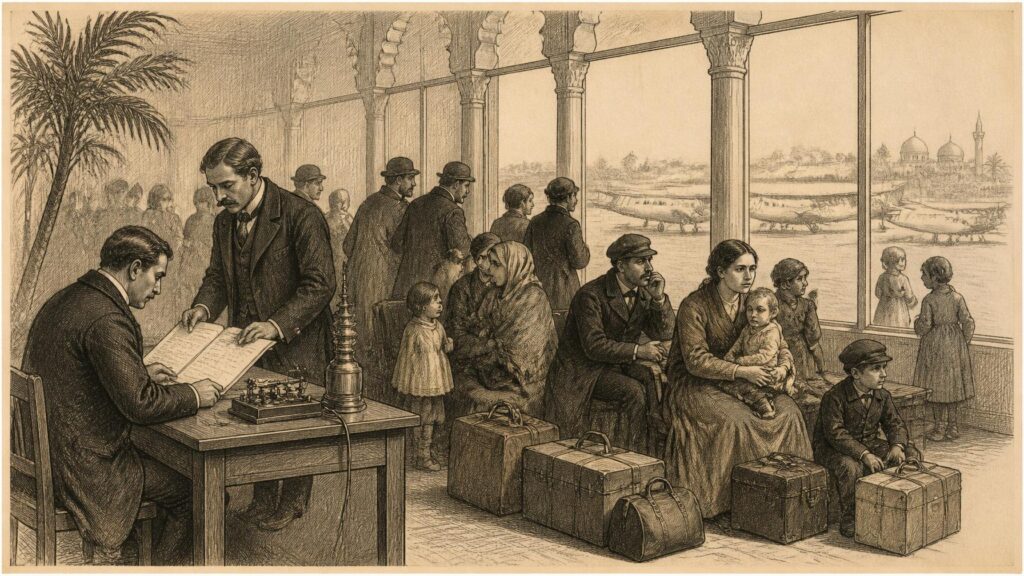
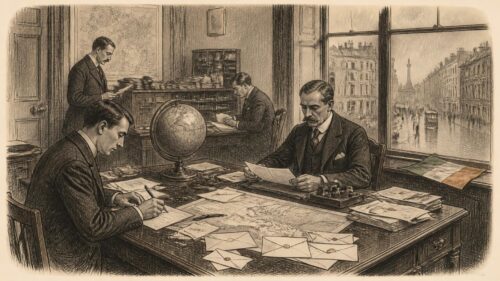
AI generated historical illustration, not a contemporary photograph.
At a Glance
In the first weeks of March 2026, a widening war in the Gulf turned the ordinary connections between Ireland and the Middle East into a sudden problem of protection, communication and return. Airports closed or operated under severe restriction, missiles struck across the region, and thousands of Irish citizens—residents, holidaymakers, business travellers and people in transit—found their routes home uncertain. Ireland’s response became one of the largest consular operations in the State’s recent history. It was not a single dramatic evacuation, but a changing combination of advice, registration, diplomacy, commercial aviation, overland travel and chartered flights.
Sudden Closure
The crisis began in circumstances that made conventional planning difficult. Hostilities involving Iran and other states rapidly widened from the end of February 2026. The immediate Irish problem was neither military intervention nor the extraction of a small embassy community from one capital. It was a regional interruption of civilian movement. Airspace restrictions, airport closures, cancelled flights and attacks affecting civilian infrastructure created uncertainty across several Gulf states at once. The Department of Foreign Affairs and Trade had to make decisions while the practical conditions on which those decisions depended could alter within hours.
The language of the first official advice is revealing. On 1 March the Department urged Irish citizens in the region to shelter in place rather than seek improvised land routes. This was an important distinction. In popular discussion, a closed airport can make a road journey seem an obvious solution. Yet a traveller who reached another frontier might still encounter closed airspace, insecure roads, unavailable accommodation, documentation difficulties or a further inability to fly. The Government’s warning was therefore not an instruction to remain passive; it was an acknowledgement that movement during a volatile conflict could create fresh risks without offering a dependable route out.
This made the event a consular crisis rather than an evacuation in the narrow sense. An evacuation implies that a state has a controlled pathway by which it can remove citizens from danger. In early March, Ireland did not possess such a pathway across the whole region. Its first task was to establish contact, gather information and reduce the danger created by rumour. The Department asked citizens to use its registration platform, follow local authority instructions and maintain contact with Irish missions. These measures were modest in appearance, but they formed the basis for every later decision about flights, vulnerability and assistance.
It is tempting, after a crisis has passed, to treat its chronology as inevitable: airports closed, officials reacted, flights resumed, passengers came home. Contemporary records show a less orderly reality. The regional situation was changing; commercial carriers retained their own operational responsibilities; host governments controlled airspace and borders; and Irish officials could not promise transport before safe routes existed. The most useful historical description is therefore one of constrained action. The State had obligations to citizens and strong political pressure to assist them, but it had no power to reopen an airport, guarantee an aircraft’s safety or direct another country’s border policy.
That limitation matters because it defines the achievement of the operation. The Irish response was judged, in the first instance, by the safety of people who were unable to leave. It was also judged by whether citizens and families at home received credible information in a period when the absence of news could magnify fear. The emergency demonstrated that modern consular work is not solely the issuing of passports or the handling of individual misfortune abroad. In a regional conflict it becomes a form of crisis administration, balancing public advice, personal contact, international coordination and the hard physical limits of transport.
Irish Presence
The scale of the emergency derived from a fact that can be overlooked in older accounts of Irish migration: the Gulf has become an important setting for Irish residence and work. Ireland’s connection with the United Arab Emirates developed after the federation’s independence in 1971, which Ireland recognised early. Over subsequent decades, trade, aviation, education, construction, professional services, sport and social networks created a substantial Irish presence, especially in Dubai and Abu Dhabi. Ireland’s official representation in the Emirates described the relationship as unusually close for two states geographically distant from one another.
This population was not a homogeneous group. It included long-term residents with homes, employment and families in the Gulf, as well as people passing through a major global aviation hub. Some Irish citizens were in the region on holiday or short business visits. Others were travelling between Ireland and destinations in Asia, Africa or Australasia, using Dubai, Abu Dhabi or Doha as connecting points. During normal times, the density of routes through these airports makes such journeys routine. During conflict, the same dependence on hubs created a large and scattered group with different needs, legal statuses and degrees of local support.
Dáil debate on 5 March placed the population in useful perspective. Speakers referred to more than 14,000 Irish people in Dubai, roughly 2,000 in Abu Dhabi, and substantial communities in Qatar and Saudi Arabia. Registration figures during the emergency rose above 24,000 across the wider region. Registration should not be mistaken for a census. It included people who had registered after the crisis began and may have included travellers who were not normally resident. Nevertheless, it showed the Department the possible scale of demand and made visible a diaspora that is less familiar in Irish public memory than communities in Britain, North America or Australia.
The Irish abroad in the Gulf also had resources that varied sharply from person to person. A settled resident might have accommodation, friends, an employer and access to local information. A traveller stranded airside or in a hotel could have none of these. A family with small children, a pregnant passenger, an older person or somebody with a medical condition could not be treated simply as another name on a flight list. The Department later explained that vulnerability and transit status influenced the selection of passengers for assisted departures. That approach recognised that equal citizenship does not always mean identical needs.
Community organisations mattered, although the official record should not be exaggerated into a claim that voluntary groups replaced state action. Irish societies, Gaelic games clubs, business networks and informal social connections gave the diaspora a structure. In normal circumstances these bodies sustain identity, sport and professional contact. In an emergency, they can help circulate reliable information, identify isolation and provide the ordinary reassurance of speaking to someone nearby. The operation nonetheless depended on the formal authority of embassies, the Department’s crisis team and host governments. Community networks were an adjunct to consular work, not a substitute for it.
The crisis also exposed the character of contemporary Irish migration. Earlier generations often left Ireland with an expectation of long separation and uncertain return. The Gulf connection is shaped instead by rapid aviation, contract employment, transnational families and electronic communication. Its apparent ease depends on stable systems. When those systems stopped, distance reasserted itself abruptly. A person accustomed to reaching Dublin from Dubai in a single overnight flight could suddenly face days of waiting, changing advice and a journey through another country. The experience was modern in its technology, but old in its emotional pattern: news delayed, families worried and home made suddenly remote.
Consular Machinery
Ireland entered the crisis with an established consular structure, though no small diplomatic service can maintain unlimited capacity for every conceivable emergency. The Department’s normal responsibilities include travel advice, passport and document services, support for citizens in distress, contact with families, and assistance through embassies and consulates. Its public charter also makes clear that consular assistance has limits. Officials cannot override another state’s laws, decide insurance disputes, give specialist medical or legal advice, or guarantee that a citizen will be removed from a dangerous situation. Those limits are sometimes disappointing to individuals in crisis, but they are fundamental to honest public administration.
The Department had already recorded growing consular demand before March 2026. Its overview for 2025 reported nearly two thousand new individual cases, alongside continuing assistance connected with conflict and instability in the Middle East. The Gulf emergency was different in scale and concentration. Rather than a succession of separate cases—an arrest, an accident, a death, a lost passport—it involved thousands of people potentially affected by the same disruption. The response required a shift from casework to surge operations without abandoning the individual attention owed to citizens in acute difficulty.
At the centre of that shift was the Consular Crisis Team in Dublin. Officials expanded telephone and information capacity, worked with missions in the region, and used the citizens’ registration system to establish who was present and what assistance might be required. The registration system did not produce a perfect map. People may fail to register, register more than once, leave without reporting it, or be unable to access the system. Yet it created a working picture far better than reliance on public estimates or social-media appeals. It also allowed the Department to send guidance to people who had identified themselves.
Irish representation in the region was necessarily regional rather than state-by-state. The Embassy in Abu Dhabi held responsibility not only for the United Arab Emirates but also for Kuwait and Qatar; the Embassy in Riyadh had accreditation to Bahrain and Oman. Other Irish missions in the wider Middle East had their own responsibilities. Such arrangements are ordinary diplomatic practice for a country with limited resources. During a crisis, however, they create a demanding geography. Staff may have to communicate across jurisdictions, time zones and very different security conditions while working with headquarters, European partners, airlines and local authorities.
The machinery was also digital. Official web notices, social-media messages, a registration platform, telephone lines and direct calls were all part of the response. This gave the operation speed, but it also meant that citizens needed to distinguish verified updates from speculation. The Department repeatedly directed people to official travel advice and embassy communications. The insistence was practical rather than merely bureaucratic. In an emergency, an inaccurate report of an open border or available flight can send people into danger, cause them to abandon safer accommodation, or overwhelm a service that has no ability to meet the demand imagined online.
Records published later in the year stated that more than one hundred officials ultimately participated in the crisis response. Such a figure should be understood carefully. It does not mean one hundred people were sitting in a single crisis room, nor does it measure the labour of airline, host-government or European personnel. It does indicate the extent to which the event drew upon a whole departmental network. The significance lies in the mobilisation: a service designed for ordinary diplomatic and consular work had to operate continuously, reinforce missions and make rapid logistical decisions under conditions of uncertainty.
Emergency Response
The first operational principle was safety. Ireland’s advice to shelter in place followed coordination with European partners and reflected the lack of recommended evacuation routes in the opening days. This could appear frustrating, particularly to travellers whose flights had been cancelled. But a government that encouraged ad hoc departure before confirming safe movement would have accepted responsibility for risks it could not control. The advice was a judgement about the least dangerous immediate course, not a declaration that assistance would never be possible.
Alongside this public advice, the Department began gathering a more detailed account of need. By 5 March, the Minister for Foreign Affairs and Trade told the Dáil that officials had dealt with more than 2,300 queries since the crisis began. Citizens contacted the service from the region, while relatives in Ireland sought information. The number conveys workload, not necessarily the number of stranded people: one family may make several calls, and many registered citizens may not seek departure. Yet it confirms that the emergency was experienced not only at airports but through a continuous stream of individual uncertainty.
Communication was an intervention in its own right. A citizen cannot make sensible choices about accommodation, medical needs, money or onward travel without knowing whether commercial options may return. The Department therefore had to explain both what it knew and what it did not know. The official record shows a deliberate reluctance to make promises about land routes or aircraft before they were confirmed. In the short term, such caution can feel unsatisfactory. In the longer view, it is a necessary element of trust. False certainty is one of the most damaging failures a consular service can make.
The response also involved political attention at the highest level. Government meetings considered the security of Irish citizens, the position of Irish personnel serving with the United Nations Interim Force in Lebanon, and contingency planning. The Minister spoke with counterparts in the Gulf, including the United Arab Emirates’ foreign minister. These contacts did not themselves transport anyone, but they mattered. A consular operation relies on permissions, local intelligence and the cooperation of authorities that control airports, roads, hotels and border processes. Diplomacy supplies the environment in which practical assistance can occur.
There was a domestic political dimension as well. Members of the Oireachtas received messages from anxious constituents and pressed for information about the scale of the crisis, capacity of telephone lines and routes of return. Parliamentary scrutiny is not merely an obstacle to officials under pressure. It records the public questions that arise when a state asks citizens to wait in a conflict zone: who is being contacted, how are vulnerable people identified, why cannot a flight leave sooner, and what happens to those who remain? The Dáil debate preserved an unusually immediate account of these tensions.
Most importantly, the initial response separated two categories that could otherwise be confused. Irish citizens who were long-term residents had reasons to remain near their homes and families, subject to local security advice. Those trapped in transit or facing particular vulnerabilities often needed a route home urgently. The State could not sensibly create a single queue based only on who had contacted it first. It had to consider safety, location, available capacity and personal circumstances. Later statements confirmed that this was the approach followed when places on assisted flights became available.
Commercial Return
For all the drama associated with chartered repatriation, commercial aviation was the principal route by which many people returned. This is a central feature of the crisis and an important corrective to the idea that governments resolve every overseas emergency by sending aircraft. Ireland had no need, and no ability, to replace the entire regional airline system. Its task was to work with carriers, obtain timely information, direct citizens towards viable options and reserve special assistance for cases that commercial routes could not meet.
Flights from Dubai began to reappear within days, though capacity and predictability remained limited. The return of direct services to Dublin was particularly valuable because it reduced the hazards of multiple transfers. The Department welcomed commercial options while warning that aviation conditions could change suddenly. This combination—encouragement without guarantee—was appropriate to an operating environment in which an airline might alter its schedule because of security assessments beyond Irish control.
Commercial return also had an unequal geography. A person in the United Arab Emirates could benefit when services from Dubai or Abu Dhabi resumed. A citizen in Qatar, Kuwait, Bahrain or elsewhere might need a different route, an onward connection or more time. The Department reported negotiations that enabled a proportion of seats on Qatar Airways flights to London to be reserved for Irish citizens leaving Doha. This illustrates the detailed, unglamorous work of consular diplomacy. A reserved block of seats does not make headlines in the way a charter flight does, but it can be the more effective solution for hundreds of people.
By 24 March, the Department informed the Oireachtas that commercial arrangements had helped more than 490 Irish citizens depart Doha, while resumed services from the Emirates were again carrying passengers to Dublin. It assessed that most holidaymakers and transit passengers who wished to return had probably done so by charter or commercial means. That statement should be read as an assessment rather than an exact count. In a mobile crisis, officials cannot always know when every individual leaves, and many residents may have chosen to stay. Still, it marks a change from the first days, when the basic question was whether safe flights would be possible at all.
There were practical reasons to prefer commercial travel whenever it was available. Scheduled airlines possess ticketing systems, crews, aircraft, ground handling and established passenger-processing arrangements. They can transport people repeatedly rather than through a single exceptional operation. Commercial departure also permits people to choose a route that suits their family, destination or onward obligations. State-chartered flights, by contrast, have limited seats and require officials to decide who receives them. A charter can be indispensable, but it is rarely the first or only answer.
This did not make commercial travel uncomplicated. Cancelled bookings, uncertain rebooking rules, insurance questions, accommodation costs and the problem of reaching an operating airport all weighed on travellers. The Department advised citizens to engage directly with airlines or travel agents about cancellations and alternative routes, while reserving consular intervention for emergencies and complex cases. Such advice can seem to shift responsibility onto the traveller. In fact it reflects the division of roles in international travel: airlines control contracts of carriage, while consular authorities can assist where a citizen’s safety or circumstances exceed the ordinary mechanisms of travel administration.
Omani Corridor
The most visible Irish operation emerged through Oman. As the authorities assessed routes and vulnerabilities, Muscat became the departure point for an assisted flight. The path was demanding. Passengers needed first to travel overland to Oman in circumstances in which the Government had earlier advised against spontaneous land journeys. The difference was organisation. What was too uncertain as an individual improvisation could become possible when officials, local authorities and embassy teams had made arrangements and when a specific flight awaited at the other end.
The first chartered repatriation flight arrived in Dublin on 8 March after departing Oman via Cairo. It carried 189 passengers, including children and infants. Official accounts described the journey as challenging and noted that several hundred citizens had been called directly to establish arrangements. More than 280 had initially been confirmed for the assisted departure, but a smaller number ultimately checked in for the road journey. Some seats were then taken by others already in Muscat who also required return.
These figures reveal something important about crisis logistics. A confirmed place is not the same as a passenger safely aboard. People may decide not to travel, encounter difficulty reaching a meeting point, find commercial alternatives, face family obligations or judge conditions too uncertain. Officials must plan for all these possibilities while avoiding both empty aircraft and unrealistic expectations. The Muscat flight therefore should not be interpreted as a simple count of those rescued. It was a managed operation whose final passenger list necessarily changed as conditions changed.
The passage through Oman also complicates any simplistic contrast between sheltering and departing. On 1 March, the Department warned that it could not recommend land routes. By 6 March, it was supporting an organised movement to Oman for a planned assisted departure. This was not necessarily a reversal. It was an adaptation to new facts: the availability of a charter, arrangements on the ground and a defined pathway rather than an unknown attempt to reach another airport. Historical analysis should preserve this distinction rather than portray the early advice as either needless caution or permanent policy.
A second repatriation flight later departed from Abu Dhabi on 11 March. By the end of the month, the Department said the two flights had helped 380 Irish citizens and their families return. The second operation showed that the State was not relying exclusively on the Omani corridor once other opportunities emerged. It also confirmed a broader principle: assisted departures were intended for people most in need, particularly the vulnerable and those stranded in transit, while commercial services remained the preferred route where they functioned.
The image of a chartered aircraft arriving at Dublin Airport had obvious symbolic force. It showed citizens and families that the State was acting visibly. Yet the historical importance of the flights lies not only in their emotional resonance. They were the product of telephone work, passenger vetting, transport coordination, accommodation decisions, diplomatic permissions and contingency planning. The Department met hotel costs in Oman when a departure was delayed by aviation conditions. Such detail illustrates the practical ethics of consular work: care is often expressed through beds, lists, buses, calls and revised departure times rather than through grand declarations.
European Support
Ireland did not face the emergency alone. European consular cooperation was a structural part of the response from the outset. Irish officials coordinated with European Union member states, the European External Action Service and the European Commission’s Emergency Response Coordination Centre. The European Union Civil Protection Mechanism was activated for the assisted flights, allowing seats to be offered to other European citizens after Irish demand had been considered. Ireland, in turn, continued to use flights organised by partner states for small groups of Irish citizens.
This cooperation was practical rather than abstract. In a region where many European countries have larger missions, more aircraft or different local links, the sharing of information and spare capacity can make the difference between a citizen leaving promptly and waiting indefinitely. Ireland’s participation showed how membership of European structures can supplement the reach of a smaller national diplomatic network. It did not erase national responsibility: Irish officials still had to identify citizens, communicate with them and make arrangements. But it widened the set of possible routes.
European coordination also helped produce common advice in the first days. If one state recommends immediate road travel while another urges citizens to remain where they are, people may assume that official guidance is contradictory or politically motivated. Shared assessment does not guarantee certainty, but it can reduce dangerous competition among national messages. The Irish instruction to shelter in place was explicitly linked to coordination with European partners. This was a notable example of quiet policy convergence serving a direct protective purpose.
The Gulf states were not merely locations in which European governments acted. Their authorities were indispensable partners. Ireland’s contacts with the United Arab Emirates and other states concerned security information, airport operations and support for residents. The language used by Irish ministers emphasised sympathy with Gulf countries affected by attacks while also calling for de-escalation and respect for international law. This diplomacy had both moral and operational value. A state asking another government to assist its citizens during a conflict must sustain relationships of trust before and during the emergency.
The European element should not be romanticised. Cooperation cannot conjure aircraft through closed airspace, nor can a mechanism remove the legal and security constraints imposed by a host state. It can also be difficult to coordinate national priorities when many countries seek the same limited routes. Nonetheless, the March operation offers a clear case in which collective capacity mattered. Ireland’s ability to make use of shared flights, share information and offer places to other Europeans was part of the practical infrastructure of citizenship.
Parliamentary Record
The Dáil debate of 5 March is one of the most useful contemporary records of the crisis because it captures the event before its outcome was known. Ministers and deputies spoke while air services were only beginning to resume and while the first charter had yet to depart. The discussion records anxiety about people travelling with children, people isolated far from home, and families in Ireland receiving incomplete information. It also records the Government’s insistence that commercial services, where safely available, should remain central to the response.
Parliamentary evidence established several facts that later accounts can easily flatten. First, not everyone registered with the Department wished to return to Ireland. Many were permanent residents and had homes, work and family lives in the region. Second, the large registration figure did not mean every registrant was stranded. Third, the priority group for assisted departure was smaller: people in transit, those with particular vulnerabilities and those whose circumstances made ordinary travel especially difficult. These distinctions were necessary for fair policy, even if they were emotionally difficult for individuals whose own need felt urgent.
The debate also demonstrates the importance of public explanation. Deputies reported receiving frustrated correspondence from citizens who wanted firmer answers. The Government responded that it could not promise what conditions did not permit. This exchange was not merely political theatre. It reveals the basic tension in consular crises between individual expectation and collective risk management. Each person sees a cancelled journey, a family obligation or a feared danger. Officials see a region with disrupted airspace, a limited number of safe routes and thousands of potential claims on assistance.
Later written answers added a more settled account. They recorded direct assistance to more than 2,500 citizens, the use of two repatriation flights, continuing support for departures through European partners, and the recovery of commercial options. Such later evidence is valuable, but it should not be treated as a complete final audit. Official figures describe departmental activity and known cases; they do not capture every personal decision, every informal act of community support or every difficulty encountered by a traveller. Historians should therefore use them as firm institutional evidence while resisting the temptation to turn them into a total social history.
There is no reliable basis for folklore-like tales of hidden airlifts, secret military corridors or unilateral Irish rescue operations beyond the documented flights. Crises invite such stories because uncertainty leaves room for speculation and because dramatic narratives travel quickly. The public record instead describes a more credible, if less cinematic, process: staff contact, host-state cooperation, airline negotiation, European mechanisms, carefully selected departures and gradual restoration of scheduled services. Its complexity is precisely what makes it historically instructive.
Diplomatic Setting
The consular operation cannot be separated from Ireland’s broader position on the war. On 5 March, the Minister for Foreign Affairs and Trade told the Dáil that the United States and Israeli military operations had no United Nations mandate or authorisation. At the same time, she condemned Iranian strikes affecting Gulf countries and called for de-escalation. The Government therefore had to speak about international law, regional violence and Irish neutrality-related concerns while protecting citizens in states directly affected by the conflict.
This was a difficult diplomatic balance. A government can condemn actions or call for restraint, but its embassy staff must still work every day with host authorities. Ireland’s contacts with Gulf governments were not evidence of political alignment with every policy of those governments; they were a necessary means of protecting residents and travellers. Conversely, the need to assist citizens did not require Ireland to abandon its public view that military escalation lacked a legitimate international foundation. The crisis shows how consular necessity and foreign-policy principle can operate simultaneously.
Ireland’s relationship with the Gulf had expanded through its wider Middle East and North Africa strategy, trade connections and a policy of deeper diplomatic engagement. The growth of the Irish community in the United Arab Emirates was both a result and a driver of that relationship. The March emergency tested whether this network had practical value. The answer appears to be yes, though not in a simplistic sense. Diplomatic relationships did not prevent the crisis, but they gave Irish officials channels through which to seek information, arrange assistance and communicate with citizens.
It also exposed the limits of a small state’s influence. Ireland could advocate de-escalation and international law; it could coordinate within the European Union; it could make consular representations. It could not determine the conduct of the war. The vulnerability of citizens abroad is one of the clearest reminders that foreign policy is not an abstraction. Decisions taken far from Dublin can affect whether Irish families can travel, work, receive news or return home. The Gulf crisis brought that reality into Irish domestic politics with exceptional immediacy.
Human Scale
Numbers are necessary to understand the operation, but they can obscure its human scale. Behind the more than 18,000 registrations reported in the first week, and the larger total later recorded, were people making difficult choices: whether to leave a long-term home, whether to remain with family, whether to trust a possible flight, whether to undertake an overland journey, and how to explain uncertainty to children or relatives. The Department’s decision to contact people directly about assisted departures recognised that a mass emergency still consists of individual circumstances.
The accounts of the Muscat flight mention children and infants, a small detail with considerable meaning. Travelling during disruption is harder when one must manage food, medication, sleep, documents and the fears of dependants. The same is true for older travellers and people with health conditions. Prioritisation in such circumstances is not a departure from equal treatment; it is an attempt to make equal citizenship meaningful when the burdens of delay fall unevenly.
Families in Ireland were also participants in the crisis. They called Dublin, followed news reports, watched embassy updates and tried to determine whether a loved one was safe. Consular work often has a dual audience: the citizen abroad and those at home. A crisis team that provides accurate information to families can reduce pressure on the person stranded and prevent the spread of misinformation. The emotional geography of the event therefore extended from the Gulf to Irish towns and cities, wherever relatives waited for news.
The operation also depended on those who did not return. Many Irish citizens in the Gulf remained where they lived. Their decision was rational: they may have had secure homes, jobs that could not be abandoned, family members of other nationalities, or confidence in local protections. Historical memory tends to privilege the returning passenger because arrival photographs provide a clear ending. Yet the larger story includes residents who continued ordinary life as far as conditions allowed, while monitoring alerts and adapting to a conflict that had made their adopted home insecure.
Institutional Lessons
By October 2026, the Department was describing a lessons-learned process and stated that the Middle East and Gulf crisis had activated an emergency task team, reinforced the core consular team and regional missions, and used a surge team. This later evidence suggests that the response was treated not as an isolated episode but as a test of institutional preparedness. The claim that plans were effective should be understood as an official assessment, not an independent verdict. Even so, the available record supports the conclusion that the Department was able to expand operations rapidly and assist large numbers of citizens.
One lesson concerns registration. The citizens’ registration platform became the operational bridge between a dispersed diaspora and the State. Its success depended on people knowing it existed, trusting it and updating their details. Future crises will likely reinforce the importance of public familiarity with registration before an emergency begins. A system used only after danger arrives can still help, but it must handle a sudden influx of users, incomplete information and expectations that registration itself guarantees repatriation. It does not; it enables officials to understand and respond to need.
A second lesson concerns aviation. The Gulf crisis confirmed that commercial airlines are not peripheral partners in consular protection. They are often the main means by which citizens leave an affected region. Governments need established channels with carriers, realistic knowledge of airport operations and an ability to identify vulnerable passengers who cannot use ordinary booking systems. Charter flights remain essential where the market cannot meet urgent need, but they work best as part of a broader transport strategy rather than as a symbolically attractive substitute for it.
A third lesson concerns language. “Shelter in place” can sound like abandonment unless it is explained alongside the reasons for the advice, the steps being taken and the circumstances under which it may change. The March operation showed that advice needs to be both clear and adaptive. The Government initially discouraged land routes because no safe, reliable departure route existed. It later helped organise movement to Oman once a particular route and flight had been prepared. The public needs to understand that changing advice can reflect improved information rather than indecision.
Finally, the crisis confirms the value of European cooperation for a state of Ireland’s size. Shared capacity cannot replace national responsibility, but it provides options that no individual mission may possess. The use of the Civil Protection Mechanism, coordination with European partners and reciprocal access to flights all suggest that consular resilience increasingly depends on networks. For Irish citizens, the relevant protection was not solely an Irish flag over an embassy building. It was a web of national staff, regional authorities, airlines, digital systems and European arrangements.
Historical Meaning
It is too soon to write a final history of the March 2026 Gulf consular crisis. The event remains close enough for records to be incomplete, official assessments to evolve and personal experiences to emerge gradually. It would be unwise to claim that it transformed Irish foreign policy, proved any single institutional model, or can be measured only by the number of seats on chartered flights. Its meaning is more specific and, for that reason, more durable.
The crisis made visible a modern Irish diaspora whose security depends upon global transport and regional stability. It showed how a state associated in public memory with emigration to English-speaking countries now bears practical responsibility for citizens living across the Gulf. It also demonstrated the changing nature of consular protection. The work was not heroic in a romantic sense. It was administrative, diplomatic and logistical: collecting names, answering phones, advising patience, negotiating seats, organising road transport, paying hotel bills and deciding who most urgently needed help.
That administrative character should not diminish the achievement. In emergencies, reliable systems are often more humane than dramatic gestures. The citizens who returned through Dublin, Muscat, Abu Dhabi, London and other routes did so because a chain of institutions functioned under strain. Those who remained received advice intended to keep them safe while conditions changed. Families in Ireland had a point of contact. The Department learned from the operation, and the Oireachtas created a record against which its choices can be assessed.
For Emerald Archives, the episode belongs within Irish history because it records the State meeting one of the oldest obligations of citizenship in a new setting: to recognise that the Irish nation extends beyond the island, and that distance does not remove responsibility. The Gulf crisis of March 2026 did not end with the landing of two chartered flights. Its longer legacy lies in the systems, relationships and public expectations that it tested—and in the reminder that Ireland’s history is increasingly made along routes that reach far beyond its shores.
The article presents the Gulf crisis as a hybrid consular operation, where safety depended less on a single evacuation than on coordination among digital registration systems, commercial airlines, host governments, Irish missions and European partners. This raises a question about equality of assistance: settled residents with homes and networks faced circumstances unlike travellers in transit, families, and people with limited digital access. The use of vulnerability-based prioritisation appears practical, yet it shows how diaspora protection relies on information, connections and transport. What criteria and evidence should Ireland use to judge whether this networked model serves citizens fairly in future crises?