Early Animal Butchery31931 BCE
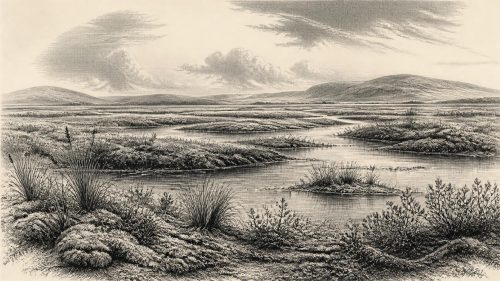
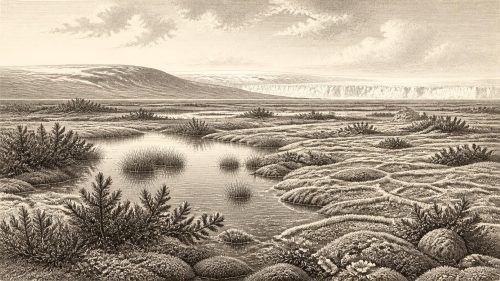
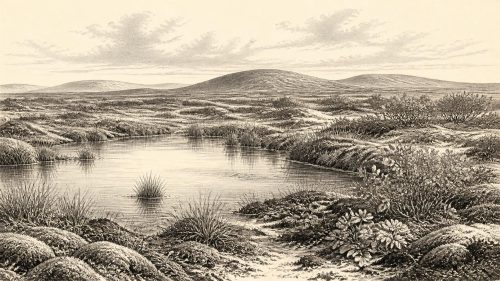
At roughly 31,931 BCE, Ireland lay in the climatically unstable Late Pleistocene, before the maximum extent of the last British–Irish Ice Sheet. Its cold, changing landscapes probably included open grassland, tundra, bare ground and restricted woodland, supporting mammals such as reindeer, mammoth, giant deer, bears, wolves, hyaenas and Arctic foxes. Castlepook Cave, County Cork, preserves crucial but imperfect faunal evidence. A reindeer femur reportedly bears a stone-tool cut mark, suggesting possible human butchery around 31,000 BCE. However, disturbed old deposits and the absence of settlements preclude claims of permanent occupation. Later glaciation and rising seas obscured sites; research remains necessary.

Dateline
The label 31,931 BCE is a modern way of indexing deep time, not a year that people in Ireland could have named or recorded. No calendar, writing system, ruler or dated event is available for this part of the Ice Age. By simple calendar arithmetic it lies roughly 33,880 years before 1950, the conventional reference point for “before present”, but that is not the same thing as a calibrated scientific date. Archaeologists and Quaternary scientists work instead with radiocarbon determinations, calibrated ranges, sediment sequences and ice-sheet chronologies, each carrying margins of uncertainty. The responsible history of Ireland at this point is therefore a history of landscape, animals and an exceptionally slight possible human trace.
A Late Pleistocene Landscape
This notional year falls in the Late Pleistocene, within Marine Isotope Stage 3: a cold, climatically unstable phase of the last Ice Age. It preceded the fullest expansion of the last British–Irish Ice Sheet. Current syntheses place the period when ice entirely covered Ireland and extended towards the Atlantic and Celtic Sea shelf edges broadly around 27,000–23,000 calibrated years before present, although the growth and maximum extent of different sectors were not simultaneous. The island at 31,931 BCE was therefore approaching, rather than securely within, that later maximum.
That distinction matters. It is misleading to imagine a single, unchanging white cap over the whole island throughout the Ice Age. Ice expanded and contracted, while local conditions differed between uplands, lowlands, coasts and the Irish Sea basin. Reconstructions for the British–Irish Ice Sheet show repeated advances, changes in flow direction and rapid responses to climate. At approximately 34,000 years before present, the exact outline, thickness and permanence of ice over every part of Ireland remain uncertain. The evidence supports a cold, severe and changing environment; it does not support a map precise enough to identify the weather or terrain of one calendar year.
Nor should this Ireland be called an “Emerald Isle”. During cold intervals, woodland would have been greatly restricted or absent across broad areas. Open herb-rich grassland, tundra-like vegetation, bare mineral ground and patches of snow or glacier ice are more appropriate possibilities, varying with local exposure and season. The sea was also lower than today because immense quantities of water were stored in northern ice sheets. Yet lower sea level did not automatically make Ireland a landward extension of Britain or continental Europe. The Irish Sea basin, changing ice margins and marine barriers made access difficult and variable.
Animals Before the Deep Freeze
Irish caves and museum collections provide the most tangible evidence for this older world. The Irish Quaternary Fauna Project concluded that a wide range of mammals reached Ireland between at least about 45,000 and 20,000 years ago, though the fossil record is uneven and individual species did not necessarily live together at the same moment. Castlepook Cave near Doneraile, County Cork, is especially important. Its old collections include remains attributed to woolly mammoth, reindeer, giant deer, brown bear, wolf, Arctic fox, lemming and spotted hyaena, among other Ice Age fauna.
These animals are evidence of ecological possibilities, not a complete census for 31,931 BCE. A mammoth bone dated to around 35,000 years ago and other dated faunal material demonstrate that large grazing animals and their predators had reached Ireland during the broader pre-maximum cold-phase world. Reindeer are particularly relevant to the period, because their movements across open landscapes could have drawn mobile predators and human hunters alike. Spotted hyaena remains, also known from Castlepook, remind us that caves were often carnivore dens and bone accumulators, not simply shelters used by people.
The traditional name “Irish elk” can also mislead. Megaloceros giganteus, or giant deer, was neither confined to Ireland nor closely related to the living elk or moose. Its famous Irish fossil record reflects preservation and collecting history as much as national uniqueness. In this earlier phase, animal bones must be understood through taphonomy: scavenging, carnivore transport, water movement, collapse, excavation and curation can all alter what survives and where it is found.
A Possible Human Footprint
The closest potentially human evidence for this article’s date comes from Castlepook. A reindeer femur from the cave has been reported by its researcher, Ruth Carden, and in Cork heritage publications as bearing a mark consistent with cutting fresh bone using a sharp stone tool. The bone has been presented as dating to about 31,000 BCE. If the mark is correctly identified as a butchery cut and is contemporary with the animal’s death, it would indicate that Upper Palaeolithic people reached Ireland far earlier than the long-accepted late-glacial evidence from County Clare.
This is important, but its limits are just as important. The reported object is not a settlement, a hearth, a stone-tool assemblage, a grave, a house floor or a human skeleton. It cannot establish the number, language, ancestry, gender, social organisation or duration of any visitors. Nor does one modified bone prove a continuously occupied Ireland. The old cave deposits were excavated in the early twentieth century, before modern recording standards, and their original contexts are difficult to reconstruct. Recent licensed investigation at Castlepook is valuable precisely because it seeks intact deposits, improved dating and a better understanding of how the cave assemblage formed.
The evidence therefore permits a cautious interpretation: small groups of hunter-gatherers may have made a short incursion into Ireland during a milder or more accessible phase of the late Ice Age, perhaps following or exploiting reindeer. It does not yet demonstrate a permanent population. In wider north-west Europe, Upper Palaeolithic groups had sophisticated stone technologies, extensive social contacts and, in some regions, cave and portable art. Those facts supply context for what visitors to Ireland might have known; they are not evidence that comparable tools, artwork or practices have been found in Ireland at this date.
No Polities, No Proven Communities
There is no basis for political history in the ordinary sense. Ireland at 31,931 BCE had no known kingdoms, chiefs, tribal names, borders, laws, diplomacy or warfare. It is equally impossible to identify an Irish people, an Irish language or an Irish religious tradition. Such terms belong to vastly later periods. The most that can responsibly be said of society and everyday life is conditional: if people were present, they were almost certainly mobile hunter-gatherers whose survival depended on ecological knowledge, cooperation, clothing, fire, portable equipment and seasonal movement. None of those necessities can be demonstrated directly from an Irish domestic site of this age.
There is likewise no Irish evidence for farming, herding, fields, monuments, formal burial rites, long-distance commerce or organised trade at this point. A hunter’s movement over water or ice-fringed routes would not itself constitute trade. The economic reality visible in the evidence is ecological rather than commercial: animal populations exploited open environments, carnivores contested carcasses and sheltered caves accumulated remains. Any human economy, if represented by the Castlepook bone, was a moment of acquisition and butchery, not a documented system of production.
What the Record Can Preserve
Glaciation helps explain why the record is so thin. Later ice eroded, transported and buried sediments across much of Ireland, while rising seas reshaped or drowned former coastal landscapes. Sites that might once have existed in lowland valleys, on coasts or beside former lakes could have been destroyed, concealed beneath drift, or submerged on the continental shelf. Caves, fissures and museum archives have consequently become disproportionately important windows onto the Pleistocene.
Absence of evidence is not proof that no person ever set foot on the island before the final ice advance. But neither can missing sites be converted into an imagined lost society. The sound conclusion for 31,931 BCE is narrower and more compelling: Ireland was part of a volatile north-west European Ice Age world inhabited by large mammals and predators, with ice-sheet growth increasingly transforming the terrain. At Castlepook, one reindeer bone offers a carefully qualified possibility of human butchery. Future excavation, dating and microscopic analysis may strengthen, revise or reject that interpretation. For now, the year belongs less to recorded human history than to the difficult archaeology of a landscape on the verge of profound glacial change.
Primary Sources
- The Mesolithic in Ireland: when was it?
- Heritage Artefacts of County Cork 2021
- Growth and Retreat of the Last British–Irish Ice Sheet, 31,000 to 15,000 Years Ago: The BRITICE-CHRONO Reconstruction
- Growth and Retreat of the Last British–Irish Ice Sheet, 31,000 to 15,000 Years Ago: The BRITICE-CHRONO Reconstruction
- Pattern and Timing of Retreat of the Last British-Irish Ice Sheet
- Maximum Extent and Dynamic Behaviour of the Last British–Irish Ice Sheet West of Ireland
- Extent and Retreat History of the Barra Fan Ice Stream Offshore Western Scotland and Northern Ireland During the Last Glaciation
- Timing and Pace of Ice-Sheet Withdrawal Across the Marine–Terrestrial Transition West of Ireland During the Last Glaciation
- Trimlines, Blockfields and the Vertical Extent of the Last Ice Sheet in Southern Ireland
- Stratigraphic and Palaeo-Geomorphological Evidence for the Glacial-Deglacial History of the Last British-Irish Ice Sheet in the North-Western Irish Sea
- Ireland: Submerged Prehistoric Sites and Landscapes
- Oscillating Retreat of the Last British-Irish Ice Sheet on the Continental Shelf Offshore Galway Bay, Western Ireland
- 2022:564 – Castlepook Cave, Castlepook South, Cork
- Archaeology Research Excavation Grant 2022
- Castlepook Cave
- The Irish Quaternary Fauna Project
- New Insights on the Fauna of Ireland's Younger Dryas and Early Holocene from Alice & Gwendoline Cave
- New Insights on the Fauna of Ireland's Younger Dryas and Early Holocene from Alice & Gwendoline Cave
- Ice Age Ireland
- Palaeoecology
- The IntCal20 Northern Hemisphere Radiocarbon Age Calibration Curve (0–55 cal kBP)
- IntCal Publications
- A Stratigraphic Framework for Abrupt Climatic Changes During the Last Glacial Period Based on Three Synchronized Greenland Ice-Core Records: Refining and Extending the INTIMATE Event Stratigraphy
- The Irish Quaternary Fauna Project: Carden et al. 2012