Castlepook Reindeer Evidence31988 BCE
Around 34,000 years before 1950, conventionally rendered as 31,988 BCE, Ireland occupied a cold, open and environmentally variable Ice Age setting before the Last Glacial Maximum. Ice extent, vegetation, coastlines and routes from Britain remain uncertain. Castlepook Cave in County Cork preserves important, though poorly excavated and potentially disturbed, faunal remains, including reindeer, mammoth, giant deer, bear, wolves, hyaenas and lemmings. A dated reindeer femur bears a possible stone-tool butchery mark, suggesting early human visitation. However, no associated tools, hearths or settlements confirm occupation. Later glaciation and rising seas obscured evidence; Ireland’s Palaeolithic human record remains unresolved and highly tentative.
Dateline
“31,988 BCE” is a modern chronological label, not a year that anyone living in prehistoric Ireland could have named or recorded. At this depth of time, archaeological dating cannot responsibly isolate a single calendar year. The useful frame is the later part of Marine Isotope Stage 3, before the Last Glacial Maximum, approximately 34,000 calendar years before 1950 in broad terms. Radiocarbon results must be calibrated and are expressed as ranges with margins of uncertainty; their conversion into BCE dates is necessarily approximate. What can be said about Ireland around this point is therefore a reconstruction from cave bones, geological deposits, dating programmes and regional ice-sheet models—not a narrative of a documented year.
An Island on the Edge of a Colder World
Ireland lay in a changing Ice Age landscape. The great British–Irish Ice Sheet had not yet reached its fullest later extent, but ice was building in northern and upland regions, and conditions were becoming increasingly severe. Modern reconstructions stress that the precise limits of ice around 31,000 years ago remain uncertain because direct dates are sparse. They nevertheless indicate expanding ice in parts of the British and Irish region, with substantial regional variation rather than one simple, unchanging blanket of ice. The Last Glacial Maximum came later, broadly between about 26,000 and 19,000 years ago, when much or all of Ireland was likely glaciated.
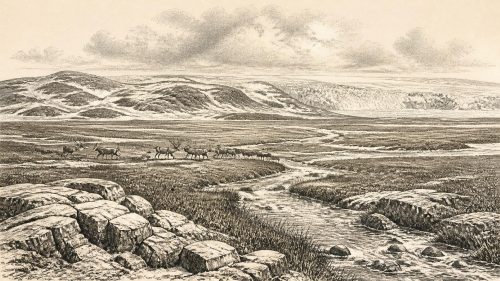
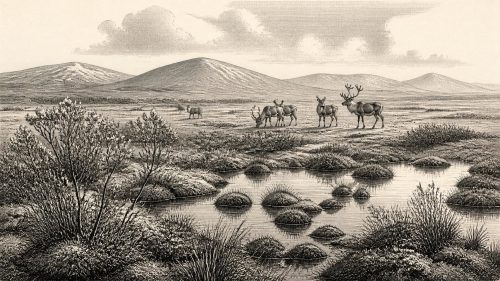
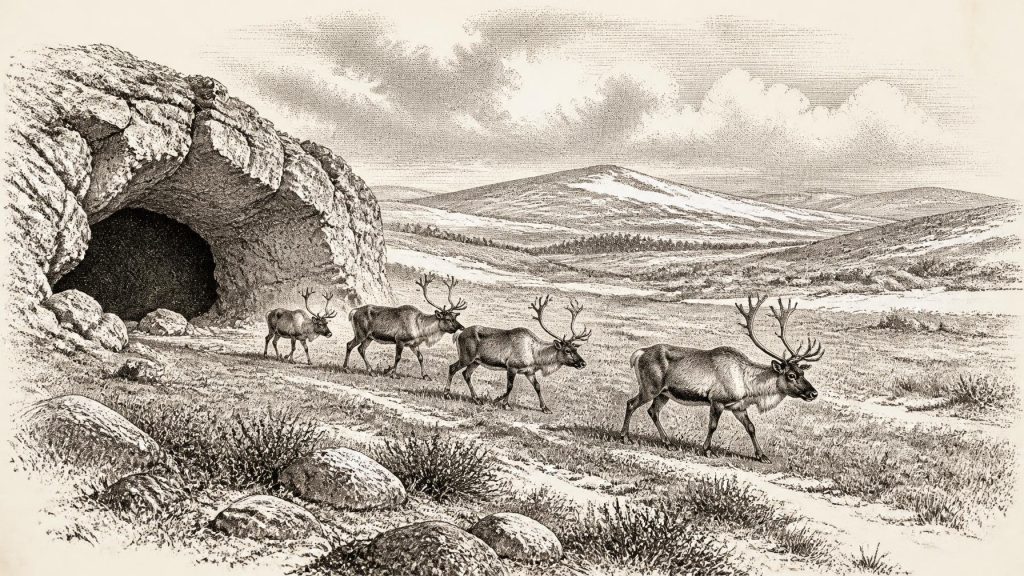
That distinction matters. Around the nominal date represented by 31,988 BCE, at least some Irish landscapes could sustain cold-adapted animals. Ireland was not the green, wooded island familiar today. The most responsible picture is of a largely open, cold environment, probably a shifting mosaic of grassland, herbs, low shrubs, exposed ground and locally icy terrain. This is an inference from the animals represented in the fossil record, not a detailed map of vegetation for every valley. There is no surviving contemporary Irish pollen sequence that permits a precise reconstruction of weather, plant cover or seasonality for this particular calendar label.
The coastline was also unlike the modern one. Global sea level was lower because enormous quantities of water were locked in continental ice sheets, while ice and changing sea levels reshaped the surrounding shelves. Yet lower seas do not licence an easy claim that Ireland was simply joined to Britain by a continuous land bridge at this moment. The geography of crossings, coastal plains, channels and ice margins changed repeatedly, and the surviving evidence does not reveal how any individual animal—or possible human visitor—reached the island. The appropriate conclusion is mobility across a difficult north-west European world, not a confidently drawn migration route.
Castlepook Cave and a Fragile Clue
The most important evidence directly relevant to this era comes from Castlepook Cave, near Doneraile in north County Cork. The cave system is renowned for Pleistocene animal remains recovered in antiquarian and early twentieth-century excavations. Those investigations amassed an exceptionally valuable collection, but they did not meet present archaeological standards of recording. Bones were recovered from complex cave deposits, and some material may have been displaced, mixed or contaminated by later activity. That makes each specimen valuable, but also demands caution. Subsequent excavations and renewed dating have sought to identify surviving, more securely stratified deposits.
A reindeer femur from the Castlepook material has become central to discussion of an Irish Palaeolithic. It has been reported as dating to around 33,000 years ago and carries a mark interpreted by zooarchaeologist Ruth Carden as having been made by a sharp stone tool during butchery. County Cork’s heritage publication presents this as approximately 31,000 BC and identifies it as possible evidence of Stone Age hunters handling reindeer. It is an arresting possibility, because it would push evidence for human activity in Ireland far earlier than the well-known post-glacial settlements.
But a responsible account must separate evidence from interpretation. The dated bone and the observed modification are evidence. The conclusion that the mark proves deliberate human butchery is an expert interpretation, albeit a significant one. No securely associated stone tool, hearth, dwelling floor, human bone, camp deposit or burial of the same age has yet been recovered in Ireland. Nor can one bone establish a permanent population, a named cultural tradition, or a continuous ancestry connecting any visitors of this period to later Irish communities. The claim is best understood as promising evidence for a very early human presence or visit, still requiring corroboration from controlled excavation and additional finds.
Animals of the Cold Landscape
Even if the reindeer mark were ultimately reassessed, Castlepook remains vital evidence for Ice Age Ireland because of its fauna. The cave assemblage includes remains attributed to reindeer, woolly mammoth, giant deer or “Irish elk” (Megaloceros giganteus), brown bear, mountain hare, Arctic fox, wolf, spotted hyaena and lemmings. Not all these animals need have occupied the cave’s surroundings at exactly the same time: a cave can receive bones over long periods, and carnivores can carry carcass parts into dens. Yet the wider pattern demonstrates that Ireland supported a richer Pleistocene mammal community than its modern fauna suggests. Re-dating work has shown that some southern Irish cave remains are substantially older than early radiocarbon determinations implied, placing important elements of this fauna within Marine Isotope Stage 3.
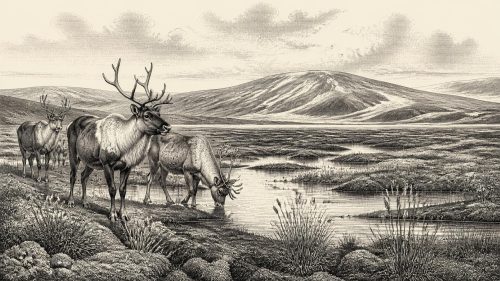
Reindeer are particularly informative. Their presence fits an open, cold landscape and would have offered a concentrated, seasonally mobile source of meat, fat, hide, sinew, bone and antler to any people able to exploit them. Mammoth and giant deer testify to large-herbivore habitats, while hyaenas and wolves signal formidable scavengers and predators. A cave containing their bones should not be imagined as a human house by default. It may have been a carnivore den, a natural trap, a place where water and sediment accumulated, or all of these at different times. The cave is evidence for an ecosystem first; evidence for people is presently much narrower.
This ecological setting places practical limits on what can be claimed about everyday life. If people were present, they were almost certainly highly mobile foragers, dependent on knowledge of animal movements, weather, stone resources and safe shelter. That is a plausible inference from Upper Palaeolithic lifeways elsewhere in Europe and from the putative butchery mark; it is not something demonstrated by an Irish settlement site. There is no evidence at this date for farming, domestic livestock, pottery, metalworking, permanent villages or field systems. There is also no basis for estimating population size. A small party making a short visit and a recurring seasonal camp would leave very different archaeological signatures, but neither has yet been identified securely in Ireland.
No Polities, No Recorded Conflict
Political history cannot be written for Ireland at this date. There were no known kingdoms, chiefs, borders, treaties, clans, written laws or diplomatic institutions. We should not replace this absence with romantic labels such as “tribes” or presume that a few travellers controlled territory in a modern sense. If humans reached Ireland, their social relationships, languages, kin networks and decisions about movement are unknown. The evidence does not tell us whether they came alone, in family groups, as seasonal hunters, or as part of wider contacts around the Irish Sea.
Likewise, there is no Irish evidence for warfare, organised conflict or diplomacy around 31,988 BCE. Animal bones with carnivore damage and humanly modified bone must not be turned into stories of violent encounters. The hazards that can be documented are environmental: cold, shifting ice margins, exposed terrain, scarce shelter and dangerous large animals. In such conditions, cooperation may reasonably be expected of any human group, but that remains a general anthropological inference rather than a fact recovered from an Irish site.
Culture Beyond the Evidence
Upper Palaeolithic communities elsewhere in Europe made sophisticated stone and bone tools, ornaments and art. None of that allows us to assign comparable objects, beliefs or artistic traditions to Ireland at this date. Ireland has no securely dated cave art, ritual site, portable art object, musical instrument, human burial or learning tradition from around 34,000 years ago. There is therefore no evidence for a particular religion or ceremonial practice. Caves can later acquire powerful cultural meanings, but Castlepook’s Pleistocene use cannot be described as sacred simply because it is a cave.
Nor is there evidence for trade in the later prehistoric sense. The possible visitors may have carried stone tools or travelled with materials from elsewhere, but no tool assemblage has been found from which sources or exchange routes can be traced. The best phrase is connectivity, not trade: any human presence would imply that Ireland formed part of a wider network of movement across north-western Europe during a temporary window before worsening glacial conditions. That proposition awaits material proof in the form of tools, sourceable raw materials or well-dated campsites.
A Record Shaped by Loss
The thinness of the evidence is not proof that nothing happened. Later ice advance eroded landscapes, redeposited sediments and probably destroyed or buried many open-air traces. Rising seas after the Ice Age also drowned former coastal zones where people and animals may have travelled. Caves are unusual survivors, preserving bones in protected settings but often complicating their history through animal activity, water movement and early excavation. The contrast between the rich faunal record and the near-absence of artefacts is itself a warning: archaeology preserves some activities far more readily than others.
By the time Ireland was again occupied more visibly after the ice retreated, the evidence would be dramatically different: Mesolithic communities left lithic scatters, camps and increasingly recognisable traces from roughly the early Holocene. That later record should not be projected backwards. The National Museum of Ireland still appropriately describes the Palaeolithic evidence as unclear, while recent research has reopened the question through cave-bone analysis. The productive historical position is neither dismissal nor certainty. Around 31,988 BCE, Ireland can be seen as an Ice Age environment inhabited by cold-adapted mammals and possibly visited by people; whether it held an enduring human population remains unknown.
Primary Sources
- A reconsideration of the radiocarbon dating of the Marine Isotope Stage 3 fauna from southern Ireland
- The Irish Quaternary Fauna Project
- First evidence of a Late Upper Palaeolithic human presence in Ireland
- New insights on the fauna of Ireland's Younger Dryas and Early Holocene from Alice & Gwendoline Cave
- Growth and retreat of the last British–Irish Ice Sheet, 31,000 to 15,000 years ago: the BRITICE-CHRONO reconstruction
- Timing, pace and controls on ice sheet retreat: an introduction to the BRITICE-CHRONO transect reconstructions of the British-Irish Ice Sheet
- The colonization of Ireland: A human ecology perspective
- Last Glacial Maximum cirque glaciation in Ireland and implications for reconstructions of the Irish Ice Sheet
- Prehistoric Details
- 2022:564 – Castlepook Cave, Castlepook South, Cork
- Heritage Artefacts of County Cork 2021
- Palaeolithic Ireland – New Evidence Emerges from the Emerald Isle
- The Irish Quaternary Association Guide No. 17: The Quaternary of Ireland
- Geology of Ireland
- Quaternary Geology Data and Maps
- Ireland Through Geological Time
- Ireland's Palaeolithic Archaeology – Fleeting Footprints in a Frozen Land
- Archaeology: The Burren and Cliffs of Moher UNESCO Global Geopark
- Anthropogenic Changes to the Holocene Nitrogen Cycle in Ireland
- Pleistocene Vertebrates in the British Isles