

Kerry Reckoning
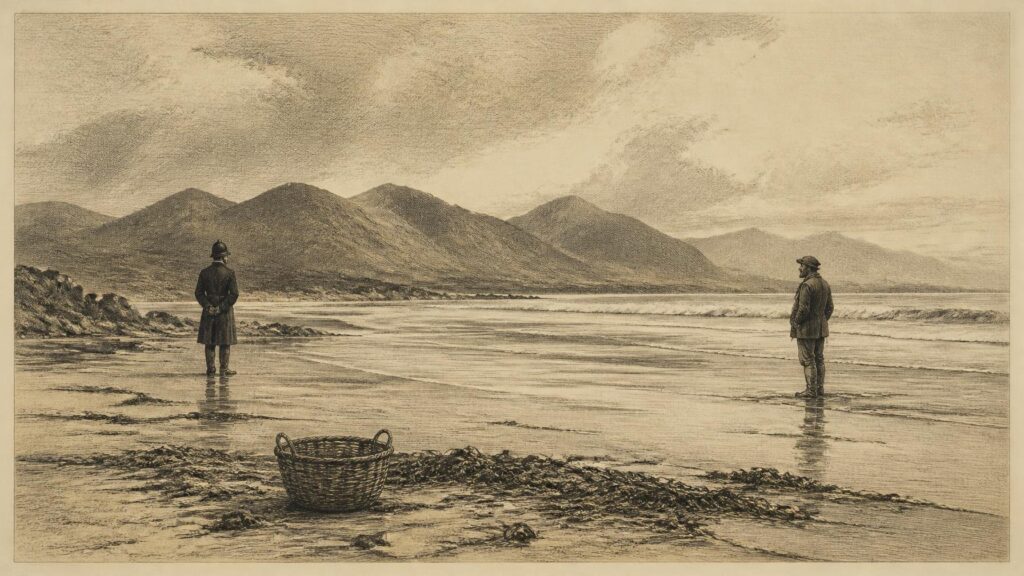
AI generated historical illustration, not a contemporary photograph.
At a Glance
The Kerry Babies case was not one event but a collision of tragedies: the murder of an unidentified newborn child, the death of another infant on a County Kerry farm, a catastrophic Garda investigation, and the public destruction of a woman and her family. Its history exposes the force of stigma surrounding unmarried motherhood in 1980s Ireland, the hazards of confession-led policing, and the limits of a tribunal that purported to establish truth while creating lasting new injustices.
White Strand
On 14 April 1984, a newborn boy was found at White Strand near Cahersiveen, in south-west County Kerry. His body had been placed in a fertiliser bag and had reached the shore after being in the sea. A post-mortem established that the child had suffered multiple stab wounds. He was later buried locally and became known as Baby John. His parentage was unknown, and the killing was immediately a grave crime requiring careful forensic work, patient local inquiry and restraint in the treatment of potential witnesses.
Instead, the discovery rapidly became the beginning of one of the most notorious episodes in the history of An Garda Síochána. It is important to start with the distinction that later became obscured. Baby John was the child found at White Strand. The expression “Kerry Babies” arose because another infant, born to Joanne Hayes at her family home near Abbeydorney, was subsequently found buried on the family farm. The children were separate. Their deaths were separate. Yet the investigation initially fused them into a single, highly improbable narrative.
For decades, accounts of the case have sometimes used the language of mystery to suggest an unknowable rural drama. That description can conceal more than it reveals. Some facts have always been plain: a murdered child was discovered on the coast; Joanne Hayes had recently given birth elsewhere in the county; blood-group evidence soon showed that she could not be Baby John’s mother; and she and members of her family nevertheless made inculpatory statements after Garda questioning. The historical question is not simply why the murders or deaths remained difficult to explain. It is why official institutions continued to act against the available evidence.
County Kerry was not a sealed world, nor was 1984 an age without forensic science. Ireland possessed pathologists, laboratories, lawyers, newspapers and national broadcasting. But access to those resources did not remove entrenched assumptions about women, sexuality, respectability or authority. The early direction of the inquiry mattered profoundly. Once Garda attention settled upon Hayes, the discovery at White Strand was not approached merely as an unsolved killing. It became linked to the private life of one unmarried woman, and the investigation acquired the momentum of a moral as well as a criminal accusation.
Abbeydorney Farm
Joanne Hayes was twenty-five and lived with her family at Abbeydorney, near Tralee. She was unmarried and had previously had a child. In 1984 she had become pregnant again during a relationship with Jeremiah Locke, a married man. These personal circumstances were real, but their later prominence reveals the social temper of the case. The question for a murder investigation ought to have been whether evidence connected Hayes to Baby John. In practice, her pregnancy and her sexual life were treated as material from which a theory of criminality might be constructed.
Following questioning in late April and early May, Hayes and several relatives made statements that appeared to place the White Strand child within the family’s story. The statements were extraordinary. They implicated Hayes and her relatives in the birth, death and disposal of the baby found near Cahersiveen, despite the considerable distance between Abbeydorney and White Strand. The family later withdrew the admissions. They said that the statements had been made under intense pressure and, in their accounts, after coercion and ill-treatment by investigators. The Gardaí disputed those allegations. That conflict became central to the later tribunal.
The Hayes family then said that Joanne had given birth to her own child at the farmhouse on 13 April. The infant, later named Shane, had died, and the family had buried him on the property. On 2 May, Gardaí recovered the child’s remains from the farm. The discovery undeniably altered the factual landscape. It confirmed that there had been two babies, born around the same time in the same county. But it did not, by itself, show that Joanne Hayes was connected with the killing at White Strand.
The presence of the second baby was interpreted through a pre-existing suspicion rather than investigated with detached caution. In a case involving two newborn boys, one violently killed and one dead after a concealed birth, authorities had to determine the identity, maternity, paternity and circumstances of death of each child. That required a willingness to recognise that parallel tragedies can occur. The investigation instead sought to preserve a single theory: that Hayes had borne both infants and had somehow caused both deaths.
Concealed birth and secret burial have often attracted retrospective speculation. In the Ireland of the period, however, secrecy cannot fairly be equated with homicide. Women who became pregnant outside marriage could face humiliation, familial pressure, economic insecurity and religiously shaped condemnation. Those conditions do not explain any individual death, and they cannot be used to excuse wrongdoing. They do help explain why a family might hide a pregnancy or burial, and why an investigating force should have treated such concealment as a context requiring care rather than as proof of murder.
Confessions Taken
The confessions remain among the most disturbing features of the case. Their existence gave the original Garda theory an apparent solidity. In ordinary public understanding, a signed confession seems to be the end of inquiry. Yet criminal justice history repeatedly demonstrates that admissions can be mistaken, induced, misunderstood, contaminated by suggestion, or given because a person believes that agreement is the only route out of an unbearable situation. Where several people make mutually reinforcing statements, the effect can be especially powerful. It can also be a warning sign if the accounts are produced in a setting dominated by a single investigative theory.
The Hayes family maintained that they had been questioned for long periods and that Garda pressure produced admissions concerning Baby John. They alleged threats, assaults and intimidation. The investigating Gardaí denied physically abusing them and disputed the suggestion that the confessions had been improperly obtained. The 1985 tribunal did not uphold the family’s allegations of physical ill-treatment. It did, however, criticise aspects of Garda evidence and recorded the pressure felt by family members who believed they were not free to leave Garda stations until they had satisfied investigators.
This distinction is crucial. The tribunal’s refusal to find physical abuse proved did not make the confessions reliable. Nor did it resolve the obvious difficulty: why did members of one family, questioned separately, provide accounts implicating themselves in an event that forensic evidence indicated Joanne Hayes could not have committed? The central puzzle was later expressed bluntly by counsel for the family: how could several people make statements about a murder which science showed to be impossible for the supposed principal?
Contemporary procedures made the problem sharper. Routine electronic recording of interviews was not then a normal safeguard in Garda stations. The public and courts depended heavily upon handwritten or typed statements, Garda recollection, and competing testimony about the atmosphere in which questioning occurred. In a case of such consequence, the absence of an objective record meant that disputes about words, tone, fatigue, threats and suggestion could rarely be conclusively reconstructed. The Kerry Babies case became part of the argument for stronger safeguards for people questioned in custody and for Garda members facing allegations about interview practice.
The case should not be reduced to an abstract lesson about false confessions. The people involved were not examples in a textbook. Hayes and her relatives lived through arrest, public accusation and months of uncertainty while their private lives were exposed nationally. Their statements were not merely pieces of evidence later found troublesome. They were the means by which a family became entangled in the most intense public scandal of the decade. The historical record requires sensitivity to that human cost without asserting as settled fact every allegation made by either side.
Forensic Doubt
Blood-group evidence quickly undermined the idea that Joanne Hayes was Baby John’s mother. The precise scientific vocabulary of the period has sometimes been lost beneath the sensational features of the story, but the broad conclusion was straightforward: the blood evidence was incompatible with the maternity alleged by investigators. Later DNA testing provided still more conclusive exclusion. In January 2018 An Garda Síochána publicly acknowledged that Hayes was not Baby John’s mother and apologised for the stress and pain caused by the original investigation.
The response to the blood evidence in 1984 is among the most revealing elements of the case. Rather than abandoning the theory that Hayes was connected with the White Strand child, investigators pursued the possibility that she had conceived twins by different men and delivered both. Heteropaternal superfecundation, the fertilisation of two ova by sperm from different men during the same cycle, is biologically possible but rare. In the Kerry context, it became a device for retaining an investigative conclusion that the available evidence should have compelled authorities to reconsider.
Possibility is not probability, and probability is not proof. An unusual biological phenomenon may be relevant where independent evidence points strongly in the same direction. It should not be deployed to protect a theory weakened by objective findings. The resort to this explanation was especially damaging because it drew yet more attention to Hayes’s sexual history. The issue was no longer only whether she had borne Baby John; it became whether her intimate relationships could be scrutinised so intensively that an otherwise implausible account might be sustained.
Forensic evidence also did not establish a clear cause of death for Shane, the child found at the Abbeydorney farm. The State pathologist could not determine the cause of that death. That uncertainty mattered because the later tribunal nevertheless made grave findings about how Shane had died. Historians must be precise here. The tribunal reached conclusions adverse to Hayes, but the eventual High Court declarations in 2020 stated that findings of wrongdoing against Hayes and her siblings were unfounded and incorrect. The legal and historical status of the tribunal’s narrative was therefore fundamentally altered.
Science did not solve every question. It did, however, mark boundaries that the original case ought not to have crossed. It excluded Hayes as the mother of Baby John. It did not establish that Shane had been unlawfully killed. It did not provide a complete account of either family’s actions in the days before the discovery at White Strand. The proper historical lesson is not that scientific evidence always supplies a full story. It is that when science disproves a central allegation, institutions must alter their course rather than invent increasingly elaborate ways to preserve it.
Public Exposure
The case developed in a country already confronting tensions between inherited Catholic social norms and changing private realities. In 1983, the Eighth Amendment had been inserted into the Constitution after a referendum that made the protection of the unborn an explicit constitutional commitment. In January 1984, only months before the White Strand discovery, fifteen-year-old Ann Lovett died after giving birth alone near Granard, County Longford. Her death provoked agonised discussion about secrecy, shame, pregnancy outside marriage and the failure of communities to support vulnerable girls and women.
The Kerry Babies case unfolded against that immediate background. Yet it must not be treated as simply another instance of a general pattern. Ann Lovett’s death and the Kerry case had different facts, locations and histories. What linked them in public memory was the exposure of a society in which childbirth outside marriage could become a crisis managed through silence. The media attention surrounding Hayes made that pressure visible, but it also reproduced it. Her relationships, body and character became matters for public commentary in ways that were disproportionate to the evidence connecting her to Baby John’s murder.
Rural Ireland is sometimes portrayed as uniformly conservative, and Kerry as an especially self-contained setting. Such portrayals are too simple. There were competing loyalties, private sympathies, feminist campaigns, lawyers, journalists and local people who rejected the official account. There was also no single “Irish” reaction. Nevertheless, the case gained force from durable ideas about honour, family reputation and the moral standing of unmarried mothers. These ideas did not require everyone to believe the same thing. They operated as an atmosphere in which suspicion could become credible and exposure could become punishment.
Hayes was not charged because she was unmarried; she was charged because Gardaí alleged that she had murdered Baby John. But the distinction between formal accusation and social judgement is essential. The prosecution’s theory and the tribunal’s proceedings gave extraordinary scope to inquiry into her private conduct. This encouraged a public reading in which perceived sexual transgression became inseparable from presumed violence. Many later commentators have argued that the case placed “womanhood on trial”. That phrase is interpretative, rather than a literal description of legal charges, but it captures the breadth of the scrutiny directed at Hayes.
The terminology of the period also requires care. “Illegitimate” was then an official and common social label for children born outside marriage. It now carries a degrading implication, and modern historical writing should not repeat it uncritically. Its former prevalence is itself evidence of the system within which the case was understood. The language classified children through their parents’ marital status and helped make unmarried mothers appear not merely socially unconventional but morally suspect. That framework shaped assumptions long before anyone entered a Garda station or tribunal room.
Charges Collapse
In October 1984, charges against Joanne Hayes and members of her family in connection with Baby John were dismissed. The case against them could not withstand the contradiction presented by the blood evidence. The collapse was not a minor procedural reversal. It should have been understood as a devastating exposure of the original investigation. A woman had been arrested and accused of murdering an infant whom the forensic evidence showed was not her child. Her relatives had also been drawn into criminal allegations through statements they had later repudiated.
The dismissal did not end the matter. Instead, the Government established a tribunal of inquiry under the chairmanship of Mr Justice Kevin Lynch. The tribunal was tasked with examining the circumstances that had led to criminal proceedings against the Hayes family, their allegations against investigating Gardaí, and connected questions it considered necessary. A tribunal can be an important instrument of public accountability. It can hear evidence in public, test witnesses and produce a detailed record when ordinary criminal proceedings have failed to answer questions of public concern.
But a tribunal is also shaped by its terms, procedures and presiding assumptions. In this instance, the inquiry soon ranged far beyond the narrow issue of how a baseless charge had been brought. It investigated the birth and death of Shane, the family’s conduct, and Hayes’s relationships. The tribunal heard evidence over eighty-two days in Tralee during 1985. Its public character intensified the ordeal. Matters that might otherwise have remained private grief or family pain were examined before a national audience hungry for explanation.
The tribunal’s creation reflected genuine public disquiet. The original inquiry had plainly gone wrong, and there was political pressure for an authoritative examination. Yet the desire for a definitive answer can produce its own dangers. A public inquiry may feel compelled to fill every gap, identify every motive and reconcile every inconsistency. In the Kerry case, uncertainty was treated less as a limit on judgment than as a space into which conclusions could be placed. The result was a report that criticised elements of Garda conduct while also directing severe blame at the family.
That duality explains why the tribunal has remained controversial. It did not simply vindicate Gardaí, nor did it provide the account sought by the Hayes family and their supporters. It recognised flaws in the investigation, including the transformation of suspicions into asserted facts, sometimes described through the phrase “gilding the lily”. At the same time, it rejected the family’s central account of Shane’s death and made findings that went beyond what the pathology could prove. Those findings became an official shadow over Hayes for more than three decades.
Tribunal Drama
The proceedings attracted immense attention because they combined crime, family secrecy, policing and sex. Such ingredients were easily framed as spectacle. The danger was that the legal form of the inquiry might lend authority to questions that were prejudicial, irrelevant or built upon stereotypes. In a criminal trial, rules of evidence and the standard of proof impose certain limits. A tribunal has different purposes and procedures. It can investigate broadly, but that breadth also creates a risk that adverse impressions harden without the protections associated with a prosecution.
Joanne Hayes’s relationship with Jeremiah Locke received sustained attention. The tribunal report portrayed her personal choices in moralising terms that many later readers have regarded as revealing rather than neutral. It was possible, of course, to examine facts relevant to maternity and paternity. But the manner of inquiry mattered. The difference between asking whether a relationship could bear on biological evidence and treating sexual history as an index of credibility or character is profound. The latter approach placed Hayes under a form of scrutiny that male participants did not experience in comparable terms.
The tribunal also considered the family’s explanation for Shane’s burial. The concealment was undoubtedly important evidence requiring examination. But concealment after a traumatic or stigmatised birth has many possible meanings. It may reflect fear, panic, shame, grief, family pressure or an effort to avoid exposure. It cannot, without more, establish the manner of a child’s death. The tribunal treated the family’s accounts as evidence of deception and constructed a narrative in which Joanne had intentionally killed Shane after birth. That conclusion was fiercely contested from the outset.
The inquiry’s public nature affected more than the immediate parties. It became a national arena in which Irish society argued about the credibility of Gardaí, the standing of judges, the treatment of women and the legacy of Catholic moral authority. The case travelled beyond Kerry through newspapers, television and political debate. Humour, slogans and popular references appeared alongside serious advocacy. Public engagement helped sustain pressure for reform, but it could also turn individual suffering into a symbol detached from the person at its centre.
Historical accounts should resist both sentimental simplification and voyeurism. The tribunal was neither a straightforward pursuit of truth nor merely a staged persecution. It brought genuine evidence into public view and documented serious issues in Garda practice. Yet its method and conclusions were later placed in question at the highest level. The most defensible interpretation is that it was a flawed attempt at institutional repair: it acknowledged enough failure to demonstrate that the original investigation was troubled, but it did not adequately confront the implications of forensic exclusion and contested confessions.
Gendered Judgement
Much scholarship on the Kerry Babies case has focused on power: who was entitled to speak with authority, whose account was presumed truthful, and how social difference influenced those judgements. Hayes was a working-class rural woman, unmarried, pregnant by a married man and dependent upon a close family household. Garda detectives, pathologists, counsel and a High Court judge occupied institutional roles carrying very different forms of public prestige. The imbalance did not prove that authorities were wrong. It did affect how readily their accounts could be accepted and how difficult it was for the family to challenge them.
The investigation illustrates the danger of interpreting vulnerability as guilt. A concealed pregnancy could be read as evidence that a woman was anxious, ashamed or frightened. Those conditions might make her more susceptible to pressure during questioning. Yet they were also treated as signs of a consciousness of guilt. This circularity is common in moral panics. The very behaviours produced by fear of disgrace become the grounds upon which disgrace is justified. Once that logic took hold, the family’s distress and inconsistency could be portrayed as confirmation of the theory imposed upon them.
There is no need to imagine that every official involved acted from personal malice. Institutional failure is often more complicated. Investigators may sincerely believe a theory, interpret fresh information through it, and become increasingly invested in defending it. A tribunal may then inherit an evidential landscape already shaped by that belief. But sincerity does not cure injustice. The historical record shows how confidently held assumptions about female sexuality and family respectability could work alongside professional certainty to produce grave error.
The case also reveals the limited place available to grief that did not conform to accepted expectations. Hayes’s bereavement after Shane’s death was entangled with the secrecy surrounding his birth. Rather than being recognised primarily as a mother who had experienced a traumatic loss, she was publicly cast as an object of suspicion. The difference mattered. It shaped the kinds of questions asked, the compassion withheld, and the ease with which an unproven account of violence could be accepted. In later decades, public understanding of maternal trauma, concealed pregnancy and coercive questioning changed substantially, though not uniformly.
It would be misleading to say that Ireland in 1984 had one immutable attitude towards women. Feminist activism, changing employment patterns, access to contraception and public challenges to church influence had already altered the country. The significance of the Kerry case lies partly in its timing. It exposed the friction between older moral structures and a society beginning to question them openly. That friction did not end in 1984, but the case became an enduring reference point whenever Ireland debated reproductive autonomy, institutional power or the credibility granted to women who accused authorities of mistreatment.
Official Findings
The tribunal report appeared in October 1985. It found that Joanne Hayes was not Baby John’s mother and that she had given birth to only one child, Shane. In that respect, it abandoned the theory of twins conceived by different men. But the report also concluded that Shane had been born alive and had died after Hayes attacked and suffocated him. It rejected the family’s allegations that Gardaí had assaulted or coerced them. In doing so, it created a formal state narrative in which Hayes was cleared of the White Strand murder but blamed for the death of her own child.
That outcome was devastating precisely because it seemed to offer the authority of a judicial inquiry. The murder charge concerning Baby John had failed, but the tribunal’s findings ensured that suspicion did not disappear. Hayes was not criminally convicted of causing Shane’s death. The distinction between a tribunal conclusion and a criminal conviction is vital. Yet in public life, the report’s conclusions could carry a weight similar to judgment. They were cited, repeated and left attached to the family’s name as the official account of what had happened.
Critics argued that the report did not justify its certainty. The pathologist’s inability to determine Shane’s cause of death was difficult to reconcile with a detailed finding of assault and suffocation. The tribunal’s treatment of the confessions also failed, in the view of later critics, to answer the central question of how false admissions concerning Baby John had emerged. A finding that Gardaí had not physically assaulted the family did not explain why their statements aligned with an impossible proposition. Nor did it remove the possibility of psychological pressure, suggestion or investigative contamination.
Defenders of the report could point to the tribunal’s access to witnesses and its lengthy hearings. It heard individuals directly and was entitled to assess credibility. That is a serious consideration, and historical analysis should not casually substitute later opinion for every contemporaneous finding. But credibility assessment is not immune from cultural assumptions. Where a tribunal evaluates a vulnerable witness through ideas about shame, sexual morality or family loyalty, its apparent advantage in seeing witnesses may reinforce rather than correct bias. The later legal developments show that the State ultimately accepted the report’s adverse findings could not stand.
The report’s mixed legacy is therefore plain. It recorded concerns about Garda investigation and helped prompt debate about custodial safeguards. Yet it also prolonged the injury caused by that investigation. Its account of Shane’s death did not provide closure because it was not supported by decisive forensic evidence and was rejected by Hayes and her family. The case demonstrates that a public inquiry can fail even while exposing genuine wrongdoing: it may identify procedural defects but still reproduce the central injustice in a more formal, durable form.
Policing Lessons
The Kerry Babies case became part of a wider debate about Garda accountability in the 1980s. Ireland’s policing system had faced criticism in other controversial investigations, including cases associated in public discussion with the so-called Heavy Gang. The phrase itself should not be used carelessly as if it identified a formally constituted unit with a single method in every case. It nevertheless became shorthand for concern about coercive interrogation, unreliable confessions and weak external oversight. Kerry gave those concerns a particularly powerful human face.
An Oireachtas committee examining safeguards after the tribunal noted that the Hayes family had felt they were effectively in custody, even if the legal character of their attendance was contested. Its report considered the need for stronger protections both for people being questioned and for Garda members against unfounded accusations. The principle was sound: fair procedure protects all parties. Access to lawyers, clearer notification of rights, proper custody records and audio or video recording can reduce ambiguity and make it less likely that disputes about an interview depend solely on competing memories.
Reform was not an instant consequence of one scandal. Changes in policing occur through legislation, court decisions, administrative practice, campaigns and cumulative public pressure. Still, the Kerry Babies case contributed to the atmosphere in which demands for accountability could no longer be dismissed as isolated complaints. It illustrated how a flawed investigation could become self-reinforcing: an early assumption generated questioning; questioning produced statements; statements seemed to validate the assumption; and contrary scientific evidence was treated as a complication rather than a reason to begin again.
There is a wider lesson about investigative humility. Police work necessarily involves forming hypotheses. The danger arises when a hypothesis becomes an identity or moral judgement about a suspect. In the Kerry case, the inquiry into Baby John’s death appears to have narrowed dramatically once Hayes was identified as a possible mother. That narrowing had consequences not only for Hayes but for Baby John. Time, resources and attention were directed towards a false solution, while the person or people responsible for his death remained unidentified.
For historians, it is tempting to describe the case as a turning point. It certainly became a landmark in public memory, but turning points are rarely clean. Problems of false confession, institutional defensiveness and gendered suspicion did not disappear. What changed was the available language for challenging them. Later generations could point to Kerry as evidence that confidence in official accounts must be earned through transparent process, responsiveness to forensic evidence and genuine willingness to acknowledge error.
State Apology
In January 2018, after DNA analysis confirmed beyond doubt that Joanne Hayes was not the mother of Baby John, An Garda Síochána apologised to her. The apology was significant not because it revealed a fact entirely unknown to observers in 1984, but because it formally acknowledged institutional failure. The Taoiseach, Leo Varadkar, also apologised on behalf of the State. A new murder inquiry into Baby John’s death was opened, separating the search for his killer from the old, discredited suspicion of Hayes.
Apology is not the same as remedy. The 1985 tribunal report remained in existence, and its findings concerning Shane continued to affect the public record. Hayes and her siblings therefore brought civil proceedings against the Garda Commissioner, the Minister for Justice, Ireland and the Attorney General. In December 2020, proceedings were settled in the High Court. The State apologised again, and declarations were made that the tribunal’s findings of wrongdoing against Hayes and her siblings were unfounded and incorrect.
The court also declared that the questioning, arrest, charge and prosecution of the family between April and October 1984 had been unfounded and in breach of their constitutional rights. These were exceptionally important statements. They did not identify Baby John’s killer or establish a complete account of Shane’s death. Nor did they erase years of suffering. They did, however, remove the legal basis for treating the tribunal’s allegations against the family as an authoritative final account.
The settlement also required that the declarations be permanently attached to the tribunal report held in the Oireachtas Library. That detail has historical importance. Archives and official publications do not merely store the past; they shape what later readers take to be true. Attaching the court’s declarations acknowledges that an original state document cannot simply be removed from history, but must be read alongside the later correction. It is a practical form of archival justice, ensuring that official records do not preserve accusation while hiding vindication.
In 2020, Hayes expressed the hope that the ordeal was finally behind her. No historical article can presume to declare closure on another person’s behalf. The case had already lasted more than three and a half decades. It had affected her relatives, her children, the community around Abbeydorney and the memory of the unnamed child at White Strand. The High Court outcome nonetheless marked a decisive repudiation of the most damaging official claims made against the Hayes family.
Renewed Inquiry
The reopening of the investigation into Baby John’s death in 2018 returned attention to the crime that had been obscured by the wrongful pursuit of Joanne Hayes. Modern DNA techniques created possibilities unavailable in 1984. Gardaí developed a DNA profile from preserved material, appealed for information and conducted extensive local inquiries. The inquiry was not a historical exercise alone. It was an active attempt to establish who Baby John was, who his parents were and how he came to be murdered.
Subsequent developments must be described cautiously because criminal investigations remain governed by evidence, due process and the decision-making role of the Director of Public Prosecutions. In March 2023, a woman in her fifties and a man in his sixties were arrested and questioned in connection with the death. They were released without charge. Their arrests did not establish guilt, and no inference should be drawn from them beyond the fact that Gardaí considered questioning necessary within an investigation.
In April 2026, Gardaí submitted an investigation file to the Director of Public Prosecutions. RTÉ News reported that the file followed an extensive cold-case investigation and that it recommended possible charges. That is not a prosecution, nor is it a judicial finding. It means that the evidential material assembled by investigators has been placed before the independent prosecutorial authority for assessment. At the time of that report, the DPP’s decision had not been publicly announced.
The renewed inquiry has a moral as well as legal significance. Baby John’s death was never simply a backdrop to the ordeal of Joanne Hayes. He was a child whose identity and killing demanded investigation in their own right. The original failure to distinguish the two babies injured both sides of the story. It harmed Hayes by falsely identifying her as his mother and killer; it harmed Baby John by diverting the investigation away from his actual origins and circumstances.
There is an understandable desire for a final solution after more than four decades. Yet historical responsibility requires patience. A prosecutorial file is not proof, an arrest is not guilt, and later journalistic reporting cannot replace a court process. What can be said is that the case has moved further than the long period in which it appeared permanently stalled. Whether that movement results in charges, a trial, further inquiry or no prosecution, the historical record must preserve the distinction between evidential development and adjudicated fact.
Public Memory
The Kerry Babies case endures because it touches several histories at once. It belongs to the history of Irish policing, especially debates about confessions, interrogation and accountability. It belongs to women’s history, because the investigation and tribunal exposed the punitive scrutiny directed at an unmarried mother. It belongs to legal history, because the State eventually apologised and the High Court repudiated tribunal findings that had long shaped public understanding. It also belongs to the history of memory, because generations have inherited the story through news reports, books, campaigns and family recollection.
Memory can be corrective, but it can also simplify. The phrase “Kerry Babies” is memorable, yet it risks turning two children into a single emblem. Historical writing should retain their distinction. Baby John was murdered and remains central to an investigation whose file was sent to the DPP in April 2026. Shane was Joanne Hayes’s child, born at Abbeydorney, whose death was not given a proven forensic cause. The 2020 High Court declarations established that the tribunal’s findings of wrongdoing against Hayes and her siblings were unfounded and incorrect.
Folklore has accumulated around the case, as it does around any event involving secrecy, death and rural community. Stories about what “everyone knew”, who saw whom, and why certain people acted as they did should not be treated as evidence merely because they have circulated for years. Such accounts may reveal communal anxieties or contested memories, but they cannot substitute for contemporaneous documents, forensic findings or tested testimony. The case is already dramatic enough without embellishment.
Interpretation remains necessary, however. Evidence alone does not explain why the official theory survived as long as it did, why the tribunal treated Hayes as it did, or why public attention lingered. The most persuasive interpretation is that the case exposed an interaction between investigative error and social prejudice. The initial error was not corrected because it was supported by assumptions that made Hayes seem a plausible suspect. Her unmarried motherhood, sexual life and family’s secrecy were read through a moral framework that enlarged suspicion and reduced sympathy.
That interpretation should not become a substitute for individual accountability. Institutions act through people, and decisions were made by identifiable investigators, lawyers and officials. But history also asks how a system permits particular decisions to seem reasonable at the time. The answer lies partly in the unequal distribution of credibility. Official voices were granted authority; a rural woman and her family were required to overcome a presumption of doubt. The eventual apologies and court declarations show how profoundly that distribution of credibility had failed.
Lasting Reckoning
The central legacy of the Kerry Babies case is not a single moral. It is a demand for distinctions: between suspicion and proof, confession and truth, secrecy and guilt, public inquiry and justice, apology and repair. It warns against the belief that an official process necessarily corrects an official error. The 1985 tribunal brought scrutiny to Garda conduct but also generated damaging findings that endured until the 2020 High Court settlement. Accountability requires more than an inquiry; it requires procedures capable of recognising when the evidence does not support certainty.
Its significance in Irish history also lies in the exposure of lives usually pushed to the margins of public respectability. The case made visible the consequences of shame attached to unmarried motherhood. It did not create those attitudes, and neither did it end them. But it helped make their institutional effects impossible to ignore. The story therefore sits beside other Irish reckonings with reproductive control, mother and baby institutions, Magdalene laundries and the policing of women’s private lives, while remaining distinct from each of those histories in its facts and legal course.
For Joanne Hayes and her family, the case was never merely a symbol of national change. It was an invasion of family life, grief and reputation. The 2018 Garda apology and the 2020 High Court declarations provided formal vindication after years in which the official record had injured them. For Baby John, justice has remained unfinished, though the 2026 submission of an investigation file to the DPP marked a major development. The two dimensions must remain together without being confused: the wrong done to Hayes, and the unresolved killing that first brought Gardaí to Kerry’s coast.
Emerald Archives should preserve the case not as a lurid tale of “mystery babies”, but as a documented warning about the costs of institutional certainty. The available evidence shows a murdered infant, a wrongful accusation, confessions that could not sustain the charge, a tribunal whose adverse findings were later declared unfounded and incorrect, and a society learning slowly to recognise the prejudices embedded in its own procedures. It is a history of failure, but also of persistence: family members, lawyers, journalists and campaigners refused to allow an official narrative to become the final truth.
The reckoning remains incomplete. A final prosecutorial decision regarding Baby John had not been publicly announced when the Garda file was reported sent to the DPP in April 2026. Even if the criminal process eventually answers some questions, it cannot restore the years lost to Joanne Hayes or resolve every uncertainty surrounding Shane’s death. What it can do is insist on a better historical standard: where evidence is incomplete, say so; where a claim is disproved, withdraw it; and where public power has caused harm, record both the harm and the correction with equal permanence.
The article highlights how forensic exclusion, unrecorded questioning and social stigma could combine to sustain suspicion after the central Garda theory had become untenable. Particularly striking is the tribunal’s dual legacy: it examined investigative failures, yet its public scrutiny appears to have extended the Hayes family’s harm, while Baby John’s death remained unresolved. This raises a question about institutions responding to investigative collapse: when scientific evidence overturns an accusation, how should police, courts, inquiries and the media balance the need for explanation with protection against prejudice, speculation and intrusion into private lives, especially in cases involving concealed pregnancy or bereavement?