

Watching Skies
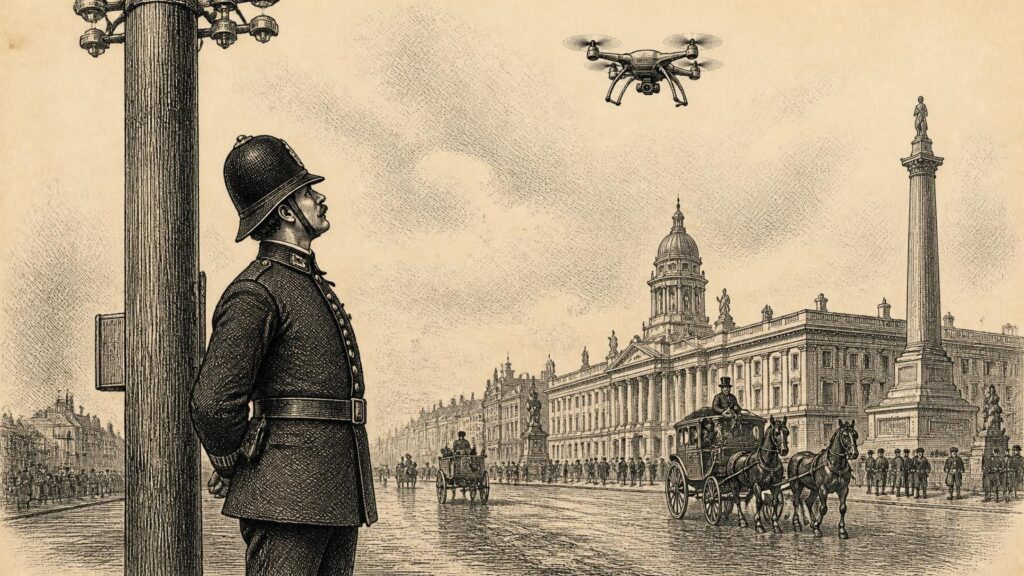
AI generated historical illustration, not a contemporary photograph.
At a Glance
The history of Garda powers in relation to drones is not simply a tale of new machines entering police service. It is part of a longer Irish history in which the State has sought to reconcile public safety, criminal investigation and emergency response with the liberties of people moving through public space. Drones have made that balance newly visible. Their cameras can look over walls, crowds, roads and fields; their small size can make observation quiet and inexpensive; and their presence can turn an ordinary stretch of sky into a place of regulation, evidence and dispute. Yet the popular phrase “drone policing” can conceal more than it explains. In Ireland it covers at least two distinct questions: the Gardaí policing the unlawful use of privately operated drones, and the Gardaí themselves using drones or related aerial technologies in the performance of their functions. Each rests upon different powers, institutions and safeguards.
Irish Foundations
An Garda Síochána was established in the unsettled early years of the Irish Free State. Its name, commonly translated as “Guardians of the Peace”, expressed an aspiration that policing in the new State would be national, civil and distinct from the heavily militarised traditions which many Irish people associated with earlier government. That aspiration has never meant that the Gardaí lacked coercive powers. They have always possessed powers of arrest, search, investigation and public-order intervention. But the civil character of the force, its general absence of routine firearms, and its strong local-station identity shaped the public language in which police authority was discussed.
For much of the twentieth century, visibility in policing was fundamentally terrestrial. A constable on foot, a patrol bicycle, a squad car, a checkpoint or a detective conducting an inquiry were recognisable embodiments of State authority. Information travelled through witness statements, notebooks, radio communications, telephones, photographs and later computer systems. Surveillance existed, of course, but it was comparatively expensive and episodic. Aerial observation belonged principally to the military, to commercial aviation and to exceptional State operations. It was not a routine feature of the everyday street.
The growth of visual technologies altered that arrangement. Photography became ordinary evidence; closed-circuit television multiplied around town centres, transport locations and commercial premises; automatic number-plate recognition enabled a vehicle registration to be compared quickly with police data. These technologies did not abolish older policing methods. They supplemented them, and often created new dependencies upon records, technical expertise and legal authority. The eventual arrival of the drone therefore needs to be understood as one development within a much longer movement towards technologically assisted observation.
This history matters because it prevents an overly simple account of drones as either miraculous tools or unprecedented threats. A drone can carry a camera, illuminate a search area, relay a live image or document a scene. In those respects it may resemble a police helicopter, a fixed camera or a photographer on a roof. Its significance lies in the combination of mobility, low operating cost, close range and rapid deployment. The legal and ethical questions arise from that combination. A camera fixed high above a junction has an obvious location and usually a visible purpose. A small aircraft that can appear above a housing estate, a protest, a sports event or a private garden raises more immediate questions about who is watching, why, for how long, and what becomes of the footage.
Aerial Precedent
Irish policing had acquired an aerial dimension before small unmanned aircraft became commercially common. The Garda Air Support Unit was established in September 1997, initially with a fixed-wing Defender aircraft and a helicopter. Based at Casement Aerodrome, Baldonnel, it developed through a partnership in which Garda personnel carried out policing functions while Air Corps personnel flew and maintained the aircraft. This arrangement was important in practical and constitutional terms. It placed police aerial observation within an existing public-service structure rather than creating a wholly separate airborne police force.
The early records of the unit show an unusually broad remit. Air support could be requested where there was an immediate threat to life, an armed or serious criminal incident, potential disorder, a search for a missing person, traffic management, evidence gathering, intelligence work or a major public event. Garda annual reporting from the late 1990s and early 2000s describes patrols, searches, security operations, photographs and support for ground units. Such tasks established the operational argument later made for drones: height and distance could offer an overview that officers on the ground did not possess.
Helicopters and fixed-wing aircraft, however, were not drones with larger engines. They were costly, conspicuous and limited by weather, aircraft availability and the need for trained crews. Their sound announced their presence across a considerable area. In most cases, they were deployed for a defined incident rather than sent casually to inspect an ordinary neighbourhood. Their expense also imposed a practical discipline. Decisions to task a helicopter required a reason that could be articulated within a command structure.
The Garda Air Support Unit consequently provides a useful historical comparison, not because it automatically supplies legal authority for drones, but because it demonstrates that aerial policing was already familiar in Ireland. It also shows that aerial support has long been associated with serious operational purposes rather than routine curiosity. Search and rescue, missing-person cases, armed incidents, traffic emergencies and major events have all been part of its recognised field. The present debate is therefore not whether the Gardaí should ever see from the air. The more difficult question is how a much cheaper, more numerous and potentially less visible form of aerial observation should be controlled.
There is also a difference in public encounter. A Garda helicopter is an unmistakable event. Residents see it, hear it and often understand that some urgent occurrence may be underway. A drone may be quieter, lower and closer. Its observer may be several streets away; its images may be transmitted rather than viewed from an aircraft cabin. This changes the social meaning of surveillance even where the formal policing aim is familiar. It is one reason that the legal conditions surrounding drone use cannot simply be inferred from the older use of helicopters.
New Aircraft
The word “drone” has become the everyday term for an unmanned aircraft system, usually shortened to UAS. The fuller expression is useful because it reminds us that the aircraft itself is only one element. A UAS may include the pilot, a handset or control station, software, satellite or radio links, sensors, stored data, live video feeds and systems for identifying the operator. A modern drone operation is therefore an information system as much as an aviation activity.
That point matters particularly for policing. A drone without a camera might still present an aviation or safety problem. A drone equipped with a high-resolution camera, thermal imaging, audio capability or facial-recognition software creates further questions of data collection and personal privacy. The legal analysis cannot stop with whether the aircraft was permitted to fly. It must also ask what information was collected, whether the collection was necessary, how long it was retained, who could access it, and whether it was later combined with other police records.
Small drones became widely available to consumers and commercial operators during the 2010s. Their usefulness was evident in photography, farming, inspection, mapping, construction, environmental work and emergency response. Their dangers were equally obvious. A careless flight near an aerodrome could endanger manned aviation. A flight over a crowd could create injury risks if the aircraft failed. A camera pointed into a home or garden could intrude upon private life. Deliberate misuse could assist harassment, trespass, contraband delivery, reconnaissance or interference with security arrangements.
Irish regulation developed in response to this changing technology. Earlier domestic rules were followed by the wider European regulatory framework for unmanned aircraft systems. The European approach sought to create common categories based upon risk rather than treating every small aircraft as if it were a conventional aeroplane. Low-risk operations may fall within an “open” category; more demanding operations require particular authorisation; and the highest-risk activities may require certification. Ireland’s rules now operate within this European environment, while Irish authorities retain important roles in implementation, enforcement and public safety.
This transition is historically significant. In the early phase of consumer drones, public discussion often concentrated on ownership and hobby flying. As equipment improved, attention shifted from the possession of a device to the context of its use. A small aircraft may be harmless in one rural field and dangerous near an airport, prison, hospital, crowd or emergency scene. It may be legitimate for a surveyor but intrusive if used to observe neighbours. The same physical machine can fall within aviation law, criminal law, data-protection law, property law and the ordinary powers of the Gardaí.
Legal Framework
The central contemporary instrument is the Irish Aviation Authority (Unmanned Aircraft Systems (Drones)) Order 2023. It came into force in February 2023 and replaced earlier Irish drone arrangements. The Order sits alongside directly applicable European Union rules governing unmanned aircraft operations. It provides for enforcement and investigation by the Irish Aviation Authority, commonly called the IAA, and for arrangements between the IAA and An Garda Síochána in the enforcement of the drone rules.
The structure is deliberate. The IAA is the specialist aviation regulator. It possesses technical knowledge of airspace, aircraft operation, registration, authorisation and safety requirements. The Gardaí are the national police service. They encounter immediate danger, investigate crime, preserve public order, protect life and enforce the criminal law. Neither institution can fully manage unlawful drone activity alone. A report of a suspicious aircraft near an airport may require aviation expertise, but it may also demand rapid local intervention, scene management and criminal investigation.
This division helps correct a common misunderstanding. The Gardaí do not possess a limitless free-standing power simply to intervene whenever a drone is seen in the air. Their authority depends upon the purpose of the intervention, the applicable aviation rules, ordinary criminal-law powers, public-safety duties and any specific statutory provision. Equally, the IAA is not an emergency police force capable of appearing at the scene of every unsafe flight. The law therefore envisages co-operation rather than a single institutional answer.
For operators, the practical rules include registration requirements in many cases, limits on height and location, restrictions near certain sites and aerodromes, and obligations relating to safe operation. The exact requirements vary according to the aircraft and category of flight. An operator cannot safely assume that recreational intent provides an exemption from regulation. Nor can a person rely on a drone’s small size as proof that it is legally insignificant. The relevant question is the nature of the operation and the risk it creates.
The legal framework also recognises that an aircraft may be used in circumstances which are not primarily aviation matters. If a drone is being used to intimidate somebody, to invade privacy, to create a public danger, to obstruct emergency work or to assist another offence, the Gardaí may have reasons to act beyond the ordinary enforcement of flight restrictions. Existing police powers do not disappear merely because the instrument involved happens to fly. Yet a lawful response remains constrained by the principles governing arrest, search, seizure, evidence and proportionality.
The importance of proportionality should not be understated. In Irish public law, State interference with rights must have a lawful basis and must be connected rationally to a legitimate aim. It should go no further than is reasonably necessary. In a fast-moving emergency, decisions will necessarily be made under pressure. But the fact that a new technology is useful does not itself establish that every use is justified. The clearer the rules, training and recorded reasons for deployment, the easier it becomes to demonstrate that police action was warranted.
Police Functions
The statutory role of An Garda Síochána is wider than crime detection alone. It includes protecting life and property, preserving peace and public order, vindicating human rights, preventing and investigating offences, and providing assistance and services for the public. Modern policing legislation frames these tasks in language which recognises community safety as well as enforcement. Drones enter this field not as an isolated new police mission but as possible tools, hazards or sources of evidence within established functions.
When policing unlawful drone use, a Garda response may begin with an ordinary call from a member of the public: an aircraft apparently flying close to an airport, hovering near homes, following a person, operating over a large gathering or interfering with emergency services. Officers must then distinguish rumour from observed fact. They may need to identify whether the object is a drone at all, locate the pilot, assess immediate risk, secure available footage and contact aviation authorities. The response is often more difficult than public expectations suggest, because a small aircraft can travel quickly and the operator may be some distance away.
Where there is immediate danger, traditional police powers and duties are central. Gardaí may seek to stop conduct that threatens life, deal with disorder, investigate suspected offences and secure evidence. The factual basis for any detention or seizure matters. The history of police powers is full of warnings against treating suspicion as proof. A drone might be operated lawfully in a location where a passer-by assumes that all flight is prohibited. Conversely, a harmless-looking device may be part of genuinely reckless or criminal conduct. Accurate identification of the legal issue is necessary before enforcement becomes fair enforcement.
Police use of drones presents a different chain of questions. The first is operational: what specific purpose cannot reasonably be achieved by a less intrusive means? A drone might help locate a missing person in difficult terrain, document a collision scene, assess a dangerous fire, survey a cordon, search for a vulnerable person near water, or give commanders a view of a developing incident. These are potentially strong public-safety cases. They are not, however, automatic permission for continuous or speculative observation.
The second question is legal authority. A Garda drone operation would need to comply with aviation requirements while also remaining within the functions of the force and the laws governing data processing. The third is governance: who approves the deployment, who pilots the aircraft, what training is required, what is recorded, where are images stored, who may view them, and how can an individual challenge misuse? These questions are not administrative trivia. They determine whether a technological capability remains a controlled public function or becomes an unexamined habit.
It is important to separate documented fact from inference. Public statements and parliamentary discussion confirm that Garda personnel have received drone training and that drones have been used in some operations, particularly in urban and event settings. It would be unsafe, however, to infer from this that there is a large, permanently deployed national drone fleet conducting routine blanket surveillance. Operational detail is necessarily limited, and the existence of capability does not reveal its frequency, location or method of use. A historically responsible account should acknowledge both the documented development and the limits of public knowledge.
Privacy Questions
Drones place privacy at the centre of the debate because their value frequently lies in what they can see. The Irish Data Protection Commission has observed that drones can become mobile surveillance systems and are likely to capture the personal data of passers-by. That observation was directed principally at non-law-enforcement operators, but the underlying point is broader. Images, recordings, vehicle details and information capable of identifying a person can all be personal data. A camera in the sky is not exempt from legal responsibility merely because its operator is standing on the ground.
For law-enforcement processing, the Data Protection Act 2018 supplies a framework separate in important respects from the general rules that apply to ordinary commercial or domestic activity. Garda processing for the prevention, investigation, detection or prosecution of criminal offences must nevertheless be lawful, necessary, proportionate and subject to appropriate safeguards. The use of a drone could involve collection at the point of flight, transmission to a controller, storage on a device or server, later viewing by investigators and eventual use in court. Each stage matters.
Ireland’s recent experience with other police surveillance systems is instructive. The Data Protection Commission’s inquiry into Garda-operated CCTV and automatic number-plate recognition found shortcomings in policy, safeguards and data-protection impact assessment. The Commission imposed corrective measures, including a temporary ban on the relevant ANPR processing until compliance requirements were addressed. This was not a ruling on drones, nor should it be represented as one. Its historical importance lies elsewhere: it showed that surveillance technology operated for policing purposes is not beyond independent scrutiny.
The lesson for drone policing is plain. Before a technology becomes embedded, an institution should understand its data flows and assess its necessity. A written policy should identify the aim of the system, the legal basis for use, approval routes, retention periods, access controls, auditing and procedures for disclosure. A data-protection impact assessment is not a ritual document. Properly performed, it forces decision-makers to confront foreseeable harms before a system is normalised.
There is a further constitutional dimension. The Irish Constitution protects the dwelling and recognises personal rights. European human-rights law also protects private and family life. Neither creates an absolute barrier to police observation or investigation. Serious crime, public safety and the protection of others can justify interference. But the history of rights protection insists that intrusion must not become routine merely because a device makes it convenient. A drone directed into a private place, or repeatedly used to monitor a particular individual, raises a different level of concern from an aircraft briefly documenting a public emergency.
The distinction between public and private space is itself imperfect. A person walking on a public street may reasonably expect to be seen by others, but not necessarily to be tracked continuously, analysed automatically or recorded in a permanent searchable archive. A drone can transform the scale and persistence of observation. For that reason, the important issue is not simply whether an image was captured in a public place. It is how the capture was organised, what other information was linked to it, and whether the purpose justified the intrusion.
Public Order
Public-order policing has often been an arena in which new visual technologies are tested. Large demonstrations, sporting fixtures, visits by foreign leaders and major cultural events create practical challenges: crowd density, changing routes, emergency access, isolated disorder and the need to co-ordinate personnel across a wide area. A drone can provide a commander with a live overview without requiring a helicopter. That apparent advantage explains why event use has featured in discussion of Garda drone capability.
Yet public assembly is also a constitutionally sensitive activity. People may attend a lawful protest without wishing to be individually identified, catalogued or subjected to surveillance unrelated to any offence. The fact that a gathering is large does not dissolve the rights of its participants. A drone operation at a protest should therefore be assessed not only by reference to operational convenience but also by its necessity, duration, field of view, recording practices and the availability of less intrusive alternatives.
Historical experience in Ireland makes this sensitivity understandable. The State has had to police political mobilisation, industrial disputes, contentious commemorations and periods of serious violence. In each period, the relationship between police intelligence and civic freedom has been contested. The lesson is not that the Gardaí must avoid all observation of public events. Rather, it is that observation must be connected to a genuine policing need and governed in a manner capable of public explanation.
Drones may also be valuable in emergencies where the language of public order is too narrow. A fire, flood, building collapse, missing-person search or dangerous road incident can require rapid situational awareness. Here the visual capacity of a drone may help protect both responders and the public. Aerial images can show whether routes are blocked, whether people remain in danger or whether a search area has been covered. The strongest case for use is often one where the technology reduces risk to human searchers or accelerates assistance to a vulnerable person.
Even then, the historical record cautions against technological determinism. A drone does not make a difficult decision easy. Images can be incomplete, distorted by weather, misread by an observer or delayed by connection problems. Thermal imagery can assist a search but is not infallible identification. Footage may support an investigation but must still be interpreted, authenticated and disclosed fairly. Technology can expand perception; it cannot replace judgement.
Counter Measures
The newest phase of the subject concerns counter-drone measures: the means by which the State seeks to detect, disrupt or neutralise an aircraft believed to pose a danger. The issue became more prominent as international incidents demonstrated that drones could threaten airports, military facilities, critical infrastructure and protected events. Ireland, like other European states, has had to consider how a country with busy airspace and important public infrastructure should respond to hostile or reckless unmanned aircraft.
Counter-drone powers are especially sensitive because the act of stopping a drone may itself create risks. A device brought down over a crowd or road may cause injury. A radio-frequency jammer may affect communications beyond the intended aircraft. A mistaken intervention may interfere with a lawful operator or an emergency service. The legal authority, technical competence and command arrangements therefore require particular clarity.
In July 2026, the Oireachtas considered and agreed legislative amendments intended to make explicit that a member of An Garda Síochána may use a radio-frequency jammer against an unmanned aircraft system where the member reasonably believes it necessary for the performance of the Garda role. The amendments were linked to the Wireless Telegraphy Act 1926 and the Policing, Security and Community Safety Act 2024. Their significance lies in the recognition that counter-drone activity cannot safely rest on uncertain implication. Interference with radio communications is a serious act and requires a clear legal foundation.
The wording is important. It does not provide a general licence to interfere with every drone. The test turns on a reasonable belief that use is necessary for the relevant Garda function. In practice, necessity and proportionality will remain crucial. A hostile aircraft near a sensitive target creates a very different situation from a nuisance flight that can be dealt with through ordinary identification and investigation. The legislation acknowledges the urgency of the threat while retaining the language of restraint.
There is an understandable public desire for simple answers: if a drone is dangerous, bring it down. The historical reality of policing is less simple. Officers must know what the device is, whether it carries a payload, where it may fall, whether the controller can be located, whether another agency has responsibility, and whether the action may affect other communications. The most responsible counter-drone policy is therefore not merely a list of equipment purchases. It is a framework for intelligence, training, inter-agency liaison, safety assessment and review.
Institutional Balance
Drone policing in Ireland is best understood as a network of institutions rather than as a single Garda power. The Gardaí, the Irish Aviation Authority, the Department of Transport, the Data Protection Commission, the Defence Forces, local authorities and emergency services may each have a role depending on the incident. The courts provide a further check where evidence is challenged or alleged misuse reaches litigation. The Oireachtas establishes the legislative framework and can test ministerial and official claims through parliamentary questions and committee work.
This complexity may frustrate those who prefer a single point of responsibility. It nevertheless reflects the fact that drones create several kinds of risk at once. Aviation safety cannot be reduced to criminal law. Privacy cannot be reduced to airspace regulation. National security cannot be reduced to a consumer-technology problem. The task of public administration is to ensure that overlapping responsibilities do not become gaps through which dangerous conduct passes unanswered.
The National Policy Framework for Unmanned Aircraft Systems, launched by the Department of Transport in 2025, illustrates this broader approach. It treats airspace and planning, compliance and enforcement, enterprise and innovation as connected matters. Its language recognises both the potential social and economic benefit of unmanned aircraft and the need to address safety, security and public concern. This is a more mature approach than viewing drones solely as toys, threats or police tools.
For the Gardaí, institutional balance also means resisting an assumption that every technical possibility should become standard practice. The fact that a drone can observe a place does not settle whether the force should observe it. A capability might be retained for defined exceptional uses, subject to authorisation and review, rather than deployed continuously. Public confidence is more likely to endure where the line between necessary operational support and generalised surveillance is visible.
Transparency need not compromise legitimate operations. Authorities cannot sensibly publish the tactical detail of every security method, particularly where disclosure would assist hostile actors. They can, however, publish general policies, legal bases, training standards, privacy safeguards, aggregate statistics where appropriate and routes for complaint. The historical relationship between Irish policing and public legitimacy suggests that explanation is not an optional public-relations exercise. It is part of the discipline which separates accountable police power from unchecked authority.
Future Choices
The future of Garda drone policing will depend less upon the aircraft themselves than upon the choices made around them. Battery life, camera quality, automation and remote identification will continue to change. Private drone use will become more varied, including commercial delivery, inspection and mapping. These developments may increase the number of lawful aircraft in the sky while also complicating the task of identifying unlawful activity. A police officer confronted with a drone incident will need good information quickly: whether a flight is authorised, who is responsible and whether there is a present danger.
There will be pressure for greater automation. Systems may be able to detect aircraft, identify operators, follow moving objects, process imagery or alert police to unusual behaviour. Such systems may reduce workload, but they also magnify longstanding concerns. An automated alert is not a finding of guilt. A technical match is not necessarily proof of identity. Patterns in data can mislead as well as assist. The more consequential the decision, the stronger the need for trained human judgement and meaningful accountability.
A sound Irish approach would retain several principles. First, exceptional aerial surveillance should have a defined purpose. Secondly, the least intrusive effective method should be preferred. Thirdly, data collection and retention should be limited and auditable. Fourthly, staff should receive specialist training not only in flying and safety but in evidence, privacy, human rights and operational decision-making. Fifthly, independent oversight should be capable of examining systems before and after their deployment.
Folklore often develops around aerial technologies. People may assume that any drone seen overhead belongs to the Gardaí, that its camera can see everything, or that a public authority can watch without constraint. Such beliefs are understandable in an age of rapid technical change, but they are not reliable guides to law or practice. The documented position is more constrained and more complicated. Public and private drones share airspace; aviation regulators and police share enforcement responsibilities; and the State remains subject to legal limits when it processes personal information or interferes with communications.
The historical importance of the subject lies in this tension. Irish policing has repeatedly adapted to new ways of seeing: photography, radio, motor transport, computer records, CCTV, number-plate recognition and manned air support. Each innovation promised greater speed, reach or certainty. Each also required rules to prevent power from drifting beyond its proper purpose. Drones are the latest, not the last, stage in that story.
Watching skies will therefore require more than sophisticated equipment. It will require clear law, careful training, co-operation between institutions and a willingness to explain why a power is being used. The strongest safeguard is not an abstract refusal of technology, nor uncritical faith in it. It is the continuing insistence that a democratic police service must be able to show that its methods are lawful, necessary and proportionate. In Ireland, that insistence is the real history behind the drone.

The article’s distinction between policing unlawful drone use and deploying Garda drones is revealing. Ireland’s earlier air-support model involved conspicuous, costly aircraft reserved for defined incidents, whereas drones make aerial observation cheaper, closer and potentially less visible. This shift suggests that operational convenience may alter public expectations of privacy and accountability even when objectives, such as locating missing people or managing emergencies, remain familiar. The article also notes uncertainty about the scale and frequency of Garda drone deployment, making governance arrangements significant. How should Ireland balance demonstrable public-safety benefits against the risk that limited, incident-based aerial observation becomes routine surveillance?