
Islandmagee Trials
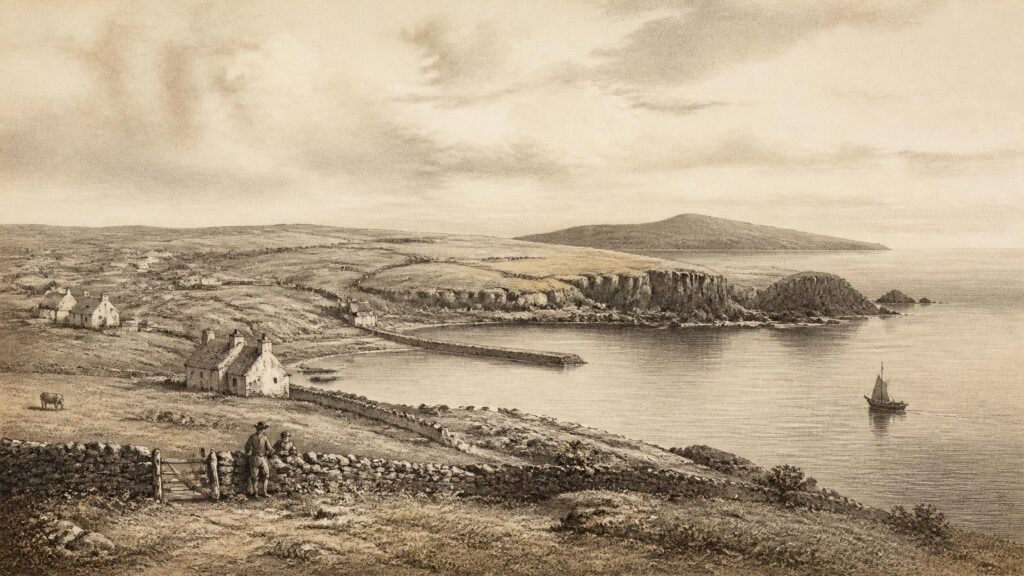
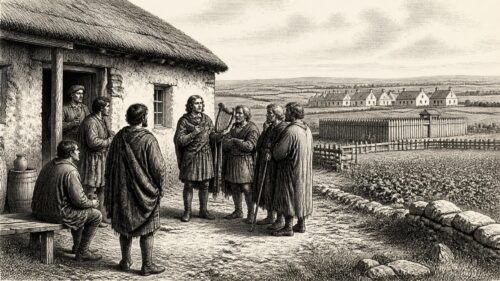
AI generated historical illustration, not a contemporary photograph.
At a Glance
Islandmagee, the long coastal peninsula east of Larne Lough in County Antrim, is a small place with an unusually dense historical record. Its story reaches from medieval settlement at Portmuck through the violence and contested testimony of the 1641 rebellion to the 1711 witchcraft prosecutions at Carrickfergus. Those episodes should not be treated as a single, simple local legend. They belong instead to the changing history of Gaelic lordship, colonisation, religion, law, coastal labour and collective memory in north-east Ireland.
Coastal Setting
Islandmagee projects into the Irish Sea between Larne Lough and the open Antrim coast. Its physical character remains fundamental to its history: a narrow peninsula of fields, small settlements, harbours, exposed headlands and cliffs, connected to larger routes but retaining the social texture of a distinct locality. Portmuck, on the north-western shore, looks across water towards the Isle of Muck; Brown’s Bay and the eastern coast face the wider sea. The peninsula’s maritime position gave its inhabitants access to fishing, coastal traffic and the markets of neighbouring settlements, while its relative separateness helped sustain a strong sense of local identity.
The modern landscape can make Islandmagee appear tranquil and self-contained, but it has never been isolated. Carrickfergus lay nearby, a major administrative and military centre in medieval and early modern Ulster. Larne Lough connected the district with coastal networks extending through the North Channel and the Irish Sea. Scotland was visible not merely as a distant shore but as part of the practical world of travel, trade, migration and, after the seventeenth-century plantations, settlement. Islandmagee’s history therefore belongs to both Irish local history and the wider history of the Irish Sea world.
Its name itself points towards a deeper Gaelic inheritance. The National Trust explains Islandmagee as deriving from Oileán Mhic Aodha, “MacAodha’s island”, associating the place with a family or kindred whose home was remembered at Portmuck. The “island” of the name should not encourage an assumption that the present peninsula has always possessed precisely its modern form, nor should the name be treated as a complete record of political control. Place-names preserve memory, but they are rarely straightforward evidence. Still, the survival of a Gaelic name in a district profoundly altered by settlement, religion and language is historically significant.
Names Memory
Islandmagee has been called by varying spellings in older sources: Island Magee, Island-Magee, Ilan Magee and related forms. Such variation is common in Irish records before the standardisation of maps, print and administration. It matters because historians must be alert to the distinction between a modern place-name and the unstable terms through which older writers described a parish, a peninsula, a family territory or a coastal neighbourhood.
The element Magee, or MacAodha, was not an ornamental survival. It recalled the Gaelic-speaking society which preceded the decisive expansion of English and Scottish influence in east Ulster. Yet that society was itself connected to the sea, to neighbouring lordships and to political changes across Ulster. The peninsula cannot responsibly be represented as an untouched Gaelic enclave suddenly transformed by outsiders. Its history was already one of shifting relationships between local families, regional powers and seaborne contact.
Later traditions frequently made Islandmagee into a place of singular strangeness: a peninsula haunted by witches, murders and supernatural presences. These stories have historical value, but not always as literal reportage. Folklore reveals how later communities interpreted a landscape and its past. It can preserve place-names, buildings, family associations and fragments of social memory; it can also reshape events into moral tales. The historian’s task is neither to mock tradition nor to repeat it as fact. It is to establish what contemporary evidence supports, identify what was later added, and ask why particular versions endured.
Early Traces
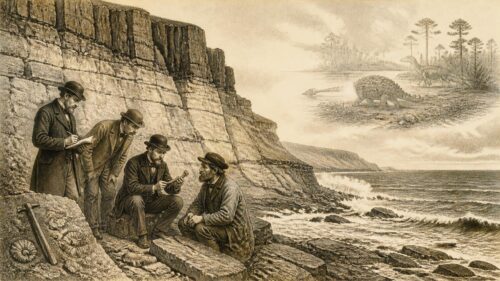
Islandmagee’s archaeological record demonstrates that the peninsula had been occupied and worked long before the events for which it later became notorious. The survival of monuments, settlement evidence and church sites confirms a long human presence, but the evidence does not authorise a neat continuous narrative from prehistory to the present. Archaeology often provides traces rather than biographies: a building footprint, a buried feature, worked ground, a cemetery, a coastal site or scattered material recovered during modern development.
For that reason, broad claims about an ancient “Celtic” Islandmagee should be treated with caution. Such language can flatten many centuries of changing settlement, economy and belief into a comforting but unhelpful image. What can safely be said is that the peninsula’s productive land, sheltered inlets and command of nearby sea routes made it an attractive place for habitation over a long period. The evidence belongs to a landscape that was repeatedly occupied, adapted and remembered.
The medieval and later religious landscape is particularly important. St John’s Church at Ballyharry, close to Larne Lough, is associated with a church and graveyard whose fabric and burials speak of long-established communal patterns. A small excavation undertaken within the church in 2002 exposed a grave cut containing both an articulated burial and disturbed human remains, along with coffin fittings and related material. Such finds are not sensational relics; they are evidence that a churchyard was a working burial place, altered and reused across generations. They remind us that Islandmagee’s history was lived in households and parishes, not only in the dramatic moments preserved by printed sources.
Medieval Portmuck
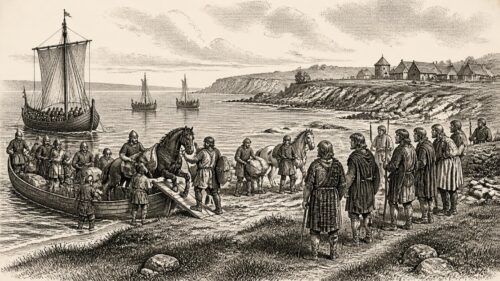
Portmuck is among the most suggestive locations on the peninsula. The harbour is associated in local heritage interpretation with a monastic site and a castle, and its sheltered position made it a natural point of contact between shore and sea. Archaeological excavation in 2000, undertaken before electricity works, found part of a rural medieval settlement. The exposed remains included a rectangular, aisled building with semicircular gables, interpreted as probably timber-built and aligned roughly north to south. The report did not uncover an entire village, nor does it allow every aspect of Portmuck’s medieval economy to be reconstructed. Nevertheless, it establishes a substantial and organised settlement in a place long central to Islandmagee’s coastal life.
The discovery helps correct the tendency to view rural medieval Ireland only through castles, monasteries or great political events. A settlement such as Portmuck was made by ordinary routines: the construction and repair of buildings, cultivation, animal husbandry, household production, burial, religious observance and the movement of people and goods. Its relationship to the sea was likely practical as well as symbolic. Boats, landing places and fishing grounds were crucial to coastal communities, although the surviving excavation report should not be made to prove a level of maritime commerce beyond what it records.
Portmuck also stood within reach of Carrickfergus, the chief urban and administrative focus of medieval east Antrim. That proximity mattered. The peninsula was not a remote margin beyond the reach of authority; it stood beside a centre of lordship, trade and later military power. But proximity did not remove local particularity. Islandmagee’s villages and townlands preserved their own social connections, kin networks and religious institutions. The tension between local life and external authority would become increasingly visible in the seventeenth century.
Plantation Frontier
During the late sixteenth and early seventeenth centuries, east Ulster experienced warfare, dispossession, settlement and demographic change. The broader transformation commonly called plantation was not confined to a single official moment or a single ethnic category. English and Scottish settlers, established landholders, Gaelic families, soldiers, clergy and merchants all formed part of a rapidly changing society. Landholding patterns altered; new religious and political loyalties became more entrenched; and the vocabulary of “native”, “British”, “Irish”, “Protestant” and “Scot” acquired sharper political force.
Islandmagee became associated especially with settlers of Scottish descent and with Presbyterian religious culture. That association is essential to the later witchcraft case, but it should not be projected backwards without qualification. The settlement of east Ulster created communities that were internally diverse and often insecure. Newcomers did not arrive in an empty landscape. They settled amid older claims, memories of war, competition for land and fears of rebellion. By the 1640s, those pressures had become explosive across much of Ireland.
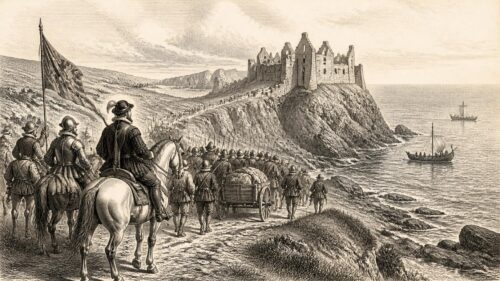
The peninsula’s location close to Carrickfergus made it particularly vulnerable to the political and military tensions of the period. Garrison towns could offer protection, but they could also project violence into surrounding districts. Local people were caught between rumour, retaliatory fear and the demands of armed groups. Later narratives of 1641 often reduced the conflict to one-sided atrocity stories. The documentary record is indispensable, but it must be read critically because testimony was collected in circumstances shaped by war, loss, political purpose and sectarian memory.
Violent Winter
Islandmagee is connected to one of the most difficult and disputed episodes of the 1641 rebellion. Evidence indicates that Irish Catholics were killed in the district during the crisis, probably in late 1641 or early January 1642 by modern dating. Accounts varied widely concerning responsibility, chronology and numbers. Later polemic magnified the event in some traditions, while other writers sought to reduce or deny it. Neither reaction is a substitute for careful historical judgement.
The surviving testimony includes statements by people connected with the Magee families. A later published discussion drawing on depositions recorded Bryan Magee’s evidence that members of his family were killed and their goods taken by men described as Scots. It also recorded other accounts associating the killings with men linked to the Carrickfergus area. These are grave allegations and should be neither dismissed merely because the sources are contested nor converted into certainty beyond what they can bear. The 1641 Depositions are a major body of evidence for the rebellion, but Trinity College Dublin rightly notes that they have long been central to controversy and political exploitation.
The key historical point is clear enough: Islandmagee was a site of violence against Catholics during the early phase of the rebellion. It cannot be honestly remembered only as a Protestant settlement endangered by events elsewhere. At the same time, claims that prescribe a fixed total of victims or a wholly settled sequence of events need strong primary support, which is not always available. The term “massacre” appears in historical discussion, but its deployment has frequently been shaped by later communal politics. A responsible account should acknowledge the killings, the suffering of families and the limits of the evidence.
This episode also shows how local memory may be formed through silence as much as through commemoration. The spectacular story of the Islandmagee witches became internationally recognisable; the killings of 1641–42 occupied a more unstable place in popular recollection. That imbalance is itself revealing. Communities do not preserve every painful past in equal measure. Some events are recast as heritage, some as accusation, some as private trauma and some as inconvenient history.
Presbyterian Society
By the early eighteenth century, Islandmagee contained a predominantly Presbyterian population of Scottish descent. The Witches of Islandmagee research project estimates that the peninsula had around 300 Presbyterians in this period. This was a small society, but it was not socially simple. It contained ministers, farmers, labourers, householders, dependants and people whose respectability could be assessed by neighbours with intimate knowledge of their standing.
Presbyterian identity did not mean that Islandmagee stood apart from the legal institutions of Ireland. The witchcraft prosecutions were held at Carrickfergus assizes under the Irish Witchcraft Act of 1586. That legal framework formed part of the kingdom of Ireland, even as religious culture on the peninsula drew heavily upon Scottish Presbyterian experience and the wider Protestant world. Islandmagee is therefore a particularly clear example of how Irish history cannot be separated neatly from Scottish, English and Atlantic contexts.
Belief in witchcraft was not confined to uneducated rural people, and it should not be explained merely as ignorance. Across early modern Europe, learned clergy, judges, pamphleteers and householders debated the reality of spirits, possession and diabolic power. Courts often treated supernatural accusations as legal questions. In Islandmagee, a community facing mortality, illness and anxiety could interpret disturbing events through categories that seemed credible to many contemporaries. Explaining that worldview is not the same as accepting its accusations as true.
Haunted Household
The events leading to the 1711 prosecutions centred on Knowehead House, the home associated with James Haltridge. According to surviving accounts, Ann Haltridge, the widow of a Presbyterian minister, had been staying there during the latter part of 1710. The household reported unsettling phenomena: disturbances around beds and bedclothes, objects behaving strangely, noises, apparitions and physical affliction. Ann Haltridge died in February 1711 after suffering severe pains, which were interpreted by those around her as the effects of supernatural assault.
After her burial, her niece Mary Dunbar came to the house. Dunbar, described in the project’s historical account as an educated eighteen-year-old gentlewoman, soon became the centre of further claims. She was said to suffer convulsions and to display symptoms understood at the time as demonic possession. The language of the sources is inseparable from the beliefs of those recording them. Modern readers should not translate every report into a confident medical diagnosis, as the evidence is too mediated and too limited. Nor should they regard levitation, spectral attacks or the expulsion of household objects as established events. These were allegations and experiences reported within a particular religious and social framework.
Dunbar named women from Islandmagee and its surroundings as her tormentors. The accused included Catherine McCalmond, Janet Liston, Elizabeth Sellor, Janet Carson, Janet Main, Janet Millar, Janet Latimer and Margaret Mitchell. Variants in names occur in the records, a warning against excessive certainty in transcription and family identification. The essential fact, however, is beyond doubt: eight women were drawn into a prosecution in which the claimed harm depended upon invisible, spectral action. Their position was especially precarious because the alleged evidence rested upon the sufferings and declarations of a young woman widely believed to be possessed.
Assize Proceedings
The eight women were tried at Carrickfergus on 31 March 1711. They pleaded not guilty but were convicted under the 1586 Irish statute against witchcraft and sorcery. The punishment reported by the Witches of Islandmagee project was a year’s imprisonment and four appearances in the pillory. The sentence was harsh, humiliating and public, although it did not carry the death penalty in the manner associated with some continental and Scottish witch-hunts.
The prosecution was exceptional in Irish history. Scholars associated with the project describe the proceedings at Islandmagee as Ireland’s last witch trials under a dedicated witchcraft law and as the country’s only mass witchcraft trial. This does not mean that supernatural belief disappeared immediately afterwards, or that every earlier Irish accusation has been equally well preserved. It means that the Islandmagee case stands out because several people were prosecuted together and because an unusually rich collection of related documents survives.
The case did not end with the March convictions. Mary Dunbar’s condition reportedly did not improve, and she later accused William Sellor, husband of Janet Sellor and father of Elizabeth Sellor. He was tried and convicted at the summer assizes in September 1711. Dunbar had died by then. The project’s historians state that Sellor was probably executed after her death transformed the alleged offence into a capital matter, but the word “probably” is indispensable: the surviving evidence does not permit an unqualified assertion of the precise manner and date of his death.
The trial should not be presented as an entertaining curiosity. It was a legal process in which named neighbours lost liberty and public standing because a court accepted claims of invisible harm. Its victims were not abstract “witches”; they were people accused by their community, processed through an official court and punished under statute. The labels used by contemporaries remain historically important, but quotation marks are appropriate when repeating the term “witches”, because they mark accusation rather than identity.
Evidence Limits
The Islandmagee material is unusually valuable because it includes pre-trial depositions, letters, a contemporary pamphlet account and newspaper reports. The recent digital project led by Andrew Sneddon and Shannon Devlin has brought surviving documents together, transcribed and annotated them, making it possible for readers to compare sources rather than rely upon a single dramatic retelling. That availability is a major advance in public history.
Abundant documents do not remove every difficulty. Depositions were produced for legal and administrative purposes; pamphlets were written to persuade and excite; newspapers condensed and selected; later nineteenth-century editors and antiquarians reframed the material for new audiences. The statements preserve voices, but often voices filtered through clerks, editors and the conventions of their time. A witness may have been sincere and still mistaken. An accuser may have experienced real distress without correctly identifying its cause. A judge may have applied existing law while reaching a grievously unjust conclusion.
It is also important to distinguish between the documented event and its interpretation. Documented evidence establishes that Ann Haltridge died, Mary Dunbar made accusations, eight women were tried and convicted, and William Sellor was later convicted. Interpretation begins when historians ask why the accusations became persuasive. Possible factors include religious belief, household tensions, gendered vulnerability, local reputation, grief, fear of disorder and the influence of English and Scottish traditions of possession narratives. These explanations can be argued from context; they cannot be proven in every individual mind.
Folklore belongs to a third category. Islandmagee retained stories of witchcraft and haunting long after the court case. Such traditions may preserve the names of houses, fields and families, yet their supernatural claims cannot be treated as historical proof. Their importance lies in demonstrating that the trial became part of the peninsula’s social memory. In this sense, the events of 1711 did not simply finish at the assizes. They continued to shape how later inhabitants understood danger, reputation and the landscape around them.
Afterlives Memory
The Islandmagee witch trials were remembered in local histories, popular retellings and antiquarian publications. Such accounts often focused upon Mary Dunbar’s supposed sufferings and the sinister atmosphere of Knowehead House. That emphasis can inadvertently repeat the structure of the original accusation, giving narrative attention to possession while reducing the convicted women to shadowy villains. Recent scholarship and public-history work have deliberately shifted attention towards the accused, the legal process and the gendered consequences of belief.
This shift matters because historical memory is never neutral. A tale of witches can be packaged as picturesque folklore; a story of wrongfully accused women demands more difficult questions about evidence, authority and social power. The Islandmagee project’s use of digitised records, exhibition work and creative interpretation reflects an effort to make the case accessible without converting it into spectacle. The best commemoration does not claim that every uncertainty has been resolved. It makes uncertainty visible while refusing to obscure injustice.
There is a related challenge in remembering Islandmagee’s seventeenth-century violence. Public interest in the witch trial should not eclipse the killings associated with 1641–42. Nor should that episode be used to impose a modern political script upon people who lived amid civil war, fear and unstable loyalties. The histories are connected by place, not by a simple moral equation. Together, however, they reveal how a small peninsula could become entangled in the largest questions of Irish history: colonisation, confessional conflict, law, identity and memory.
Victorian Coast
In the nineteenth century, changing transport and tourism altered the way the Antrim coast was seen. The dramatic cliffs of the Gobbins became a celebrated destination after the construction of the cliff path associated with railway engineer Berkeley Deane Wise at the turn of the twentieth century. This was a new kind of encounter with the peninsula: not the working coastline of fishermen, farmers and coastal traders, but a managed landscape of scenery, engineering and leisure.
That Victorian reinvention did not erase older histories. Rather, it layered a modern picturesque identity over a district already marked by churchyards, ruined sites, local traditions and difficult memories. Visitors could admire cliffs and sea bridges without knowing the history of Portmuck’s medieval settlement or the court proceedings at Carrickfergus. Local people, meanwhile, continued to inhabit a landscape where heritage was not abstract. It was embedded in fields, congregations, graveyards and family stories.
The present-day peninsula still carries these overlapping meanings. It is a place of natural beauty and recreation, but it is also an historical landscape whose past includes ordinary rural continuity, religious life, archaeological discovery, communal violence and judicial persecution. No single story can contain it. The temptation to reduce Islandmagee to witches, massacre or scenery should be resisted.
Historical Reckoning
Islandmagee deserves attention precisely because its history is not simple. It offers no uncomplicated tale of ancient continuity, Protestant settlement, supernatural terror or coastal romance. Its Gaelic place-name sits beside evidence of medieval rural occupation. Its seventeenth-century record includes the killing of Catholics amid rebellion and counter-violence. Its eighteenth-century notoriety rests upon prosecutions that reveal the consequences of fear and credulity when supported by law. Its later memory shows how communities select, reshape and sometimes evade their past.
For Irish history, the peninsula is a useful corrective to national narratives that move too quickly between capitals, parliaments and famous battles. Local history does not mean minor history. At Islandmagee, matters that appear intimate—a disturbed household, a parish burial ground, a coastal settlement, an attack on neighbouring families—open onto the wider histories of Ireland, Scotland and England. They show how broad political change was experienced in particular houses and townlands.
The most responsible legacy is not a claim that Islandmagee is uniquely cursed or uniquely heroic. It is the recognition that historical evidence must be read with care, that folklore should be respected without being confused with proof, and that the people harmed by violence or accusation should not disappear beneath a more convenient legend. The peninsula’s past remains difficult. That is precisely why it should be remembered honestly.



Islandmagee’s history raises a striking question about historical memory: the 1711 witchcraft prosecutions became a prominent local and international story, whereas the documented yet contested killings of Catholics during 1641–42 have occupied a less secure place in popular recollection. The article suggests that this contrast reflects more than the availability of evidence; it may reveal how communities transform trauma, conflict and belief into heritage or silence. Its careful separation of testimony, interpretation and folklore is valuable here. How might comparisons with other Irish Sea communities help explain why certain painful episodes are commemorated, while others remain contested, muted or overshadowed?